Remembering Corky Lee
2021-07-28 23:19:12ConstanceChien
漢語(yǔ)世界(The World of Chinese) 2021年3期
Constance Chien


The photographer who documented 50 years of Chinese in American history
追憶華裔攝影師李揚(yáng)國(guó):他用鏡頭記錄了美國(guó)亞裔社區(qū)半個(gè)世紀(jì)的變遷和民權(quán)運(yùn)動(dòng)史
Corky Lees photos show movement: People at work, at demonstrations, and occupying their place in history.
A Chinese American photographer who documented Asian American culture and history for over 45 years, Corky (Young Kwok) Lee died in late January of complications from Covid-19. He dubbed himself the “unofficial Asian American photographer laureate,” and described his work as “only a small attempt to rectify omissions in our history textbooks.”
Lee was born in Queens, New York City, the second child of immigrants from China. His mother was a seamstress, and his father, once a welder who served in World War II, started a hand-laundry business. He was inspired to pursue photojournalism in junior high school when he saw in a history textbook the well-known photograph of two trains meeting at Promontory Point, Utah, commemorating the completion of the transcontinental railroad in 1869. There were no Chinese faces in the photo, despite the fact that thousands of Chinese had lost their lives in building the most dangerous sections of the railway.
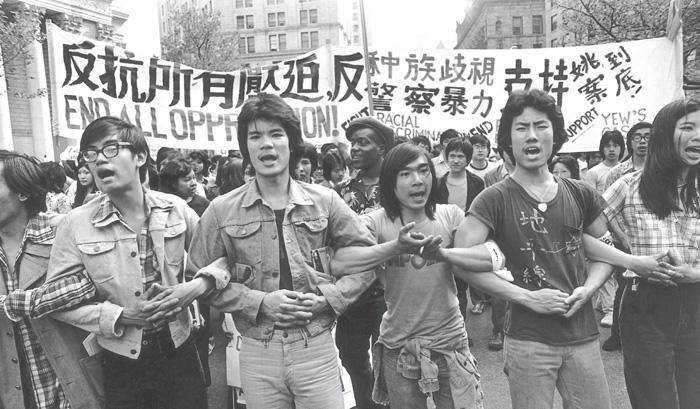
Lee taught himself photography, initially borrowing cameras from friends. He became a routine presence at festivals and protests in New York Chinatown. In 1975, he photographed a Chinese American man named Peter Yew who had been assaulted by members of the New York City Police Department after he asked them to stop beating a teenager for a traffic violation. The photograph was published on the front page of the New York Post the next day.
He also expanded his reach beyond New York, photographing protests that took place in Detroit after the 1982 murder of Chinese American Vincent Chin. In 2014, he restaged the photograph taken at Promontory Point with the American-born descendants of Chinese railroad workers.
Lee has published his works in newspapers and periodicals, and exhibited them in galleries and museums like the Museum of Chinese in the Americas in New York, the National Portrait Gallery in Washington, D.C., the Chinese American Museum in Los Angeles, and the Overseas Chinese History Museum of China in Beijing. A photographic series titled “Asian Women in America” showcased Asian American women at work: sitting in their offices, standing in medical labs, and working in their communities.
These photos are accompanied by brief first-person narratives in which a diverse cast of women—a taxi driver in New York, a medical student in New Orleans, a minister in the New York City Korean American community, the director of the New York City Jazz Coalition—describe how other people have questioned their professional identity and discouraged them from their chosen paths. The women emphasize that their stories have often been told by people other than themselves.
Lee will be remembered for documenting some of the most important moments in Asian American culture and history in the past five decades, up until the months before his death. Last October, he hosted an exhibition at a newsstand in New Yorks Chinatown, with photos depicting residents and visitors against the backdrop of historical buildings in the neighborhood. Just after Christmas, he photographed members of the Guardian Angels organization in New York subway stations as they passed around flyers warning of violence against Asian Americans during the Covid-19 pandemic.
In China, Lees passing received little news coverage. However, two of his photographs are permanently exhibited at the Overseas Chinese History Museum of China, depicting the protests against police brutality in 1975 and a rally in New York the same year, where Chinese Americans demanded access to taxi services and the right to celebrate Chinese New Year. Lee had donated eight works in total and attended the museums opening ceremony in Beijing in 2014, having been introduced to the curators by a mutual acquaintance in New York.
In New Yorks Chinatown, Lee was a mentor and a great connector of artists and community members. At an online tribute to Corky Lee organized by the Asian American Arts Alliance in February, artists reminisced about Lees central role in the New York Asian American community. Photographer Alan Chin spoke of Lees mission to photograph the community with “intentionality,” tirelessly attending every community event he could. “He rose to the occasion and created this job for himself,” Chin said.
An Rong Xu, calling in from Taipei, was struck by Lees desire to ensure that people in the community knew that they mattered and would not be forgotten. Lee had taken a photograph of Xu as an elementary school student. Years later, as a photographer living in New York, Xu met Lee again. Though Xu had long forgotten their first encounter decades ago, Lee remembered, and later showed Xu the photograph he had taken of him as a child.
With racism and attacks against Chinese and Asians on the rise around the world, it is increasingly important for Asian Americans to visualize themselves within the greater fabric of American history. Yet Lees photographs are not all about galvanizing touchstone moments: There were also everyday community cultural events like Chinese New Year and Fourth of July parades. He has even photographed Sonya Thomas, a Korean woman who won the Coney Island hot dog eating contest several times.
As a visible minority, seeing ones self is in close relationship to how one is seen. Images help us envision the communities to which we belong, and where we might situate ourselves within grand historical narratives. Lees photographs not only made the personal stories and public history of Chinese American communities visible to a wider audience, but helped create a vision of a unified community with shared history, common aims, and political power—a kind of social context in which Chinese Americans could see themselves.