
納米銀柔性農用溫度傳感芯片設計與試驗
2021-09-02 13:03:58李浩榛
農業工程學報 2021年10期
路 逍,李浩榛,劉 剛,2,張 淼,2
納米銀柔性農用溫度傳感芯片設計與試驗
路 逍1,李浩榛1,劉 剛1,2,張 淼1,2※
(1. 中國農業大學現代精細農業系統集成研究教育部重點實驗室,北京 100083;2. 中國農業大學農業農村部農業信息獲取技術重點實驗室,北京 100083)
柔性傳感技術可拓展生態無人農場“機-物”感知與信息交互的應用場景。該研究利用噴墨打印技術制備了基于導電納米銀材料的柔性溫度傳感芯片,解析了聚二甲基硅烷(Polydimethylsiloxane,PDMS)保護層對傳感芯片靈敏度、重復性、穩定性及壽命的改進作用,并通過動植物體表、根際及極端溫度動態監測驗證了該傳感器農用測溫可行性。結果表明:PDMS保護層實現了對納米銀溫敏層的防水保護,提升了傳感器環境適應性及壽命;在零下18~100 ℃范圍內的自制柔性溫度傳感芯片的測溫靈敏度為0.330 ℃-1,測定誤差小于0.6 ℃,穩定性達到0.02 ℃/min;典型農用測溫場景下,柔性溫敏芯片與高精度鉑電阻測溫結果的一致性較好,測溫誤差明顯小于商用紅外測溫儀,均方根誤差僅為0.108 ℃。納米銀柔性溫度傳感芯片可快速準確地獲取待測對象的溫度變化,具有良好的農業應用前景。
溫度;傳感器;納米銀;柔性傳感;芯片;農業環境監測
0 引 言
以傳感器為基礎的環境感知技術是推動生態無人農場發展的底層驅動力,是實現農場無人化作業的關鍵支撐技術[1]。溫度是決定農業生態系統結構、動植物生理生態過程、農業裝備功能特性的重要因素。近年來,研究人員使用接觸型剛性金屬熱敏電子傳感或非接觸型紅外測溫儀表開展了典型農業應用場景下,如植株體表[2-4]、作物根系及土壤剖面[5-6]、農田環境[7]、畜禽養殖動物體表[8-9]等溫度動態監測研究[10],測溫范圍覆蓋零下40~90 ℃,分辨率及精度達到0.1~0.2 ℃,準確度不低于±0.5 ℃,響應時間小于1 min[11-12]。如何減少接觸式剛性熱敏傳感器對傳感對象的擾動[13],提高非接觸式紅外測溫儀的環境抗干擾性[14],是農用溫度傳感器應用研究的熱點問題。柔性傳感器因其良好的曲面共形特征及輕、柔、韌等特性,革命性顛覆了“機-物”感知與信息交互的物理載體形態[7],為破解上述難題提供了可能。與傳統的剛性金屬熱敏傳感器相比,柔性傳感器易于微型芯片化、能耗低、材料生物兼容性好,可加工為“電子皮膚”貼附于高曲率表面,對待測對象擾動較小,同時能耗低,可高密度布設[15];較非接觸型紅外測量,柔性傳感環境抗干擾性及準確性更為優越[14]。
溫敏換能材料是決定柔性溫度傳感器性能的關鍵。研究報道表明,納米銀隨材料粒徑尺寸下降,溫敏系數增大,材料表面張力及表面能顯著提升,材料熔點下降,低溫燒結即可獲得穩定導電連接,芯片化加工難度不高。納米銀柔性溫敏芯片可在0~30%、0~70%應變下,保持良好的測溫速率及精度,明顯優于納米碳基柔性溫敏芯片的環境應力適應性及反應速率[16]。隨著聚合物粘合調節劑、有機溶劑、功能模板與納米銀復合材料加工工藝及配方優化研究的發展,基于納米銀導電油墨的“噴墨打印”(Inkjet)及“直寫式”(Direct Ink Write)柔性傳感芯片的3D打印批量化加工方法日益完善。2015年,Yokota等[17]報告了一種基于半結晶丙烯酸酯聚合物/石墨復合材料超柔性溫度傳感器,該傳感器可通過打印技術制備,實現的大面積陣列式測量,靈敏度高達0.02 K,高速響應時間小于100 ms。2016年,Dankoco等[18]通過噴墨打印技術將有機銀復合油墨平滑沉積于聚酰亞胺薄膜上,制備了可彎曲柔性溫度傳感器,其靈敏度可達2.23×10⁻³℃-1。2017年,Liao等[19]報道了一種基于轉移印刷技術制備的聚對苯二甲酸乙二醇酯(PET)/二氧化釩(VO2)/聚二甲基硅氧烷(Polydimethylsiloxane,PDMS)多層膜結構的高靈敏度溫度/機械雙參數傳感器。該傳感器的溫度監測范圍為270~320 K,分辨率為0.1 K。同年,Hoeng等[20]將羥丙基甲基纖維素用于納米銀線導電油墨制備,印刷得到電阻為 12±5 Ω/m2,透光率為 74.8%的導電透明柔性薄膜。2018年,Oh等[21]設計了基于聚(n-異丙基丙烯酰胺)(pNIPAM)溫敏水凝膠、聚(3,4-二氧乙基噻吩)摻雜聚對苯乙烯磺酸(PEDOT:PSS)和碳納米管(CNTs)組成的高靈敏度電阻溫度傳感器,模仿章魚腳吸盤粘附結構,在25~40 ℃的溫度范圍內,靈敏度可達2.6%/℃。2019年,Ke等[22]以水和無水乙醇為溶劑,聚乙烯吡咯烷酮(PVP)為黏度調節劑,制備了高深寬比銀納米線(Ag-NWs)水溶性導電油墨,采用絲網印刷技術將Ag-NWs油墨加工了柔性可拉伸織物電極。室溫固化后,Ag-NW織物電極的片電阻為1.5 Ω/m2。Liu等[23]通過在石墨烯表面自組裝MOF模板的方法制備了較細的銀納米板,并制備了含銀納米板的低溫燒結高導電油墨,在150 ℃燒結后,該油墨的電阻率為2.2×10⁻⁸Ω·m。2020年,He等[24]通過將基于氫鍵的超分子聚合物與低成本炭黑混合,開發了一種3D可印刷的自愈復合導電聚合物,該復合材料在室溫下具有良好的導電修復能力和力學性能。其機械性能和電性能分別達到89%和71%。Chen等[25]以多元醇合成銀納米粒子(AgNPs)為原料,采用浸涂法和燒結法制備了高導電性銀電極,通過微波燒結獲得的銀膜片電阻低至0.75 Ω/m2。近年來,在農業工程領域,中國科學院蘇州納米技術與納米仿生研究所、浙江大學相關研究團隊也在納米智能材料、仿生微納結構、柔性可延展傳感器件及其智能系統方面取得系列基礎性研究突破[26-27]。國內外柔性傳感芯片相關研究多集中于特異性、靈敏度及延展性能強化的機理性探索,而針對柔性傳感薄膜“易損”、性能“易退化”的環境適應性改進評估的工程性研究仍不多見,限制了柔性傳感器的生產應用。
綜上,本文使用3D打印技術,基于納米銀導電油墨設計并測試了一種農用柔性溫度傳感芯片,探討加附PDMS保護涂層對柔性溫度芯片防水保護、穩定性、靈敏性及重復性的影響,并在生菜植株體表及根際溫度動態監測、生物體體溫變化追蹤、極端環境溫度等典型農業生產應用場景中驗證了該柔性溫敏芯片的性能。
1 材料與方法
1.1 傳感原理及柔性芯片設計
納米銀是一種正溫度系數的金屬材料,金屬銀內部帶正電的原子實規則排列形成晶體點陣,原子實外部價電子為整個晶體所共有。銀導體內部晶體點陣上的銀原子實圍繞振動中心往復不斷進行熱振動。在外加電場作用下,價電子產生與電場方向相反的定向漂移運動,運動中不可避免與原子實碰撞,導致運動受阻,導體產生阻抗。因熱振動強度與環境溫度成正比,隨溫度升高銀原子實熱振動加強,漂移電子相碰幾率增大,納米銀溫敏導體阻抗升高。納米銀溫敏機理如圖1a所示。
溫敏電阻變化與其導線尺寸、環境溫度之間的理論計算公式,如式(1)所示
式中Δ表示溫度變化下的溫敏電阻變化量,Ω;表示材料的電阻率,Ω·m;表示電阻的總長度,m;表示電阻的橫截面積,m2;0表示溫度為0時的電阻值,Ω;表示金屬銀的溫度系數,25 ℃時為3.5×10⁻³℃-1[28];表示測試時的環境溫度,℃;0表示試驗中作為基點的溫度,℃;Δ表示測試時的環境溫度變化量,℃。
由式(1)可知,溫敏材料電阻率固定情況下,單位溫度變化引起的電阻變化量主要由導線長度與橫截面積的比值決定。如導線厚度確定,該值與溫敏線長寬比正相關。較半導體或電化學加工方法,3D打印方法制備柔性傳感器在設計、加工傳感涂層結構方面更據優勢。本研究中,柔性溫敏芯片為4層“三明治夾心”結構,納米銀溫敏層、電極層及PDMS隔水保護層逐層打印在柔性聚酰亞胺(Polyimide,PI)基底之上。打印柔性溫敏芯片過程如圖1b所示。
3D壓電噴墨打印技術使用液體油墨,通過控制墨腔壓電陶瓷噴頭脈沖電壓,調節油墨噴出速度、形狀等參數。溫敏墨水的剪切黏度是影響墨滴噴出質量、微墨滴沉積及溫敏層成型的重要影響指標,導電納米銀墨水的剪切黏度測定結果如圖1c所示。該墨水為典型剪切變稀非牛頓流體油墨,易于噴出,且與PI基底之間的親和性較好,低溫燒結后附著性能優良,保證了溫敏電阻線導電連接的穩定。
芯片表層設計PDMS涂層旨在實現對納米銀溫敏層的隔水保護,減緩其使用損耗及性能退化,因此PDMS與納米銀兩材料間的鍵合性能、對待測介質水分的疏水程度是性能驗證的重要內容;同時,有機聚合物PDMS熱膨脹系數高達310·10-6/℃,而納米銀熱膨脹系數極低[29],升溫變溫后,芯片復合材料的熱形變性能差異勢必影響納米銀導線的內部結構,進而影響其電阻率,由式(1)易知,加附PDMS前后,溫敏芯片的測溫性能勢必產生變化。PDMS保護涂層是提高柔性傳感器環境適應性的關鍵,加附該涂層對傳感器靈敏度、重復性及穩定性的影響是本研究待明確的主要問題。
納米銀溫敏芯片設計采用“蛇形”結構,芯片面積設計為10 mm×10 mm,電極層為2.5 mm×2.5 mm。溫敏層厚度為75m。通過調整納米銀溫敏層線寬、線間隔對溫敏電阻變化率進行優化,線寬/線間距分別為450/300,350/250和250/200m。測試結果及芯片實物分別如圖1d和1e所示。經測試,未加附PDMS保護層,裸納米銀柔性溫度傳感芯片的測溫靈敏度與銀溫敏層線寬、線間隔相關,受限于試驗打印機加工精度,最優加工參數組合為250/200m,此時靈敏度達到0.317/℃。固定PDMS涂層為0.2 mm。
1.2 儀器與試劑
試驗所用試驗儀器有:柔性微電子打印機及打印耗材(scientific2,上海眾瀕科技有限公司,上海,中國),支持多種印刷和半導體工程。PI基底(0.05 mm×200 mm× 150 mm,上海冪方科技有限公司,上海,中國)。納米銀打印油墨(BASE-CP12,上海冪方科技有限公司,上海,中國),可通過噴墨打印工藝在塑料基底上進行圖案化制備,并在較低的燒結溫度下獲得高導電率的線路。高精度鉑電極數顯溫度采集儀表(UT325,深圳海旭儀器儀表有限公司,深圳,中國),量程為-200~1 372 ℃。紅外測溫儀(AS530,淄博森源電氣有限公司,淄博,中國),測溫范圍為-32~550 ℃。超低溫冰箱(FS-DW-100,上海井岸儀器有限公司,上海,中國)。接觸角測量儀(CSCDIC-100,東莞市晟鼎精密儀器有限公司,東莞,中國)。UV光清洗機(CCI250GF-TC,上海眾瀕科技有限公司,上海,中國),有效清洗面積256 mm×256 mm。實驗室納米加熱板(HTL-300EX,深圳市博大精科生物科技有限公司,深圳,中國),設置溫度RT-450 ℃,控溫精度±0.1 ℃。超級恒溫槽(CH-1006,上海冪方科技有限公司,上海,中國),溫度范圍室溫15~100 ℃,顯示分辨率0.1 ℃。
所用試劑皆購自國藥集團化學試劑北京有限公司,分析純等級。所用溶液皆采用去離子水配置。主要試劑有四水硝酸鈣(Ca(NO3)2·4H2O 6.376 g)、硝酸鉀(KNO35.257 g)、二水合硫酸鈣(CaSO4·2H2O 0.516 g)、硝酸鈉(NaNO31.19g)、七水合硫酸鎂(MgSO4·7H2O 4.189 g)、磷酸二氫銨(NaH2PO40.92 g)。
試驗過程中,零下溫度調控由實驗室超低溫冰箱冷凍冰水實現,16~40 ℃調控由恒溫水浴實現,>40~100 ℃調控由加熱板調控。
溫度芯片的導電電阻測量使用自研發測量電路,數據采集部分主要由阻抗轉換、中央處理器及電源電路組成。其中,阻抗轉換電路中的濾波、放大及抗干擾電路是實現阻抗數據采集的關鍵電路模塊。該便攜式阻抗測量電路的阻抗檢測量程為0~2 kΩ,精度為0.1 Ω,測量誤差為±1%。
1.3 傳感器性能測試
首先,基于接觸角測定結果解析了PDMS材料的疏水特性、與PI基底和溫敏涂層的鍵合性能。測定了加附PDMS后納米銀溫敏芯片的靈敏度、重復性等參數,解析了熱膨脹系數差異對傳感器性能的影響。疏水特性通過純水在加附PDMS涂層柔性溫敏芯片表面的接觸角測定,疏水性越強接觸角越大;靈敏度、重復性測定試驗分別將芯片貼附于直徑分別為4、6 cm的透明亞克力管,調控芯片彎曲角度為14.4°及9.5°,通過500次的升溫降溫試驗,分析PDMS對柔性溫度傳感器性能的影響。
進一步,設計了3種典型農用測溫場景,對加附PDMS保護層的柔性溫度傳感芯片實測性能進行了評估:因試驗條件限制,生物體體溫追蹤試驗中以人體為測溫對象,監測運動前后人體額頭、手臂以及腋下溫度變化;植株體表及根際溫度監測中,以無土栽培散葉生菜為對象,每天9:00~21:00每隔3 h對生菜葉片、莖以及根際營養液溫度進行測定,連續測量7 d。傳感器布設示意,如圖2所示。
極端溫度監測試驗包括凍土消融及沸水監測兩部分。凍土消融過程溫度監測試驗中,將“烘干-粉碎-過篩”土樣填滿玻璃燒杯,填充過程中將自制柔性溫度傳感芯片包埋于距土表5 cm深度。土樣及傳感器組放入低溫冰箱零下18 ℃冷凍室靜置24 h后取出,測定凍土消融過程中的溫度變化。沸水溫度調控水浴溫度在70~100 ℃間變化。應用試驗中,同步記錄自制柔性打印傳感芯片、高精度鉑電極數顯溫度采集儀表以及紅外測溫儀的溫度傳感數據。
1.4 傳感器評價指標
選用靈敏度(),準確性()、穩定性()作為柔性溫度傳感器性能評價指標。靈敏度是表征單位溫度變化下傳感器阻值的變化情況,幅值越大表明傳感器靈敏度越好,單位為℃-1。準確性指標使用自制柔性溫度傳感芯片與當前溫度真值(Pt1000溫度傳感器,精度0.01 ℃)的差值表示,測溫絕對誤差越小,則認為該傳感器越準確,單位為℃。穩定性指標用于評估設定溫度下10 min測定時長內傳感器溫度測定值的變化程度,變化波動越小,傳感器穩定性越理想,單位為℃/min。評價指標的計算公式如式(2)~(4)所示。
1.5 數據處理與統計分析
采用Microsoft Excel 2010 進行數據計算;使用Origin 2018 進行作圖;用SPSS 22.0 進行方差分析(Tukey HSD)。
2 結果與分析
2.1 PDMS保護層對柔性溫度傳感器的影響
PDMS防水保護層加附前后,傳感芯片表面疏水特性測定如圖3所示。溫敏層裸露時,純水在納米銀溫敏涂層表面的接觸角測定值為67.243°,溫敏涂層的親水性較強。裸溫敏芯片無法在含水介質中測溫,介質水易于附著于納米銀溫敏涂層表面,影響傳感性能,加速溫敏層破損。加附PDMS涂層后,接觸角測定值達到105.100°,芯片表面疏水特征明顯,液滴無法附著于PDMS表面,PDMS實現了對納米銀導線在液態環境中的防水保護功能。
加附PDMS涂層前后,柔性溫度傳感芯片在不同彎折角度下的溫敏特性測定結果如圖4所示,其線性擬合曲線統計如表1所示。由圖4可以觀察到,彎折角度對柔性溫度傳感器的測量性能無明顯影響。裸溫敏芯片在16~40 ℃處的測定試驗中數據波動明顯,長時間的水浴浸泡式測定,溫敏層出現了剝落現象,傳感性能出現退化。加附PDMS涂層的芯片的測定結果穩定性較好,溫敏層較好地隔水保護于PDMS涂層之下。長時間14.4°及9.5°的芯片彎曲未影響PDMS涂層與溫敏涂層的鍵合,試驗過程中兩層始終保持緊密附著,無漏水問題。
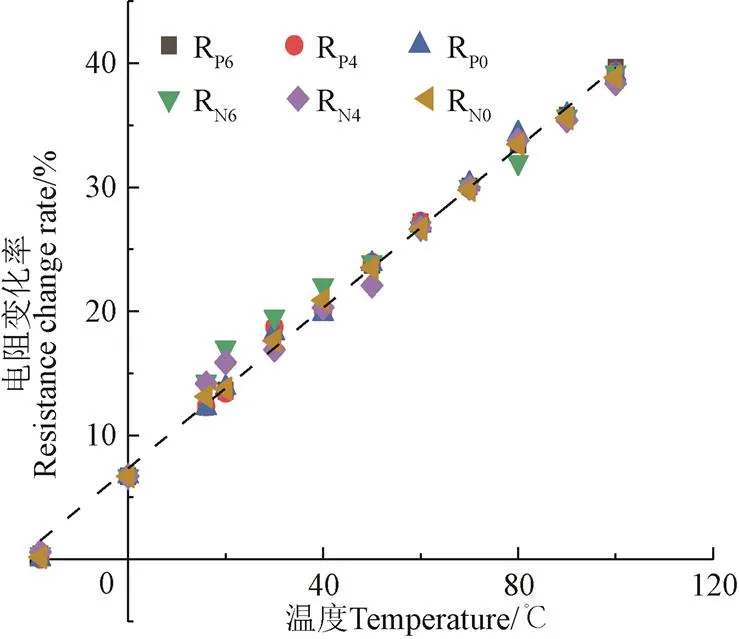
注:RP0及RN0分別代表有、無PDMS防水涂層傳感芯片,角標0表示傳感器無彎折,4、6分別對應芯片貼附于直徑分別為4、6 cm的透明亞克力管,彎折角對應14.4°及9.5°,下同。
根據表1,相同測定條件下,加附PDMS 防水涂層后芯片的線性擬合曲線斜率均有不同程度增大。熱膨脹系數差異顯著的兩種材料牢固鍵合后,復合材料的熱形變性能由PDMS決定,溫度變化后,由PDMS的劇烈形變導致了其下方溫敏層納米銀線出現不間斷裂解,電阻變化率因而增大。PDMS涂層提高了溫度傳感芯片的溫度靈敏度。
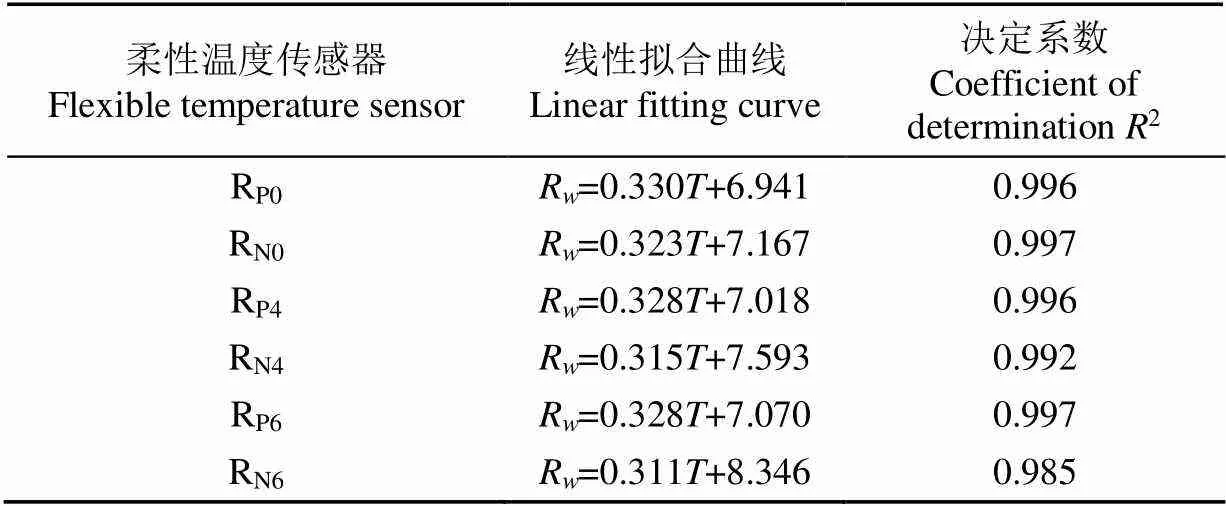
表1 柔性溫度傳感器加附PDMS保護層前后線性擬合統計表
圖5展示了柔性傳感芯片重復性測試結果。未加附PDMS保護層的柔性溫度傳感器在測定過程中靈敏度逐漸降低:使用100次后,靈敏度下降近40%,芯片已臨近失效;300次使用后,靈敏度僅為測定初期的10%;500次循環使用后,溫敏層已大面積脫落。加附PDMS保護層后,500次重復使用后的柔性溫度傳感芯片的靈敏度仍與使用初期相近,未發生明顯性能退化。由此可知,PDMS涂層提高了柔性溫度芯片的穩定性及壽命,柔性溫度傳感芯片具備了開展農業應用試驗研究的可能性。
在4種溫度下系統測定了PDMS防水柔性溫度傳感芯片的測溫性能,結果如表2所示。與鉑電阻相比,柔性溫度傳感芯片的絕對偏差小于0.42 ℃,均方根誤差小于0.35 ℃,測溫穩定性達到0.02 ℃/min,靈敏度達到0.330 ℃-1。
2.2 柔性溫度傳感器應用試驗
人體運動前后體溫檢測結果如圖6a所示。3種傳感器測量的人體溫度均在32~37.5 ℃之間,運動前后體溫總體呈先上升后下降的趨勢,與心率變化結果一致;柔性溫度傳感芯片與鉑電阻的溫度測定結果具有較好的一致性,紅外測溫槍偏差相對明顯。額頭、腋下及手腕處,自制柔性芯片與紅外測溫槍與鉑電阻測溫結果的最大誤差分別為0.4、0.5、0.4 ℃及1.2、0.8、0.8 ℃。

表2 柔性溫度傳感芯片性能分析
散葉生菜7 d連續溫度監測試驗中,鉑電阻T1、紅外測溫槍T2以及柔性溫度傳感芯片T3的溫度測定值均在17~27 ℃范圍內,植物莖部、葉片以及根部營養液的溫度隨空氣溫度均呈自然先上升后下降的鋸齒狀變化。其中,柔性溫度傳感器在植物莖部的測量溫度與標準溫度的最大誤差為0.5 ℃,在植物葉片處的最大誤差為0.6 ℃,在植物根部營養液處的最大誤差為0.4 ℃。紅外測溫儀3個位置上的最大測溫誤差分別1.5、1及1 ℃。監測結果如圖6b所示。
極端溫度監測試驗中,3組傳感器的溫度輸出一致性較好,自制柔性芯片與標準溫度的最大誤差為0.4 ℃,紅外測溫槍在極端溫度測量中的誤差較大,低溫誤差約為1 ℃,沸水測溫誤差高達2.7 ℃。監測結果如圖6c所示。
將高精度鉑電阻的測溫結果作為測量真值,分析了自制柔性溫度傳感芯片與商用紅外測溫儀表在上述應用試驗中的測溫誤差,結果匯總如表3所示。自制柔性溫度傳感芯片與紅外測溫儀的測溫誤差具有顯著性差異(<0.001),兩者平均值差為0.359 ℃,柔性溫度傳感芯片的測溫誤差明顯小于紅外測溫儀。在真實樣本測定試驗中,柔性溫度傳感器與鉑電阻溫度傳感器的均方根誤差僅為0.108 ℃,紅外測溫儀與鉑電阻溫度傳感器的均方根誤差達到0.709 ℃,自制柔性溫度傳感芯片的測溫數據更準確。
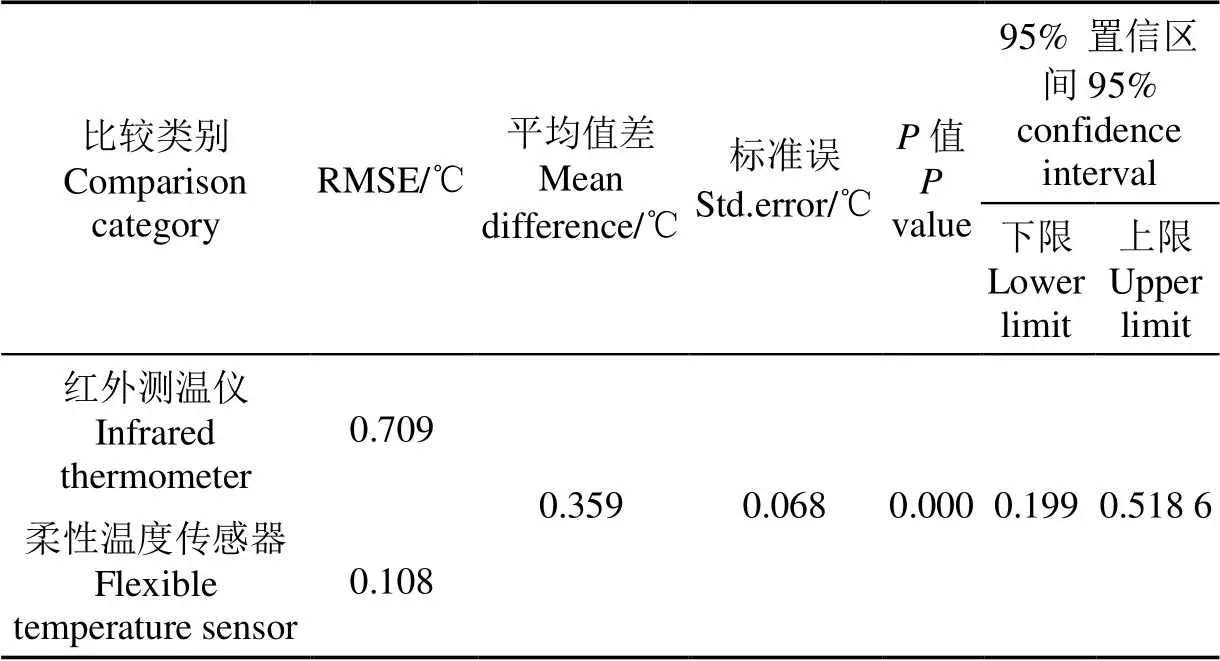
表3 柔性溫度傳感芯片與紅外測溫儀測溫誤差顯著性檢驗
3 結 論
1)使用噴墨打印技術制備了一種納米銀柔性溫度傳感芯片,通過附加PDMS保護層提高了傳感器的靈敏度、穩定性、重復性及壽命。
2)自制柔性溫度傳感芯片在-18~100 ℃范圍內的靈敏度為0.330 ℃-1,穩定性可達0.02 ℃/min,與高精度鉑電阻的測溫結果具有良好一致性,測溫絕對誤差不超過0.6 ℃,準確性明顯優于紅外測溫儀。
柔性傳感芯片具有輕、柔、韌的特性,環境適應性強,在生態無人農場信息獲取領域具有廣闊應用前景。然而,傳感器準確性仍較高精度鉑電阻存在差距,如何通過溫敏材料優化及芯片結構設計提升芯片測溫性能仍是需要解決的問題。
[1] 李道亮,李震. 無人農場系統分析與發展展望[J]. 農業機械學報,2020,51(7):1-12.
Li Daoliang, Li Zhen. System analysis and development Prospect of unmanned farming[J]. Transactions of the Chinese Society for Agricultural Machinery, 2020, 51(7): 1-12. (in Chinese with English abstract)
[2] 張勁松,孟平,高峻,等. 基于冠層葉氣溫差的蘋果園土壤水分預報模型[J]. 農業工程學報,2007,23(6):17-20.
Zhang Jinsong, Meng Ping, Gao Jun, et al. Model for predicting soil water status based on the canopy-air temperature differential in apple orchard[J]. Transactions of the Chinese Society of Agricultural Engineering (Transactions of the CSAE), 2007, 23(6): 17-20. (in Chinese with English abstract)
[3] 楊文攀,李長春,楊浩,等. 基于無人機熱紅外與數碼影像的玉米冠層溫度監測[J]. 農業工程學報,2018,34(17):68-75.
Yang Wenpan, Li Changchun, Yang Hao, et al. Monitoring of canopy temperature of maize based on UAV thermal infrared imagery and digital imagery[J]. Transactions of the Chinese Society of Agricultural Engineering (Transactions of the CSAE), 2018, 34(17): 68-75. (in Chinese with English abstract)
[4] 張智韜,邊江,韓文霆,等. 無人機熱紅外圖像計算冠層溫度特征數診斷棉花水分脅迫[J]. 農業工程學報,2018,34(15):77-84.
Zhang Zhitao, Bian Jiang, Han Wenting, et al. Cotton moisture stress diagnosis based on canopy temperature characteristics calculated from UAV[J]. Transactions of the Chinese Society of Agricultural Engineering (Transactions of the CSAE), 2018, 34(15): 77-84. (in Chinese with English abstract)
[5] 高志濤,劉衛平,趙燕東,等. 多層土壤剖面復合傳感器設計與性能分析[J]. 農業機械學報,2016,47(1):108-117.
Gao Zhitao, Liu Weiping, Zhao Yandong, et al. Design and performance analysis of composite sensor for multilayer soil profile[J]. Transactions of the Chinese Society for Agricultural Machinery. 2016, 47(1): 108-117. (in Chinese with English abstract)
[6] 杜金鳳. 新型無土栽培設施及其根區溫度調控系統的研制[D]. 鎮江:江蘇大學,2016.
Du Jinfeng. Development of A New Type of Soilless Cultivation Facility and Its Root Zone Temperature Control System[D]. Zhenjiang: Jiangsu University, 2016. (in Chinese with English abstract)
[7] Huang Y, Li C C. Real-time monitoring system for paddy environmental information based on DC powerline communication technology[J]. Computers and Electronics in Agriculture, 2017, 134: 51-62.
[8] 李隱俠,王慧利,鄧維,等. 高溫環境下湖羊直腸溫度和血液生化指標的監測[J]. 中國畜牧獸醫,2018,45(1):271-277.
Li Yinxia, Wang Huili, Deng Wei, et al. Monitoring of rectal temperature and blood indexes of Hu sheep under high ambient temperature[J]. China Animal Husbandry & Veterinary Medicine, 2018, 45(1): 271-277. (in Chinese with English abstract)
[9] 賈桂鋒,蒙俊宇,武墩,等. 被毛對熱成像檢測生豬體表溫度精度的影響及噪聲濾除方法[J]. 農業工程學報,2019,35(4):162-167.
Jia Guifeng, Meng Junyu, Wu Dun, et al. Effect of hair on thermometry of skin by infrared thermography and noise reduction method for live pigs[J]. Transactions of the Chinese Society of Agricultural Engineering (Transactions of the CSAE), 2019, 35(4): 162-167. (in Chinese with English abstract)
[10] 李顧勇. 聯合收割機柴油機余熱回收系統設計及仿真研究[D]. 長春:吉林大學,2020.
Li Guyong. Design and Simulation Study on Comnined Harvester Diesel Engine Waste Heat Recovery System[D]. Changchun: Jilin University, 2020. (in Chinese with English abstract)
[11] 劉云鵬,申思,潘余強,等. 干旱脅迫下玉米葉-氣溫差與葉溫差日變化特征及其品種差異[J]. 中國農業大學學報,2014,19(5):13-21.
Liu Yunpeng, Shen Si, Pan Yuqiang, et al. Diurnal variation in leaf-air temperature differenceand leaf temperature difference and the hybrid difference in maize under different drought stress[J]. Journal of China Agricultural University, 2014, 19(5): 13-21. (in Chinese with English abstract)
[12] 張馨,郭瑞,李文龍,等. 可裝配式土壤溫度傳感器設計與試驗[J]. 農業工程學報,2015,31(增刊1):205-211.
Zhang Xin, Guo Rui, Li Wenlong, et al. Design and experiment of assembled soil temperature sensor[J]. Transactions of the Chinese Society of Agricultural Engineering (Transactions of the CSAE), 2015, 31(Supp.1): 205-211. (in Chinese with English abstract)
[13] 康銘文. 基于納米復合材料的柔性溫度傳感器研究[D]. 成都:電子科技大學,2020.
Kang Mingwen. Research on Flexible Temperature Sensor Based on Nanocomposite[D]. Chengdu: University of Electronic Science and Technology of China, 2020. (in Chinese with English abstract)
[14] 于明含,高廣磊,丁國棟,等. 植物體溫研究綜述[J]. 生態學雜志,2015,34(12):3533-3541.
Yu Minghan, Gao Guanglei, Ding Guodong, et al. A review on body temperature of plants[J]. Chinese Journal of Ecology, 2015, 34(12): 3533-3541. (in Chinese with English abstract)
[15] Jin Y, Chen G, Lao K, et al. Identifying human body states by using a flexible integrated sensor[J]. npj Flexible Electronics, 2020, 4(1): 28.
[16] Tran T Q, Ramasundaram S, Hwang B, et al. An all-elastomeric transparent and stretchable temperature sensor for body-attachable wearable electronics[J]. Advanced Materials, 2016, 28(3): 502-509.
[17] Yokota T, Inoue Y, Terakawa Y, et al. Ultraflexible, large-area, physiological temperature sensors for multipoint measurements[J]. Proceedings of the National Academy of Sciences, 2015, 112(47): 14533-14538.
[18] Dankoco M D, Tesfay G Y, Benevent E, et al. Temperature sensor realized by inkjet printing process on flexible substrate[J]. Materials Science & Engineering B, 2016, 205: 1-5.
[19] Liao F Y, Lu C, Yao G, et al. Ultrasensitive flexible temperature-mechanical dual-parameter sensor based on vanadium dioxide films[J]. IEEE Electron Device Letters, 2017, 38(8): 1128-1131.
[20] Hoeng F, Denneulin A, Reverdy-Bruas N, et al. Rheology of cellulose nanofibrils/silver nanowires suspension for the production of transparent and conductive electrodes by screen printing[J]. Applied Surface Science, 2017, 394: 160-168
[21] Oh J H, Hong S Y, Park H, et al. Fabrication of high-sensitivity skin-attachable temperature sensors with bioinspired microstructured adhesive[J]. ACS Applied Materials & Interfaces, 2018, 10(8): 7263-7270.
[22] Ke S H, Xue Q W, Pang C Y, et al. Printing the ultra-long Ag nanowires inks onto the flexible textile substrate for stretchable electronics[J]. Nanomaterials, 2019, 9(5): 686.
[23] Liu P, He W Q, Lu A X. Preparation of low-temperature sintered high conductivity inks based on nanosilver self-assembled on surface of graphene[J]. Journal of Central South University, 2019, 26(11): 2953-2960.
[24] He M N, Zhao Y, Liu Y Q, et al. A 3D printable self-healing composite conductive polymer for sensitive temperature detection[J]. Chinese Chemical Letters, 2020, 31(3): 826-830.
[25] Chen Tianrui, Yang Hui, Bai Shengchi, et al. Facile preparation of high conductive silver electrodes by dip-coating followed by quick sintering[J]. Royal Society Open Science, 2020, 7(1): 191571.
[26] Wang Yingli, Zhao Chen, Wang Jingjing, et al. Wearable plasmonic-metasurface sensor for non-invasive and universal molecular fingerprint detection on biointerfaces[J]. Science Advances, 2021, 7(4): eabe4553.
[27] Li T, Li Y, Zhang T. Materials, structures, and functions for flexible and stretchable biomimetic sensors[J]. Accounts of Chemical Research, 2019, 52(2): 288-296.
[28] 張帆. 基于噴墨打印柔性傳感技術的研究[D]. 西安:西安電子科技大學,2020.
Zhang Fan. The Research of Flexible Sensor Technology Based on Ink-Jet Printing[D]. Xi’an: Xidian University, 2020. (in Chinese with English abstract)
[29] 初永志,郭洪吉,尹鵬和,等. 基于納米裂紋的超高靈敏度柔性溫度傳感器[J]. 機電工程技術,2018,47(11):47-49,73.
Chu Yongzhi, Guo Hongji, Yin Penghe, et al. Ultra-high sensitivity flexible temperature sensor based on nanoscale cracks[J]. Mechanical & Electrical Engineering Technology, 2018, 47(11): 47-49, 73. (in Chinese with English abstract)
[30] Cui Z X, Zhao M Z, Lai W P, et al. Thermodynamics of size effect on phase transition temperatures of dispersed phases[J]. The Journal of Physical Chemistry C, 2011, 115(46): 22796-22803.
Design and test of a nanosilver flexible sensing chip for agro-enviroment temperature monitoring
Lu Xiao1, Li Haozhen1, Liu Gang1,2, Zhang Miao1,2※
(1.,,,100083,; 2.,,,100083,)
Flexible sensing technology can greatly expand the physical energy conversion carrier morphology and application scenarios of "machine object" perception and information interaction in an ecological unmanned farm. In this study, a flexible temperature sensor chip was fabricated using 3D printing (additive manufacturing). A sandwich structure of sensor was adopted with four layers, including the substrate, temperature-sensitive layer with nanosilver ink, an electrode layer, and a PDMS protective layer. Among them, the temperature-sensitive layer was fabricated as a "turn-back track" shape to increase the temperature-sensitive area of nanosilver ink. A systematic analysis was made to explore the effects of the PDMS protective layer and chip structure parameters on the sensor performances, including the sensitivity, accuracy, and stability. The feasibility of the sensor for agricultural temperature measurement was verified using the dynamic thermo-monitoring on the bodies of agro-living objects, plant rhizosphere, soil, and agro-equipment. The results showed that the PDMS protective layer realized the waterproof protection in the nanosilver temperature-sensitive layer, thereby improving the environmental adaptability and service life of sensors. Optimal line width and spacing in 3D printing were achieved in the range of 450/300, 350/250, and 250/200m, particularly for the temperature-sensitive layer of self-developed flexible sensor chips. The experimental results show that when “line width/line spacing” is 250/200m, the sensitivity of the flexible temperature sensor chip can reach 0.317 ℃-1, which is the highest sensitivity. In addition, the resistance change rate of temperature-sensitive wire per unit substrate area increased, with the decreasing of line width and spacing. An optimized fabrication structure was chosen as the line width of 250m and the line space of 200m. Correspondingly, the optimal performance was achieved, where the sensitivity of the temperature sensor was 0.330 ℃-1, while the measurement error was less than 0.5 ℃, and the stability was 0.02 ℃/min. The sensor was bent along the rounded edge of circles with diameters of 4 and 6 cm, respectively. The resistance variation was measured at different temperatures. The data showed that the bending angle could not affect the performance of the temperature sensor. The flexible temperature sensor was pasted on the human forehead, arm, and armpit to measure the body temperature before and after exercise. The measurement demonstrated that the flexible temperature sensor accurately presented the changes in body temperature, where the maximum error was less than 0.5 ℃. A 7-day continuous temperature monitoring test was performed on the plant body and the nutrient solution in hydroponic lettuce cultivation. One flexible sensor was stuck onto the stem and leaf of lettuce. Another sensor was installed under the nutrient solution, close to the lettuce root. The temperature sensor accurately reflected the change of the daily average temperature of lettuce, where the maximum error was less than 0.6 ℃. The fluctuation trend of temperature in different parts of the plant was consistent with the room temperature during the testing duration. Additionally, the sensor tracked the process of soil frozen and water boiling, where the maximum error was less than 0.4 ℃. A self-made flexible temperature sensor chip was designed and subsequently tested in the typical agricultural temperature measurement. An excellent agreement was achieved in the flexible sensor with the high-precision platinum resistance sensor, where the measurement error was less than 0.6 ℃, indicating better performance than that of the non-contacted temperature measurements conducted by the infrared sensor. Flexible nanosilver temperature sensor chip can quickly and accurately capture the temperature change of measured target, indicating a promising agricultural application prospect.
temperature; sensor; nanosilver; flexible sensing; chip; agro-enviroment monitoring
10.11975/j.issn.1002-6819.2021.10.024
S126
A
1002-6819(2021)-10-0198-08
路逍,李浩榛,劉剛,等. 納米銀柔性農用溫度傳感芯片設計與試驗[J]. 農業工程學報,2021,37(10):198-205.doi:10.11975/j.issn.1002-6819.2021.10.024 http://www.tcsae.org
Lu Xiao, Li Haozhen, Liu Gang, et al. Design and test of a nanosilver flexible sensing chip for agro-enviroment temperature monitoring[J]. Transactions of the Chinese Society of Agricultural Engineering (Transactions of the CSAE), 2021, 37(10): 198-205. (in Chinese with English abstract) doi:10.11975/j.issn.1002-6819.2021.10.024 http://www.tcsae.org
2021-03-14
2021-05-13
浙江省重點研發計劃課題(2020C02017);云南省院士工作站項目(LJGZZ-2018001);中央高校基本科研業務費項目(2021TC031)
路逍,研究方向為柔性打印農用傳感技術。Email:S20203081509@cau.edu.cn
張淼,博士,副教授,研究方向為農業信息獲取技術。Email:zhangmiao@cau.edu.cn
