LAND LINKING RAILS
2021-09-13 15:38:05ByZhangJianhua,ZiQian
中國東盟報道 2021年12期
By Zhang Jianhua, Zi Qian



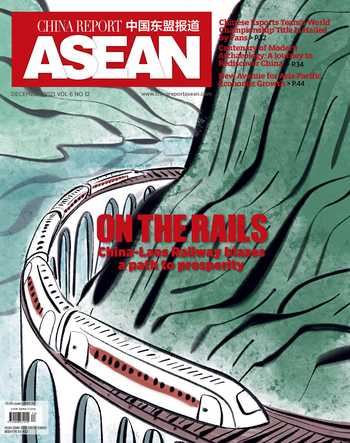
The China-Laos Railway winds its way through mountains to boost transport and trade links between China and the landlocked country of Laos
At 16:45 on December 3, bullet trains“Fuxing”and“LaneXang”departedKunming and Vientiane respectivelyat the same time to commenceoperations of the 1,035-km-longChina-Laos Railway, the first railwayjointly constructed by China andLaos according to Chinese standards. During early operation, the railwaywill dynamically adjust its operationplan according to the pandemicsituation and demand for passengerand freight services. The railwaysopening cuts the travel time betweenthe two cities down to about 10 hours,including time for customs clearance at the border.
The newly-completed China-LaosRailway is like a link connectingChina and Laos and radiating toother Southeast Asian countries.Its commercial operation marksLaosentry into a new era of railwaytransportation. Chinese and Laoconsumer goods and products willrealize“door-to-door”transportationthrough this corridor. The railwayis also becoming a“golden link”connecting China to Thailand,Malaysia, and other ASEAN countries, playing a positive role in the economic integration of the China-ASEAN FreeTrade Area and the Greater MekongSubregion.
As a symbol of Belt and Roadcooperation and China-Laosfriendship, the railway will providestrong support for acceleratingcompletion of the China-LaosEconomic Corridor and construction of a China-Laos community with ashared future. The railway realizesthe Lao dream to convert from alandlocked country to a land-linked hub and has great significance tothe already close economic, social,cultural, and people-to-peoplecooperation and exchanges between China and Laos.
Smart Construction
The China-Laos Railway runsthrough the mountainous areas ofsouthwestern China and northernLaos. The overall terrain tilts from the northwest to the southeast throughhigh mountains and deep valleys. The relative height difference between the highest point and the lowest point is 2,900 meters. About 70 percent of the rails were laid in mountainous areas, and 87 percent of the line is bridgesand tunnels.
During the construction process, the builders overcame numerousdifficulties to dig 15 tunnels morethan 10 kilometers long and several mega bridges high above the valleys of the Lancang-Mekong and Nanxirivers.
In order to better achieve the design goal of the railway, the constructionteam adopted smart technology tooptimize route choosing. Xie Yi,chief engineer of China Railway
No.2 Institute and head designer ofChina-Laos Railway, said that in theareas with undulating terrain, megabridges and long tunnels can reducethe length of the line and save project investment. In environmentallysensitive areas, multiple options such as bypasses, tunnels, and bridgeswere used to minimize the impact on the environment.
“The China-Laos FriendshipTunnel right on the border is oneimpressive example,”saidXie.“The cross-border tunnel is 9,590meters long with some segmentspassing through 80 percent salt rock, which has the special engineeringproperties of solubility, corrosion,and expansion. To deal with it,we eventually devised solutionsincluding grouting to stop water,wrapping everything to waterproofit, using strengthened materialfor anticorrosion, and adoptinground multilayered structure. Afterconsiderable efforts, we formed astructure and a waterproofing system suitable for high-content salt rocktunnels.”China is the global leader in technology related to waterproofing, anticorrosion, and environmentally- friendly treatment of waste salt rock.
Tailored Services
Alongside the jaw-droppingline design, that of the“LaneXang”train, operated by Laos, alsodeserves attention. The train wasprocured by the Laos-China RailwayCompany through public biddingand manufactured by subsidiariesof China Railway ConstructionCorporation (CRRC). Its designand manufacturing were basedon mature technology of Chinas“Fuxing”electrical multiple units(EMUs) with improvements andadaptations for cross-bordertransportation through mountainous areas featuring advanced technology,safety and reliability, large passenger capacity, comfortable ride, and lower operational costs.
According to a briefing from China Railway International Company, thetrain is called“LaneXang”as Laoswas once called Lane Xang Kingdom. It is also known as“Lancang,”thename of the upper reaches in Chinaof the Mekong River, symbolizing the friendship between the two countriesas good neighbors, good friends, goodcomrades, and good partners. Theexterior of the“LaneXang”EMU trainis painted red, blue, and white, thecolors of the Lao national flag, whilethe interior of the train is decoratedwith national flowers and beautifulpatterns from both countries.
The“LaneXang”EMU train canoperate at a maximum speed of 160kilometers per hour. Under each set ofseats are installed standard Chineseand Lao power outlets. Passengerinformation display, broadcasts,and service information are in threedifferent languages: Chinese, Lao, andEnglish. The train is also equippedwith a dining car, barrier-free seats,braille, and other facilities.
The first stage of operation offers25 railway stations along the lineincluding Kunming, Yuxi, Yuanjiang,Puer, Xishuangbanna, Mohan,Boten, Luang Prabang, Vang Viang,Penghong, and Vientiane. Amongthe stations, Mohan and Boten havebeen built with the key technologiesof integrated design and cross-borderinterconnection, providing bothdomestic and international serviceswith convenient customs clearance.
“To ensure a more convenienttravel experience for passengers,we fully considered Laosnationalconditions and passenger habits,”saidLi Tianyi, an engineer from the ChinaAcademy of Railway Sciences,“Withreference to the mature technologyand business model of I2306, ChinaRailways official website and appfor tickets, we have tailored a brandnew ticketing system for Laos with multilingual services and multicurrency payments and settlement.” He hopes such meticulous efforts will bring smiles to the faces of passengers from both countries.
Brand-new Blueprint
Before completion of the ChinaLaos Railway, Laos operated only a 3.5-km-long railway. For a long time, the traffic bottlenecks were a major factor restricting the economic development of Laos. Surrounded by China, Vietnam, Thailand, Myanmar and Cambodia, Laos is geographically “landlocked” with no ports. Its location and mountainous terrain have seriously hindered its development.
“The commercial operation of the China-Laos Railway will not only help Laos make the historic leap from a ‘landlocked country to a ‘land-linked hub, but also promote the economic development and cooperation between the two countries, and in the subregion and the whole region, for win-win results,” said a spokesperson from China Railway Group.
The China-Laos Railway is more than a physical connection between the two countries, but also a bond of friendship between the two peoples. The construction process involved the builders of China and Laos working together to overcome difficulties and participating in public welfare activities such as emergency rescue, medical assistance, and school donations. The project created 110,000 job opportunities for local residents. The builders helped Laos build nearly 2,000 kilometers of roads and irrigation channels and purchased more than US$780 million of building material and supplies from the local market.
“Since I began to participate in the railway construction, I have learned a lot including how to use highend instruments and equipment,” said SongtsaiSayafong, a 34-yearold Lao employee, who has worked for the railway for four years. “The experience and technology that I have acquired will likely help me land a position surveying and mapping for a company that cooperates with Chinese companies.” Over the years, he has personally witnessed how the tunnels and bridges were built through big mountains. “Before such a railway, I never dreamed of traveling out of Laos,” he said. “Now Im ready to see the world.”
Dreams Come True
On the evening of December 4, a fully-loaded freight train arrived in the Lao capital of Vientiane. It was the first ever international freight train to depart Kunming on the China-Laos Railway after its official opening.
At 23:10 on December 4 local time (00:10, December 5, Beijing Time), the train arrived at Vientiane South Station. Zhou Yukui, the conductor, reported feeling “both happy and excited” to have been a participant in the Belt and Road Initiative and a messenger of China-Laos friendship. He also said that he had devoted all of his focus to ensuring safe operation.
Li Tongxu, director of the Vientiane South Station, said his station was ready to welcome the train, which was loaded with phosphate fertilizer and animal feed to be transferred to Thailand. The station will help the cargo owner with customs clearance and transfer at the station. At present, the station staff includes nine Chinese technical and management personnel and 59 Lao employees. That same day, the first international freight train from Vientiane arrived in China.
Data released by the Yunnan provincial state assets regulator on December 9 showed that since the beginning of its operation on December 3, the domestic section (Yuxi-Mohan) of the China-Laos Railway had transported a total of 114,000 passengers, with an average of more than 20,000 per day. On the first day of its operation, the average passenger load factor was as high as 94.6 percent. On December 4, a total of 27,000 person/times traveled along the line, including 5,800 person/ times from Puer Station and 7,200 person/times from Xishuangbana Station.
On December 8, the first “Jiangsu” freight train (Nanjing-Vientiane) began official operation on the China-Laos Railway. The train, fully loaded with 76 containers of export commodities, departed the cargo terminal of Jiangsu Provinces Nanjing Railway Station, marking the beginning of a direct link between the Yangtze River Delta and Vientiane. It took the train six days to travel a distance of more than 3,500 kilometers from Nanjing to Vientiane via the Mohan land port in Yunnan Province.
The entire line of the China-Laos Railway adopts Chinese standards. It takes 5.3 hours to travel from Kunming to Mohan and 3.3 hours from Boten to Vientiane, meaning that passengers can travel from Kunming to Vientiane in around 10 hours, including waiting for customs clearance. Transportation time of goods between the two countries along the line will also be significantly reduced, which will in turn reduce logistics costs. Freight business can be handled at all the major stations in Laos including Nadu, Luang Prabang, and Vientiane South. By press time, more than 100,000 tons of goods were scheduled to leave Vientiane South Station.