Sharing Knowledge for a Sustainable Belt and Road
2021-10-08 15:35:46ByZHANGJIU’AN
CHINA TODAY 2021年9期
By ZHANG JIUAN
IN recent years, cross-cultural exchanges between institutions of higher learning, knowledge sharing, and the consensus that humanity has a shared future have been playing an increasingly prominent role in the advancement of the Belt and Road Initiative (BRI).
A Strong Bolster for the BRI
Cross-cultural exchanges in higher education have served as a bridge to connect people of different countries and deepen their mutual understanding, providing strong support for the cooperation among the BRI partner countries.
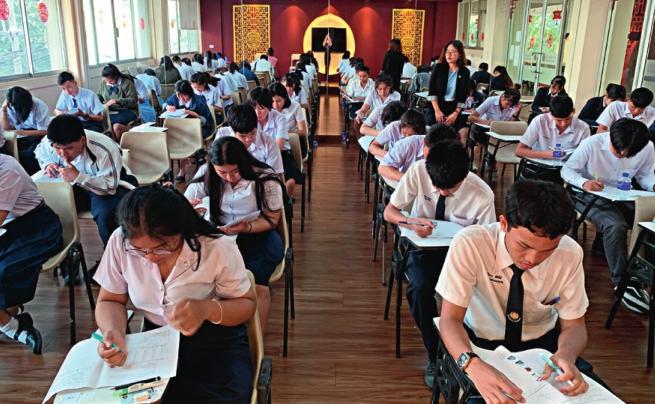
From the inception of the initiative, Chinas institutions of higher learning have been active in going global. They have carried out cultural and educational cooperation with countries along the Belt and Road routes, such as Chinese-foreign cooperativelyrun schools, especially schools that are based outside China, setting up a multi-level and multi-channel student exchange mechanism, and signing agreements for the mutual recognition of college degrees. Through these concrete measures, they aim to facilitate the flow of talent among BRI countries and thus lay a “soft” foundation for more international cooperation.
Chinas Ministry of Education has already implemented a number of educational initiatives for BRI. Since its establishment in 2015, the BRI University Alliance has expanded from 47 universities in eight countries to 173 universities in 27 countries, forming a Belt and Road community of higher learning, involving universities from every continent. To follow up on that, alliances of different majors have also formed, to share professional knowledge in a more targeted way for win-win development.
Take the railway infrastructure connectivity between China and Mongolia for example. The operation and development of Mongolias railway system relies heavily on China. However, in the past, due to language barriers, Mongolian railway technicians could only communicate in Russian with their Chinese counterparts. Annar, a Mongolian student studying in the Beijing Jiaotong University, compiled a Chinese-Mongolian and Mongolian-Chinese Dictionary of Railway Terminology during his spare time and got it published. The dictionary, containing over 3,000 railway-related vocabularies and terms, has greatly facilitated communication and exchanges between the professionals and students of the two countries working in the field.
Since the outbreak of COVID-19, China has upgraded the Belt and Road educational initiative by expanding the supply of public education products and voluntarily sharing its experience and practices in the provision of e-learning when in-class education was suspended and later in the orderly resumption of schools. The move is aimed at providing needed help to the international community, especially developing countries.
According to the data released in December 2020 by the Ministry of Education, during the 13th FiveYear Plan period (2016-2020), China signed 11 new agreements on mutual recognition of higher education degrees, which raised the number of countries and regions having such an agreement with China to 54. Now more than 50 percent of the students studying in China are from the BRI countries.
Fuzhou University employed an Italian bridge expert Bruno Briseghella to lead its College of Civil Engineering. This not only improves the academic capability of the university, but also enhances its foreign exchanges. In addition to this, the university also provides training classes on bridge and tunnel engineering for Ethiopia and Nepal, and shares key technology in road construction with Vietnam and Uzbekistan.
In Fuzhou City, back in 2016, the Juncao (literally fungus and grass) growing technology of Fujian Ag-riculture and Forestry University was added into the“going out” projects of the 21st Century Maritime Silk Road. Through technological assistance and international cooperation, a total of 205 training classes in 106 countries have been conducted, benefiting over 7,900 participants. Juncao growing technology demonstration bases have been built in 13 countries, including Papua New Guinea, Rwanda, Fiji, Lesotho, South Africa, Malaysia, Thailand, and Eritrea. A college student from Nigeria who is studying in Fuzhou said in an interview that when he returns to his home country, he will take Juncao technology back with him to benefit his countrymen.
After over eight years, the function of international higher education cooperation under the BRI is no longer limited to serving the people of one country, but has expanded to promote the development of the world.
More Cooperation in the Educational Sector
As a strong driving force for global development, knowledge and talent are the keys to achieving highquality connectivity. How to share scientific knowledge that promotes development and prosperity and cultivate more outstanding talent with a global vision, social responsibility, and a scientific spirit are key issues to be solved.
Back in 2015, a report titled “Rethinking Educa- tion: Towards a Global Common Good” issued by UNESCO argued that sustainable development in an increasingly interdependent world requires that people see education and knowledge as a global common good. The implications are even more profound in the context of the continuing impact of COVID-19 and the dramatic changes it has brought about in the world.
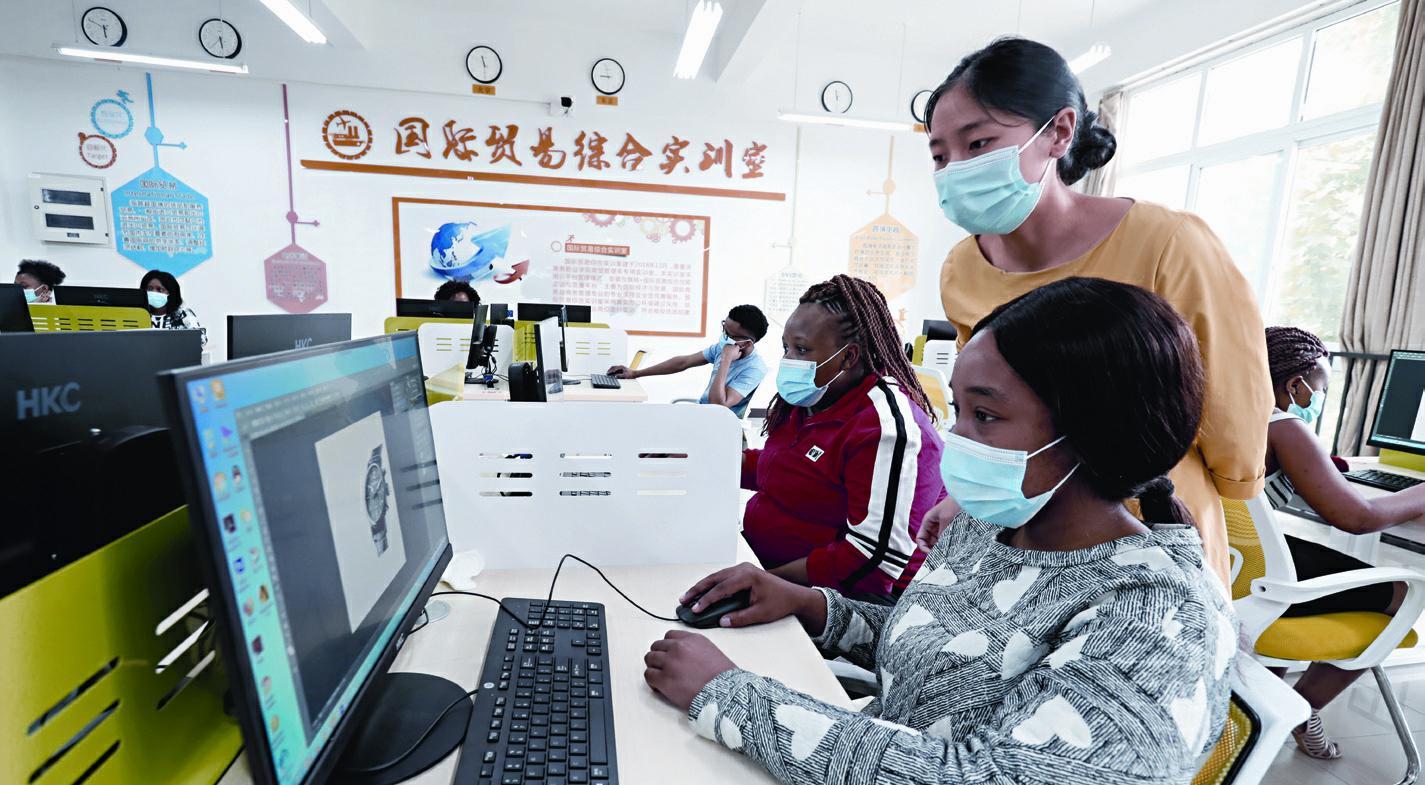
China has been active in educational cooperation and knowledge sharing with other BRI countries. Wherever Chinas projects are implemented, its educational resources and knowledge sharing also follow. A survey shows that the kind of professionals most demanded in the BRI countries are concentrated in international trade, computers, finance, language, industrial design, law, civil engineering, financial management, journalism, and machinery manufacturing; and there is also a strong demand for vocational education. In order to promote the construction of railway infrastructure in the ASEAN region, Beijing Union University and universities in the ASEAN region have carried out a joint educational program to cultivate talent in rail transit.
In order to provide vocational training to young people, the Chinese city of Tianjin, taking into consideration the needs emerging in the BRI construction and combining them with major industrial projects, has built 17 Luban Carpenters Workshops in 16 countries in Asia, Africa, and Europe, in order to train young technicians who are familiar with Chinese technology, crafts, and products.
Likewise, with the support of the United Arab Emirates (UAE), the Beijing Institute of Technology is building a China-UAE joint international lab and a China-UAE unmanned intelligent system control lab in Beijing.
All in all, Chinese institutions of higher learning have taken as their mission to build a Belt and Road educational community with the objectives of training talent, helping young men from BRI countries find their direction in life, and promoting the spread of advanced technologies and industries.
Need for High-quality BRI Cooperation
As the COVID-19 swept across the world, China selflessly shared its first-hand experience in pandemic prevention and control, scientific cooperation, and stabilizing domestic economy with the rest of the world, especially with the BRI countries. From the very beginning, China has set out to help them resume work and production, which is of great importance to global economic recovery.
Chinese President Xi Jinping once noted that without cultural support no cause could last long. Presently, many countries around the world are quite optimistic about the future of the BRI. This is not only because of the BRIs promising economic benefits, but also due to its cultural genes featuring mutual benefits and shared future, things extracted from Chinas traditional culture. The Chinese nation has always cherished the dream of building a world of universal peace and happiness.
When seen in the bigger picture of the development of human civilization, the diverse cultures around the world need to share, dialogue, and learn more from each other to promote joint development. Through international cooperation in higher education within the BRI framework, different cultures are getting the chance to learn more about each other, which will help people from BRI countries to have a deeper understanding of the positive, constructive, and creative values inherent in the BRI.
The Belt and Road cooperation is expanding beyond the traditional political and economic scope to deeper and more essential areas of people-to-people and development experience exchanges, knowledge sharing, and national governance cooperation.
In 2018, the Academy of Contemporary China and World Studies worked with Dataway Technology Group to conduct a survey in 17 countries along the BRI routes to better understand how local people in these countries viewed China. The results show that up to 85.7 percent of the respondents thought China boasts a rich culture, and 72.5 percent believed that Chinese culture is conducive to the development of cultural diversity and multi-cultural integration. Seventy-five percent of them supported their governments in further expanding cultural exchanges with China. Besides, as an important carrier of Chinese culture the Chinese language is increasingly favored by overseas respondents, with 36.4 percent of them hoping to learn Chinese within the next five years. Among them, the proportion of young people was as high as 42.2 percent.
The BRI cooperation in knowledge exchange, which has stood the test of COVID-19, is ushering in a new era. As for now, there is growing mutual consensus, common interests, and common needs among BRI countries. Against this background, there is a need for focused cooperation among institutions of higher learning to breed exchange programs of international influence and cultivate inter-disciplinary talents who have a global vision. All these efforts aim to contribute more to building a community with a shared future for mankind.