孟加拉國(guó)傳統(tǒng)刺繡被的歷史與工藝研究
2021-10-23 02:06:11馬扎爾田偉趙洪杰胡蕓鑫祝成炎
絲綢 2021年10期
馬扎爾 田偉 趙洪杰 胡蕓鑫 祝成炎
摘要: Nakshi Kantha是一種手工刺繡的被子,屬于孟加拉國(guó)500年前的土著手工藝品。它是通過回收人們使用過的衣服和紗線,并進(jìn)一步縫制而成,目的是防止古老的孟加拉人民遭受寒冷的冬天侵襲。該手工藝品是孟加拉國(guó)的本土藝術(shù),與該國(guó)人民的傳統(tǒng)文化和情感息息相關(guān)。該工藝品在孟加拉國(guó)的重要性無(wú)法形容,因?yàn)槊總€(gè)家庭至少有一個(gè)傳統(tǒng)的手工刺繡被,它是由家中受人愛戴的女性來(lái)完成,被用在日常生活和重要節(jié)日里。不幸的是,隨著時(shí)間的流逝,這種美麗的土著手工藝品逐漸消失。文章介紹了該土著手工藝品的歷史文化、縫制技術(shù)和應(yīng)用,并展示了一些古老的孟加拉國(guó)傳統(tǒng)手工刺繡棉被圖案,目的是讓讀者能夠更加了解孟加拉國(guó)這種傳統(tǒng)的土著手工藝品。
關(guān)鍵詞:
繡花被;本土工藝;傳統(tǒng)紡織品;縫制技術(shù);孟加拉國(guó)
中圖分類號(hào): TS941.11;J533.6(354)
文獻(xiàn)標(biāo)志碼: B
文章編號(hào): 1001-7003(2021)10-0113-08
引用頁(yè)碼: 101301
DOI: 10.3969/j.issn.1001-7003.2021.10.018(篇序)
A study on the history and craft of traditional embroidered quilt in Bangladesh
MAZHARUL Islam Md, TIAN Wei, ZHAO Hongjie, HU Yunxin, ZHU Chengyan
(School of Textile Science and Engineering, Zhejiang Sci-Tech University, Hangzhou 310018, China)
Abstract:
Nakshi Kantha refers to a kind of handmade embroidered quilt, which is an indigenous craft in Bangladesh with a history of 500 years. It is made by recycling second-hand clothes and yarns and further sewing, for the purpose of protecting the ancient Bangladeshi People from extreme winter cold. The craft is an indigenous art of Bangladesh with close link to the traditional culture and emotions of the people. The significance of this craft in Bangladesh is beyond description as every household has at least one traditional hand-embroidered quilts made by their beloved female and used in daily life as well as in important festivals. Unfortunately, the beautiful indigenous craft is gradually vanishing with the passage of time. The article introduces the historic culture, sewing technology and application of this indigenous handicraft, and exhibits some ancient Bangladeshi traditional hand-embroidered quilt patterns, aiming to help readers know more about this traditional indigenous handicraft of Bangladesh.
Key words:
embroidered quilt; indigenous craft; traditional textiles; sewing technology; Bangladesh
收稿日期: 2021-03-19;
修回日期: 2021-09-15
基金項(xiàng)目:
作者簡(jiǎn)介: 馬扎爾(1996),男,碩士研究生,研究方向?yàn)榧徔椃b先進(jìn)制造技術(shù)。通信作者:祝成炎,教授,cyzhu@zstu.edu.cn。
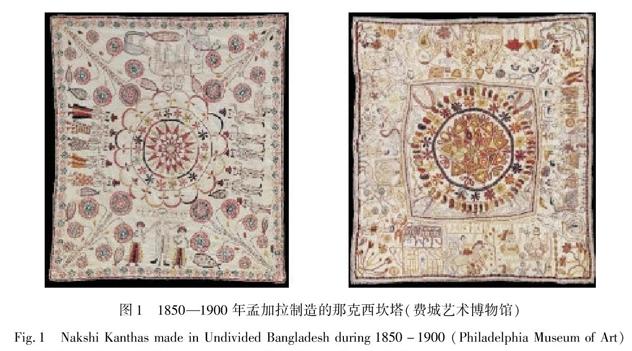
Bangladesh is a small country in south Asia with a very rich history of arts, adjacent to the east side of China, also known as an important hub for classical South Asian arts. In addition, there are also several ethnic and religious minorities. Bangladesh is the origin of many arts such as Muslin, Jamdani, Scroll portray, etc., and Bangladeshi women are also well-known for their embroidery works, known as embroidered quilt or Nakshi Kantha(Fig.1).
The phrase, "Nakshi Kantha" is a combination of two different words, where "Nakshi" is derived from Bengali, with the meaning of embroidery or artistic pattern, and the word "Kantha" is derived from Sanskrit, which means quilt, rag or patched cloth.
So, from the etymology, it can be said that Nakshi Kantha or Bangladeshi embroidered quilt is an indigenous act of reshaping worn cotton cloth into household textiles. Evolved from a patched cloth, it is remade out of necessity to resist against cold, or in short it is a recycle embroidered textile in Bangladesh[1].
The craft is performed by the rural women of Bangladesh, who give the old discarded apparel a new life(cotton garment that becomes too frail and worn out due to frequent use and cannot be worn anymore) by transforming them into the extraordinary handmade craft, called Nakshi Kantha or embroidered quilt of Bangladesh(Fig.2).
In traditional Nakshi Kantha, the pattern is embroidered with colorful threads taken from the Sari fringe, and the empty space is sewn with white thread to create a ripple effect. In most Bangladeshi Families, a Kantha is used to wrap a baby as it is believed to protect it from evil eyes. In some areas of Bangladesh, Kanthas can also be found as a part of the dowry[2].
Generally, to make a full-size(152 cm×182 cm) traditional Kantha, 5-7 old discarded saris(Traditional Bangladeshi womens clothing) are needed(Fig.3), but now the old material is replaced by new cotton fabric. Commercially two-layer cotton fabric is needed to make a commercial kantha as the new cotton fabric, which is thicker than the old sari[3].
The design of embroidery in the Nakshi Kantha represents the ethics, emotion & values of artisans, who use kantha as a drawing canvas, but due to the commercialization, the emotional attachment is rarely seen today, replaced by the lit colorful designs[4].
A bitter truth that must be admitted is that this beautiful indigenous craft of Bangladesh is disappearing over time. Though the tradition of performing this craft is important and meaningful in many aspects in Bangladeshi society including economy, trade, export & culture, some people have taken the initiative to reveal this craft again.
Many womens organizations in Bangladesh such as BRAC, AARONG, KUMUDINI etc. played significant role in the revival of this Kantha craft, which initiated the women empowerment and also brought the focus of the modern textile industry as well as the new designers & researchers towards this craft, so that new clothing industries are showing more interest in using printing & embroidery technology to manufacture products with Nakshi Kanthas Design due to the high demand of this indigenous design among customers[5].
Regarding this point, now the Nakshi Kantha or Embroidered quilt of Bangladesh is a name of elite product, which is being widely marketed in Bangladesh & all over the world, especially in USA. Because of the poor adoption of marketing strategy in terms of exporting this craft, the export rate cannot be measured now. The exporter & traders can step forward and turn this indigenous craft into a future asset in textile history.
The main idea of this paper lies in introducing this beautiful indigenous ancient foreign craft and its detail biography, embroidery technique & applications to foreign countries while studying its beautiful designs so that it can be further used and placed by modern machines to create a better textile market for this traditional handcraft.
1 孟加拉繡花被的發(fā)展簡(jiǎn)介
1 Introduction to the development of embroidered quilt of Bangladesh
1.1 孟加拉繡花被的歷史
1.1 History of Nakshi Kantha or embroidered quilt of Bangladesh
Nakshi Kantha or Bangladeshi Embroidered Quilt is probably the most established type of embroideryoriginated in South Asia which was found in thrift. Poor women in Bangladesh are used to making handmade quilts by patching the old used clothes to withstand the mild cold in the winter night. Its origin can be traced back to the antiquated pre-Vedic ages[6].
The first convincing evidence of its existence can be found in the nearly 500-year-old book "Chaitanya Charitamrita" written by Krishnadas Kaviraj in 1557. He mentioned that the mother of Chaitanya sent a Kantha to her son in Puri(A providence of India) through some pilgrims[7].
The second earliest evidence can be a note of Duarte Barbosa in 1516, where he wrote, "They have beautiful quilts and testers of beds that are finely worked and painted, and quilted articles of dress.[8]"
In 1629, the Portuguese missionary Sebastian Manrique visited Bangladesh. In his travel diary, he noted, Among the more important commodities dealt in by the Portuguese in Bangladesh, there are very rich back-stitched quilts, bed-hangings, pavilions and other curious articles with hunting-scenes that are made in these kingdoms[9].
400 years prior, Portuguese showed up on the eastern shore of India. Intrigued by the Kantha quilts, which helped them to remember their needle-makes, they returned home seventeenth-century Portuguese boat "71 or-de-la-Mar" conveyed Bangladeshi Kantha to Portugal. Kantha's stitched works were traded from Bangladesh in mid-seventeenth century and worn by the Queens of Portugal[10].
There are also several references in history, in which the author mentioned the traditional quilt of Bangladesh. Those prove the ancient history of traditional embroidered quilt of Bangladesh(Fig.4).
1.2 孟加拉繡花被子的衰落
1.2 Decline of Nakshi Kantha or embroidered quilt of Bangladesh
The tradition of Nakshi Kantha or Embroidered quilt of Bangladesh is related to the birth history of Bangladesh. According to the British rule(1858) to independent Bangladesh(1971), there were so many issues, such as destroying the local cottage enterprises and advancing their own imports, religious & cultural conflicts etc., which can be said to result in the decline of this indigenous craft(Fig.5).
The decline or the degeneration of the Kantha can be ascribed to three forces at any rate: impoverishment and the attendant loss of leisure time; the migration of Hindus to India; and the influx of present-day or external influences. As more and more families became impoverished in 1971(after independence of Bangladesh), more and more women had to look for paid jobs and fewer ladies had time to quilt kanthas, which after all were rarely made for trading or income. With the migration of enormous quantities of Hindus to India(in 1947 after the split of Hindustan), a tremendous storehouse of Kantha themes(Hindu folklore and custom) was partly lost in Bangladesh and with modernization and external influence, changing tastes have produced crossover forms: the popularized, cross-connected kanthas and kanthas combined with a blend of non-traditional and traditional fasteners and themes[11].
1.3 孟加拉刺繡被的復(fù)興
1.3 Revivalism of Nakshi Kantha or embroidered quilt of Bangladesh
This traditional craft did not appear in public view until the mid-1980s. Liberation War in 1971 had left numerous ladies down and out. After the liberation of Bangladesh, they endeavored to give work to such ladies. This empowered the recovery of the Kantha[2].
Several women welfare organizations like BRAC, AARONG & KUMUDINI started providing training for the rural women in kantha projects that time to make them financially stable[10]. The following table can describe the number of women employed through kantha projects in different regions of Bangladesh after the independence(Tab.1).
2 孟加拉繡花被的原料
2 Raw materials of Nakshi Kantha or embroidered quilt of Bangladesh
As already mentioned, the Nakshi kantha is basically a recycled textile made from the used apparel, allowing us to imagine that the basic element of this textile should be used garments, but in addition, many other things are used to make this beautiful craft. The following is a brief discussion of the raw materials of Nakshi Kantha:
Fabrication: Traditionally, Sari or Dhoti or Lungis made of old plain weaved cotton(Traditional Bangladeshi Dress which is frequently worn by the massive people of Bangladesh) are used as a base fabric, making a Nakshi Kantha incredibly soft due to the frequent use(Fig.6). Five or seven layers of discarded garments are used to make a traditional Kantha using basic running stitches(The sewing threads are also collected from the Sari fringe) and to create a ripple effect[10].
Basically, the above garments are a piece of unstitched plain weave fabric with the length of 4.5 to 9 meters and width of 600 to 1,200 millimeters(Fig.7). The traditional Bangladeshi people are used to wearing this kind of garments a lot for its comfort and breathability.
Fabric Placement: Traditionally, thorns of date tree are used to tuck the corners of a Nakshi kantha by a heavy object before connecting the layers together for a required thickness. Regarding this, firstly, the thorns are collected from date palm tree, and then dried in the sun to provide the strength. This usually take 2/3 days heavy sun dry to make thorns suitable for tucking(Fig.8).
Embroidery: Embroidery is the core of a Nakshi Kantha. It is the process by which an ordinary kantha is transformed into a beautiful Nakshi Kantha. Traditionally, the Embroidery is performed by hand, requiring the use of needles and threads. A detailed description of the needles and threads used to perform the hand embroidery to make a Nakshi Kantha is described below:
Needle: Different kinds of hand sewing needles are used for quilting the Nakshi Kantha according to classification and design(Fig.9). Usually 5-10 size number needles are used for quilting light or medium Nakshi Kantha and 2-4 size number needles are used for quilting heavy Nakshi Kantha.
Threads: In traditional Nakshi Kantha quilting, usually recycled threads are used for drawing the patterns to create a design. The weft yarn is collected to embroider the Nakshi Kantha design from the border of a used Sari(Fig.14).
From the above discussion, the basic elements can be summarized below(Tab.2), which are needed to quilt a Traditional Nakshi Kantha:
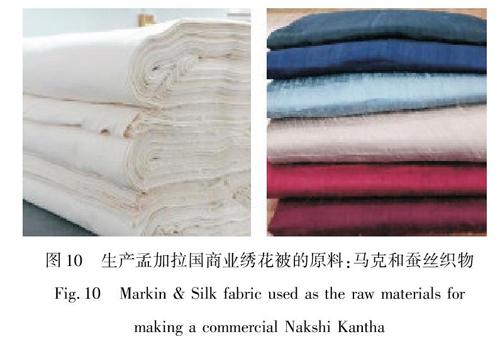
Though traditional Kantha is produced from the old discarded Sari, Lungi or Dhotis, in commercial production, new thick cotton or markin(unbleached white cotton) and sometimes silk fabric are used with the same plain weave structure(Fig.10). The old mute color threads have also been replaced by the new colorful threads in commercial production along with the wooden embroidery frame. Metal nails are commonly used now in commercial production for tucking instead of date thorns.
3 孟加拉國(guó)繡花被的縫紉技術(shù)
3 Quilting technique of Nakshi Kantha or embroidered quilt of Bangladesh
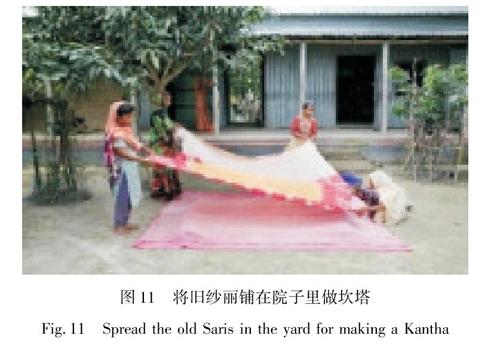
Quilting a kantha is a professional job, the artisan of it need knowledge and experience about different kinds of stitching. A final kantha or quilt represents a persons emotion, patience and love. For quilting a traditional Nakshi Kantha or Embroidered quilt of Bangladesh, the artisan must be mentally prepared beforehand. She needs to be picky about the collection of raw materials. The incredibly soft and colorful garments need to be collected for the quilting. Also, it will take long time to collect the date thorns and sewing threads for performing the craft. Each process of quilting a Kantha requires patience and skills[12]. The pictorial representation of quilting technique of a Kantha is stated below(Fig.11-15):
First, the old discarded apparel needs to be spliced collectively to obtain the desired length, and then layers are spread out on the ground to attach together with minimum running stitches for the required thickness, where the elimination of any kinds of crease or fold is a must for performing smooth stitching. Before starting the stitching, it is necessary to tuck the four corners of the spread layout with date thorns. Finally, the sewing threads for performing the embroidery are collected from the sari borders, and then the designs are embroidered directly on the fabric surface using needles[12].
Quilting of Nakshi Kantha is a traditional activity in Bangladesh. Girls have been taught to make this quilt since very young. The rural women in Bangladesh perform this activity to spend the leisure time, so it may take 6-12 months or more than that to finish a kantha. The quilting process of a traditional kantha is stated in below table(Tab.3):
4 孟加拉國(guó)刺繡被子的特征,應(yīng)用和類型
4 Features, applications & types of Nakshi Kantha or embroidered quilt of Bangladesh
The traditional Bangladeshi Nakshi Kantha is enriched by its superior features along with convenient everyday household applications based on its types, satisfying its consumers after purchase. The basic features, applications and types of a traditional Nakshi Kantha are discussed below:
Features: Bangladeshi Nakshi kantha or embroidered quilt is unique in its feature and quality. The unique design, color & comfort make this craft distinct from ordinary quilts or blankets. The craft is considered as a symbol of tradition and poshness to the people of Bangladesh, which is more likely to be purchased by the elite. The identical features of a traditional Bangladeshi Nakshi Kantha or Embroidered Quilt are stated below:
1) Unique hand-embroidered design represents the ancient Bangladeshi tradition and history. These designs are so unique in themselves that Kanthas design can never match another.
2) Extremely soft in feeling provides super comfort to consumers while using.
3) Each traditional kantha is a symbol of love, emotion, ethics and values of the artisan, which is why it is often used as a gift to the beloved ones, especially those who are far away from home.
Applications & Types: The Kantha is an indigenous craft of Bangladesh, which can be found everywhere. The applications of Kantha depend on its types. Two individual kanthas cannot be the same because they are independent in design, material selection, and the overall layout. The kanthas are also influenced by geographical and religious factors. Thats why all the kanthas have their own identity, making them different from each other, which is why the classification of Kantha is not an easy job[12]. However, according to the application, seven major types of Kanthas or quilts can be found, where the basic plain weave fabric is used as the base fabric to create the embroidery for all. The basic types are:
Cosmetic wrapper or Arshilata Kantha: This kind of quilt is made of plain cotton weave fabric for covering mirror or toilet articles with wide and colorful borders(Fig.16)[13].
Book cover or Beton Kantha: This is a square-shaped wrap kantha made for the purpose of covering the religious holy books & other precious objects(Fig.17)[13].
Wallet or Durjani Kantha: This is a rectangular envelop-shaped quilted wallet made for the purpose of keeping money & other precious elements(Fig.18)[13].
Blanket or Lep Kantha: Basically, this is a rectangular shaped heavily padded kantha used as a warm quilt in winter embroidered with different kinds of motifs(Fig.19)[13].
Sujni Kantha or Quilt: The Sujni Kantha is mainly a decorative quilt made for the purpose of spreading in religious activities or occasions and also for resisting cold(Fig.3)[13].
Pillow cover or Oaar kantha: This kantha is made for the purpose of covering pillows with different types of motifs(Fig.20)[13].
Handkerchief or Rumal Kantha: This kantha is used as a napkin, which is meant to be small square in shape(Fig.21)[13].
5 結(jié) 論
5 Conclusion
Nakshi Kantha or embroidered quilt is an indigenous craft of ancient Bangladesh with deep correlation to the culture, tradition and emotion of Bangladeshi people. Regarding this, consumers have special attachment towards this craft.
Throughout the research process, the article has summarized the detailed basic information of this craft, exhibited the recent market scenarios and products of this craft, hoping to provide a path for the new researchers, designers and exporters to explore the textile market.
In the upcoming journals, the researcher looks forward to studying more on the design, motif and application of this beautiful indigenous craft in modern clothing.
參考文獻(xiàn):
[1]DEBNATH D D, PALIT S. Kanthaembroidery-a woman-centric path towards empowerment[J]. Asian Journal of Science and Technology, 2017, 8(10): 6048-6089.
[2]ZAMAN N, STEVULAK C. The refining of a domestic art: Surayia Rahman[C]//Textile Society of America. Textile Society of America Symposium Proceedings. Lincoln: University of Nebraska, 2014.
[3]YASMIN N, ISLAM M E. Revitalization of Nakshi Kantha through modern stitches technology[J]. Elixir International Journal, 2018, 120: 51366-51369.
[4]AFROJ S. Investigating the Potential to Incorporate Bangladeshi Textile Crafts into a Global Supply Chain[D]. Yorkshire: University of Huddersfield, 2012.
[5]DEVI S, PUNIA P, PRUTHI N, et al. Transformation of Kantha traditional embroidery: as fabric painting[J]. Indian Journal of Traditional Knowledge, 2017, 16(4): 720-725.
[6]HOWDHURY R. Semiotic study of the motifs in Nakshi Kantha[R]. A study on Kantha and the selection of motifs based on their symbolic meanings for self-expression and manifestation of the artisans aspirations. Kolkata, India: National Institute of Fashion Technology, 2012: 7.
[7]PALIT M S, DEBNATH D D. The depiction of socio-cultural change through transformation in motifs: a case study of the Kantha Embroidery of Bengal[J]. Universal Review, 2018, 7: 632.
[8]ORLOFSKY P, ORLOFSKY M. Quilts in America[M]. New York: Abberville Press, 1992.
[9]IRWIN J, HALL M. Indian Embroideries[M]. Ahmedabad: Calico Museum of Textiles, 1973.
[10]ZAMAN N. The Art of Kantha Embroidery[M]. Dhaka, Bangladesh: The University Press Limited, 2012: 29-37.
[11]CHEN M A. Kantha and Jamdani: revival in Bangladesh[J]. India International Centre Quarterly, 1984, 11(4): 45-62.
[12]ISLAM S. Nakshi Kanthas[J]. Prairie Schooner, 2019, 93(3): 172-173.
[13]MANDAL R. Ornamental surface of Nakshi Kantha[J]. Anukriti, 2014, 4(7): 35-38.