
Irradiation behavior and recovery effect of ferroelectric properties of PZT thin films?
2021-10-28 07:16:28YuZhao趙瑜WenYueZhao趙文悅DanDanJu琚丹丹YueYueYao姚月月HaoWang王豪ChengYueSun孫承月YaZhouPeng彭亞洲YiYongWu吳宜勇andWeiDongFei費維棟
Chinese Physics B 2021年10期
Yu Zhao(趙瑜) Wen-Yue Zhao(趙文悅) Dan-Dan Ju(琚丹丹)Yue-Yue Yao(姚月月) Hao Wang(王豪) Cheng-Yue Sun(孫承月)Ya-Zhou Peng(彭亞洲) Yi-Yong Wu(吳宜勇) and Wei-Dong Fei(費維棟)
1Laboratory for Space Environment and Physical Sciences,Harbin Institute of Technology,Harbin 150001,China
2School of Materials Science and Engineering,Harbin Institute of Technology,Harbin 150001,China
3National Defense Science and Technology Key Laboratory for Space Materials Behavior and Evaluation,Harbin 150001,China
4State Kay Laboratory of Advanced Welding and Joining,Harbin Institute of Technology,Harbin 150001,China
Keywords: proton irradiation,electron irradiation,ferroelectricity
1. Introduction
Lead zirconate titanate(PbZrxTi1?xO3,PZT)has several applications in many high-tech fields, such as storage and memory devices, piezoelectricity, electrical acoustical transducer, pyroelectric infrared detectors, and optical waveguide devices.[1]A previous study[2]has shown that ferroelectric materials have excellent radiation resistance;hence,they have broad application prospects in the field of aerospace. PZT films,as a material with a clear physical mechanism,excellent electrical and optical properties, and radiation resistance, are likely to replace the widely used materials, such as Si, SiO2,and GaAs.
The space environment, where spacecraft operates, is very complex and harsh. Spacecraft and its electronic components are constantly influenced by interference from various harsh environments and some coupling effects in space.[3]The charged particle radiation environment dominated by proton and electron radiations is one of the main environmental factors in near-Earth space. Space environmental effects,such as ionisation,displacement,and single-event effects,can damage spacecraft materials and severely affect the service life and performance of spacecraft.[4]Therefore, research on the electron and proton radiation effects of lead zirconate titanate ferroelectric thin film materials and the annealing recovery behavior of its electrical properties are of great significance for the application of ferroelectric materials in aerospace field,design,and optimization of materials.
Louet al.[5]studied the total dose effect of electron irradiation of PZT films and devices. They found that an increase in the electron irradiation dose results in a gradual decrease in the area enclosed by the hysteresis loop,and the residual polarizationPr,saturated polarizationPs,and coercive field strengthEcdecrease. Moreover,there is an approximately linear relationship between the decreasing trend and the radiation dose.In addition,they found that PZT fails when the electron radiation dose reaches 1.5×10⁸rad(Si).[6]This indicates that PZT films can resist radiations with a total dose of 108rad (Si).Yanget al.[7]studied the changes of ferroelectric properties of PbZr0.52Ti0.48O3under the total dose ofγ-rays and found that after 300-kGyγirradiation,theProf the PZT film reduced by 35%. There are several studies on the effect of total dose on the ferroelectric properties of PZT thin films under different radiation sources,such asγ-rays,x-rays,and neutrons.[6,8–10]Although the radiation source used and the values obtained both vary,the reports basically arrive at a common conclusion:the resistance of PZT to total dose radiation is better than that of Si,SiO2,and other materials.
Yanget al.[7]also studied the changes in the PZT film phase structure and scanning electron microscopy surface morphology byγ-irradiation. There was no significant change in the surface morphology as well as the peak intensity, peak position and full width at half maximum (FWHM) in the xray diffraction (XRD) patterns. Baralaet al.[11]studied the change in the FWHM of the PZT(100)diffraction peak after being irradiated by different doses ofγ-rays, and they found that with an increase in the radiation dose, the FWHM of the(100)diffraction peak gradually increases from 0.148 to 0.168 and the crystallinity of the PZT film decreases.
In this study, we characterized PbZr0.52Ti0.48O3films,which have good ferroelectric properties, to investigate the damage mechanism of electron and proton irradiation in ferroelectric thin films. The ferroelectricity was characterized before and after electron and proton irradiation. Surprisingly,after electron and proton irradiation, the films recovered to a certain extent after heat treatment, but not to the original level. The polarization intensity of the films after electron irradiation decreased continuously with time, whereas their ferroelectricity after proton irradiation was almost destroyed.Electron irradiation not only caused ionization damage to the PbZr0.52Ti0.48O3film but also destroyed its crystal structure under an instantaneous strong electric field. The proton irradiation caused mainly crystal structural damage to the film.
2. Experimental methods
We prepared the PbZr0.52Ti0.48O3precursor by dissolving Pb(CH3COO)2·3H2O, C16H36O4Ti, and C12H20O4Zr in CH3OCH2CH2OH and CH3COOH. A PbZr0.52Ti0.48O3film with good crystallinity was obtained by rapid heat treatment at 650°C after spin coating. Phase and stress analyses were performed using the X’Pert x-ray diffractometer produced by Philips, with CuKαtarget source. An element valence-state analysis was conducted on the film using the ESCLAB 250Xi x-ray photoelectron spectrometer (ThermoFisher,United States).The ferroelectric performance of the PZT film was examined using a Radiant Precision LC-type ferroelectric tester. The energy irradiated by protons in the film is 50 keV, and the energy irradiated by electrons is 50 keV–70 keV using the KNΦK-type space environment simulation equipment at National Defense Science and Technology Key Lab for Space Materials Behavior and Evaluation,Harbin Institute of Technology.
3. Results and discussion
3.1. Effect of electron irradiation on time evolution process of ferroelectric properties of PZT thin films
The XRD image of the film (Fig. 1(a)) shows that the annealed PbZr0.52Ti0.48O3exhibited good crystallinity. Figure 1(b) reveals a change in the electric hysteresis loop of the PZT film before and after electron irradiation. The fluence of the irradiation was 7×1015cm?2and the energy was 170 keV.After the irradiation,the hysteresis loop shifted rightward,the coercive field was basically unchanged and the ferroelectricity was preserved, butPmax,Ps, andPrbecame smaller. An instantaneous strong electric field was formed during the electron irradiation, and the PZT film was polarized under the strong electric field,resulting in a bias electric field. The change in maximum polarization intensity ?Pmax(?Pmax=Pmax,i?Pmax,0, wherePmax,iis the maximum polarization value at each moment after electron irradiation andPmax,0is the maximum polarization value of the PZT film before irradiation)of the PZT film after electron irradiation with different energy is shown in Fig. 1(c). The trend of ?Pmaxat every moment after irradiation shows an exponential change.ThePmaxof the PZT film after irradiation decreased continuously and gradually levelled off after a period. The strong electric field during electron irradiation may not only polarize the PZT film but also damage the crystal structure of the PZT.After irradiation for a period,there was a structural damage in the film and the ferroelectricity could not be recovered. As the irradiation energy increased, ?Pmaxafter stabilization gradually decreased. This implies that the greater the energy of the incident electrons, the more thePmaxafter irradiation is lost relative to thePmaxbefore irradiation,that is,the more severe the PZT film is damaged. Figure 1(d) shows the change in the ?Pmaxof the PZT film with time under different electron fluxes. After irradiation, ?Pmaxchanged exponentially with time and different electron irradiation fluences. As time increased, the value of ?Pmaxcgradually decreased to a stable value. As the electron irradiation fluence increased,?Pmaxdecreased;that is,the loss of maximum polarization after irradiation increased with an increase in the fluence.This is because the lattice damage in the PZT film becomes more severe as the irradiation fluence increases. Extrapolating the fitted curve to the time when irradiation is completed(T=0),we can obtain the change in maximum polarization intensity,?Pmax,0,at the time the irradiation is completed. Observations show that as the fluence increased,?Pmax,0gradually decreased.
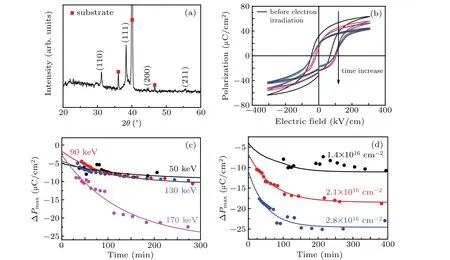
Fig.1.(a)XRD image of the PbZr0.52Ti0.48O3 film;(b)electric hysteresis loop of the PZT film before and after irradiation;(c)the change of polarization intensity of the PZT film after electron irradiation with different energies with time;(d)the change of polarization intensity of the PZT film with time under different electron fluxes.
3.2. Heat treatment recovery of PZT film after electron irradiation
Figure 2(a)shows the trend of the maximum polarization intensity of the PZT film after electron irradiation with an energy of 90 keV and fluence of 7×1015cm?2after annealing at different temperatures compared with the non-irradiated PZT film (the value atx=0 represents the ratio of the maximum polarization intensity without annealing but electron irradiation to the maximum polarization intensity without irradiation).At annealing temperatures less than 300°C,Pmax/Pmax,0remained almost unchanged, indicating that the ferroelectric properties were not recovered. At annealing temperatures greater than 300°C,Pmax/Pmax,0increased,and the ferroelectric properties began to recover, reaching the maximum at 500°C. Then,Pmax/Pmax,0cwas about 0.87. After annealing at 500°C, the ferroelectricity recovered by 6.4%. However,when the annealing temperature reached 600°C,Pmax/Pmax,0started decreasing and was only 51%after annealing at 700°C.This may be because the Pt top electrode is damaged due to the high temperature, which affects its performance. Heat treatment cannot fully recover the ferroelectric properties of the PZT film after electron irradiation, because the crystal structural damage caused by the electron irradiation in addition to the main ionization damage makes the PZT film unable to restore the original structure under thermal drive.
Figure 2(b) shows the hysteresis loop after annealing at 500°C in the air and oxygen atmosphere and the hysteresis loop before and after irradiation without annealing. After annealing,the shape of the hysteresis loop was symmetrical,andPmaxandPrincreased. The position of the hysteresis loop also gradually shifted leftward after irradiation, returning to its state before irradiation. However, the hysteresis loops obtained after annealing in the oxygen and air atmosphere at the same temperature overlap,and there was no significant difference in the ferroelectricity recovery. This proves that the oxygen atmosphere has no obvious effect on ferroelectricity recovery. Thus,it is probably the structural damage rather than oxygen vacancies that affected the ferroelectric properties of the PZT film after irradiation.
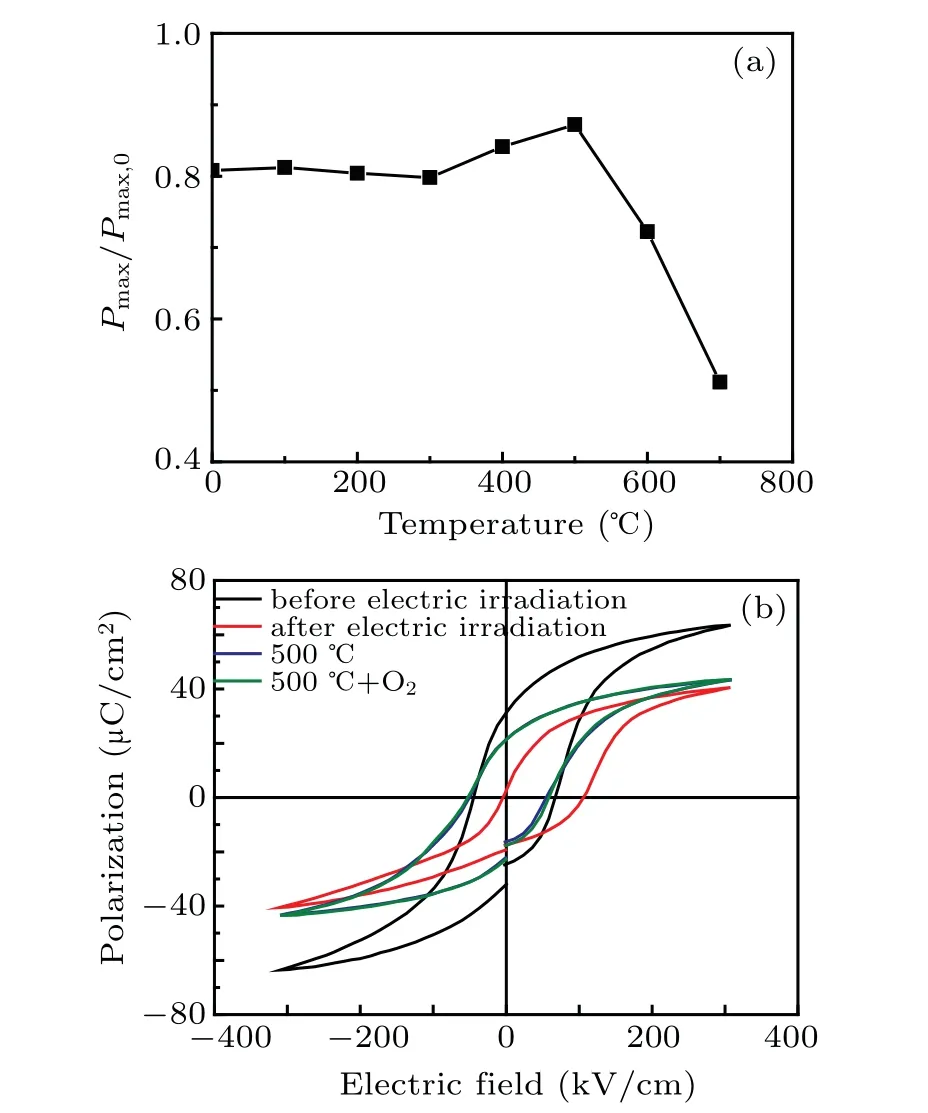
Fig.2. (a)The trend of the polarization intensity difference of the PZT film after electron irradiation after annealing at different temperatures;(b)the hysteresis loop after annealing at 500 °C in the air and oxygen atmosphere and the hysteresis loop before and after irradiation without annealing.
3.3. Effect of proton irradiation on time evolution process of ferroelectric properties of PZT thin films
The damage on oxides caused by proton irradiation is often much higher than that caused by electron irradiation.Electron irradiation causes mainly ionization damages, whereas proton irradiation causes mainly structural damages, which have a greater impact on the performance of oxides. Figures 3(a) and 3(b) show the hysteresis loop of the PZT film before and after proton irradiation. The proton irradiation energy was 50 keV, and the fluence was 4×1014cm?2and 1.2×1016cm?2,respectively. The PZT film exhibited a fullshaped hysteresis loop before irradiation, andPrandPmaxwere both large. After proton irradiation with a small fluence(4×1014cm?2),although the PZT film sample was still ferroelectric, the shape of the hysteresis loop became thinner and narrower.Pmax,Ps, andPrall reduced significantly andEcbecame smaller. After proton irradiation with a fluence of 1.2×1016cm?2, the hysteresis loop disappeared, andPmax,PsandPrgreatly changed. The change in the ?Pmaxof the PZT film with proton irradiation fluence before and after proton irradiation is shown in Fig. 3(c). As the irradiation fluence increased,?Pmaxgradually decreased;that is,the loss ofPmaxincreases as the fluence increases. The change in ?Pmaxwith time before and after proton irradiation at a fluence of 4×1015cm?2is shown in Fig.3(d). It shows that ?Pmaxwas less than 0 after irradiation, which implies that after proton irradiation, the ferroelectric properties of the PZT film worsened. Comparing the change in ?Pmaxwith time after electron irradiation with different fluences, we found no significant change in ?Pmaxwith time after proton irradiation. This is probably because electron irradiation is mainly ionizing irradiation, thus, the polarization intensity continues to change for a period after irradiation. However,for proton irradiation,structural damages are induced during irradiation, and there are no major changes after the irradiation.
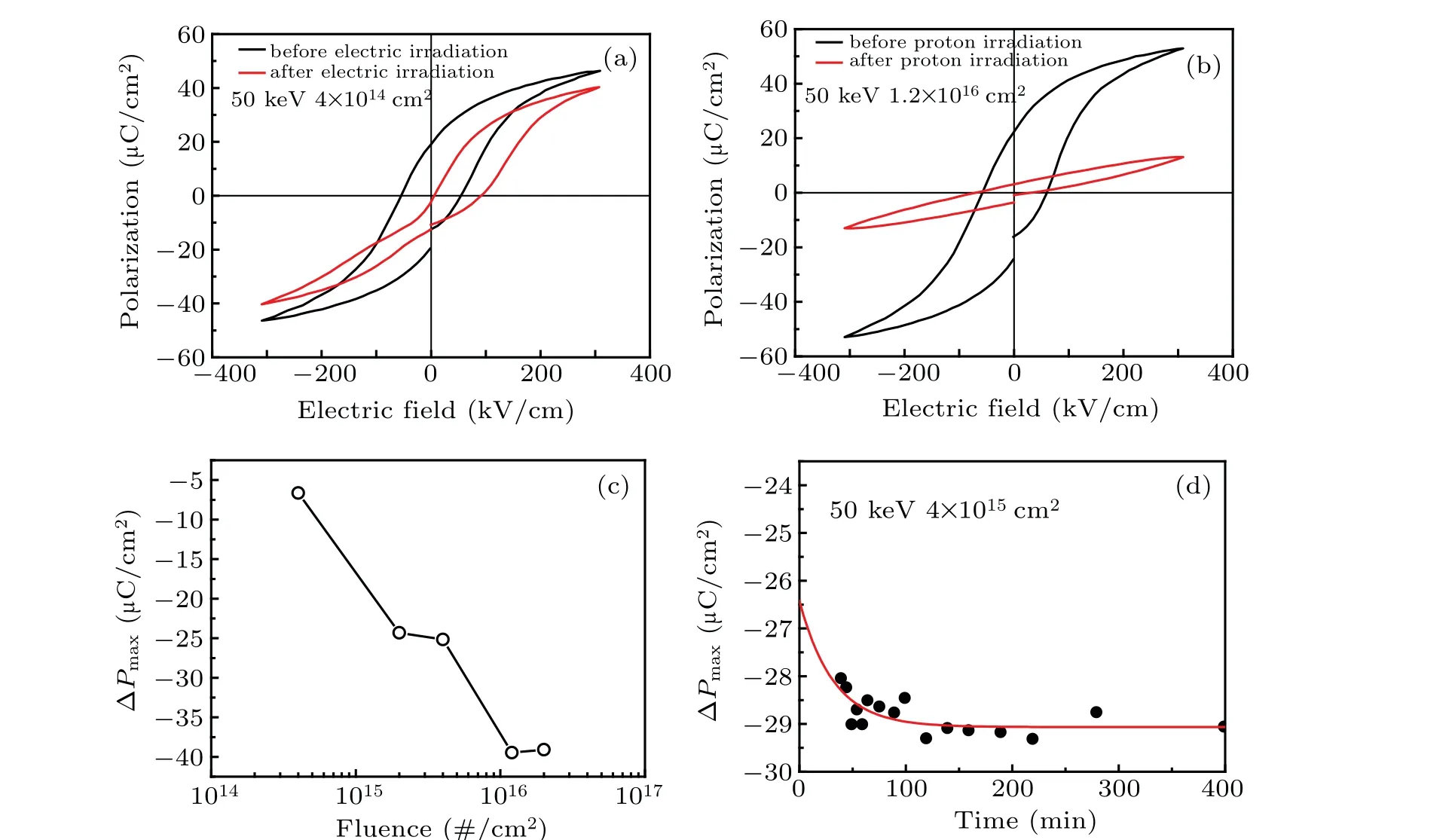
Fig. 3. Panels (a) and (b) show the hysteresis loop of the PZT film before and after proton irradiations; (c) the change in the polarization intensity difference of the PZT film with proton irradiation fluence before and after proton irradiations;(d)the change in the polarization intensity difference of the PZT film before and after proton irradiations at a fluence of 4×1015 cm?2.
3.4. Heat treatment recovery of PZT film after proton irradiation
The ferroelectric properties of the PZT film irradiated by protons with a fluence of 4×1015cm?2after 2-h heat treatment at different temperatures are depicted in Fig.4(a).
(i)AtT<200°C,there was no significant change in the shape of the hysteresis loop andPmax,Ps,Pr,Ec, and other parameters that characterize the ferroelectric properties after annealing.
(ii) AtT=300°C, there was still no obvious change in the shape of the hysteresis loop,but the maximum polarization intensity began to increase.
(iii) AtT> 300°C, as the annealing temperature increased,the shape of the hysteresis loop gradually became full and then slowly returned to the shape before irradiation. The maximum polarization intensity continued to increase as the annealing temperature increased.
(iv)AtT=500°C,the maximum value ofPmaxwas obtained,and it returned to the level of 71%before irradiation.
(v) AtT=600°C, the maximum polarization intensity slightly reduced, which may be caused by the melting of the top electrode.
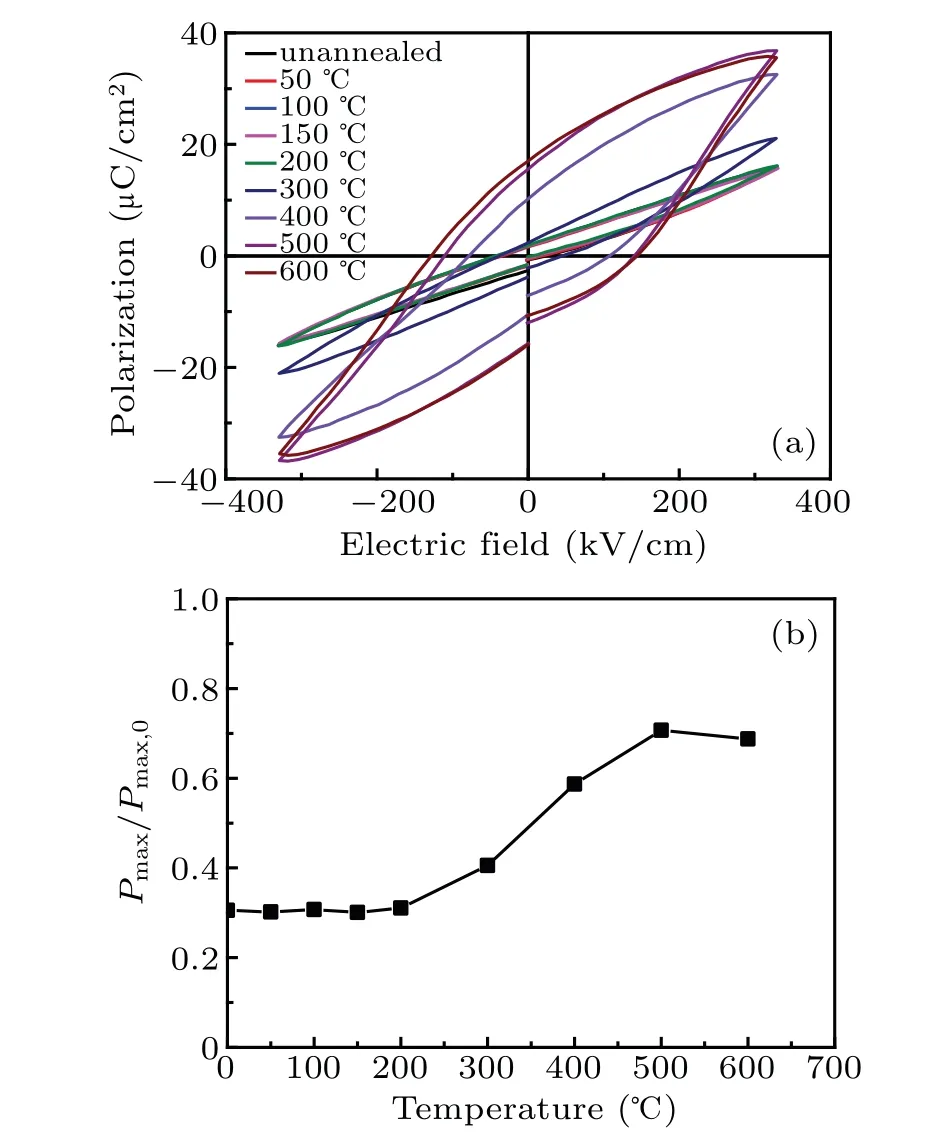
Fig.4. (a)and(b)The ferroelectric properties of the PZT film irradiated by protons with a fluence of 4×1015 cm?2 after 2-h heat treatment at different temperatures.
3.5. Effect of proton irradiation on the phase structure of PZT film
By fine-scanning the (111) XRD characteristic peaks of the non-irradiated and proton-irradiated PZT films, we found that the intensity of the(111)characteristic peaks sharply decreased after irradiation and the crystallinity of the PZT film decreased significantly. The sin2ψmethod was used to determine the residual stress on the PZT film before and after proton irradiation,and the results were analyzed,as shown in Fig.5(b).
Residual stress can be calculated by the XRD method using the following equation:
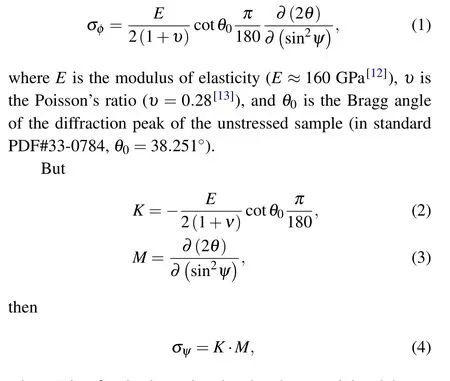
whereKis a fixed value only related to the material and the selected diffraction surface index. Substituting the relevant values into Eq. (2), we obtain thatK=?79.28.Mis the slope of the 2θ–sin2ψline. The slope of the 2θ–sin2ψline for the PZT film before irradiation was positive but became negative after irradiation. BecauseKis negative, the residual stress of the PZT film was negative before irradiation,which implies compressive stress.After proton irradiation,the residual stress became positive,thus,the residual stress became tensile.
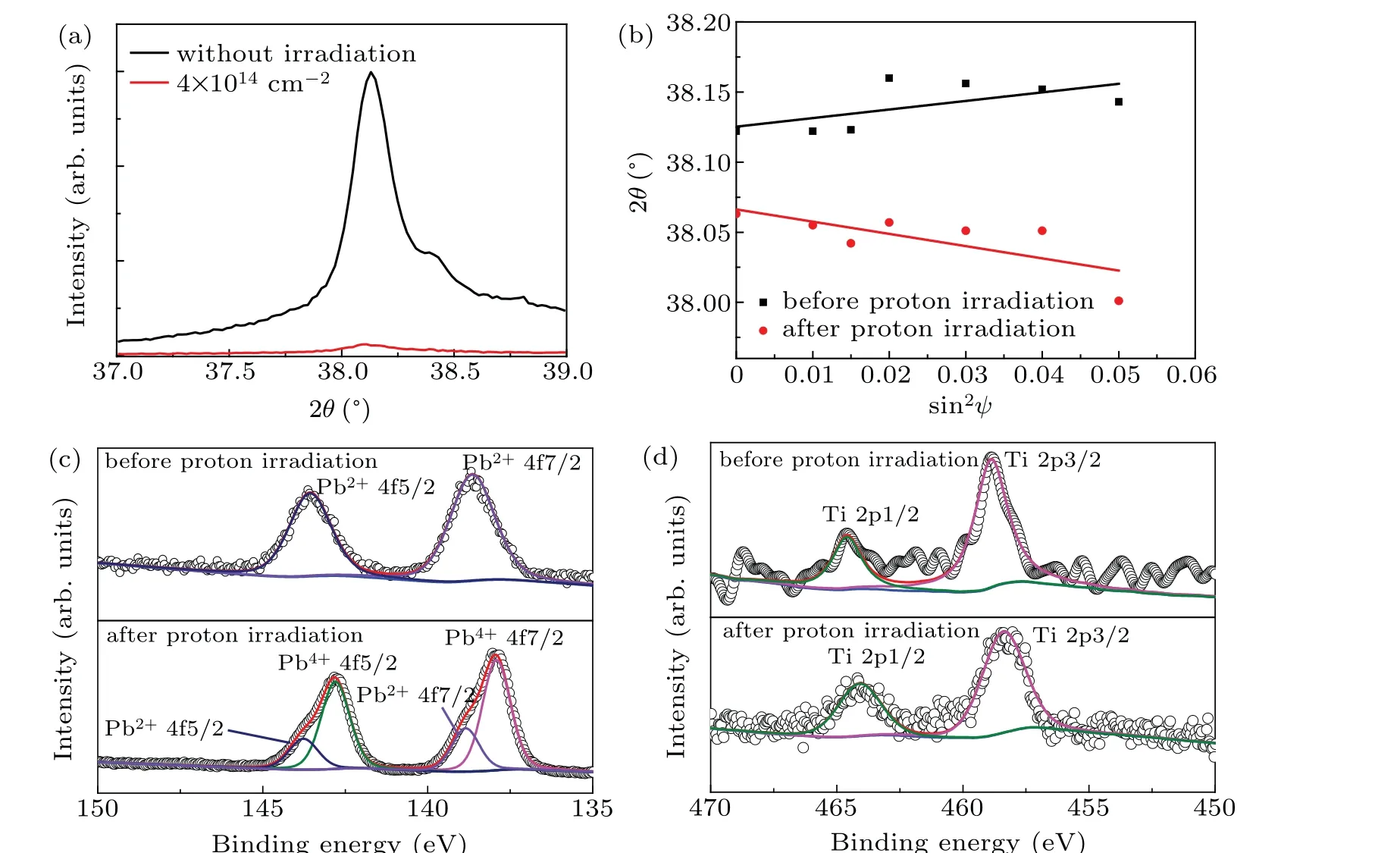
Fig.5. Panels(a)and(b)show the residual stress on the PZT film before and after proton irradiations;panels(c)and(d)show the XPS spectra of the PZT film before and after proton irradiations.
Proton irradiation produces ionization and displacement effects, electron–hole pairs, interstitial atom–vacancy pairs,etc., which change the valence state of elements and affect the chemical environment around each element. Figures 5(b)and 5(c) show the XPS spectra of Pb and Ti elements in the PZT film before and after proton irradiations after split peak fitting. Figure 5(c) shows absorption peaks corresponding to the Pb element at binding energies of 143.6 eV and 138.6 eV before irradiation, and these two peaks are both Pb2+peaks.Four absorption peaks appeared after irradiation at the binding energies of 137.9, 138.8, 142.8, and 143.7 eV, respectively.After searching the XPS database, we found that the pair of splitting peaks at 137.9 eV and 142.8 eV are the absorption peaks of Pb4+, indicating that part of Pb2+oxidized to Pb4+after proton irradiation. Figure 5(d)shows the XPS spectrum of Ti before and after irradiations.The two absorption peaks of Ti before irradiation are located at 458.9 eV and 464.6 eV,respectively.After irradiation,the peaks shifted to lower binding energies (458.4 eV and 464.1 eV, respectively). The valence state of the Ti element did not change,but the absorption peak broadened,indicating the presence of defects in the PZT film after proton irradiation.
4. Conclusion and perspectives
This paper evaluates the changes in the ferroelectric properties of PbZr0.52Ti0.48O3(PZT) films before and after electron and proton irradiations. It clarifies the spatial environmental effects and physical mechanisms of different types of irradiation in PZT films. Both electron and proton irradiations damage the properties of oxides,but the damage mechanisms differ. The ferroelectric properties of the PZT films could not be restored naturally after electron irradiation, which proves that electron irradiation also causes structural damages,in addition to the ionization damage.The ferroelectric properties of the PZT film almost completely disappeared after proton irradiation. The recovery effect after heat treatment in the air and oxygen atmosphere was almost the same, indicating that the irradiation damage was mainly structural rather than oxygenvacancy damage. XPS also revealed that proton irradiation induced a reduction reaction,and part of Pb2+oxidized to Pb4+.

- Chinese Physics B的其它文章
- Physical properties of relativistic electron beam during long-range propagation in space plasma environment?
- Heterogeneous traffic flow modeling with drivers’timid and aggressive characteristics?
- Optimized monogamy and polygamy inequalities for multipartite qubit entanglement?
- CO2 emission control in new CM car-following model with feedback control of the optimal estimation of velocity difference under V2X environment?
- Non-peripherally octaalkyl-substituted nickel phthalocyanines used as non-dopant hole transport materials in perovskite solar cells?
- Dual mechanisms of Bcl-2 regulation in IP3-receptor-mediated Ca2+release: A computational study?