
Crystal growth and magnetic properties of quantum spin liquid candidate KErTe2?
2021-10-28 07:02:58WeiweiLiu劉維維DayuYan閆大禹ZhengZhang張政JiantingJi籍建葶YouguoShi石友國FengJin金峰andQingmingZhang張清明
Chinese Physics B 2021年10期
Weiwei Liu(劉維維) Dayu Yan(閆大禹) Zheng Zhang(張政) Jianting Ji(籍建葶)Youguo Shi(石友國) Feng Jin(金峰) and Qingming Zhang(張清明)
1Department of Physics and Beijing Key Laboratory of Opto-electronic Functional Materials and Micro-nano Devices,Renmin University of China,Beijing 100872,China
2Beijing National Laboratory for Condensed Matter Physics,Institute of Physics,Chinese Academy of Sciences,Beijing 100190,China
3School of Physical Science and Technology,Lanzhou University,Lanzhou 730000,China
Keywords: quantum spin liquids,exchange and superexchange interactions,magnetic anisotropy
1. Introduction
Quantum spin liquid is a novel quantum state in which no spontaneous symmetry break occurs even at zero temperature.[1]After the discovery of high temperature superconductivity(HTS),Anderson tried to apply the QSL picture to understand the mechanism of HTS. It was proposed that when doped with holes, the resonating valence bond is a singlet state with coherent mobile carriers and is indistinguishable in terms of symmetry from a singlet BCS superconductor.Based on this idea,many theoretical concepts have been proposed to understand the connection between QSLs and hightemperature superconductivity, for example, the spin–charge separation (holon and spinon),[2]the slave-boson theory,[3]and the mean-field theory.[4–7]
Experimentally, several compounds with spinS= 1/2,such as herbertsmithite (ZnCu3(OH)6Cl2), YbMgGaO4, andα-RuCl3,have been proven to be QSL candidates.[8–21]However, most of them suffer from one or more problems (such as site disorder, interlayer exchange interactions, or antisymmetric Dzyaloshinsky–Moriya(DM)interactions[22,23])which make these systems complex to explore. For example,the recently discovered YbMgGaO4has a perfect triangular lattice structure(Rˉ3m)[11–14,16,24,25]with the adjacent triangle layers having a relative large distance. Thus,the interlayer exchange interactions and the DM interactions can be ignored in this system.However,it still suffers from the issue of Ga/Mg disorder,which was suggested to be responsible for the disordered spin state and/or QSL stability.[11,26–28]
Recently, we discovered the family of rare-earth chalcogenides ARECh2(A = alkli or monovalent ions, Re = rare earth, Ch=O, S, Se, Te) as QSL candidates, which has attracted much attention since these systems inherit almost all the advantages of YbMgGaO4,but do not suffer from the site disorder issue.[29–34]The compounds have a high symmetry with space groupRˉ3mand the magnetic rare-earth ions form triangular layers that are well separated.[29]Compared with transition metal ions, the 4f rare-earth ions with odd number of electrons have stronger spin orbital couplings and are protected by time reversal symmetry (Kramers doublets). Thus,they can be treated as an ion with effective spinS=1/2 on the crystalline-electronic field(CEF)ground state. Moreover,the huge difference of radii of the cations makes the site disorder impossible. Thus, the rare-earth chalcogenides family ARECh2(A=alkli or monovalent ions, Re=rareearth,Ch=O,S,Se,Te)provide a platform to study QSLs.
On the other hand,it is noted that with increasing the radius of the chalcogen ions,the charge gapΔdecreases,for example,ΔNaYbO2?4.5 eV>ΔNaYbS2?2.7 eV>ΔNaYbSe2?1.9 eV.[29]Then it is interesting to ask what will happen if the chalcogen ions are replaced by bigger ions(such as Te2?).Particularly, is it possible to realize the crossover from QSL to metallization even superconductivity? This basically motivates the present work.
In this paper,we report the successful synthesis of a new rare-earth chalcogenide compound KErTe2. It shares the same structure(Rˉ3m)as NaYbSe2with the magnetic rare-earth ions forming perfect triangular layers. No structural and magnetic transition are observed down to 1.8 K in susceptibility and specific heat measurements. Moreover,the charge gap of KErTe2is roughly 0.93±0.35 eV,which is the smallest gap among all QSL candidates. These findings suggest that KErTe2represents a QSL candidate with much smaller charge gap. Thus,KErTe2provides a platform on which one can easily tune the charge gap and may have chance to explore the connection between QSLs and high-temperature superconductivity.
2. Experiments and methods
Single crystals of KErTe2were synthesized by the selfflux method with molar ratio K:Er:Te=1.5:1:9. K, Er,and Te elements were put into the carton crucible orderly,then sealed into the quartz tube in vacuum. The quartz tube was annealed at 800°C for 20 h,and then the ampoule was slowly cooled down to 500°C with about 2°C/h. Finally, the ampoule was span in a centrifuge. The same processwas also used to successfully grow KLuTe2single crystals. The obtained KErTe2single crystal is shown in Fig.1(a).
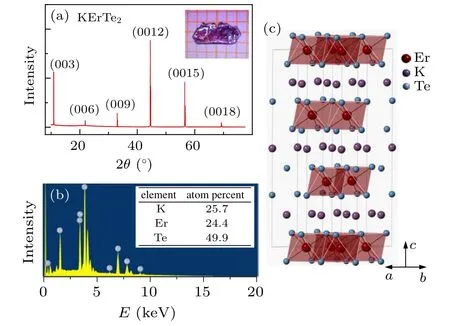
Fig.1. (a)XRD pattern of KErTe2 single crystal on the(00L)plane. Inset:An image of the synthesized sample. (b) EDX and (c) crystal structure of KErTe2.
After the successful synthesis of single crystals KErTe2,several measurements were used to characterize them,such as x-ray diffractometer(XRD;Bruker-D8),energy-dispersive xray spectroscopy (EDX; Oxford X-Max 50), and four-circle single crystal diffractometer (X’Pert3MRD). All these measurements indicate the high quality of the synthesized KErTe2single crystals and the detailed results will be discussed in the next section.
The magnetic susceptibility and heat capacity measurements were performed using a Quantum Design physical property measurement system (QD PPMS DynaCool) over the temperature range from 1.8 K to 300 K and under magnetic fields of up to 9 T.The absorption spectrum of the sample was collected by a UV-Vis absorption spectrometer (PerkinElmer Lambda 750)to obtain the charge gap of KErTe2.
3. Results and discussion
Figure 1(a) displays the XRD pattern of the synthesized KErTe2single crystals, and several discrete peaks can be observed. These peaks can be well described by the Bragg equation 2dsinθ=nλand no other impurity peaks can be observed, indicating the high quality of the synthesized single crystals. In addition,the EDX spectroscopy is used to characterize the atomic ratios of the single crystals(Fig.1(b)). The determinted average atomic ratios are K:Er:Te=1.05(3):1:2.04(5),close to the stoichiometric ratio of KErTe2.All above results indicate the high quality of the synthesized KErTe2single crystals.
Moreover, we further determined the crystal structure and the lattice parameters of the KErTe2by x-ray four-circle diffraction. Its space group isRˉ3mand the detailed lattice parameters are summarized in Table 1. According to the determined lattice parameters, the schematic structure of KErTe2is shown in Fig.1(c), which is isomorphic to NaYbCh2. The magnetic 4f rare-earth Er3+ions form perfect triangular layers that are well separated by nonmagnetic K layers. The distance between the two adjacent triangular layers is 8.131 °A while the nearest neighbor distance between magnetic Er3+ions is 4.4294(9) °A. Due to the larger radius of Te2?, both of these two distances are larger than those of KErSe2.
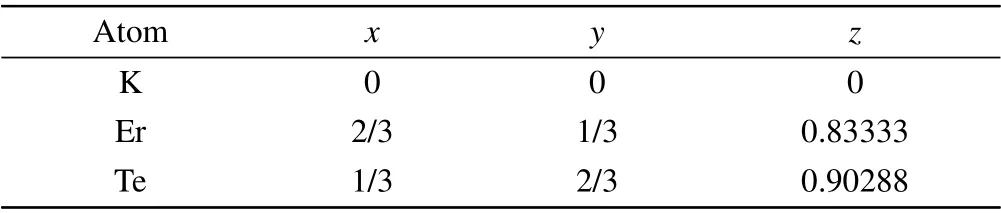
Table 1. Structural parameters of KErTe2 given by x-ray four-circle diffraction (space group Rˉ3m, No. 166; a = 4.4294(9) °A, and c =24.392(7) °A).
To characterize the behavior of the local moment of Er3+,we first measured the magnetic susceptibility of single crystals KErTe2(Fig. 2(a)). Down to 1.8 K, no magnetic order/transition can be observed for magnetic fieldsHapplied both in theabplane (H//ab) and along thec-axis (H//c).We also examined the magnetic susceptibilities in field cooling(FC)and zero-field cooling(ZFC)measurements.No splitting was detected between the FC and ZFC results down to 1.8 K,indicating the absence of spin glassy transitions (Fig. 2(a)).These magnetic properties imply that KErTe2is a perfect platform to study novel magnetic properties in the frustrated system.

Figures 2(e) and 2(f) present the temperature-dependent magnetic susceptibility under different magnetic fields with the fieldH//ab(Fig.2(e))andH//c(Fig.2(f)),respectively.For both directions of the field,the susceptibilityχ(T)shows similar behaviors, decreasing with increasing field. This behavior indicates that huge frustrations in KErTe2exist at zero field and with increasing field, the frustrations are strongly suppressed. Anyway,the above magnetic measurements suggest that the magnetic Er3+ions are antiferromagnetically coupled with each other and even down to 1.8 K,these local moments are disorderly distributed. Thus, KErTe2represents a QSL candidate.

Table 2. Parameters extracted from Curie–Weiss fitting for KErTe2.
To better characterize the ground state of KErTe2,we performed temperature-dependent specific heat measurements on KErTe2single crystals.As shown in Fig.3(a),below 10 K,the heat capacity of KErTe2exhibits a significant different behavior from that of a perfect nonmagnetic reference compound KLuTe2, whose lattice is nearly the same as that of KErTe2.Moreover, it can be found that the heat capacity of KLuTe2can be well described by the Debye phonon heat capacity model, indicating that it is totally contributed by the lattice.Thus, other contributions to the heat capacity of KErTe2can be precisely extracted by directly subtracting the lattice contributions,i.e.,the heat capacity of KLuTe2from that of KErTe2.As shown in Fig.3(b),two broad peaks located at~2 K and~10 K can be well resolved. The origin of these two peaks due to the impurities can be excluded since no impurity signal has been found from the structural and magnetic susceptibility measurements.
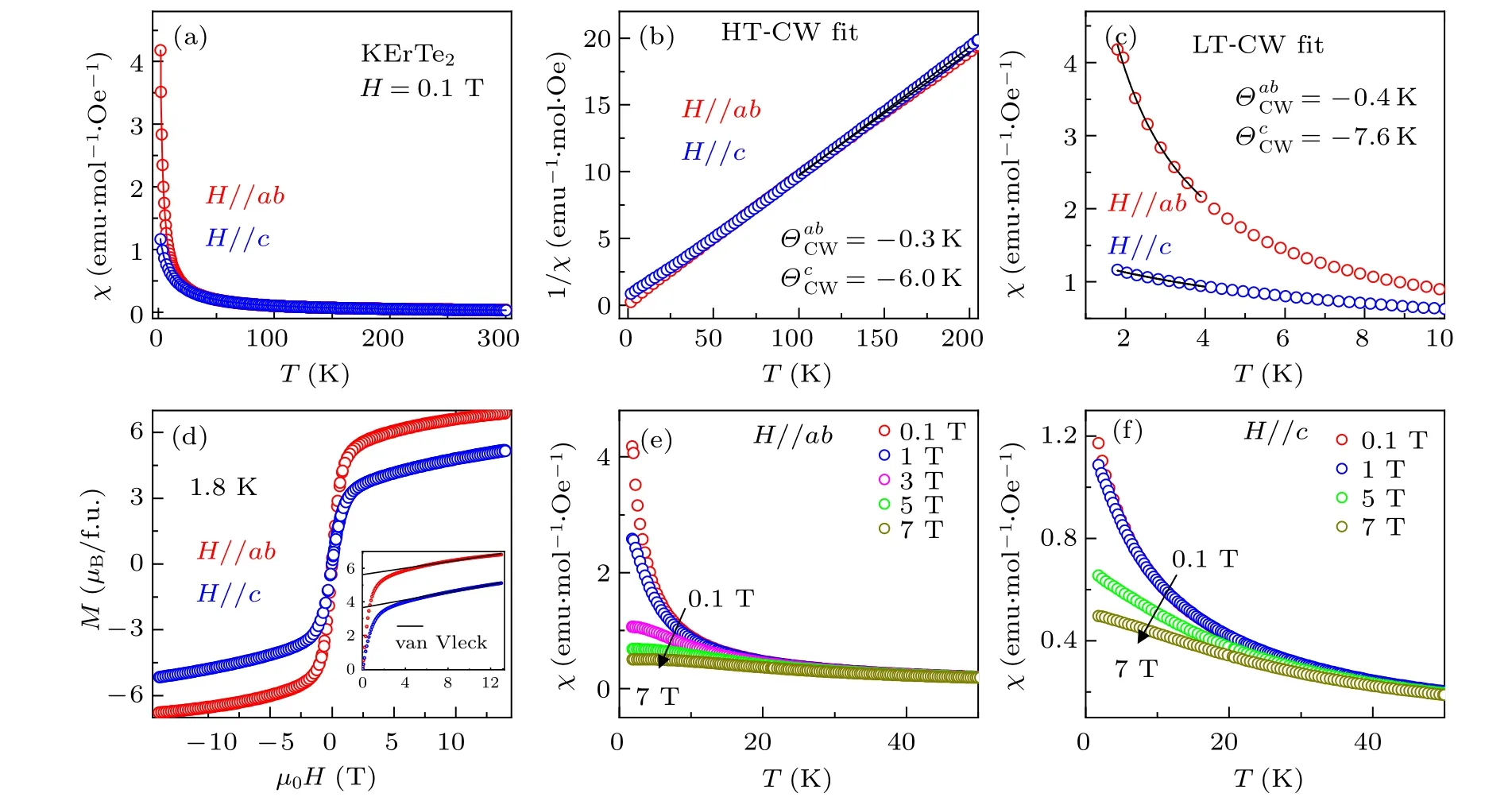
Fig.2. (a)Temperature-dependence of the magnetic susceptibility χ(T)measured under zero-field cooling(ZFC,opend circles)and field cooling(FC,solid curves)with the field μ0H =0.1 T applied in the ab plane and along the c axis. Paramagnetic behavior is observed at low temperature with no obvious differences between ZFC and FC data. (b)Curie–Weiss fitting of the high temperature magnetization data(HT:100–200 K).The ftiting results in Curie temperatures of =?0.3 K and =?6.0 K.(c)Curie–Weiss ftiting of the low temperature magnetization data(LT:1.8–4 K).The ftiting results in Curie temperatures of =?0.4 K and CW =?7.6 K.(d)The magnetic hysteresis loop curves of KErTe2 at 1.8 K.The field-dependence of the χ(T)curves with the field applied(e)in ab-plane and(f)along c axis is also shown.
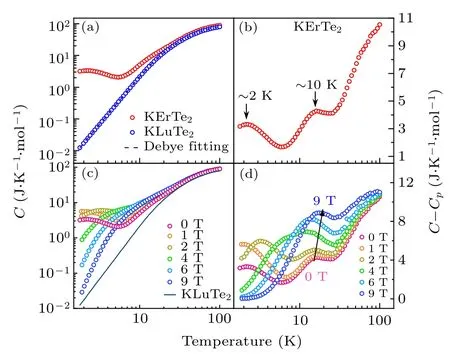
Fig.3.(a)The zero-field heat capacities of KErTe2 and KLuTe2.The dashed curve is the fitting result based on the Debye model.(b)By directly subtracting the lattice contributions,other contributions to heat capacities of KErTe2 are obtained. (c)The temperature-dependence of heat capacities under several different magnetic fields. (d)Same as(c)with the lattice heat capacities having been subtracted.
In order to better understand the origin of these two peaks, the field-dependent specific heat measurements were performed on KErTe2single crystals, as shown in Figs. 3(c)and 3(d). One can find that with increasing field, both these two peaks move to high temperatures and above 4 T, these two peaks overlap with each other. Such a behavior suggests that the two peaks can not be related to the spin exchange interaction since the heat capacities contributed by the spin exchange interaction will move to low temperatures with increasing magnetic field, inconsistent with our observation. Moreover,based on the Curie–Weiss fitting of the susceptibility,one can estimate that the spin exchange interaction is about 1 K,which is lower than the observed two peaks, also indicating that these two peaks do not origin from the spin exchange interaction.
Having exclude the possible origins of impurities and spin exchange interaction, we suggest that these two peaks origin from the CEF of Er3+. The reason is that these two peaks exhibit the same behavior as those observed in KErSe2,[35]where two broad peaks are also observed below 10 K, and move to high temperatures with increasing field. Thus, we believe that the two peaks at~2 K and~10 K have the same origin as that observed in KErSe2. A quantitative understanding of these two peaks requires more theoretical work in the future and goes beyond the scope of this paper.
We further performed absorption spectrum measurements to get the charge gap of KErTe2. As shown in Fig. 4, the absorption spectrum exhibits an un-saturated behavior over a wide wavelength range (from~2150 nm (0.58 eV) to~980 nm(1.27 eV)).Thus,the charge gap can be roughly estimated as 0.93±0.35 eV.Compared with the charge gaps of other QSL candidates(see Table 3),one can find that KErTe2has the smallest charge gap. Thus, it provides a perfect platform for metallization of QSL insulators to explore the connection between QSLs and high-temperature superconductivity.
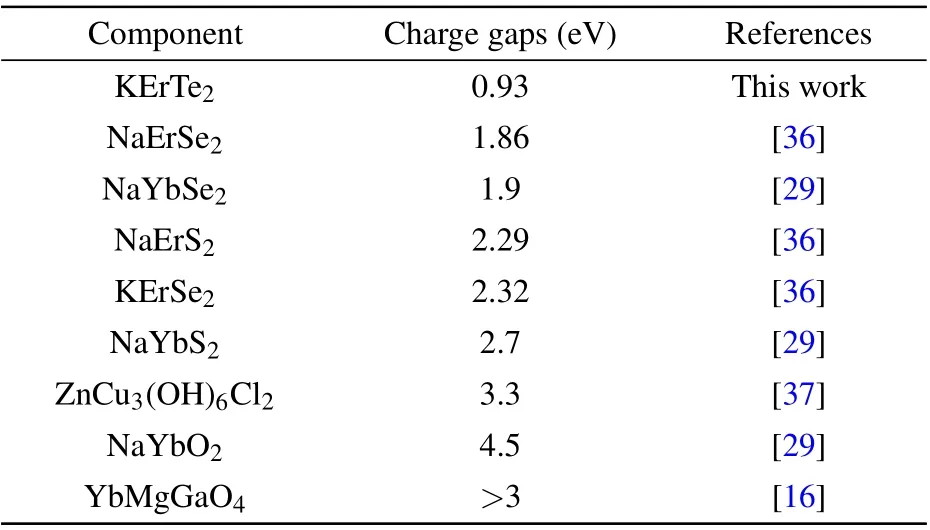
Table 3. Charge gaps of some reported QSL candidates.
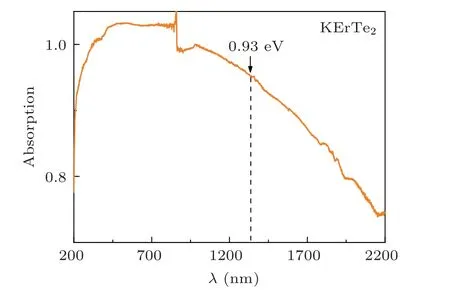
Fig.4. The UV-Vis absorption spectrum of KErTe2.
4. Summary
In conclusion, we report the successful synthesis of a new rare-earth chalcogenide compound KErTe2. Specific heat and magnetic susceptibility measurements on KErTe2single crystals reveal no structural and magnetic transition down to 1.8 K, suggesting that KErTe2represents a well QSL candidate. Moreover, the absorption spectrum shows that the charge gap of KErTe2is roughly 0.93±0.35 eV,which is the smallest gap among all QSL candidates. These findings suggest that KErTe2represents a QSL candidate with much small charge gap, providing a perfect platform to explore the connection between QSLs and high-temperature superconductivity by means of tuning the charge gap(for example hydrogen doping or pressure).

- Chinese Physics B的其它文章
- Physical properties of relativistic electron beam during long-range propagation in space plasma environment?
- Heterogeneous traffic flow modeling with drivers’timid and aggressive characteristics?
- Optimized monogamy and polygamy inequalities for multipartite qubit entanglement?
- CO2 emission control in new CM car-following model with feedback control of the optimal estimation of velocity difference under V2X environment?
- Non-peripherally octaalkyl-substituted nickel phthalocyanines used as non-dopant hole transport materials in perovskite solar cells?
- Dual mechanisms of Bcl-2 regulation in IP3-receptor-mediated Ca2+release: A computational study?