
Geometric structure of N2Oq+(q=5,6)studied by Ne8+ion-induced Coulomb explosion imaging*
2021-11-23 07:26:08XiZhao趙曦XuShan單旭XiaolongZhu朱小龍LeiChen陳磊ZhenjieShen沈鎮捷WentianFeng馮文天DalongGuo郭大龍DongmeiZhao趙冬梅RuitianZhang張瑞田YongGao高永ZhongkuiHuang黃忠魁ShaofengZhang張少鋒XinwenMa馬新文andXiangjunChen陳向軍
Chinese Physics B 2021年11期
Xi Zhao(趙曦) Xu Shan(單旭) Xiaolong Zhu(朱小龍) Lei Chen(陳磊)Zhenjie Shen(沈鎮捷) Wentian Feng(馮文天) Dalong Guo(郭大龍) Dongmei Zhao(趙冬梅)Ruitian Zhang(張瑞田) Yong Gao(高永) Zhongkui Huang(黃忠魁)Shaofeng Zhang(張少鋒) Xinwen Ma(馬新文) and Xiangjun Chen(陳向軍)
1Hefei National Laboratory for Physical Sciences at the Microscale and Department of Modern Physics,University of Science and Technology of China,Hefei 230026,China
2Institute of Modern Physics,Chinese Academy of Sciences,Lanzhou 730000,China
Keywords: Coulomb explosion,kinetic energy release,molecular geometry,ion collision,nitrous oxide(N2O)
1. Introduction
The geometry or configuration of a molecule is a central issue in molecular physics, which governs the molecular structure and properties. It is well known that electron diffraction, microwave, and infrared spectroscopy methods are widely used to determine molecular structures. Coulomb explosion imaging (CEI) technique[1,2]is an alternative to spectroscopy for yielding molecular geometric information.The basic principle of CEI consists of quick ionizations of a molecule induced by thin foils, photons, electrons, or ions,and thereby creating a multiply charged molecular ion which undergoes a fast dissociation due to the Coulomb repulsion between fragment cations. By measuring the final vector momenta of the ionic fragments in coincidence, one can reconstruct the initial positions of the fragments and thus obtain an image of the molecule. Development of the recoil momentum spectroscopy or reaction microscope[3,4]promoted the application of CEI to imaging the structures of diatomic or polyatomic molecules and van der Waals complexes.[5-25]For lowly charged molecular ions, due to the existence of predissociative or metastable states,Coulomb explosion occurs also through these non-Coulombic states. As a result, the critical nuclear distanceRcof molecular ions at the moment of explosion reconstructed by using the Coulomb potential model was found to overestimate the equilibrium separationReof the neutral molecule.[6]In order to derive the accurate structural parameters by CEI,highly charged molecular ions were paid more attention.Intense laser fields can conveniently make more electrons of a molecule be ionized and thereby form a highly charged molecular ion that readily undergoes Coulomb explosion(CE).However,intense laser pulses also could result in the deformation of molecular structures during the multiple ionization process.[5-12]TheRcdetermined by intense laser CEI experiments was found to be approximately two to three timesRe. When the laser pulse duration is shorter than 10 fs,that is, the ionization interaction of laser with a molecule is fast so that the molecular geometry still remains, the reconstructedRccould representRe.[5-7,11-13]Electron impact experiment also can create highly charged molecular ions and obtain accurate structural parameters such as bond lengths and angles by using the CEI technique,[15,16]although it presents relatively small multi-ionization cross-sections. Collision of highly charged ion (HCI) with molecules is another way to well produce high charge molecular ions through electron capture and transfer ionization processes.But researches on imaging molecular geometry by the HCI induced CEI method are relatively scarce.[17-19]
In the present study, we apply the CEI technique to the Coulomb explosion of nitrous oxide (N2O) induced by the HCI collision. N2O is the prototype of asymmetric triatomic molecules including two different N-N and N-O bonds. The study of imaging N2O geometry may bring a suggestion to the polyatomic molecules which are confronted with great challenges to quantitatively determine the geometric parameters.The CE dynamics of N2Oq+(q ≥2) induced by electron,ion, and photon collisions have been extensively studied experimentally and theoretically.[8-10,26-43]Most of the previous works concentrated on the two-body fragmentation of N2Oq+(q=2,3). Relatively few works[8-10,29-31]presented the complete three-body CE process of highly charged N2Oq+(q ≥3).In the HCI collision experiments of Werneret al.[29]and Khanet al.,[30]the kinetic energy release (KER) distributions for a part of three-body CE channels of N2Oq+(q=3-7) have been obtained and explained using the simple CE model in which the fragment ions are treated as point charges at the equilibrium bond lengths. As for the geometry of N2Oq+,only the laser-induced CE experiments have been performed to tentatively derive the structural parameters by Hishikawaet al.[8]and Ueyamaet al.[9]But the obtainedRcof N2Oq+was found to be about 1.4-2 times larger than theReof neutral N2O. In addition, the coexistence of sequential and nonsequential three-body dissociation processes of N2O3+and N2O4+has been revealed,[10]which are no longer pure concerted Coulomb explosions.
Here,we focus on the concerted three-body CE channels of highly charged N2O5+and N2O6+induced by 56 keV/u Ne8+ion collisions.Six CE channels for N2O5+and seven for N2O6+are identified by measuring three ionic fragments and the charge-changed projectile in quadruple coincidence. Utilizing the experimental KER and momentum correlation angles (MCA) of the three ionic fragments for each of the CE channels, the N-N and N-O bond lengths and N-N-O bond angles of N2Oq+prior to dissociation are deduced by numerical computation.
2. Experimental method
The present experiment is performed by using the reaction microscope on the 320-kV platform for multidisciplinary research with highly charged ions at the Institute of Modern Physics in Lanzhou. The detailed description of the experimental setup has been presented previously.[44,45]Here only a brief introduction is given. The Ne8+ions are produced in the electron cyclotron resonance ion source and accelerated to the experimental energy of 56 keV/u for collisions. After being collimated by two sets of adjustable slits and purified by several sets of electrostatic deflectors,the ion beam is transported to the target chamber and intersected with a cold supersonic N2O gas jet which is introduced into the reaction chamber through a nozzle of 0.03 mm diameter and picked up by two skimmers of 0.05 mm diameter. A Wiley-McLaren type time of flight(TOF)system[46]is employed to extract and transfer the ionic products of N2O into a time- and position-sensitive detector(PSD-R).The primary beam of Ne8+projectile is collected by a Faraday cup,and the charge-changed projectile is analyzed by a pair of electrostatic deflectors downstream of the collision zone combined with another position-sensitive detector (PSD-P). All position-sensitive detectors are constructed as a combination of the microchannel plate with the standard delay line anode. The signal and data acquisition system is triggered by the signal from the PSD-P,and the fragment ions are recorded in coincidence with the scattered projectile. The information on the position and TOF of the ionic fragments is recorded event by event.In the off-line data analysis,the threedimensional momentum vector for each of the fragment ions can be obtained by the measured TOF and position(x,y)on the PSD-R.Through the correlation analysis on the TOFs and the momentum conservation of three fragment ions,the complete three-body CE channels can be determined, i.e., N2Oq+→Nl++ Nm++ On+(q=l+m+n). For the convenience of discussion, the specific channels are denoted as (lmn) in the following parts.
3. Results and discussion
Various fragmentation channels of N2Oq+are opened in the present experiment. Here we only concentrate on the concerted three-body CE channels of the highly charged N2O5+and N2O6+. It is well established that for a linear triatomic N2Oq+,the fragment ion from the central nitrogen atom(hereafter as Nc),relative to the terminal nitrogen(hereafter as Nt)and oxygen atoms, is usually assigned the smallest momentum(kinetic energy)in the concerted three-body CE process.So the two nitrogen ions with the same charge from N2Oq+breakup can be distinguished unambiguously. In this case by further utilizing the TOF correlation analysis and the momentum conservation of the three fragment ions,six CE channels for N2O5+and seven for N2O6+are identified as follows:


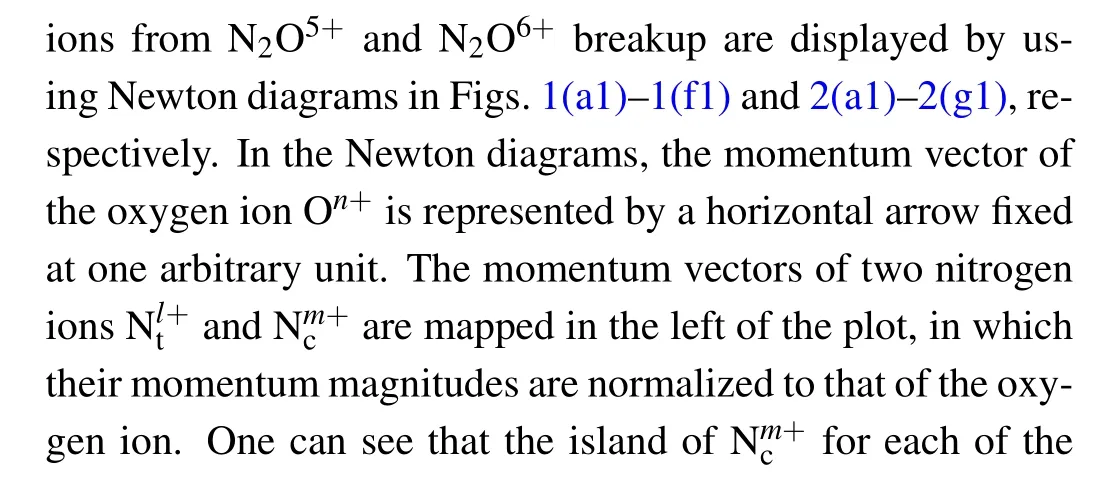

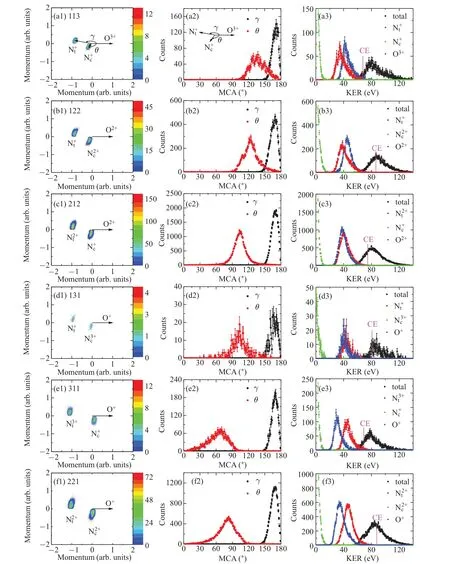
Fig.1. The experimental Newton diagrams,momentum correlation angle(MCA)and the kinetic energy release(KER)distributions for three atomic ions of the six CE channels of N2O5+. (a1)-(f1) Newton diagrams. (a2)-(f2) MCA distributions. (a3)-(f3) KER distributions, the vertical lines denote the predictions of the CE model.
Fig.2. The same as that of Fig.1,but for the seven CE channels of N2O6+.
The islands in Newton diagrams can reflect the geometric distributions of fragments,while the momentum correlation angle(MCA)αcan be obtained by the momentum vectors(p1,p2)of two associated ions,

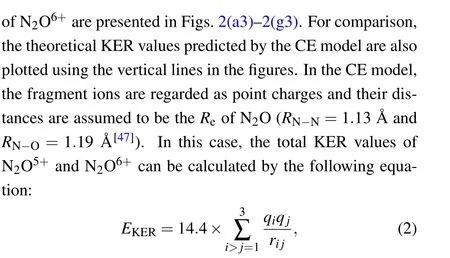
whereqiandqjare the charges of the fragment ions, andrijis their distance. The calculated KER values for the six CE channels of N2O5+and those of N2O6+are listed in Table 1,together with the experimental KER peak values, as well as the KER ratio of the CE calculation and the measurement.

Table 1. The total KER and the derived geometric parameters for the CE channels of N2O5+ and N2O6+.
As shown in Figs.1(a3)-1(f3),for the CE channels(113),(212) and (311) of N2O5+, the KER values estimated by the CE model largely underestimate the presently measured KER peak values. The specific deviations can be seen in Table 1.But for the channels (122) and (221), the CE predictions can agree well with the most probable values of the experimental KER distributions. Werneret al.[29]reported the KER value(~84.0 eV)for the(221)channel of N2O5+→N2+t+N2+c+O+in 5.9 MeV/u Xe18+collision experiment,consistent with the present experiment(85.6 eV)but inconsistent with the previous measurement (75 eV) of Khanet al.in 1 MeV Xe15+ion collision.[30]For the seven CE channels of N2O6+, their KER distributions are presented in Figs. 2(a3)-2(g3). One can see the serious KER deviation of the CE predictions from the measurements for (213) and(312) channels and the good agreements for the channels of(123),(132),(222),(231)and(321). The KER value(~116 eV)of Werneret al.[29]for the(222) channel is approximately close to the present measurement(120.4 eV)and the CE prediction(124.3 eV),while that(112 eV)of Khanet al.[30]still remained a slightly large deviation. Generally,for the CE channels of N2O5+and N2O6+,the experimental KER values from Khanet al.[30]are relatively smaller than the present results with the deviation of about 3-12 eV except for the channel(231).
The bond angle and bond lengths of N2Oq+just before explosion can be reconstructed through the measured MCA and KER based on the CE model. Although the MCAγis directly related to the molecular bond angle,generally there is no analytical relationship between them.[14,15]In order to obtain their relationship,a numerical simulation for the explosion dynamics of N2O5+and N2O6+is performed by assuming the fragment ions moving in a Coulomb repulsive potential. In the simulation,the N-N and N-O bond lengths which change synchronously in the same step,as well as the bond angle are regarded as independent variables. The dependences of MCAγas functions of the N-N-O bond angle and the N-N and N-O bond lengths for the CE channels of N2O5+and N2O6+are shown in Figs. 3(a1)-3(f1) and 4(a1)-4(g1), respectively.One can see that the relationships between the MCAγand the bond angle for all channels are obviously independent of the bond length variation, very similar to the case of CO2molecule.[14,15]Their relationships therefore can be derived at theReof N2O(RN?N=1.13 ?A,RN?O=1.19 ?A[47]),as shown in Figs. 3(a2)-3(f2) and 4(a2)-4(g2). According to such numerical relationships,the N-N-O bond angle distributions for all channels have been obtained by transforming the measured MCAγdistributions, which are depicted in Figs.3(a3)-3(f3)and 4(a3)-4(g3), respectively. So the most probable values of the N-N-O bond angle for all channels are determined to be about 170°, as listed in Table 1, indicating that the highly charged N2O still keeps an approximately linear structure.The deviation from 180°should be ascribed to the molecular vibrations, especially bending vibrations. A similar phenomenon has been found and explained by the vibrational effect in the studies of CO2molecule.[14-17]
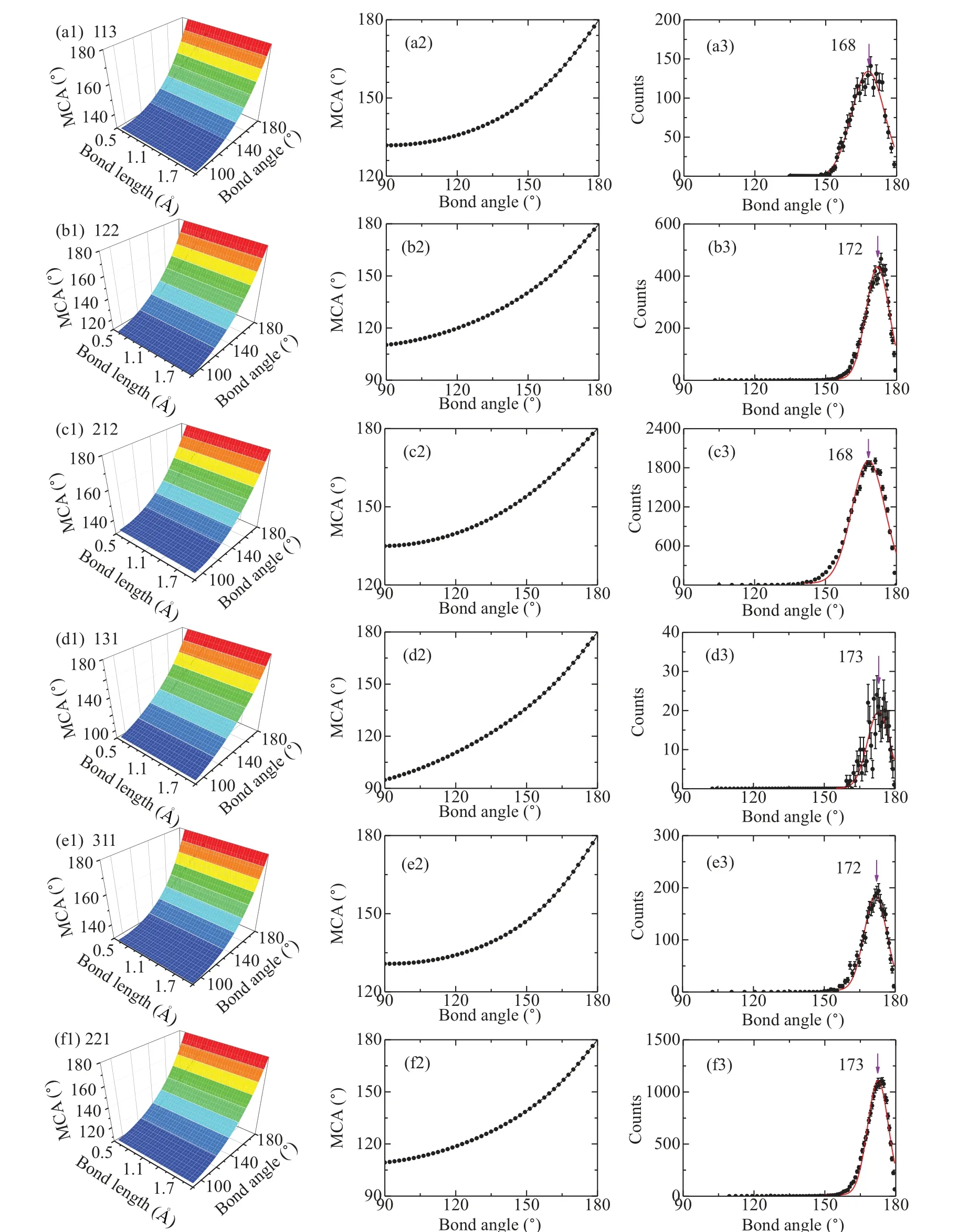
Fig.3. Simulations and observations for the six CE channels of N2O5+. (a1)-(f1)The relationship between momentum correlation angle γ,bond lengths and bond angle. (a2)-(f2)The relationship between the momentum correlation angle γ and the bond angle at a fixed bond length.(a3)-(f3)The obtained bond angle distributions.
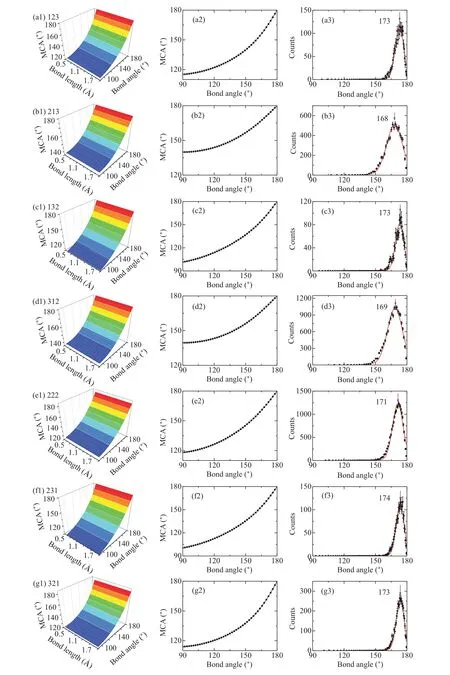
Fig.4. The same as that of Fig.3,but for the seven CE channels of N2O6+.
Not like diatomic molecules or symmetric triatomic molecules, for which only one bond length variable involved can be reconstructed conveniently according to the measured KER of the fragments in the CE model,[14,15]but for the asymmetric N2O molecule,two variables of the N-N and N-O bond lengths make the reconstruction complex. In this work,a numerical computation is carried out to deduce the N-N and N-O bond lengths by solving the classical mechanical equations of motion for the three fragment ions of N2O5+and N2O6+explosion. In the calculation,it is assumed that the initial momenta of the respective atomic ions are zero,and only Coulombic force acts among the three fragment ions.For each of the CE channels,the bond angle is fixed by using the experimental most probable value while the N-N and N-O bond lengths vary separately with the step of 0.01 ?A.Two variables are adjusted in a trial-and-error manner so that the calculated KER values for the terminal nitrogen,oxygen,and the sum of three ions simultaneously approach the corresponding experimental most probable values with less than 2%difference. In this way, the N-N and N-O bond lengths can be determined and listed in Table 1.It can be seen that for the channels(122),(131), (221), (123), (132), (222), (231)and(321)the derived N-N and N-O bond lengths are overall agreed with those of N2O (RN?N=1.13 ?A,RN?O=1.19 ?A[47]). For other channels, the results obviously deviate from those of N2O since the experimental KER values cannot be well predicted by the CE model. Possible factors may lie in: (1) the assumption of point charges is too simple for this multi-electron system.The point-charge picture implies that the nuclear charge of the fragment ions is ‘fully’ screened by the remaining electrons. At large distances this is usually a good approximation,while at the short distances in an exploding molecule the actual screening depends strongly on the occupation of individual orbitals. In this picture,an incomplete screening will finally result in larger kinetic energies observed. (2) The deformation of molecular geometry in the multi-ionization process results in a deviation from the equilibrium geometry of a neutral linear rigid molecule which is used in the CE model. (3) The fragment charges may be rearranged at a later stage of the dissociation process, which is different from the initial charge distributions generated in the ionization. For these possible factors,further experiments with the variable HCI or collision energies and theoretical calculations for the electronic states of highly charged molecular ions are expected.
4. Conclusion
The complete three-body Coulomb explosion of N2Oq+(q=5,6)is studied in the collision of 56 keV/u Ne8+projectile with N2O gaseous target. Through the correlation analysis on the TOFs and the momentum conservation of three fragment ions, six CE channels for N2O5+and seven for N2O6+are identified. Using the measured KER and momentum correlation angles of the three ionic fragments for each of the CE channels, the N-N and N-O bond lengths and N-N-O bond angles of N2Oq+prior to dissociation are determined by a numerical computation based on the CE model. For the channels(122), (131), (221), (123), (132), (222), (231) and (321), the mean values for the derived N-N and N-O bond lengths are 1.08 ?A and 1.22 ?A,respectively,consistent with those of neutral N2O (RN?N=1.13 ?A,RN?O=1.19 ?A[47]). A tendency is found that when the charge of fragments from the central atom of a triatomic molecule is smaller than those of the terminal atoms,the fragmentation channel usually cannot be well described by the CE model. We suggest this kind of channels should be avoided for imaging molecular geometry by CEI technique. In general,the present study demonstrates the feasibility of the HCI-induced CEI and numerical computation methods to imaging molecular geometry,which will be a useful reference to the case of asymmetric polyatomic molecules.

- Chinese Physics B的其它文章
- Erratum to“Floquet bands and photon-induced topological edge states of graphene nanoribbons”
- Viewing the noise propagation mechanism in a unidirectional transition cascade from the perspective of stability*
- Nonlinear signal transduction network with multistate*
- Optical strong coupling in hybrid metal-graphene metamaterial for terahertz sensing*
- Any-polar resistive switching behavior in Ti-intercalated Pt/Ti/HfO2/Ti/Pt device*
- Magnetic two-dimensional van der Waals materials for spintronic devices*