
Retrieval of the effective constitutive parameters from metamaterial absorbers*
2021-11-23 07:31:50ShaomeiShi石邵美XiaojingQiao喬小晶ShuoLiu劉朔andWeinanLiu劉衛(wèi)南
Chinese Physics B 2021年11期
Shaomei Shi(石邵美), Xiaojing Qiao(喬小晶), Shuo Liu(劉朔), and Weinan Liu(劉衛(wèi)南)
School of Mechatronical Engineering,Beijing Institute of Technology,Beijing 100081,China
Keywords: effective constitutive parameters,metamaterial absorber,negative refraction
1. Introduction
Since Landyet al.[1]proposed the concept of the perfect metamaterial absorber in 2008, they have attracted wide attention, and a large number of articles have been published on their behavior. Their absorption spectrum covers microwave,terahertz,[2]infrared,[3]visible light,[4]and the ultraviolet band.[5]Three explanations have been proposed for their behavior:the effective medium theory,[1]the transmission line theory,[6]and the multi-reflection interference theory.[7]Although the transmission line theory and the multi-reflection interference theory can partially explain the absorbing mechanism,the magnetic response and the electromagnetic coupling effect is not considered. On the contrary,the effective medium theory indicates that if the metamaterial absorber’s effective permittivity is equal to its effective permeability, impedance matching to free space can be achieved. Simultaneously,if its loss factor is large enough, perfect absorption can be achieved.[8]This requires the effective constitutive parameters to reveal its magnetic response and the electromagnetic coupling effect.
The retrieval of effective constitutive parameters for metamaterials, which are symmetric in the direction of electromagnetic wave propagation, was firstly proposed in 2002 by Smithet al.[9]Symmetric metamaterials conform to reciprocity,S11=S22, andS21=S12. TheS-parameters of the symmetric metamaterial are obtained through simulation or measurement, and then the relative impedance and refractive index are calculated through the transfer matrix

wherek=ω/cis the wave number of the incident wave,anddis the effective thickness of the metamaterial. For passive materials, the real part of the relative impedance Re(z)>0,so the signs of the impedance can be determined.[9]The index has multiple branches. The proper branch can be determined by K-K relationship[10]or phase unwrapping.[11]Then,the effective permittivity and permeability can be obtained byε=n/zandμ=nz.
In 2005, Smithet al.[12]proposed the retrieval of effective constitutive parameters for metamaterials that are asymmetric in the direction of electromagnetic wave propagation.Asymmetric metamaterials are non-reciprocal structures, that is,S11?=S22,andS21=S12. Similarly,theSparameters of the asymmetric metamaterial are obtained through the simulation or measurement. TheTmatrix can be expressed as

The relative impedance is

The same method can be used for passive materials to determine the impedance sign,select the proper index branch,and calculate their effective permittivity and permeability.
In 2011, Hollowayet al.[13]proposed a method to retrieve the effective constitutive parameters of metasurfaces.The surface electrical susceptibility and magnetic susceptibility,which can be obtained from theSparameters,are defined by
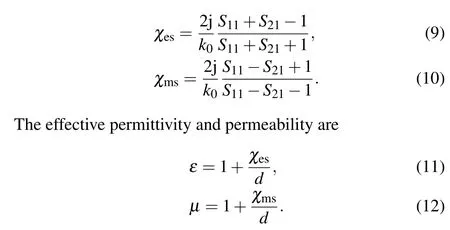
Compared with other metamaterials, metamaterial absorbers have three notable characteristics. One characteristic is their non-reciprocity.[14]Metamaterial absorbers have different responses to the electromagnetic waves depending on the incident direction. They show a strong absorption in one direction but a strong reflection in the opposite direction, that is,S11?=S22. Therefore,although there are some articles,[3,15-17]using the method of symmetric metamaterials to retrieve the effective constitutive parameters, this method is not suitable for metamaterial absorbers. It is worth mentioning that there is some confusion in determining the impedance in the two opposite direction near the absorption frequency when the asymmetric metamaterial method is adopted, which makes the retrieved constitutive parameters meaningless (details will be presented in Section 2). Therefore, this method requires approximate treatment of impedance,z=(1+S11)/(1?S11),[8]otherwise the symmetric metamaterial method is still the best choice.[18-26]
The strong internal electromagnetic coupling produces the second characteristic of these materials. At the absorption frequency,the current generated in the bottom layer is opposite to that of the electric resonance layer. This phenomenon leads to the magnetic response.[27]In 2014,Bhattacharyyaet al.[28]proposed that the metamaterial absorber has only one unit cell in the wave propagation direction. The total thickness is very thin relative to the wavelength,so the metasurface method can be used to retrieve the constitutive parameters.[29-33]However, Chenet al.[34]verified that the constitutive parameters retrieved from a unit cell in the wave propagation direction can represent the properties of metamaterials. When the metasurface method is applied to the metamaterial absorber,the retrieved constitutive parameters are inconsistent with the electrical resonance and magnetic resonance because the electromagnetic coupling is not considered(details will also be presented in Section 2).
The third characteristic of the metamaterial absorbers is that most of the metamaterial absorbers have a metallic bottom layer. In this case,their transmittance is equal to 0,making it impossible to retrieve the constitutive parameters.
In this paper, a retrieval method is proposed based on these three characteristics. This new method is helpful to further understand the absorption mechanism of metamaterial absorbers.
2. Retrieval of effective constitutive parameters for metamaterial absorbers with a cut-wire bottom layer
The constitutive equation of a metamaterial absorber,considering both the non-reciprocity and electromagnetic coupling,can be expressed as

whereξandζare the electromagnetic coupling coefficients.According to the retrieval method for a one-dimensional active metamaterial proposed by Popaet al.,[35]the model and its signal flow diagram are shown in Fig.1.
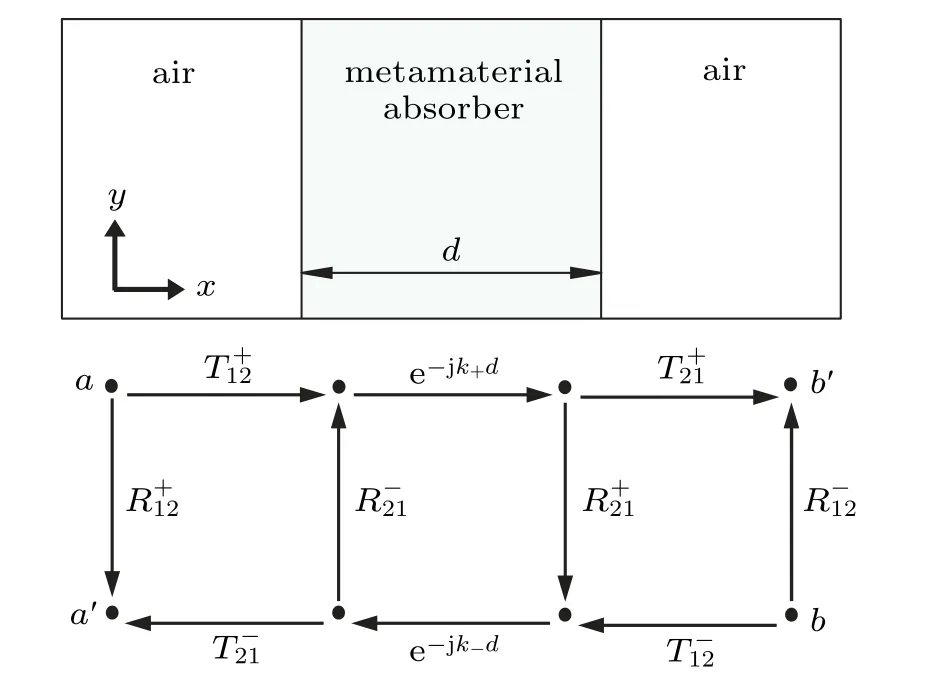
Fig.1. Analysis model of one-dimensional metamaterial absorber and its signal flow.
TheSparameters can be written according to the Mason’s formula as
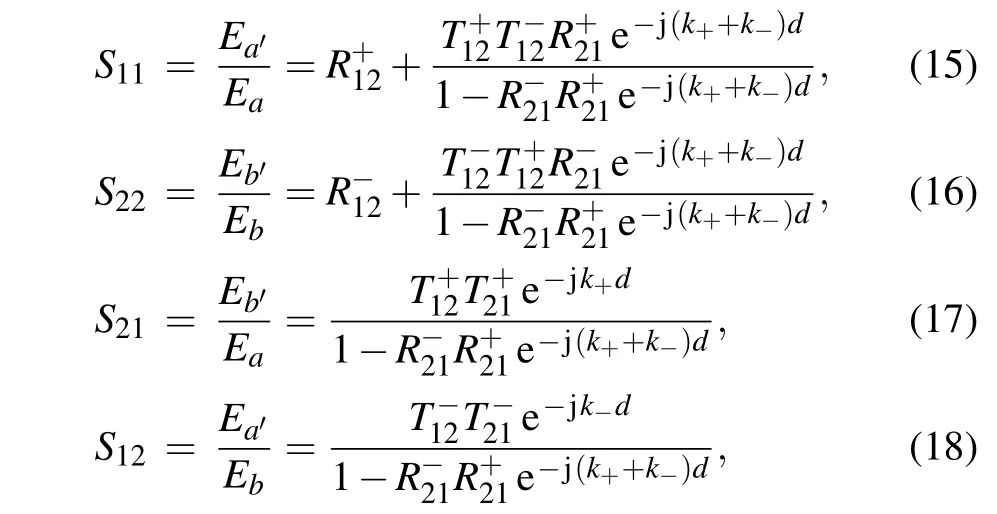
wheredis the thickness of the metamaterial absorber. The+and signs indicate the direction of propagation.The subscripts,iandj,suggest that the wave goes from mediumito mediumj, where medium 1 is air, and medium 2 is the metamaterial absorber.
The wave number and relative impedances can be obtained according to Eqs.(15)-(18)as
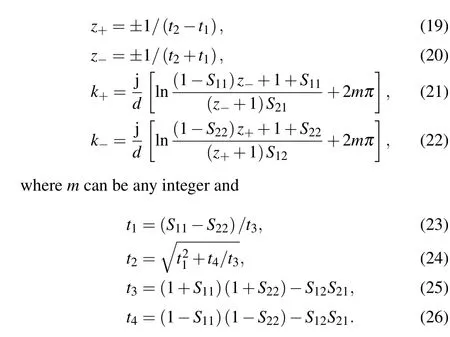
For passive metamaterial absorbers, the same method can be used to determine the signs of impedance and select the proper wave number branch.
Because the electromagnetic properties of non-reciprocal metamaterials in the +xdirection and?xdirection are very different,we believe that the average effective constitutive parameters in the two directions cannot represent their electromagnetic properties in one direction. For a metamaterial absorber,we only care about its electromagnetic properties in the direction of wave absorption. Assuming that it absorbs electromagnetic waves in the +xdirection, then the permittivity and permeability can be written for this direction as


Next, we use the metamaterial absorber proposed by Landyet al.[1]to verify this retrieval method. The dimensions of the absorber area1=4.2 mm,a2=12 mm,W=3.9 mm,G=0.606 mm,t=0.6 mm,L=0.7 mm,andH=11.8 mm.The two copper layers’thickness is 0.017 mm,while the FR4 middle layer’s permittivityεr=4.2×(1+0.025i).The Floqut port of HFSS is used for simulation,and the absorptance,the reflectance and the transmittance in the+xdirection are shown in Fig.2. The maximum absorptanceA(ω0)=99.7905%occurs at 10.076 GHz, and the minimum reflectanceR(ω0)=0.5693%occurs at 10.078 GHz.

Fig.2. Absorbance,reflectance,and transmittance of the metamaterial absorber proposed by Landy et al.
We now compare the electromagnetic parameters retrieved by the symmetric metamaterial method,the asymmetric metamaterial method, the metasurface method, and our method. The metasurface method does not involve the retrieval of relative impedance, thus the results from the other three methods are shown in Fig. 3. In the +xdirection, the relative impedance retrieved by the symmetric metamaterial method (Fig. 3(a)) and our method (Fig. 3(c)) is different in the non-absorbing frequency bands but agrees in the absorbing frequency band. At the minimum reflection frequencyω0=10.078 GHz,the symmetric method hasz=0.8611?0.0284i,and our approach hasz= 0.8610?0.0285i. It can be explained thatS22approaches 1 whileS21andS12approach 0 at the absorption frequency. Therefore, Eq. (19) can be simplified toz=(1+S11)/(1?S11),which coincides with Eq.(1).Clearly, our method is valid in the entire frequency range,while the symmetric metamaterial method is only approximate near the absorption frequency.The impedance retrieved by the asymmetric metamaterial method is shown in Fig.3(b). There is some ambiguity in the two opposite directions at 8.621 GHz,9.896 GHz, 11 GHz, and 12.67 GHz, which affects the retrieval of effective permittivity and permeability in the next step.
Since the metasurface method also does not involve the retrieval of refractive index, the results retrieved by the other three methods are shown in Fig. 4. The index retrieved by the symmetric metamaterial method(Fig.4(a))is different in the +xand?xdirections, while the result retrieved by the asymmetric metamaterial method(Fig.4(b))is unique. In our method, the index can be obtained byn=k/k0. Figure 4(c)shows that the index is the same in the+xand?xdirections and is equal to the value retrieved by the asymmetric metamaterial method. In addition,the index retrieved by the symmetric metamaterial method has a significant deviation at low frequencies in the +xdirection, and a small peak appears at the maximum absorption frequency. The deviation and peak are caused by the assumption ofS11=S22.

Fig.3. The relative impedance of the metamaterial absorber retrieved by(a)symmetric metamaterial method,(b)asymmetric metamaterial method and(c)our method along the+x and ?x directions.
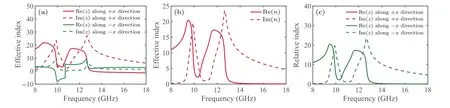
Fig. 4. The index of the metamaterial absorber along the +x and ?x directions retrieved by (a) symmetric metamaterial method, (b) asymmetric metamaterial method,and(c)our approach.

Fig. 5. The effective permittivity of the metamaterial absorber retrieved by (a) the symmetric metamaterial method, (b) asymmetric metamaterial method,(c)metasurface method,and(d)our approach. The corresponding effective permeability is shown in(e)-(h).
Next,the effective permittivity and permeability in the+xdirection retrieved by the four methods are shown in Fig. 5.The effective permittivity retrieved by our method(Fig.5(d))shows that the metamaterial absorber has two electrical resonances. One resonance is about 10 GHz, which corresponds to the top ERR’s electrical resonance(electric ring resonator)layer. The other resonance is about 12.7 GHz, which corresponds to the bottom cut-wire layer’s electrical resonance.The retrieved effective permeability (Fig. 5(h)) shows a magnetic resonance about 10 GHz, which is consistent with the ERR layer’s electrical resonance. At 10.078 GHz,ε=3.3818+15.9953i, andμ=3.2902+11.6794i, which means that the impedance is matched well to free space, so there is a minimum reflectance. It can be seen that the permittivity and permeability retrieved by our method are very consistent with the characteristics of the metamaterial absorber. The effective permittivity (Fig. 5(a)) and permeability (Fig. 5(e)) retrieved by the symmetric metamaterial method are similar to those of our approach, but the values are larger and the first electrical resonance has an apparent redshift. The effective permittivity retrieved by the asymmetric metamaterial method (Fig. 5(b))only shows one strong electrical resonance around 12.7 GHz,caused by the obfuscation of its impedance in the two opposite directions.Although the effective permittivity retrieved by the metasurface method(Fig.5(c))has two peaks,its trend is opposite to an electrical resonance. The negative permittivity at low frequencies is not consistent with the characteristics of the metamaterial absorbers. Similarly, the retrieved effective permeability(Fig.5(g))also does not agree with the traits.

Fig. 6. The electromagnetic coupling coefficient of the metamaterial absorber from our method.
The electromagnetic coupling coefficients obtained by our method are shown in Fig.6. Strong electromagnetic coupling appears at 9.4 GHz and 11.5 GHz. These two electromagnetic couplings correspond to the two electrical resonances of the metamaterial absorber. Besides, it can be seen from Fig.6 thatξ=?ζ. For passive media,ξandζare equal in size. Therefore,the retrieved coupling coefficients are consistent with the theory. It is also consistent with the derivation of the constitutive parameter matrix for magnetoelectric coupling metamaterial by Xuet al.[36]
In summary,by considering the non-reciprocity and electromagnetic coupling,the effective constitutive parameters retrieved by our method are consistent with the characteristics of the metamaterial absorber.
3. Retrieval of effective constitutive parameters for metamaterial absorbers with a metallic bottom layer
When the metamaterial absorber has a metallic bottom layer,S21=S12= 0, the denominators of symmetric metamaterial method, asymmetric metamaterial method, and our method are 0. That value makes it impossible to retrieve the constitutive parameters. Yeet al.[15]proposed that since the electrical resonance structure of the metamaterial absorber is located in the center of the unit cell, creating openings in the four corners of the metallic bottom layer in the unit cell will not significantly change its absorption performance and result inS21=S12?=0.Therefore,we can use this method to retrieve its constitutive parameters.
When a cut-wire bottom layer is changed to metallic,the maximum absorbance and corresponding frequency of the metamaterial absorber becomes significantly altered. In order to rematch the impedance to free space, the dimensions are adjusted toa1=a2=4.9 mm,w=3.9 mm,g=0.606 mm,andt=0.6 mm. The results are shown in Fig.7. Whenf=8.194 GHz, the maximum absorbanceA(ω0) = 99.9945%,and the minimum reflectanceR(ω0)=0.0055%. The maximum absorbance and minimum reflectance are at the same frequency.

Fig.7. The metamaterial absorber with four square openings around the metallic bottom layer in the unit cell: (a)top view,(b)side view,(c)bottom view,and(d)absorbance,reflectance,and transmittance when b=0.
Next,we investigate the maximum absorbance,minimum reflectance, transmittance, and the corresponding frequencies when four square openings with a side length ofbare created in the metallic bottom layer(Fig.7(c)). As shown in Table 1,whenb ≤1 mm, the frequencies of the maximum absorption and minimum reflection are the same. However, whenbbecomes larger, the maximum absorption frequency blue shifts,and the maximum absorbance decreases while the minimum reflectance increases. Whenbdecreases to 0.01 mm,the maximum absorption and minimum reflection frequencies are consistent with the metallic bottom layer metamaterial absorber. The maximum absorbance is only decreased by 0.0004%, while the minimum reflectance is increased by 0.0004%, and the transmittance is zero. It is worth noting that the side lengthbof the opening is about 1/4000 of the wavelength at the maximum absorption. These tiny openings not only ensure the successful retrieval of effective constructive parameters,but also make the transmittance equal to 0 at the accuracy of 0.000001. Thus, the metamaterial absorber properties in this condition are almost the same as the metallic bottom layer metamaterial absorber.
Next, the constitutive parameters are retrieved whenbis set to 0.01 mm. The results in the +xdirection are shown in Fig. 8. Figure 8(c) shows that the metamaterial absorber has an electrical resonance at 8.2 GHz. Both below and above this frequency, its effective permittivity is negative. This value is consistent with the characteristics of a metamaterial absorber with a metallic bottom layer. Besides,Fig.8(d)shows that the absorber has a magnetic resonance at 8.2 GHz. Both below and above that frequency, the effective permeability is much greater than 1, indicating a strong magnetic response. Surprisingly, Fig. 8(b) shows a region where the index is negative above 8.2 GHz. This behavior shows that half of the absorption is taking place in a double negative region. At the maximum absorption frequency of 8.194 GHz,the relative impedance isz=1.0155?0.0003i, the indexn=0.6876+194.3234i, the permittivityε=0.6196+191.3522i, and the permeabilityμ=0.7575+197.3407i. It can be seen that this enormous imaginary part of index is the reason for the absorption of the metamaterial absorber.This result is consistent with the analysis of Landyet al.[8]

Table 1. The maximum absorbance, minimum reflectance, transmittance,and corresponding frequencies of the metamaterial absorber as a function of b.

Fig.8. The constitutive parameters of the metamaterial absorber with a metallic bottom layer retrieved by our method: (a)relative impedance,(b) index, (c) permittivity, and (d) permeability. The constitutive parameters retrieved by the metasurface method for the same absorber: (e)permittivity and(f)permeability.
The effective permittivity and permeability retrieved by the metasurface method are shown in Figs.8(e)and 8(f). The trend of effective permittivity and permeability is the opposite of the electrical and magnetic resonance at the maximum absorption frequency. Meanwhile, the permittivity is positive,while the permeability is negative above and below the maximum absorption frequency. This status is inconsistent with the characteristics of the metamaterial absorber. Although the metasurface method is not affected by zero transmittance,which is very convenient to retrieve the effective constitutive parameters, it is inconsistent with the characteristics of the metamaterial absorber.
4. Conclusion and perspectives
The effective constitutive parameters of the metamaterial absorber are fundamental to understand its absorbing mechanism. Compared to these three retrieval methods, the constitutive parameters retrieved by our method are more successful in describing the characteristics due to the consideration of its non-reciprocity and electromagnetic coupling. For a metamaterial absorber with a metallic bottom layer, the effective constitutive parameters are successfully retrieved by creating openings in the metallic bottom layer. Besides, the influence of a side length in the opening is analyzed. It is found that this small opening allows one to obtain the constitutive parameters successfully and that no frequency shift occurs at the maximum absorption frequency. From the retrieved constitutive parameters, it is also found that the electromagnetic coupling is very strong at the absorption frequency and that the sizeable imaginary part of the index produces the wave absorption.Furthermore, there is a double negative absorption region above the maximum absorption frequency,which is of great significance to the understanding of the absorption mechanism.

- Chinese Physics B的其它文章
- Erratum to“Floquet bands and photon-induced topological edge states of graphene nanoribbons”
- Viewing the noise propagation mechanism in a unidirectional transition cascade from the perspective of stability*
- Nonlinear signal transduction network with multistate*
- Optical strong coupling in hybrid metal-graphene metamaterial for terahertz sensing*
- Any-polar resistive switching behavior in Ti-intercalated Pt/Ti/HfO2/Ti/Pt device*
- Magnetic two-dimensional van der Waals materials for spintronic devices*