
CIFTIS:A Barometer of Global Trade in Services
2021-11-26 13:31:17ByLilyWang
China’s foreign Trade 2021年5期
By Lily Wang
CIFTIS is the worlds larg- est comprehensive fair for services trade, and also an important platform to showcase Chinas services. According to the organizers, this years CIFTIS reached 1,627 outcomes, including 624 contracted projects, 223 investment projects, 200 agreements and contracts, 158 official publications, 46 cooperation platforms, 139 innovation debuts and 264 rating and recommendations.
The CIFTIS established platforms for the global service trade industry and related companies. It has become the barometer of the global trade in services.
Service trade cooperation of Belt and Road countries commendable
Data shows that China has been the worlds second-largest service trade country for 7 consecutive years. It has service trade cooperations with about 240 countries and regions in the world, and has signed bilateral service trade cooperation agreements with 14 countries. Total service trade volume between China and Belt and Road regions reached USD 84.47 billion.
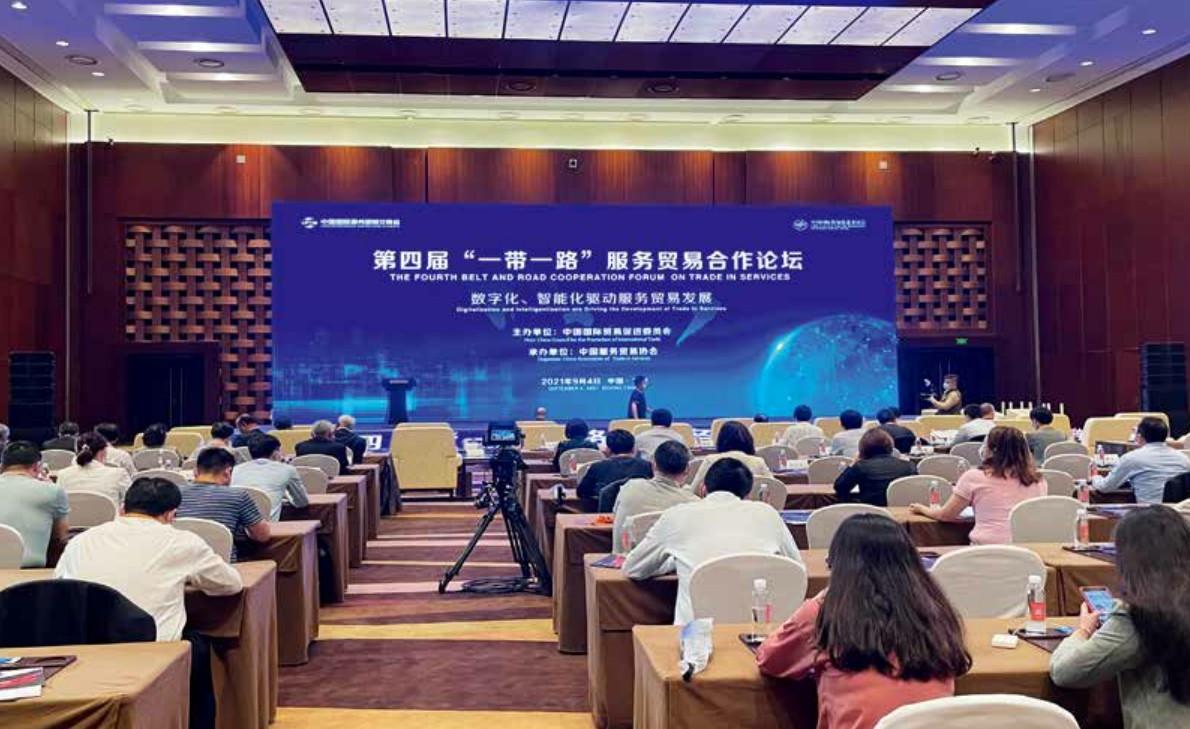
Zhang Shenfeng, Deputy Chairman of the CCPIT, said at the fourth Belt and Road Cooperation Forum on Trade in Services that the service trade has become an increasingly important part of international trade and it is also the major driving force of global economic growth. To promote the innovative development of the service trade requires further stimulation of the vitality of innovation and active cultivation of new driving forces for the development of the service trade. We should promote high-quality construction of the Belt and Road and improve the level of service trade cooperation; we shall optimize the business environment and facilitate free trade and investment to make more contributions to the world economic recovery and growth.
Zhu Guangyao, second-grade inspector of the service trade department of the Ministry of Commerce, said that in recent years, China has been working successfully with countries along the Belt and Road in the realm of service trade. In 2018, Chinas service trade with countries along the Belt and Road region increased by 22.3%; in 2020, the service trade with countries along the Belt and Road region maintained the same level with 2019 despite impact from the COVID-19 pandemic. During Q1 this year, Chinas service trade with countries along the Belt and Road region increased by 6.6%. The service trade cooperation with countries along the Belt and Road region has great potential and is key for global economic recovery and development.
Moin ul Haque, Pakistan Ambassador to China, said that it is hoped that China and Pakistan shall increase cooperation in the service trade, especially the digital economy, to become a new growth point for bilateral cooperation. “There will be many challenges in building mutual trust and unifying standards. Therefore, the most important thing is that China and Pakistan shall uphold the spirit of cooperation, and we shall stand together with our Chinese partners.”
Federico Lach, Deputy Head of Uruguays Embassy in China, said that the service trade is important to Uruguay. The service trade accounts for 70% of Uruguays GDP and 1/3 of Uruguays exports. Uruguay has great competitiveness in the IT, finance and innovation industries. For investors, it is really beneficial to invest in the software industry of Uruguay, as Uruguay has rich human resources and could offer many favorable policies in terms of finance and tax. “In the past 8 years, China has been our most important trade partner. Although the service trade volume between Uruguay and China is limited, the bilateral cooperation potential is huge.”
Zhou Chenghu, Director of the China Association of Trade in Services and academician of the Chinese Academy of Science, said that it is an inevitable global consensus that the digital trade rule system is the foundation for the promotion of trade, digitization and economic development. This requires the formulation of a new consensus system from different perspectives of economy, culture, nationalities and even religion. This can not be achieved in a short period of time.
Long Yongtu, Counsel of the China Association of Trade in Services and former Deputy Minister of the Ministry of Foreign Trade and Economy, said that it is important to advocate for multilateralism and fight against unilateralism. Trade should be open, transparent and involving all countries and cannot be made by a single coun- try closing the door. We shall respect each other on the basis of equality and mutual benefits, to achieve a win-win situation and formulate international rules. Long Yongtu said that although the COVID-19 pandemic had a heavy impact on the global service trade, the cooperation of trade in services among countries of the Belt and Road region shows good momentum. Countries of the region have endeavored to develop service trade to implement the Belt and Road Initiative.
Digitization changes the industrial logic
Wang Zhongmin, former Vice Chairman of the National Social Security Fund Council, said that the service industry is a new industry. Without the empowerment of knowledge, the service industry cannot achieve continuous growth. Digitization has changed all industrial logic. It worked out the application program of manufacturing industry, formed the system integration of the manufacturing industry through the whole process and modern digital design, to empower the manufacturing industry to take off. The development of service industry and service trade needs fair and reasonable trade rules, transaction rules and market rules. Services and service trade happen almost everywhere.
Tatiana Prazeres, former Senior Advisor to the WTO Director-General, said that with development and the application of digital technology, the trade in services will continue to grow faster than the trade in goods. Digital technology can help increase peoples participation, especially in helping developing countries, small countries and small and medium-sized enterprises to get involved in international trade. Driven by blockchain technology, international trade will enhance automation, reduce costs and increase revenue, achieve full traceability, and further improve consumer trust.
Chen Zhijian, Northern District Partner of Corporate Financing and M&A Department of PwC China, said that traditional digitization is electric data collection, but it focuses on the deep utilization of data during the collection process. Data collection will depend on unmanned facilities, rather than personnel, and data will play a key role in managing, controlling and mobilizing resources. Digital platforms will enable faster sharing of more materials about the upstream, the downstream and related parties. The supply chain will also empower innovations platform to make these more inclusive, efficient and productive.
“The COVID-19 pandemic has accelerated the process of global digitization, which stimulated the emergence of new business models like crossborder e-commerce, which enable small and medium-sized enterprises to engage in international trade and provide a new track for economic development. Global e-commerce is showing strong development. On the one hand, this is driven by the rising demands for cross-border business and on the other hand, this is due to the fact that digital technology is pushing forward crossborder e-commerce business,” said Wu Kai, CEO of Greater China Area of Airwallex. Such background will provide fresh opportunities for Airwallexs international business.
Knowledge-intensive services as a major driving force of growth
Feng Yaoxiang, Director of Trade and Investment Promotion Department of the CCPIT, released the Research Report on the Development of Chinas Trade in Services (2020) at the forum. This report shows that during the 13th Five-Year Plan period, Chinas service trade industry has been achieving rapid growth and the opening up and innovation development of the service trade have made tangible progress. Chinas position as the worlds second-largest service outsourcing supplying country and the worlds second-largest cloud service supplier has been further consolidated.
Despite impact from the COVID-19 pandemic, Chinas service industry picked up in 2020, up by 2.1% from the previous year. Online shopping, livestreaming and other new consumption models have seen strong growth; the national express delivery business has increased by 31.2% from previous year; the incremental value of information transfer, software and the IT service industry has increased by 16.9% from previous year. Meanwhile, the foreign trade of knowledgeintensive services has increased by 8.3%, accounting for 44.5% of the total trade in services, which is up by 9.9%. Knowledge-intensive services have become the main driving forces of the service trade.
At the same time, the report also points out four weaknesses in Chinas service industry and service trade: first, the industrial foundation for the development of service trade is still relatively weak. The proportion of the service industry in the added value of GDP is 54.5%, which is lower than the world level of 67%; Second, the proportion of service trade in international trade is 14.64%, lower than world level of 24%; third, the institutional opening of the service industry is relatively insufficient; fourth, the export competitiveness of the service trade has improved slowly. During the 13th Five-Year Plan period, Chinas export in services ranked fourth in the world, following the United States, Britain and Germany, and the service trade deficit is still at a high level.
Regarding these weaknesses, the report raised four suggestions to promote the high-quality development of China service industry and service trade.
First, seize the important strategic opportunity period for the development of the service trade. Chinas service industry has outperformed the manufacturing industry in the creation of export added value. The trade in services is playing an increasingly important role. During the 14th Five-Year Plan period, cross-border investment and cooperation in the service industry and the opening-up and development of service trade will introduce new opportuni- ties. It is estimated that by 2025, the added value of Chinas service industry will account for 60% of GDP, and the service industry has huge potential for development.
Second, implement an overall plan for the high-quality development of trade in services. China will continue to promote the pilot of innovative development of trade in services, deepen reform and opening up in the field of trade in services, promote the construction of export bases for distinct services in the fields of culture, digitization and traditional Chinese medicine services, explore the negative list management system of cross-border trade in services, accelerate the transformation and upgrading of service outsourcing, establish and improve the technology trade facilitation system, and strengthen international cooperation in trade in services. The purpose is to consistently promote high-quality development of trade in services.
Third, strengthen the construction of “one pilot, one demonstration and multiple bases”. We will strive to deepen the innovative development of the service trade in eight aspects including improving management systems, increasing opening up to the outside world, improving the level of convenience and innovation of the development model. We shall focus on accelerating the digital transformation, promoting the development of key areas, and building a global service network system. We will actively expand the export bases of distinct services, develop new forms and models of the service trade, and create a new growth pole of service exports.
Fourth, fully release the institutional dividend of the opening-up of the service industry. We shall promote institutional opening-up that focuses on the trade in services, establish and improve the negative list management system of cross-border trade in services, promote the construction of Hainan free trade port by the benchmark of the worlds highest opening standards, accelerate the process of bilateral regional free trade, and strive to create a favorable external environment for Chinas economic transition and expanding reform and opening-up.
- China’s foreign Trade的其它文章
- A Trillion-dollar Medical Device Market
- Haidilao Tops China’s Most Valuable Restaurant Chains List
- Maternity and Kids Market Expected to Continually Grow
- China’s Shipbuilding Industry Sees Strong Increase of Orders
- China’s Electric Vehicle Makers Target Europe
- Both Production and Sales of New Energy Vehicles Grow Rapidly