
Carbon Peak and Carbon Neutralization Accelerate Green Industry Development
2021-11-26 02:51:32ByGuoYan
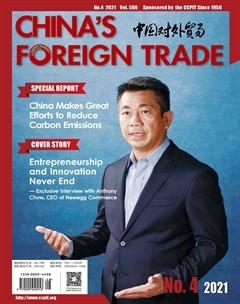
China’s foreign Trade 2021年4期
By Guo Yan
The carbon peak and neutral- ization are goals set up by the Chinese government to in order achieve sustainable economic development. Although China had been doing a lot in terms of reducing emissions and saving energy, it must still face huge challenges in order to achieve the carbon peak and neutralization as promised, especially in light of the COVID-19 pandemic outbreak since 2020. There will also be opportunities for the Chinese economy to accelerate the energy saving and emission reduction process. Emerging industries will receive more benefits and grow rapidly, which will promote the change in driving forces of development and bring about new opportunities for the green economy.
Forcing traditional energy industry to upgrade
Recent years have witnessed the launch of national policies to promote the green development of Chinas traditional energy industry in order to achieve the carbon peak and neutralization goals as early as possible.
Public data shows that in 2020, coal was still the major source of energy for Chinas end users, accounting for 56.7%. Oil, natural gas and other renewable energies followed in the rankings, accounting for 19.1%, 8.5% and 15.7% respectively. This shows that traditional oil and chemical energy is still the major source of energy for China.
From 2015 to 2020, although the Chinese government has gradually realized the importance of energy conservation and emission reduction, Chinas consumption demand for traditional energy has still exhibited an upward trend due to the needs of economic development. Due to the implementation of policies such as reducing production capacities and accelerating industrial structure transformation, Chinas coal consumption is controlled at approximately 4 billion tons; in terms of crude oil and natural gas, Chinas consumption demand shows a rising trend. In a nutshell, traditional petrochemical energy cannot be completely replaced by other energy sources within a short amount of time. Therefore, Chinas energy conservation and emission reduction still faces great challenges.
In addition to the carbon emissions caused by using traditional energy, the production, processing and transportation of traditional energy are also energy-consuming and cause carbon emissions. Taking the proportion of energy consumption of Chinas traditional energy in industrial consumption in 2019 as an example, the energy consumption of traditional energy related businesses accounts for 30.32% of total Chinas industrial energy consumption. Indeed, 23.3619 million tons of standard coal were consumed in the production and supply of electricity, heat and gas, 16.4831 million tons of standard coal were consumed in the petroleum processing, coking and nuclear fuel processing industries, and 16.4695 million tons of standard coal were consumed in the manufacturing of chemical raw materials and chemical products. Therefore, in order to achieve the carbon peak and neutralization, reducing energy consumption in the field of traditional energy is also a top priority.
In order to achieve the carbon peak and neutralization, the traditional petrochemical energy industry has entered a phase of less-favorable policies. However, as new energy cannot completely replace petrochemical energy in a short amount of time, economic development will still require more traditional petrochemical energy in almost all walks of life. It is expected that Chinas demand for traditional energy will continue to grow in the short term. Therefore, in order to ensure the realization of the carbon peak and neutralization goals, and to also realize the supply for industry development, Chinas traditional energy industry is bound to change and will bring about new development opportunities.
The manufacturing industry: the manufacturing industry is one of the most energy-consuming industries in China. In 2019, approximately 2.684 billion mt of standard coal was consumed in the manufacturing industry, accounting for 55.06% of Chinas total energy consumption. When exam-ining the segmented sectors in the non-metal mineral product industry, ferrous metal smelting and rolling, telecommunications equipment, and chemical materials and processing are the top 3 energy-consuming industries, accounting for 24.36%, 19.85% and 12.42% respectively.
The steel industry: the steel industry features the largest volume of carbon emissions, and is a key part of the ferrous metal smelting and rolling industry. It is estimated that in 2026, Chinas raw steel production will have reached 1.59 billion mt. If there are no measures to curb this production, the total carbon emissions of Chinas steel industry in 2026 will reach 3.148 billion mt. This shows that although Chinas carbon emission policies have achieved certain accomplishments, there are still many challenges to face and a lot of room for improvement.
The cement industry: the Qianzhan Research Institute predicts that with the further recovery of the domestic economy since the pandemic and the rapid growth of Chinas infrastructure constructions, the demand of Chinas cement industry is expected to reach 2.8 billion mt by 2025. By 2025, the total energy consumption of Chinas cement industry will reach 302 million mt and its carbon emissions will reach 1.449 billion mt. Therefore, Chinas cement industry also still faces great challenges in terms of energy conservation and emission reduction.
The paper-making industry: the paper-making industry is also an energy-consuming industry, ranking after the oil and chemical industry, and the metal and non-metal industry. According to calculations regarding the energy consumption of paper-making industry, the energy consumption and carbon emissions of the paper-making industry decreased during 2015-2019 due to policy guidance. Moreover, for normal paper-making enterprises, the carbon emissions for the treatment of industrial waste water are also high, accounting for 7.45%.
New energy industry is growing rapidly
New energy refers to types of energy other than traditional petrochemical energy, including hydro-power, nuclear power, wind power, solar energy and so on. Compared with traditional energy that emits a huge amount of carbon through thermal power generation and heating, the power generation process of new energy creates almost no pollution. Therefore, in order to achieve the goal of carbon peak and neutralization, using new energy will be the general trend. From the perspective of Chinas energy output and consumption structure, with recent policy guidance and support, the proportion of new energy has been increasing rapidly in recent years. Due to the non-renewable nature of traditional petrochemical energy, China started to develop new energy technologies from the 9th five-year plan period. New energy technologies have been incorporated into the national key development plan. In 2020, China proposed to achieve the goal of a carbon peak and neutralization. Therefore, in the more recent “14th five year plan”, China further proposed to focus on the development of the new energy industry and accelerate the growth of the industry.
In 2021, when the National Energy Administration solicited opinions on the development of wind power and photovoltaic power generation in 2021, it clearly proposed the implementation of the goals and tasks of carbon peak by 2030 and carbon neutralization by 2060, such that the proportion of non-fossil fuel energy in primary energy consumption will reach approximately 25% by 2030, and the total installed capacity of wind and solar power generation will reach more than 1.2 billion kw. In the solicited opinions, it also advocates for improvements in the development mechanism, releasing space for consumption, optimizing the development environment, giving full play to the leading role of local governments, mobilizing the enthusiasm of investors, and focusing on developing the current and incremental power capacities and the centralized and distributed capacities together to achieve faster development of wind power and photovoltaic power generation projects.
In order to achieve carbon peak and neutralization, China has set goals in terms of the installed capacity of photovoltaic and wind power generators and the proportion of national wind power and photovoltaic power generation in the power consumption of the whole society. In 2020, Chinas installed capacity of photovoltaic and wind power generators were only 502 million kwh, a gap of approximately 700 million kwh from the national goal of reaching 1.2 billion kwh in 2030. In order to achieve that goal, the annual compound growth must reach more than 9.1%, which means that the market scale of Chinas photovoltaic and wind power industry needs to double from 2020 to 2030. The industry has broad investment prospects.
In recent years, with the gradual maturity of photovoltaic and wind power technology, the power generation cost of photovoltaic and wind power in China has also decreased. In the past, due to the high cost of photovoltaic power and wind power, the state gave huge subsidies to the industry. With the decline in costs, the national subsidies for photovoltaic and wind power have also decreased.
According to the Notification about Improving the On-Grid Price Policies for Wind Power which was issued by the National Development and Reform Commission and the Notification about Improving the On-Grid Price Mechanism for Photovoltaic Power by the National Development and Reform Commission, from 2021, photovoltaic and wind power will receive no benefits, except for photovoltaic power for home use. Furthermore, the guide price of photovoltaic and wind power in all provinces of China is approximately a cent cheaper than that of coal power. This means that photovoltaic and wind power enterprises need to be responsible for their own profits and losses, and their income will decrease. There will be huge doubts about whether they can and are willing to continue to develop their businesses in the future. This will also bring about new challenges in relation to the achievement of goals related to photovoltaic and wind power in the context of the carbon peak and neutralization.
In order to achieve the carbon peak and neutralization, the promotion of the use of new energies is inevitable. However, when developing new energy, there will be different types of challenges and obstacles considering the nature and characteristics of clean energies.
- China’s foreign Trade的其它文章
- Fresh Food E-commerce Has Huge Potential for Development
- Housekeeping Service Industry Presents Super Opportunities for Investment
- China Becomes Top Machinery Exporter for the First Time
- Outlook for Investment from Insurance Institutions in the Belt and Road Initiative
- A Growing Market for Mobile Medical Apps
- China’s Game Industry Exhibits“Smile Curve”