
A closer look at cannabimimetic terpenes, polyphenols, and flavonoids: a promising road forward
2021-12-09 14:12:42JulianaCavalliRafaelCyprianoDutra
中國神經再生研究(英文版) 2021年7期
Juliana Cavalli, Rafael Cypriano Dutra
Despite the current interest in the potential medical use ofCannabis, it is worth remembering that cannabis is not a new drug, with both a nonmedical and medical history supporting its effectiveness. This history advanced in scientific strength and importance worldwide when Professor Raphael Mechoulam and colleagues initiated their pioneering discoveries in 1971. At first, Mechoulam et al. (1972)achieved the complete synthesis of the pure compounds fromhashish(including?1-tetrahydrocannabinol and other neutral cannabinoids such as cannabigerol,cannabichromene, and cannabicyclol), and established their molecular structures.This set a strong pace for the study of their structure-activity relationship and started to pave a promising road of discovery! Later on, the most important compounds were isolated and identified,namely ?9-tetrahydrocannabinol (?9-THC),cannabidiol (CBD), and cannabinol, which represent some of the main tools used in preclinical and clinical research in the cannabinoid field. The endocannabinoid system (ECS) was proposed with the discovery of the endocannabinoids anandamide and 2-arachidonoylglycerol.With further progress in research, it became clear that the functions of the endocannabinoid signaling system are not limited to the brain, but are exerted throughout the organism. It has been proposed that endocannabinoids are released from cells as soon as their biosynthesis ends, avoiding release via secretory vesicles. Their actions on receptors are locally restricted, possibly due to their high lipophilicity and rapid inactivation under physiological conditions. In this scenario, the former would determine the promiscuity of cannabinoids in terms of their actions on different molecular targets, while the latter would affect the levels of cannabinoids since they are under the influence of biosynthesis and degradative enzymes. Both endocannabinoid compounds have been shown to mimic some effects of synthetic cannabinoids on their G-protein coupled receptors (CB1R and CB2R) and metabolizing enzymes. The G-protein coupled receptors CB1R (cloned in 1990) and CB2R (cloned in 1993) exhibit 48% similarity in their amino acid sequences. These receptors have been shown to exhibit particular differences in signaling mechanisms, tissue distribution and sensitivity to agonists and antagonists that depict marked binding selectivity between both receptors. When CBR is activated,adenylate cyclase is inhibited provoking the conversion inhibition of ATP to cyclic AMP.CB1R and CB2R located at peripheral, spinal,or supraspinal sites are important targets,mediating the effects of cannabinoids via the inhibition of presynaptic neurotransmitter and neuropeptide release, modulation of postsynaptic neuronal excitability, activation of the descending inhibitory pain pathway,and reductions in neuroinflammatory signaling (Starowicz and Finn, 2017).Other receptors have been reported to be activated by cannabinoid drugs and related molecules, including GPR55, GPR18, and GPR119. However, the CB1R has been considered a key component of the ECS since it is the most abundant metabotropic receptor in the brain and interacts with endogenous and exogenous cannabinoids,including ?9-THC. Furthermore, there is a large body of evidence to demonstrate that CB1R and CB2R, as well as their ligands,play a significant role in physiological and pathological processes. Therefore, changes in endocannabinoids anandamide and 2-arachidonoylglycerol concentration, as well as activation or deactivation of both CBRs in the tissues have been widely studied, as they can be relevant for the modulation of neurological and neurodegenerative diseases, neuroinflammation, cancer,immune-mediated inflammatory diseases,and autoimmunity (Di Marzo, 2008).
By definition, cannabinoids are the terpene phenolic constituents ofCannabissativaL.and until recently, the only natural products known to directly interact with cannabinoid receptors. However, in recent years, several non-cannabinoid plant-derived natural compounds have also been reported to act as cannabinoid receptor ligands. Thus,the definition of phytocannabinoids was upgraded to comprise any plant-derived natural compound sharing chemical similarity with cannabinoids and/or being capable of directly interacting with cannabinoid receptors. Direct cannabinoid ligands show high binding affinity for CBRs and exert discrete functional effects, acting as agonists, neutral antagonists, or inverse agonists. On the other hand, indirect ligands interact with proteins within the ECS, for example regulating endocannabinoid tissue levels or modulating CB1Rs via allosteric sites(Gertsch et al., 2010). Naturally, one or some of these properties can be found in certain plant-derived natural products, although it’s important to be aware of the high variability of molecular and pharmacological data obtained from different laboratories and its interpretations. In terms of applicability,there is consistent evidence showing that therapy with the main phytocannabinoid constituents ofCannabis(e.g., ?9-THC and CBD) is applied for different clinical conditions, including multiple sclerosis,schizophrenia, bipolar mania, social anxiety disorder, neuropathic and cancer pain,cancer anorexia, Huntington’s disease,insomnia, and epilepsy (Gertsch et al.,2010). Both ?9-THC and CBD interact with CB1R and CB2R. While THC acts as a partial agonist of CB1R and CB2R, CBD presents relatively little affinity for the orthostatic sites of cannabinoid receptors and inhibits THC binding to CB1R (Laprairie et al.,2015). This evidence supports the idea that cannabimimetic terpenes could interact with CB1R and CB2R and exert their particular action on a huge range of physiological and pathological conditions.
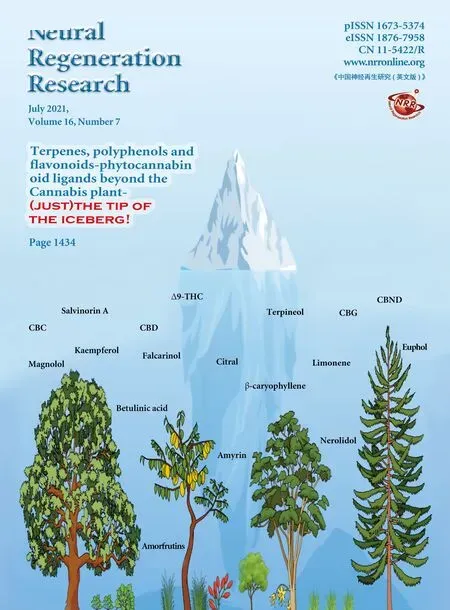
Beyond the ligands derived from theCannabisplant, there are other compounds with cannabinoid-like properties (Figure 1). Cannabimimetic ligands can act as CBR agonists or antagonists, or ECS enzyme inhibitors, playing a role in several clinical conditions. For instance, the cannabigerollike phytocannabinoid called amorfrutin has been identified in the genusHelichrysumand, similar toCannabis, has been shown to have anthelmintic properties and lead to nausea, diarrhea, vomiting,and respiratory tract infections (Kumar et al., 2019). In particular, terpenoids or phenolic compounds are cannabimimetic ligands that can be derived fromCannabis sativaor derived from other plants(non-cannabinoids) (Kumar et al., 2019;Goncalves et al., 2020b). In recent decades,studies regarding terpenoid compounds(i.e., D-limonene, β-myrcene, α-pinene,α-terpineol, β-pinene, β-caryophyllene, and others) have been growing, considering their large number and extensive employability. Recently, our group showed the antidepressant-like effect of terpineol, a monoterpenoid alcohol, in an inflammatory model of depression. Moreover, it was demonstrated that this effect is dependent on the cannabinoid system and D2 dopamine receptor, but not on A1/A2 adenosine receptors or β-adrenoceptors, usingin silico(docking analysis) andin vivo(tail suspension test and splash test) approaches (Vieira et al., 2020). Based on these findings, we speculated that CB1R and CB2R are the most promising targets for the mechanism of action of terpineol and should be prioritized in further studies (Vieira et al., 2020).Previous evidence supports our hypothesis,showing that cannabigerol, another phytocannabinoid, alters behavioral despair in an animal model of depression by binding CB1 and CB2 cannabinoid receptors (Cascio et al., 2010).

Figure 1|Schematic representing terpenes, polyphenols, and flavonoids—phytocannabinoid ligands beyond the Cannabis plant—(just) the tip of the iceberg!
As discussed, the presence of terpenoids,polyphenols, and flavonoids is not been restricted to theCannabis sativaplant(Figure 1). There are manyCannabisterpenoids and polyphenolic compounds that are not found in theCannabisplant in large quantities but are highly expressed in other plants. As reviewed by Gon?alves et al. (2020b), β- and α-caryophyllene are the major sesquiterpenes found in theCannabisplant, presenting a strong affinity to CB2R,but not CB1R. Its effects include its action as a repellent, antimicrobial or antibacterial,anticancer or antiproliferative, and antifungal agent, together with its properties as an acetylcholinesterase inhibitor, antioxidant,and anti-inflammatory mediator (Goncalves et al., 2020b). Regarding analgesic effects,β-caryophyllene has been demonstrated to attenuate paclitaxel-induced peripheral neuropathy in mice by a mechanism dependent on mitogen-activated protein kinase inhibition. Moreover, anticancer activity has been reported against MCF-7 cells for the essential oil ofCyperus longus, which mainly consists of β- and α-caryophyllene. In another report, our group also showed the anti-inflammatory properties of β-caryophyllene in an inflammatory bowel disease mouse model,in which β-caryophyllene oral treatment mitigated TNF and interleukin-1β (IL-1β) expression, reduced colon damage,and ameliorated the disease score. It was reported that these effects were related to CB2R activation and, to some degree,dependent on peroxisome proliferatoractivated receptor gamma (Bento et al.,2011). More recently, Gon?alves et al.(2020a) showed the immunomodulatory property of citral appears to be related to its ability to modulate CB2R, TLR4, and TLR2/dectin-1, as well as CBR- and TLRs-activated downstream signaling pathways, including ATP-dependent K+channels. Citral has shown to exhibit mainly anti-inflammatory and anticancer properties that have been evaluated using several protocols. Falcarinol,also named panaxynol or carotatoxin, has been shown to exert antineoplastic and anti-inflammatory activities, and has been also investigated as a pharmacological tool for the treatment of cardiovascular and metabolic diseases (Goncalves et al., 2020b). Moreover,falcarinol has been reported as a facilitator of type I hypersensitivity and atopic dermatitis.It seems to facilitate sensitization by other allergens, suggesting that falcarinol-induced dermatitis could be associated with CB1R antagonism in keratinocytes (Goncalves et al., 2020b). The varieties of terpenoid plantderived natural compounds (cannabinoid and non-cannabinoid) were revised by Gon?alves et al. (2020b), and were further detailed in their report (Goncalves et al., 2020a). Altogether, these reports improve and strengthen the state of the art related to the discovery, investigation,and clinical importance of cannabimimetic ligands beyondCannabis sativa. However,current legislation, bureaucracy, barriers in legalization for medicinal use, prejudice and stigma surrounding theCannabisplant hinder its routine use in clinical practice, and also its global dissemination as a medicinal.For this reason, it is necessary and relevant to discover and investigate new cannabinoid ligands, particularly those obtained from other traditionally used and known plant species, which may arrive faster and with less difficulty in medical practice.
Importantly, besides the therapeutic effects,unwanted side effects of targeting CBRs,mainly related to CB1R, have been reported.These include cardiovascular dysfunction,digestion failure, neurological disorders,and psycho(social)active effects (including depression and suicidal thoughts), together with a large potential for addiction. Preclinical studies have shown that, at low doses, CB1R agonists are able to induce anxiolytic- and antidepressant-like effects. However, at high doses, these compounds may have the opposite effect, producing aversive states.The mechanisms underlying the biphasic effects remain to be unraveled, although it is possible that the biphasic effects can be explained by the low expression of CB1R on glutamatergic neurons, together with the high expression of CB1R on GABAergic interneurons. Further studies may reveal important limitations in the clinical use of cannabinoid ligands for both CB1R and CB2R. Rimonabant?, the earliest discovered CB1R antagonist, has shown long-term efficacy in clinical trials, but also the studies showed specific psychiatric side-effects and depression-like states related to its use,which appear to be reversible after cessation of the drug (Moreira et al., 2009). Altogether,these data suggest caution in the use of cannabinoid agonists and/or antagonists due to unknown and as yet uninvestigated side effects. Likewise, until now, little is known about the side effects of terpenes,polyphenols, and flavonoids when linked to CBRs and/or interactions with ECS. In fact,these questions and gaps are expected to be answered by the scientific community in the coming years.
The next stages of cannabinoid history are extremely promising and thought-provoking,yet formidable challenges remain. Certainly,we will still have the leading role of the team coordinated by Professor Raphael Mechoulam, who has been dedicated to identifying, isolating, and investigating the pharmacological action of cannabidiolic acid and cannabidiolic acid methyl ester (HU-580),a stable synthetic analogue of cannabidiolic acid, which are extremely potent when compared to the precursor CBD (Pertwee et al., 2018). Innovative technologies are also under development, such as the creation and appearance of new pharmaceutical and biotechnological startups, novel biotech products and educational strategies focusing on theCannabisindustry. For instance,recently, the first plant-derived cannabisbased medicine, Epidyolex?, a CBD oral solution from GW Pharmaceuticals, was approved by the European Medicines Agency for use, in conjunction with clobazam,as an adjunctive therapy for seizures associated with Lennox Gastaut syndrome or Dravet syndrome (VanLandingham et al., 2020). Additionally, Eybna and CannaSoul Analytics—two Israeli research and development companies specializing in terpene-based medicines for conditions like cancer and Alzheimer’s disease—recently showed that the terpene formulation NTVRLTM, which contains 30 individual terpenes,inhibited the cytokine storm syndrome assay with human peripheral blood mononuclear cells. This cytokine storm is to that induced by the novel coronavirus COVID-19, reinforcing the new pathway for synergistically effective natural formulations.In fact, Assiniboine Community College, in partnership with Durham College in Oshawa,is now preparing students for careers in Canada’s cannabis industry, aiming to train people for jobs in quality assurance,quality control, production, sales, and other roles within the marijuana business.More recently, the Australian government recently announced an investment of nearly€ 1.65 million from the Medical Research Future Fund into medical cannabis research.Thus, we believe that research on medical cannabis and cannabimimetic compounds will be supported by new biotech companies and products, which probably will build on the recent confirmed findings and create benefits for a wider market in the near future. These benefits would then reach customers who need or want alternative treatments for their health issues and strengthen the perspectives of the usefulness of the cannabinoid industry in its entirety.
In summary, taking into account the extensive literature concerning the development of new drugs and scientific evidence obtained to date, we believe that CBRs are very promising targets and will probably be continuously prioritized in further studies concerning the mechanism of action of terpenoid, polyphenol, and flavonoid compounds. For instance, a better understanding of the mechanisms of action of terpineol or citral or β-caryophyllene and its uses as a therapeutic drug should be further investigated, especially as considerable evidence about its actions has been already determined. It is appealing and possibly worth to proceed with profound investigations into new phytocannabinoid ligands, even beyond theCannabissativa plant. A new scientifically guided road might need to be paved to obtain commercial products better oriented to satisfying the persistent needs for the treatment of several diseases.
The authors would like to thank Maíra Assun??o Bicca for his English assistance and valuable comments during multiple discussions of this work.
This work was supported by grants from Conselho Nacional de Desenvolvimento Científico e Tecnológico (CNPq), Coordena??o de Aperfei?oamento de Pessoal de Nível Superior (CAPES), Funda??o de Apoio a Pesquisa do Estado de Santa Catarina(FAPESC), Programa INCT-INOVAMED (Grant 465430/2014-7) and Programa de Pós-Gradua??o em Neurociências (PGN), all from Brazil. RCD was recipient of a research productivity fellowship from the CNPq.
Juliana Cavalli, Rafael Cypriano Dutra*
Laboratory of Autoimmunity and Immunopharmacology, Department of Health Sciences, Center of Araranguá, Federal University of Santa Catarina, Araranguá, SC, Brazil (Cavalli J,Dutra RC)
Post-Graduate Program of Neuroscience, Center of Biological Sciences, Federal University of Santa Catarina, Florianópolis, SC, Brazil (Dutra RC)
*Correspondence to:Rafael Cypriano Dutra, PhD,rafaelcdutra@gmail.com or rafael.dutra@ufsc.br.
https://orcid.org/0000-0002-4986-3662(Juliana Cavalli);
https://orcid.org/0000-0002-6938-2161(Rafael Cypriano Dutra)
Date of submission:June 8, 2020
Date of decision:July 13, 2020
Date of acceptance:August 8, 2020
Date of web publication:December 7, 2020
https://doi.org/10.4103/1673-5374.301011
How to cite this article:Cavalli J, Dutra RC(2021) A closer look at cannabimimetic terpenes,polyphenols, and flavonoids: a promising road forward! Neural Regen Res 16(7):1433-1435.
Copyright license agreement:The Copyright License Agreement has been signed by both authors before publication.
Plagiarism check:Checked twice by iThenticate.
Peer review:Externally peer reviewed.
Open access statement:This is an open access journal, and articles are distributed under the terms of the Creative Commons Attribution-NonCommercial-ShareAlike 4.0 License, which allows others to remix, tweak, and build upon the work non-commercially, as long as appropriatecredit is given and the new creations are licensed under the identical terms.
Open peer reviewers:Evguenia P. Bekman,Universidade de Lisboa, Portugal; Raffaele Capasso, University of Naples Federico II, Italy.
Additional file:Open peer review reports 1 and 2.
- 中國神經再生研究(英文版)的其它文章
- Clusterin: a multifaceted protein in the brain
- The future of adenoassociated viral vectors for optogenetic peripheral nerve interfaces
- Are mitochondria the key to reduce the age-dependent decline in axon growth after spinal cord injury?
- A standardized crush tool to produce consistent retinal ganglion cell damage in mice
- The molecular profile of nerve repair: humans mirror rodents
- Neuritogenic function of microglia in maternal immune activation and autism spectrum disorders