Mystical Dai Ethnic Villages
2021-12-09 08:50:23ByZHAOYANQING
CHINA TODAY 2021年10期
By ZHAO YANQING
Folk Traditions and Culture
Xishuangbanna Dai Autonomous Prefectures Imperial Park in Jinghong City was originally the garden of Dai kings. The first, 700 years ago, was King Payazhen, and the last was King Dao Shixun, who stepped down in 1949 upon New Chinas establishment. That an ethnic group living in one region maintained solidarity sufficient to uphold a single political power for more than 700 consecutive years is a rare phenomenon in both Chinese and world history.
Historical records tell of ruthless Mongolian military oppression during the early Yuan Dynasty (1271-1368) that compelled people of the feudal Ruili Dai kingdom to migrate to and settle in the valleys and mountainous areas southward. It was there that the first chieftain, or Tusi, built the city of Menglian, which means “the search for an ideal place.” Emperor Yongle of the Ming Dynasty (1368-1644) recognized the Tusi, and appointed him imperial official of Menglian. His office was in Nayun Old Town, now the county seat of Menglian Dai, Lahu and Va Autonomous County, which has become the last wellpreserved ancient Dai town in China. His domain encompassed many regions including Menglian, Lancang, and Ximeng.
The old village of Manzhang (which means “elephant village”) in the city of Jinghong has a history of around 500 years. Villagers here have always taken great care of their old residences and its environment. In addition to preserving the outward beauty of the old village, local residents have also stayed true to their traditional culture and customs. Consequently Manzhangs alleys and lanes are permeated with the aroma of glutinous rice wine mixed with mead that the private winery of each home emits. Dai traditional lifestyle and customs also feature bamboo weaving, slow-wheel pottery, Buddhist scriptures carved on palm leaves, papermaking, and Dai ethnic papercuts. Senior Dai women spend much time at their looms weaving geometric patterns in silk.
The Dai people have passed down the art of carving Buddhist scriptures on palm leaves with steel blades for a millennium, so creating the profound“palm-leaf culture.” Palm leaves are revered by the Dai people. Those ancient palm-leaf scriptures have been regarded as auspicious relics bearing their history and culture. Ancient palm-leaf carvings discovered in Xishuangbanna indeed bear records of Hinayana Buddhist classics, legends, historical stories, and poems in the Pali and Dai languages.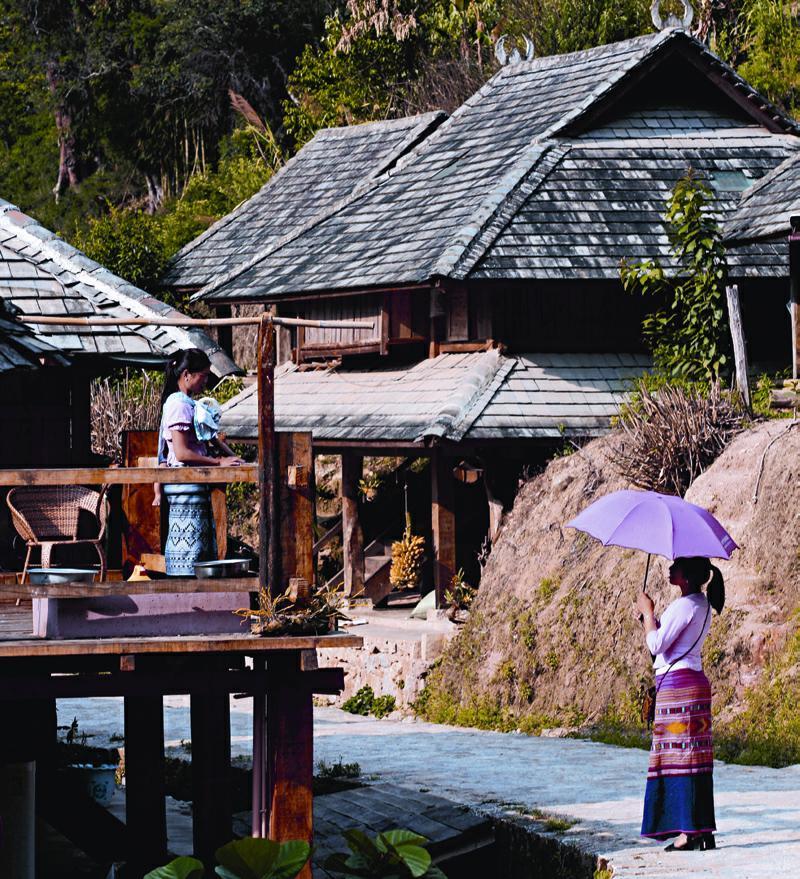
The Dai method of papermaking is one of Chinas earliest. Its importance to the local Dai culture is attributable to supplanting palm leaves as the medium for copying out the scriptures housed in Buddhist temples. The selection of material and actual manufacture of Dai paper is identical with that of the paper mulberry bark papermaking techniques used by ancient Chinese and recorded in agronomist Jia Sixies book Important Arts for the Peoples Welfare. Now a “living fossil” of Chinese ancient papermaking, the Dai technique consists in manually beating paper mulberry bark fiber into a pulpy substance resembling rice porridge. Dai paper protects against mosquitoes, and is thick enough to resist tearing, so able to last for centuries. Originally earmarked for the copying out of Buddhist scriptures, it was also used to document the Tusi and magistrates official proclamations and announcements. The common people, meanwhile, used Dai paper to make figurines and props for sacrificial ceremonies. As it was a cottage industry, men and women took equal responsibility for the papermaking process. Men usually carried out the washing, boiling and beating of the bark into pulp that women poured into molds to dry.
Dai paper is no longer used for the keeping of historical records, but Dai papermaking workshops still abound in Manzhang Village. Locals transform fresh-made Dai paper into aesthetic decorations. The beauty of their naturalistic depictions on clusters of frangipani flowers in bloom defies description.
Features of Dai ethnic culture include elephant riding, peacock dances, exaltation of cleanliness, and the wearing of tube-like sarongs. Yearly traditional and religious celebrations include the riotously playful water-splashing festival. The middle of the sixth month of the lunar calendar, however, is when locals celebrate the three-month-long Closed-Door Festival. Out of respect for various Buddhist activities at that time, it forbids villagers from travelling or holding wedding ceremonies. Upon its conclusion marked by the Door-Opening Festival, the busy farming season is over, temperatures then fall, and Buddhist activities dwindle. Young Dai folk may go courting to express love for the prospective partners of their choice, and marry. Consequently the Dai people regard the Door-Opening Festival as a time to set off firecrackers, light sky lanterns, and travel to different villages. In short, it is the most joyous time of the year, when every village is illuminated and infused with a festive spirit.
Daily Life of the Dai People
The Dai people mainly live in several autonomous prefectures of Yunnan Province, which usually see Dai villages cluster, adjacent to each other surrounded by paddy fields. Dai dwellings usually sit in bamboo courtyards whose floors bulge with the roots of the custard apple, papaya, mango, banana, pineapple, and jack fruit trees growing there. The red, yellow, and green colored leaves of heliconia rostrate plants contrast vividly with the more subtly colored Dendrobium orchids hanging from the second floor of each bamboo building, exuding a gentle fragrance. Amid this exotic scenario, young bamboo-hatted Dai women dressed in traditional colorful short blouses and straight skirts make their way to and from the nearby terraced fields. Meanwhile egrets and magpies fly by as peacocks, geese, and ducks wander about the courtyard.
Each day, as the pink glow of sunset spreads across the western horizon, villagers make their way home on mopeds, motorcycles, farm vehicles, and cars after a long day laboring in the fields. Their families help them unload the baskets filled with treasures from the fields, and children search eagerly for treats. The buzz of the days activities soon recedes as the smoke and aroma of supper cooking in the kitchen steal their way into each courtyard. Here and there can be heard the sounds of a rooster crowing, a dog barking, or a child crying. Also the faint yet unmistakable sound of the CCTV evening news broadcast can be heard through open doors and windows.
Dai people live peaceably with one another. Families of three, four, or even five generations often live harmoniously together under one roof. In line with the local culture, the eldest son or daughter lives with the older generation. The relevance of gender equality to the Dai culture is apparent in families endorsing and approving a bride or grooms choice either to bring their spouse home to live with them after the wedding, or to go and live with their husband or wifes family.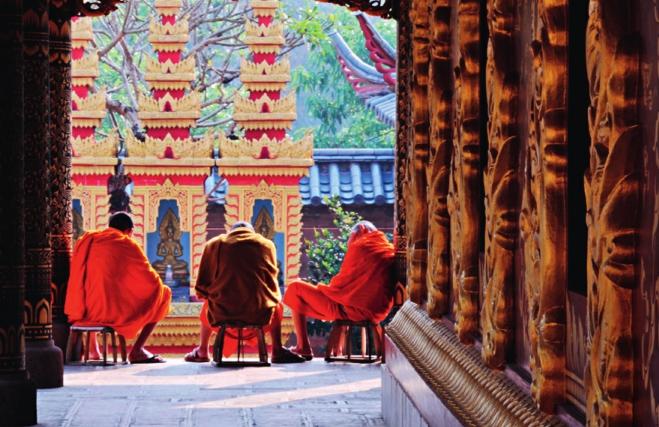
Theravada Buddhist temples are also part of Dai village life. The temple in Mengsuo Village in Ximeng Va Aconomous County is a showcase of Dai cultural characteristics. Decorated in vibrant colors, the temple houses a golden statue of Buddha standing against a red wall, as well as golden steps and pillars, a golden surrounding wall, and golden decorations, all beneath a red tiled, green edged roof. Two aus-picious animal statues decorated in gold and blue guard the entrance.
In a basketball court nearby, I met a local young woman on her way to meet her friends to rehearse a Dai dance performance in a scenic area of the county Ximeng. A few minutes later, I heard their peals of joyous laughter, and then the melodious strains of a Dai folk song as the young women began to dance. Two of them sang while the rest displayed exquisite flexibility in their dance moves to a melody evoking the murmur of pristine water flowing down the mountain.
Tracing Ancestral Roots along the Lancang River
Jingmai Mountain, located in Lancang Lahu Autonomous County of Yunnan Province, is a beautiful yet mystical region, one of the birthplaces of China tea culture. Several ethnic groups have lived under the protection of the towering mountain for millennia, not least the Dai people, whose ethnic roots go back 2,000 years. According to the legend, about 1,800 years ago the Dai tribal prince Zhaonuola realized that the population of his people was swelling as food resources diminished. He accordingly led several thousands of his people south in search of a new home. Having forged rivers, tramped through forests and valleys, and scaled steep mountains, they finally arrived at the magnificent Lancang River region in the nowaday county of Lancang. At that time, that boundless expanse of primitive forests of towering trees and bamboo was the preserve of millions of elephants and countless other species of free roaming beasts.
Zhaonuola and his people hence settled in the Jingmai Mountain region, cutting bamboo with stone implements, logging wood to build their homes, and relying on wild fruits and freshwater fish for nourishment. Its new denizens enjoyed a comfortable life of ample food and clothing and sturdy shelter. Today, ancient stone tools from the Neolithic period may be seen on decorative display in local village dwellings there.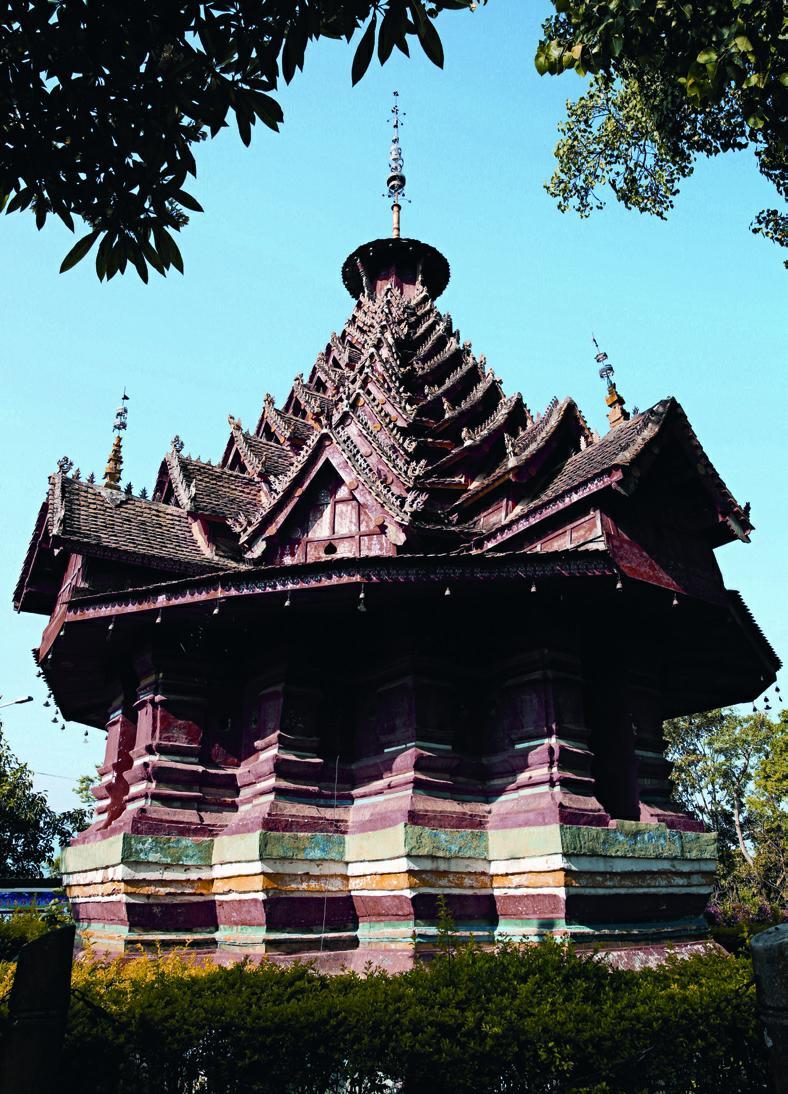
“Nuogan” means “the place where deer drink water” in the Dai language. The hamlet Nuogan in the Jingmai Mountain region is a well-preserved ancient settlement for Dai people where they live peaceably in stilted gray folk dwellings. The hamlet nestles in a small, flat, peaceful basin ringed with mountains, surrounded by primeval trees and tea trees, with a creek running through it. On the rare occasion outsiders wander into Nuogan, villagers give them a warm welcome, urging them to sit for a while in their homes and enjoy a cup of local Jiangmai tea. Everything about local life here is “ancient”— the villages history dating back over 1,000 years, its tea culture, way of life, and traditional ways of entertaining guests. The place Nuogan is also famous as home to seniors over 100 years old. The oldest resident there is 128 years old.
Dai people enjoy a peaceful and tranquil life in Chinas southwest. While maintaining the ancient customs of their ancestors, they also embrace modern civilization.