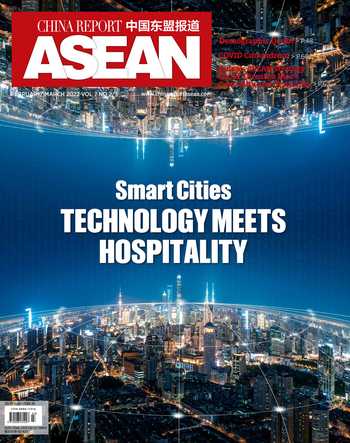
Visionary Cities
2022-04-20 12:23:58YuanYanan
中國東盟報道 2022年3期
Yuan Yanan

Cities have been undergoing changes through thousands of years since they first emerged. The “city dwellers” of the agrarian age could not have imagined the hustle and bustle of traffic, a serpentine overpass, or a towering skyscraper. The only constant in ever fluid cities is change.
Technological advancements, among others, have driven the changes of cities. By helping improve urban management and people’s life, new technologies such as big data and cloud computing are playing an increasingly important role in shaping cities.
Future City
The term “Smart city” was coined by IBM in 2009 as “using information and communication technology to sense, analyze, and integrate the key information of core systems in running cities. At the same time, a smart city can make an intelligent response to different kinds of needs including daily livelihood, environmental protection, public safety and city services, and industrial and commercial activities.”
IBM stressed the role of technology but did not offer a more specific description of smart cities. There was still no clear explanation of what exactly smart cities were or what they would ultimately look like. However, we already get a glimpse of smart cities of the future when new technologies start tackling specific problems in cities such as traffic congestion, environmental pollution, elderly care services in communities, and interactions between governments and businessorganizations.
Areas of Chicago, the most populous city in the U.S., have been fitted with a network of sensors, which works like a “fitness tracker” to provide both scientists and citizens with open data about the urban environment, and the government uses the information for urban greening and bus routing and scheduling. With the improvement of air quality, incidence of childhood asthma has decreased.
In Barcelona, a city on the coast of northeastern Spain, the street lights provide pedestrians free WiFi while collecting data on air quality. Energy consumption of street lights installed with sensors is reduced by 30 percent.
In the Lingang New Area in Shanghai, one of the largest cities in China, the intelligent management system “city brain” dispatches drones to automatically monitor the city at a five-minute interval, with daily flight mileage exceeding 100 kilometers, enabling civil servants to provide services to enterprises and residents more efficiently.
In Bangalore, capital of the Indian state of Karnataka, traffic congestion is frequent, and traffic speed on some roads averages only four kilometers per hour during peak hours. To tackle the problem, the local government introduced a smart bus system to collect real-time traffic information to adjust traffic signal timing and diverttraffic volume.
In 2018, McKinsey Global Institute released a research report entitled “Smart Cities: Digital Solutions for a More Livable Future.” MGI assessed 60 smart applications that will be relevant for cities through 2025. Thesmart applications in eight domains affect multiple aspects of the quality of life, namely mobility, safety, healthcare, water, waste, economic development and housing, and engagement and community. Studies showed that these applications could improve the quality of life in cities by 10 to 30 percent. Specifically, the report found that “these tools could reduce fatalities by 8-10 percent, accelerate emergency response times by 20-35 percent, shave the average commute by 15-20 percent, lower the disease burden by 8-15 percent, and cut greenhouse gas emissions by 10-15 percent, among other positive outcomes.” The data points to a more ideal urban life with guaranteed safety, efficient transport, green environment, and healthy lifestyles. Application of technologies seems key to solving many urban diseases.
Avoid Pitfalls
Although the future of smart cities seems promising, one must be clearly aware of the risks when applying new technologies.
“It would be dangerous to exaggerate technology’s role in solving social problems,” said Ben Green, former data scientist in the City of Boston’s Department of Innovation and Technology. In his book The Smart Enough City, he wrote, “cities need to have a clear policy agenda before deploying technology,” and “thinking about the city’s challenges and needs before thinking about technology is essential.”
Technologies are not neutral because algorithms and technological arrangements are embedded with different values that make discriminatory decisions. Relying too much on technologies to solve urban problems could lead to neglect of people’s needs and experiences.
Green suggested that by improving transportation efficiency with an eye only on arrival at a destination as quickly and barrier-free as possible, the fixers could end up making a city entirely unlivable.
“If we want cities in which people are able to cross the street, then we must avoid visions of downtown intersections where autonomous vehicles (AVs) speed through without ever stopping,” he wrote. “Main streets would turn into high-speed corridors: Imagine how unpleasant it would be to eat lunch or go shopping along the side of the freeway.”
Therefore, although the prospect of unencumbered AV travel is exciting to many technologists, it is not a central feature of successful urbanism. “A city devoid of traffic lights in the interest of enabling high-speed streets would also be devoid of people and character.”
Technology should be a means to solve problems instead of the purpose of urban development. Relying too much on technology is contradictory to the ambition of building an Ideal City, and cities should be livable and comfortable places for people.
Since smart cities need to be built on the basis of big data and data analysis, collection and protection of personal information is also an important issue. In the information age, privacy has been threatened as more and more personal data is collected and used. In particular, combining databases and artificial intelligence could enable people to acquire a wealth of personal information such as people’s identity, gender, marital status, health, and travel records. If personal information is collected indiscriminately, citizens will feel like the cities are controlling them, which is not what people want.
Ben Green advocated “Smart Enough Cities,” which means that the cities must embrace the benefits of new technology without falling prey to technological solutionism or treating cities as a simple object for technological optimization. A livable, democratic, just, green, and innovative city is the vision of an Ideal City. City managers should focus on the people and stay committed to preserving the energy and vitality of cities.