
ART IN THE FIELD
2022-04-20 01:36:48
漢語世界 2022年2期
Art festivals try to bring visual culture to China’s villages,but are they being put to good use?
For centuries,the sprawling terraced fields above Hanxi village,Fuliang county,had nurtured the highland region’s famous black tea:“The merchant cared more for money than for me,one month ago he travelled to Fuliang to purchase tea,”goes the poem“The Pipa Player”by Bai Juyi (白居易) in the ninth century,describing the attractions of the tea from the viewpoint of the merchant’s wife.
Yet in May of 2021,Hanxi’s tea terraces had new company—a huge lantern-like installation standing at the top of the hill made of see-through fabric.By daytime you could see the tree encased within it,while lighting up with ambulating contours at night.
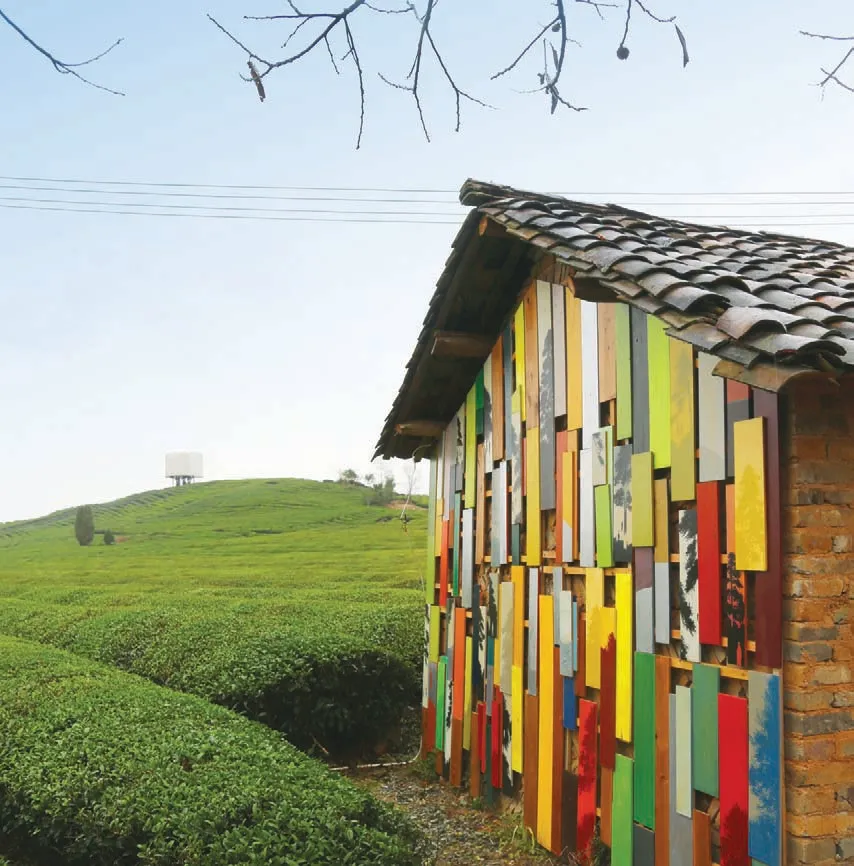
A once-abandoned home in Hanxi village serving as a gallery to exhibit art projects based on local history
This isThe Light of the Earth,created by Chinese architect Ma Yansong and inspired by Fuliang’s mountainous landscape.Located outside China’s porcelain capital of Jingdezhen,Jiangxi province,Fuliang was once where artisans gathered in the Song dynasty (960–1279) to produce porcelain directly for the emperor’s stores.But today,artists,architects,and musicians are flocking here under a different sort of invitation:to turn Fuliang’s unremarkable village buildings,abandoned warehouses,barren land,and empty tea gardens into an open-air gallery.
Art at Fuliang,the first Chinese edition of the Echigo-Tsumari Art Field Triennale festival,began in May of 2021 with 26 artists from five different countries invited to give new life to Fuliang’s landscape and cultural heritage.Deploying local resources and workers,even turning locals’ stories into visual exhibits,the artists completed 22 projects that drew in around 50,000 visitors in May last year,and tried to create a new model for rural revitalization.
Like the countryside of Japan’s Niigata prefecture,which began the Art Field Triennale in 2000 to bring visitors to its aging and natural-disaster stricken villages,China’s rural regions face similar problems of depopulation,poverty,and environmental degradation.A massive flow of labor from the countryside to the cities has deprived villages of young life and economic opportunity,while pollution and construction have degraded the natural environment.
Curator and educator Zuo Jing,however,tells TWOC that projects like Art at Fuliang should not be categorized as“rural art”per se—“there’s no such concept”—but rather,“rural reconstruction through culture and art.”The basic idea is“to participate in the development of the countryside from the perspective of culture and art,to emphasize the creative power of art to bring sustainable development,increase locals’ consciousness,as well as pride and happiness,”he explains.
PHYSICAL INTERACTION,IN THE FORM OF PHOTO AREAS OR THE SELECTION OF ENGAGING VISUAL ARTISTS,IS MORE AND MORE IMPORTANT EVEN IN SERIOUS ART INSTITUTIONS.
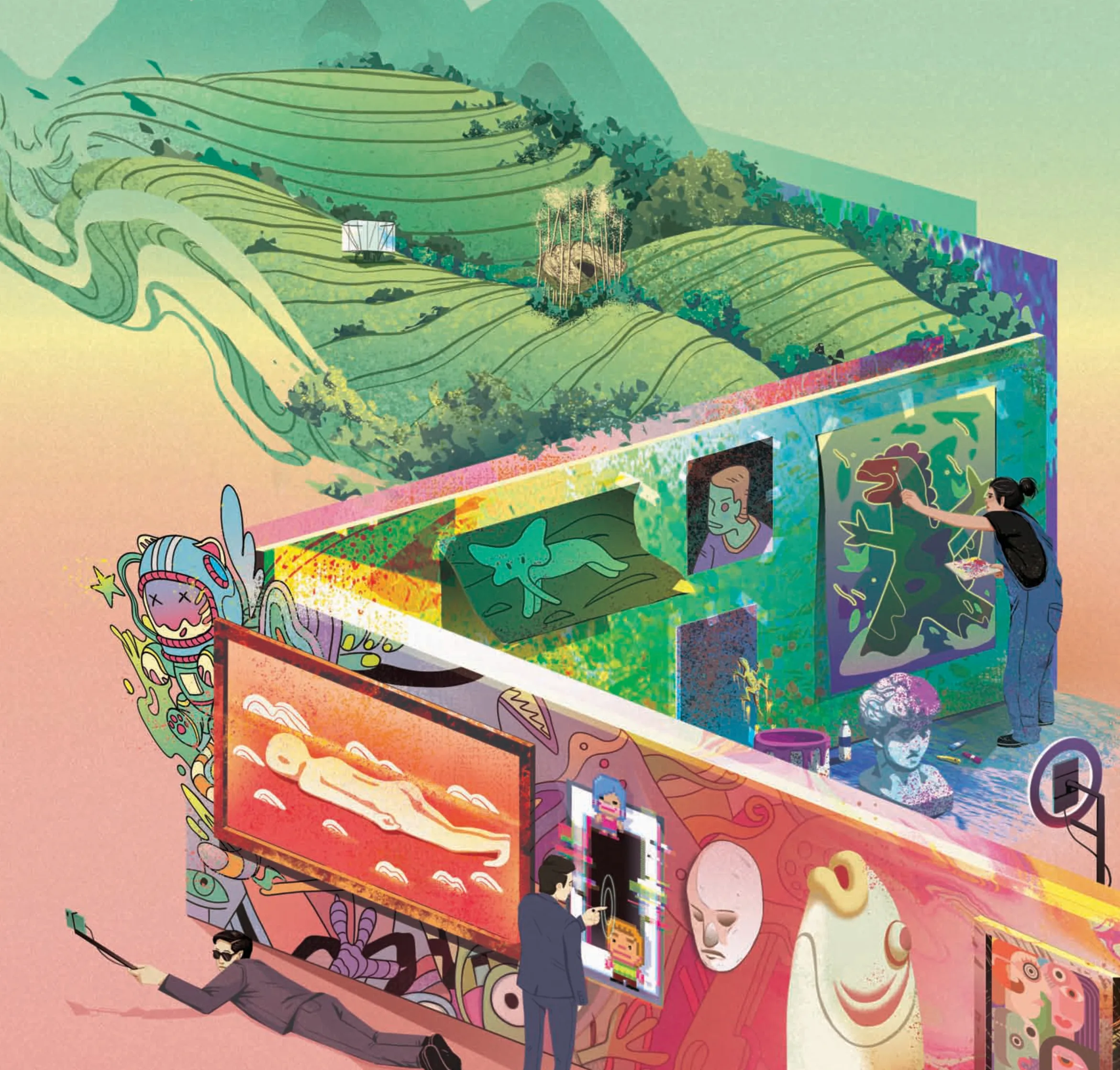
ILLUSTRATION BY XI DAHE
In 2011,Zuo launched the Bishan Village Project in Anhui province with his friend,filmmaker Ou Ning,which saw the conversion of a disused ancestral hall into a bookshop café,the opening of chic guesthouses,and a collaboration with designers to launch community-branded stationery and apparel to secure ongoing funds and create a marketable identity for the village.This was followed by projects in Guizhou,Yunnan,and Henan provinces.In each,Zuo collaborated with professionals such as architects,painters,photographers,sculptors,and dancers to develop conservation projects,workshops,exhibitions,and festivals according to local resources and needs.
Dozens of art festivals take place in villages around China today,and rural governments have invited private institutions or individual artists to open up art projects,art schools,and rural residency programs.They will often offer abandoned village homes and schools as places that artists can live and work in,transform into businesses,or even turn into installations.The biennial Heshun International Art Festival in Xucun village,Shanxi province,has been held every two years since 2011,and claims to attract tens of thousands of visitors to boost businesses,fill up village homestays,and buy local handicrafts.
Locals were encouraged to join Arts at Fuliang.“Six out of 50 volunteers were locals from this village in November,”Teng Huimin,head of the festival’s local working group,tells of the event’s second edition in the fall of last year.“Some eloquent volunteers are trained to introduce the artwork [to tourists],while the rest took charge behind the scenes by selling local products,guarding the entrance,checking visitors’ health codes,and more.”
In Hanxi village,the first stop for festival visitors are two abandoned houses that served as the canvas forStardust in Evolution:Memory of Shiziyuan Villageby artist Xiang Yang,who has exhibited at the Museum of Arts and Design in New York and National Art Museum in Beijing.Xiang and local villagers renovated the roofs of the houses together and repainted the walls 16 times with different colors with the idea of showing layers of history.Xiang also collected past and present images of Shiziyuan—people washing clothes by a stream,chickens chasing each other—and carved those scenes onto the walls,collecting the peeled-offpaint scraps and lacquer in a small transparent bag posted under each relief.
Inside one of the homes,visitors can see the process of ceramicmaking from a screen inside the cooking stove.In another house,Qian Changxian,a 50-year-old local volunteer guide,bursts into tears while describingMemory Containersto visitors in a dim room filled with dazzling rose-red painted jars.Artist Wu Jian’an had collected these ordinary jars for storing pickles,water,and rice from villagers,and arranged them on the walls and ceiling,showering the rustic dwelling in bright pink.
Most of the villagers in Hanxi are immigrants from Chun’an,Zhejiang province,who moved here in 1957 when the construction of the Xin’an River Hydropower Station flooded their homes.They had brought these jars,and little else,as they travelled nearly 300 kilometers by foot to settle in what was then an uncultivated part of Fuliang.Qian was born here to immigrant parents from Chun’an,and says her neighbors used the pickle jars to make a paste of mashed fermented soybeans,chili,and salt that they called“immigration sauce.”“When I was in elementary school,I ate rice mixed with this sauce for three years,no other dishes at all,”she recalls.“That’s what extreme poverty is.”
But not all rural artistic renovations run smoothly,asDream Home,a reality TV show which invited urban professionals to redesign homes for people in the China’s rural villages,found out.During the show’s eighth season in November 2021,a rural property owner from Gansu province accused architect Tao Lei of disregarding his wishes and leaving his family with a 1.3 million yuan(200,000 US dollars) price tag for a home they did not like.Combining wood panels with cement and red bricks,Tao adopted a minimalist design that fit his interpretation of local aesthetics,but the homeowner viewed exposed bricks as a sign of poverty,and preferred a two-story European-style villa like his neighbors had:with columns,balconies,and ceramic tiles for the exterior walls.

Artist Wu Jian’an painted old jars from villagers rose-red and arranged them on the walls and ceiling in“Memory Containers”
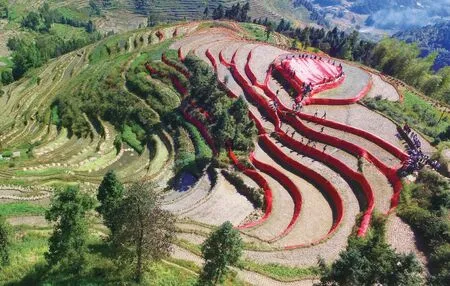
A group of artists wrapped red cloth over the Ziquejie rice terraces in“Land’s Pulse,”part of an art festival in Hunan province in 2015
Local governments also sometimes need convincing.In 2016,the central government issued a statement to close the Bishan commune,saying the project was not“politically correct”as the local party committee’s leadership was not apparent.However,when the central government proposed rural vitalization as a key national policy in 2017,rural administrators across the country began to enthusiastically push for similar projects.
This has sometimes led to overdevelopment and projects which critics argue have little to do with local culture,or bring few direct benefits to locals.After residents of Xiaoruo“Rainbow Village”in Wenling,Zhejiang province,painted their seaside homes a variety of pastel colors to attract lifestyle bloggers and trendy businesses,an investigation by TWOC last year found that rising property prices had created rifts between formerly close-knit neighbors in the village.Most of the profits also went to business-savvy outsiders,though the project at least brought more young locals back to the village.
Li Yaying,CEO of a tourism company contracted to create boutique homestays,cafes,and libraries out of old village dwellings,also describes“cognitive asymmetries”between her team and the local government.Local administrators were not confident that her project in Dongyang village,western Jiangxi province,would succeed,so they withheld supplies and infrastructural support.
“Imagine rebuilding houses with no water and electricity,”Li recalls.“I was so desperate,we asked the locals to use their residential power,but our high-capacity machines caused power outrages which delayed the project.”Not until the businesses started operating did the government connect them to water pipelines and roads.
On some level,Zuo admits that“rural reconstruction through art”has moved away from art for art’s sake.“In the beginning,we wanted to bring artistic resources from the city,but after so many years,at least in my experience,it’s no longer as important…[as] design,”he says,pointing to the design of buildings,landscapes,and products as the new keywords of his work.
“This is not to negate the use of art,”he adds,pointing out the role of artwork and festivals in giving locals a cultural education and a visual identity they can be proud of.“Art might not be the only solution to the development of rural areas,but it could undoubtedly establish dialogue and build a link with the outside world.”
