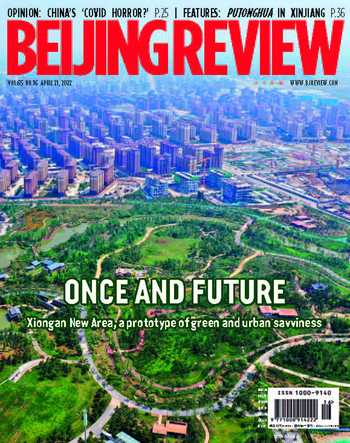
A FUTURISTIC CITY
2022-04-21 14:15:44ByJiJing
Beijing Review 2022年16期
By Ji Jing
Yang Lei, a manager at an engineering design company in Beijing, chose to be transferred to her company’s newly established branch in Xiongan New Area in Hebei Province in 2018.
It was challenging to leave her comfort zone but she didn’t want to miss out on opportunities working in the new area would present.
“When I first came here, the area was a little desolate, without many restaurants or entertainment venues. However, now, supermarkets, restaurants and bars that are open 24 hours are everywhere,” she told The Beijing Times.
In the first few years after she began working in the area, Yang commuted between her home in Beijing and Xiongan by car every day, with the round trip taking three hours. Today, she rents a newly built apartment in Xiongan, which is inexpensive and similar in quality to high-end residential compounds in Beijing.
With the construction of public facilities such as hospitals and schools, an increasing number of professionals like Yang have made Xiongan their homes.
On April 1, 2017, China’s central authorities announced a plan to establish Xiongan New Area—an area approximately 100 km southwest of Beijing, spanning Rongcheng, Anxin, and Xiongxian counties—and some adjacent areas. According to the plan, Xiongan will cover around 100 square km initially and expand to cover 200 square km in the mid-term and about 2,000 square km in the long term, with a population of 2 to 2.5 million.
Built to relieve Beijing of functions nonessential to its role as the national capital, it will be home to administrative and public institutions, corporate headquarters, financial institutions, universities and research institutes relocated from Beijing.
For a long time, there has been a large gap in development between Beijing and Tianjin and neighboring Hebei Province. Since the 18th National Congress of the Communist Party of China (CPC) in 2012, China has been promoting the coordinated development of the Beijing-TianjinHebei region, which was elevated to a national strategy in 2014.
The building of Xiongan New Area is a key step in implementing this strategy and relieving Beijing’s noncapital functions to help remedy its big city maladies such as traffic congestion and air pollution.
“This is another new area of national significance after the Shenzhen Special Economic Zone and Shanghai Pudong New Area,” read a circular issued by the CPC Central Committee and the State Council on April 1, 2017.
The move is a “major historic and strategic choice on the part of the CPC Central Committee with Comrade Xi Jinping at the core,” the circular continued, describing the decision as “a strategy crucial for the millennium to come.”
President Xi, also General Secretary of the CPC Central Committee, has planned for, made decisions on and promoted the Xiongan New Area in person.
During an inspection tour to Hebei on February 23, 2017, President Xi called for “global vision, international standards, Chinese characteristics and high targets in the area’s planning and construction.”
He called for efforts to turn Xiongan into “a demonstration zone for innovative development.”
The area should prioritize ecological protection and improve people’s wellbeing, as well as protect and carry forward Chinese traditional culture, he said.
Xi visited Xiongan again in January 2019. During a visit to the exhibition center for the planning of the new area, he emphasized that the creation of Xiongan is “a strategy that will have lasting importance for the millennium to come.”
China should remain committed to the new development concept and stick to high-quality growth when building the area, Xi said.
While visiting a government service center, Xi emphasized that development of the Xiongan New Area requires concerted efforts from a large number of enterprises.
“We welcome all companies whether they are state-owned enterprises or private companies, local firms or companies from Beijing, Chinese enterprises or foreign-funded companies, as long as they conform to the industrial development plan of the new area,” he said.
In June 2017, the Xiongan New Area Management Committee was established to take charge of government affairs for the new area. In July 2017, state-owned China Xiongan Construction and Investment Group was established to raise capital and undertake construction projects for subsidized housing, commercial real estate, transportation and energy infrastructure, as well as municipal utilities.
In April 2018, a master plan for Xiongan New Area was approved by the central authorities. The blueprint is the fundamental guideline on the planning and development of the new area, mapping out its future up to 2035 and looking into the mid-21st century. According to the plan, by 2035, Xiongan will have developed into a modern city that is green, intelligent and livable, with strong competitiveness and harmonious humanenvironment interaction.
Under the guiding blueprint, by mid-century, Xiongan will become a significant part of the world-class Beijing-Tianjin-Hebei city cluster, effectively performing Beijing’s noncapital functions and providing the Chinese solution to the country’s big city malaise.
“Promoting the high-quality construction of Xiongan New Area to high standards” was highlighted as a priority in this year’s government work report.
Liu Chuang is a project manager at China Construction Third Engineering Division Corp. Ltd., which was responsible for constructing the Xiongan Civil Service Center, a project that was completed in March 2018. Liu’s company had taken part in the construction of the Shenzhen Special Economic Zone in Guangdong Province decades ago and created a legend by building one office floor in three days.
The Civil Service Center was the first large construction project to begin after the establishment of the new area. The project used prefabricated components, which greatly improved the quality and speed of construction. Every component had a chip or QR code, which enabled big data management of the overall construction process.
New architectural technologies have been applied to the building of the center to ensure a green and environmentally friendly atmosphere.
Five years since the decision to establish the new area was first announced, large-scale construction is well underway and a city of the future is taking shape.
In the first quarter of this year, construction of 43 key projects with an investment of 60.1 billion yuan ($9.4 billion) began in Xiongan’s startup area, which covers 198 square km and will be part of Xiongan City proper.
The city itself will be a new home for Beijing’s colleges, research institutes, hospitals, business headquarters and financial institutions.
Headquarters of three centrally administered state-owned enterprises(SOEs)—China Satellite Network Group Co. Ltd., Sinochem Holdings Corp. Ltd. and China Huaneng Group Co. Ltd.—are currently under construction and other centrally administered SOEs have established over 100 subsidiaries and branches in the new area.
In addition to SOEs, Beijing’s high-quality education and medical resources are also being introduced to the area. Three premium schools—Beihai Kindergarten, Shijia Hutong Primary School, and Beijing No.4 High School—have set up campuses in Xiongan. Beihai Kindergarten’s Xiongan campus opened in December last year and the other two schools will be completed this year. A branch of Xuanwu Hospital, affiliated with a medical university in Beijing, will be completed next year.
Construction of transportation infrastructure in Xiongan has been accelerated and the Beijing-Tianjin-Hebei region has become better connected.
On December 27, 2020, the Beijing-Xiongan Intercity Railway went into operation, cutting travel time between Beijing and Xiongan down to 50 minutes.
The Xiongan Railway Station, which is an oval shape when viewed from above, has a unique structural design with no pillars seen in the waiting hall. The roof is covered with photovoltaic panels. The station uses an intelligent energy management system, which can report real-time energy consumption and carry out data analysis to inform the management process.

In May last year, three expressways passing through Xiongan—the Hebei section of the Beijing-Xiongan Expressway, the Rongcheng-Wuhai Expressway connecting Wuhai in Inner Mongolia Autonomous Region and Rongcheng in Shandong Province, and the expressway connecting Beijing and Dezhou in Shandong—went into operation. These three expressways, plus four existent ones, form a road network consisting of four north-south and three east-west expressways connecting Xiongan with the rest of the country.
The Beijing-Xiongan Expressway, which is expected to be completed by the end of this year, will slash road travel time from Beijing to Xiongan to an hour. An express railway line linking Xiongan with Beijing Daxing International Airport is also under construction. The line is 85.75 km long, will have seven stations, and is set to shorten the journey between the new area and the airport to half an hour.
Over recent years, Xiongan has seen better air quality, cleaner water and a higher forest coverage rate. Planting trees before building the city is one of the new concepts adopted in the creation of the new area.
Under the Millennium Forest project, an afforestation project that began in November 2017, over 23 million trees covering 30,266 hectares of land have been planted, increasing the new area’s forest coverage from 11 to 32 percent.
The high-quality development concept is being applied to the Millennium Forest project. A big data system is being used with a QR code attached to each tree, allowing for the targeted management of the trees’ planting, growth and maintenance. A remote surveillance system enables rapid detection and reporting of fires.
Through a series of cleanup projects, water quality in the new area’s Baiyangdian Lake, north China’s largest freshwater lake, has improved from worse than Grade V before the establishment of the New Area to Grade III last year. Grade III is the threshold level for water to be used for drinking.
The lake has become an important stop for migratory birds. According to Tian Haizhan, head of the Natural Resources Bureau of Anxin County, by the end of January, there had been 230 wild bird species at Baiyangdian, 24 more than before the new area was established.
The area’s first waste treatment facility is being built underground. Above the facility is a park, and the facility uses sound insulation and seepage-proofing measures to reduce its impact on surrounding residents.
The facility is also capable of turning trash into treasure. It can transform organic waste into thermal power, burn waste to generate electricity and turn slag into building materials.
Advanced smoke and exhaust gas treatment technologies will be used at the facility to minimize emissions.
The planning and construction of the new area has been steadfastly forward-looking. In contrast to other cities, the construction underground precedes that above ground. In Rongdong District, where over 30,000 relocated people were moved to new residential buildings at the end of last year, there is an underground city with two floors. One is for the electricity grid, water and gas pipelines and network cables; the other is a logistics channel making it possible for autonomous logistics vehicles to navigate underground in the future. The problem of overhead power lines will be solved and the roads in the new area will be better looking and safer.

In addition to the underground city, there is a city in the cloud. The first urban intelligent infrastructure platform in China will be established in the new area: an urban computing center will function as the “brain”of the city, which is responsible for the computing and storage of all kinds of intelligent city systems. An Internet of Things (IoT) platform and video platform will be responsible for managing the city’s IoT equipment and surveillance cameras, functioning as the city’s “neural system.” CIM, a three-dimensional urban space model, will be a replication of the real world in the digital world. Every new building and even every new street lamp in the city will be reflected in the system to facilitate urban management.
The new area has also been exploring institutional innovation to inject vitality into its development. Not only has Xiongan been designated as a pilot area for the digital yuan, but the Xiongan section of the China (Hebei) Pilot Free Trade Zone is also gaining steam as it was approved as a comprehensive pilot zone for cross-border e-commerce in April 2020.
The new area will be bustling with construction activity this year as over 230 projects with an investment value of more than 300 billion yuan ($47 billion) will be carried out, according to its official website. The projects include both public service projects, such as a sports center and a library, and major industrial projects like the industrial parks of the three major telecom operators, China Mobile, China Unicom and China Telecom. BR