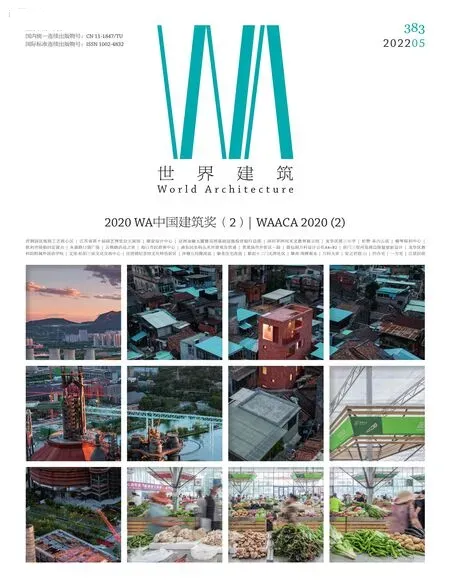
勝利市場臨時(shí)安置點(diǎn),濮陽,河南,中國
2022-05-25 06:37:46羅宇杰工作室
世界建筑 2022年5期
關(guān)鍵詞:建筑設(shè)計(jì)
羅宇杰工作室
業(yè)主:河南省濮陽市華龍區(qū)勝利路辦事處
主創(chuàng)建筑師:羅宇杰
參與設(shè)計(jì)人:王蓓蕾,魏文景
施工方:濮陽市晶藝建筑裝飾設(shè)計(jì)工程有限公司
建筑面積:2902m2
設(shè)計(jì)時(shí)間:2018.12
竣工時(shí)間:2019.04
攝影:金偉琦
Client:Shengli Sub-District Office,Hualong District
Principal Architect:LUO Yujie
Project Team:WANG Beilei,WEI Wenjing
Construction Firm:Puyang JINGYI Architectural Decoration Design And Engineering Co.,Ltd.
Area:2902 m2
Design Time:2018.12
Completion Time:2019.04
Photos:JIN Weiqi

1 干貨調(diào)料區(qū) Dry food &seasoning area
臨時(shí)性建筑&可持續(xù)利用
臨時(shí)市場,甲方的訴求是建造足夠快速,造價(jià)盡量低廉。作為設(shè)計(jì)師,則希望兼顧建造的可持續(xù)性,臨時(shí)使用期滿,依然可以進(jìn)行功能的轉(zhuǎn)換和再回收利用。低造價(jià)、快速、空間滿足多重使用的建造狀態(tài)在設(shè)計(jì)推導(dǎo)中被疊加考量,“方形”平面也是前置條件之一。充分工業(yè)化、超級(jí)標(biāo)準(zhǔn)套件的蔬菜大棚方式第一時(shí)間被納入實(shí)施優(yōu)選方案。它的建造部件是模塊化、輕量化、裝配化的,可快速建造,通過低成本而獲得相對(duì)大的空間,還可拆除異地建設(shè),桿件是標(biāo)準(zhǔn)件,亦可回收再用。
從無序空間到場所秩序
標(biāo)準(zhǔn)的工業(yè)大棚空間是均質(zhì)而無序的,常規(guī)菜市場的問題就是辨識(shí)混亂。如何通過必要的增建,在無序的空間里營造出秩序,方便販賣管理和市民采購,是設(shè)計(jì)的第二個(gè)議題。增建必須滿足兩個(gè)條件:尊重和利用現(xiàn)有結(jié)構(gòu)和構(gòu)造桿件的模數(shù);新增建造非標(biāo)準(zhǔn)工業(yè)構(gòu)件(再用性弱)必須低價(jià)、高效。
增建構(gòu)件選取低價(jià)且易得的材料,如普通木材、輕型鋼材、水泥板、成品角鋼、陽光板等。這些材料既方便安裝,又利于建造。通過主動(dòng)的材料控制,將具有自然感、暖色調(diào)的木材設(shè)置于底部的開放貨架、中部的封閉店鋪檐口、上部的結(jié)構(gòu)柱傘架,梳理了空間、歸納和強(qiáng)化了辨識(shí)度,營造出場所的秩序。
評(píng)委評(píng)語
菜市場與城市居民的日常生活密切相關(guān),作為原市場重建過程中用于騰挪的臨時(shí)建筑,河南濮陽勝利市場臨時(shí)安置點(diǎn)采用了盡量模塊化、輕量化和裝配式的建造體系,用低廉的造價(jià)快速建成了明亮、衛(wèi)生和整潔的“水晶宮”式市場,結(jié)構(gòu)、空間與構(gòu)造渾然一體,節(jié)奏輕快,秩序井然,且功能可靈活轉(zhuǎn)換。
勝利市場臨時(shí)安置點(diǎn)有著清晰的空間組織邏輯,注重干濕分離和氣味隔離,回應(yīng)疫情時(shí)期的空間管理訴求。主體空間以封閉式店鋪環(huán)繞開放式貨架布置,以四面錐體作為結(jié)構(gòu)柱傘架和雨棚的母題,特點(diǎn)鮮明。建筑使用了相對(duì)溫暖的木材、冷灰的輕型鋼和易于獲取的陽光板等相互配合,并考慮了材料回收再利用的可能。勝利市場臨時(shí)安置點(diǎn)無法按照永久建筑的技術(shù)標(biāo)準(zhǔn)和造價(jià)來設(shè)計(jì)和建造,但建筑師總體上創(chuàng)造了有品質(zhì)的空間環(huán)境和對(duì)使用者友好的場所,通過建筑設(shè)計(jì)對(duì)城市社區(qū)的日常生活的活力和環(huán)境品質(zhì)做出了積極有益的貢獻(xiàn)。
Temporary Architecture &Sustainability
The client required a fast construction process and low cost,while as designers we attached great importance to sustainability and wanted the architecture to be used for other purposes or recycled and reused after it had fulfilled its role as a temporary market.Taking those into consideration,we tried to figure out a solution to create a lowcost,multifunctional and sustainable architecture on the square plan in a short term.Eventually,we decided to adopt a fully industrialised vegetable greenhouse-like architectural structure,built with standardised component sets.All the components are lightweight,modular and prefabricated,which ensured rapid construction,reduced cost and obtained a relatively large architectural space.The building elements,including standardised rods,can be dismantled,recycled,or reused in other constructions.
From Disorder to Order
The space of standard industrial sheds is usually homogeneous and disordered.The common problem of most traditional vegetable markets is chaotic visual identity.Therefore,after deciding to adopt an architectural structure resembling industrialised vegetable greenhouse,the next important step was to create order in the disordered space by adding some necessary "extensions",so as to facilitate the management of selling activities and improve the shopping experience of the public.On the one hand,the added extensions must respect and utilise the standard modules of the existing structures and rods.On the other hand,additional construction of non-standard components (less reusable) must be low cost.

2 老市場 Old market

3 原狀航拍 Aerial view of the original status

4 黃昏的入口廣場 Entrance area at dusk

5 上午的入口區(qū) Entrance area in the morning

6 入口雨棚 Entrance canopy

7 總圖 Site plan

8 首層平面 Ground floor plan

9 蔬菜區(qū) Vegetables area

10.11 草圖 Sketches
All the extensions were built with cheap and easily accessible materials including common timber,lightweight steel,cement panels,steel angles and polycarbonate sheets,which were easy for installation and construction.Natural and warm tone timber can be widely seen within the entire space,which was applied to the open shelves,cornices of the enclosed shops and umbrella-shaped structural columns,thereby resulting in a clear visual identity of the space and creating a sense of order in it.
Jury Statement
Food markets are closely related to the daily life of urban residents.As a temporary building used for transition during the reconstruction of the original market,the Temporary Site of Shengli Market in Puyang City,Henan Province adopts a modular,lightweight and prefabricated construction system as much as possible,and quickly builds a bright,sanitary and clean "Crystal Palace-like" market at low cost.Its structure,space and construction are integrated.The pace is brisk with good order,and the function can be flexibly changed.
The Temporary Site of Shengli Market has a clear logic of spatial organisation,and focuses on the separation of dry and wet areas and odour control,responding to the demands of spatial management during the pandemic period.The main space features open shelves surrounded by enclosed shops,with rectangular pyramid form as the motif of the umbrella-shaped column structure and canopy:a distinctive feature.This project employs a combination of relatively warm tone wood,cold grey lightweight steels and easily-ob tained polycarbonate sheets,while the possibility of recycling materials is also considered.
The site could not be designed and constructed according to the technical standards and cost of a permanent building,but the architect created an overall user-friendly place with a quality spatial environment that makes a positive contribution to the vitality and environmental quality of the everyday life of an urban community through architectural design.□ (Translated by Dandan Wang)

12 入口正立面 Entrance fa?ade

13 雨棚節(jié)點(diǎn) Details of canopy

14 傘柱節(jié)點(diǎn) Details of umbrella-shaped columns

15 立面 Elevation

16 剖面 Section

17 傘柱標(biāo)識(shí) Signs on umbrella-shaped columns

18 傘柱與貨架 Umbrella-shaped columns and shelves

19 開放式貨架 Open shelves
猜你喜歡
北方建筑(2021年6期)2021-12-31 03:03:54
文苑(2020年10期)2020-11-07 03:15:36
現(xiàn)代裝飾(2020年7期)2020-07-27 01:27:42
現(xiàn)代裝飾(2020年6期)2020-06-22 08:43:12
現(xiàn)代裝飾(2020年4期)2020-05-20 08:55:08
流行色(2020年1期)2020-04-28 11:16:38
藝術(shù)啟蒙(2018年7期)2018-08-23 09:14:18
海峽姐妹(2017年7期)2017-07-31 19:08:17
Coco薇(2017年5期)2017-06-05 08:53:16
福建農(nóng)業(yè)科技(2016年10期)2016-03-07 09:46:49