
What’s Next For Sri Lanka
2022-05-30 09:25:52HuZhiyong
中國東盟報道 2022年8期
Hu Zhiyong
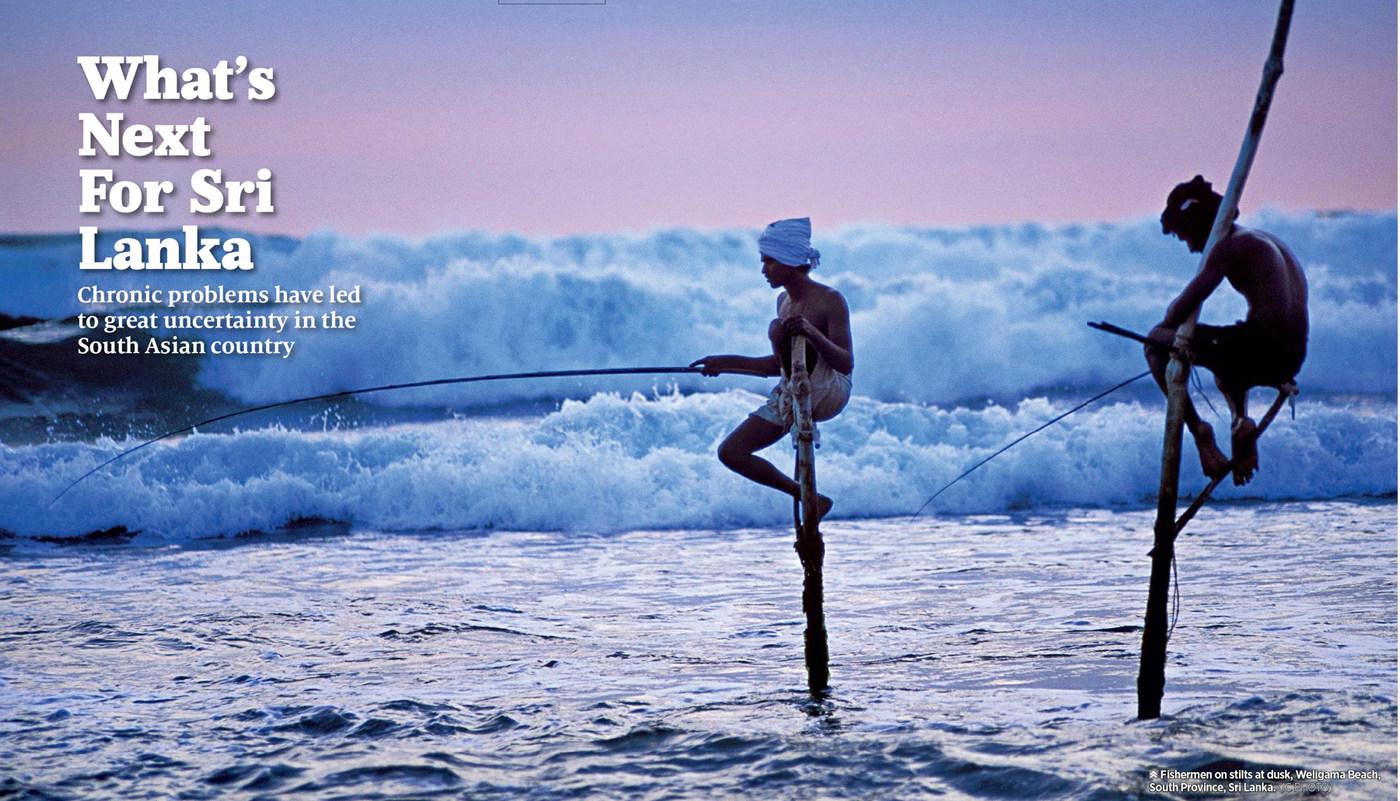

Sri Lanka is suffering its worst economic crisis since its independence in 1948.
The ongoing crisis has resulted in collapse of the currency, rising inflation, and a severe shortage of essentials, which have led to an eruption of street protests and strikes in many parts of the country. The domestic situation has been tense. On July 5, Prime Minister Ranil Wickremesinghe said in Parliament that Sri Lanka had “gone bankrupt.” On July 9, demonstrators stormed the presidential palace, the presidential secretariat, and the prime ministers residence. In the early hours of July 13, President Gotabaya Rajapaksa left the country on a military aircraft. Hours later, Sri Lanka entered a state of national emergency, and curfew was imposed in the Western Province, where the executive and judicial capital Colombo is located.
For quite some time, Sri Lankas foreign exchange reserve has been dwindling alongside high debt and depreciating currency. The Sri Lankan government was forced to turn to the International Monetary Fund (IMF) for help. However, due to its over-reliance on international assistance and policy, Sri Lanka has failed to deliver effective development alternatives and has been unable to respond to this unprecedented crisis.
Chronic Economic Problems
Long-standing economic development problems are the root causes of the current crisis. From the perspectiveof economic structure, Sri Lankas economy relies heavily on external markets, with agriculture (fishery), primary processing industry, and general service industry as pillars, and tourism as an important source of foreign exchange. The industrial foundation is relatively weak, based on laborintensive light industries and with underdeveloped capital markets and technologyintensive industries.
Sri Lanka was the first country in South Asia to implement economic liberalization policyto make structural adjustments towards the neoliberal track. In 1978, the government introduced a free market economy while actively attracting foreign investment, establishing free trade zones, and removing state control over imports. It also incorporated privatization and promoted private enterprises to create a free economic environment and gradually form a market economy system. This process of liberalization and deregulation widened the gap between the rich and the poor, which exacerbated the vulnerability of its national economy.
In large part because the Sri Lankan Civil War (1983- 2009) lasted for 26 years, the fairly radical neoliberal economic policy could not be implemented effectively, and global capital lost interest in Sri Lanka. After the end of the war, Sri Lanka implemented radical deficit fiscal policy to restore and develop its economy, which added more to the burden of national debt. In total, Sri Lanka has accumulated about US$51 billion in foreign debt. In terms of international trade, Sri Lanka has had a deficit on its balance of payments for many years. In April, the Sri Lankan government announced that it would suspend payments on its foreign debt due to a foreign exchange shortage.
Failures of domestic policy over the last four years accelerated Sri Lankas economic collapse. After the Rajapaksa government took office in 2019, it introduced significant tax cuts, losing more than US$1.4 billion in annual government revenues. By the end of 2019, Sri Lankas foreign exchange reserve was a mere US$7.6 billion.
In early 2021, Sri Lanka began to suffer a foreign exchange shortage. In April 2021, the government suddenly announced an organic farming program with a ban on the import of fertilizers, pesticides, herbicides, and fungicides to reduce foreign exchange outflows. The ban resulted in more expensive farming that produced only half of the yield, severely weakening self-sufficiency in rice. The government was then forced to import grain from abroad at high prices to replenish its reserves, which only exacerbated the foreign exchange shortage. Although the ban was revoked for certain crops in November, irreparable damage had already been done to the production of grain, tea, and rubber—the countys trademark exports.
When the Civil War ended and the Rajapaksa regime stabilized, global capital began to flow into Sri Lanka, making the Sri Lankan economy appear strong. Boosted by foreign capital, Sri Lanka made a large investment in domestic real estate which damaged smallscale agriculture and the selfsufficiency rate of grain. State investment in agriculture has continuously declined, reducing the growth rate of agricultural production.
Impact of External Crises
The global surge of the COVID-19 pandemic hit the fragile Sri Lankan economy hard. Tourism is a key pillar of the Sri Lankan economy. Before the pandemic outbreak, tourism accounted for more than 12 percent of the countrys GDP, and tourism revenues accounted for 14 percent of its foreign exchange. The pandemic caused a sharp drop in international tourists to Sri Lanka. In addition, the remittance of 2 million Sri Lankan nationals working overseas plummeted, which further aggravated the foreign exchange crisis.
The lack of foreign exchangefor imports became a “catalyst,” worsening problems such as fuel shortages, drug shortages, power outages, and rising food prices.
The Russia-Ukraine conflict and Western sanctions have led to soaring international oil and gas prices, which has had a severe impact on the Sri Lankan economy and peoples lives. Both Russia and Ukraine are important trading partners of Sri Lanka and important markets for exported Sri Lankan tea. Whats more, they are important sources of international tourists to Sri Lanka. The Russia-Ukraine conflict has not only blocked normal trade between Sri Lanka and the two countries, but also led to soaring grain and energy prices in the international market. Sri Lanka has been left trapped in a desperate situation of spiking prices of food and energy imports, a hard-hit tourism industry, and a foreign exchange shortage.
Crisis Response
The current crisis in Sri Lanka is the combined effect of a series of factors. It not only reflects the chronic deep-rooted problems of Sri Lanka during its process of economic development, but also the risks and difficulties that small and medium-sized countries must navigate to facilitate social and economic development in a complex and volatile international economic and political environment.
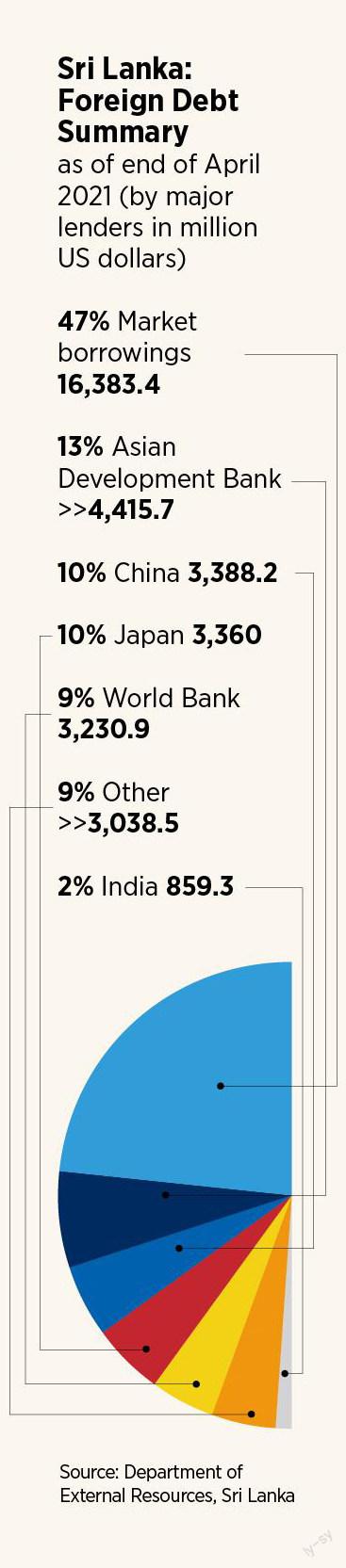
Sri Lanka is an important participant in the Belt and Road Initiative (BRI). Chinas generous assistance has directly promoted infrastructure improvement and socio-economic development in Sri Lanka. Despite its large debt deficit, the debt Sri Lanka owes China is not the root cause of the current crisis, contrary to what some Western media have alleged. In reality, loans from China for BRI projects account for only 10 percent of Sri Lankas total foreign debt. China is also a potential victim of Sri Lankas debt crisis.
In a July 15 media interview, Sri Lankan Ambassador to China Palita Kohona said that the World Bank, Asian Development Bank, and Western institutional investors are currently Sri Lankas largest creditors. “We owe Western institutional investors a lot of money, including Wall Street,” said the ambassador. He said that Sri Lanka hopes that the World Bank, Asian Development Bank, and other institutions would step up with a package to solve the countrys debt problem. “We also encourage countries including India, Japan, and China to offer us more aid,” he added. “We need help from our friends to get out of the current predicament.”
China hopes that Sri Lanka will escape the turbulence, solve the chronic problems, and get back on track as soon as possible. According to Chinas Ministry of Foreign Affairs, in April and May 2022, the Chinese government announced that it would provide emergency humanitarian assistance worth 500 million yuan (US$74 million) to Sri Lanka, the largest amount of free assistance for Sri Lanka since the beginning of this crisis. On July 14, the second round of emergency humanitarian food assistance provided by China was delivered to Sri Lanka.
On July 12, Chinese Foreign Ministry spokesperson Wang Wenbin said that China would continue providing assistance for the economic and social development of Sri Lanka and supporting its efforts to revive the economy and improve its peoples livelihoods. “As to Sri Lankas debt to China, China supports relevant financial institutions in having consultations with Sri Lanka to seek a proper settlement,” Wang said. “China stands ready to work with relevant countries and international financial institutions and will continue to play a positive role in helping tackle Sri Lankas current difficulties, ease its debt burden, and achieve sustainable development.”
How should Sri Lanka deal with this crisis?
First, stabilize the situation as soon as possible. Sri Lanka should take the crisis as an opportunity to organize an allparty unity government, set aside prejudices, and improve its governance capacity. It should also work to restore social and economic order to overcome difficulties and climb out of the crisis as quickly as possible.
Second, fundamentally, its necessary for Sri Lanka to carry out both institutional and structural reforms to diversify its over-reliance on tourism and exports and reduce or eliminate over-reliance on the single market.
Third, Sri Lanka should seek support and assistance from other countries and international financial institutions to accelerate debt restructuring and actively apply for short-term loans to reduce the pressure of debt payments.
In addition, the government can consider selling assets while cutting any extravagance. Government budgets and expenditures can be reduced so that the limited financial resources can be applied to the most urgently needed projects to improve the national economy and peoples livelihood.
The future of Sri Lanka depends on the formation and functioning of the new government. Due to chronic problems, the evolving situation in the country remains highly uncertain.
