Harmony Between People and Water in Beijing
2022-06-08 02:52:26TextbyMaDongchun
China Pictorial 2022年6期
Text by Ma Dongchun

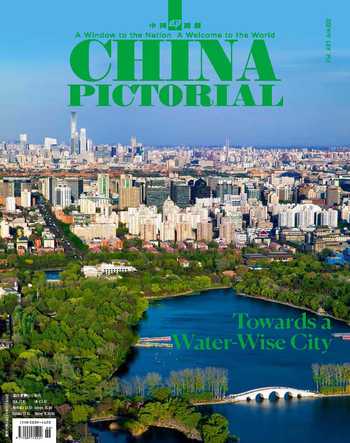
Yuyuantan Park is adjacent to Diaoyutai State Guesthouse and the CCTV Tower in the west part of Beijing.by Ma Yue/China Pictorial
Historically, the site selection of cities in China was closely related to the layout of the water system.The city of Beijing was also built with an eye on water.Eight centuries of history as a capital has left Beijing with plentiful aquatic cultural legacies.Appearing in various forms and distributed in a concentrated way,they are unquestionably unique.
Three Kinds of Water Conservancy Heritage
The water conservancy heritage of Beijing falls into three categories: First, the heritage of the Yongding River, which mirrors the development of Beijing; second,the water system of the imperial city, which reflects the political characteristics of the ancient capital; third, the heritage of canal excavating, dredging, and shipping that served the political center.
The Yongding River is the largest river flowing through Beijing.In prehistoric times, the river carried a large volume of soil and gravel from upstream, which eventually formed the Yongding River alluvial fan, which merged with the alluvial fans formed by the Juhe, Chaobai, Wenyu, and Dashi rivers to become Beijing’s plain area.
Water systems of the ancient Lotus Lake and the ancient Gaoliang River are all ancient tributaries of the Yongding River.These ancient water systems,alongside springs in the Western Hills and the rich groundwater resources in the suburbs of the city, are mainly fed by the Yongding River.The ancient Yongding River also spawned the Wanquan and Qinghe rivers, as well as many lakes and wetlands, providing abundant water resources for Beijing and the surrounding areas.Beijing’s earliest large-scale water conservancy projects—the Liling Weir and the Chexiang Canal,as well as China’s oldest existing multi-arched stone bridge dating back to the 13th century—the Lugou Bridge, were all built along the Yongding River.The river helped foster a profound and unique culture in Beijing.
As an ancient capital of six dynasties, the old district of Beijing adopted a water system with characteristics of an imperial city.The water system is laid out in circles, offering several layers of shelters to the ancient capital.In the past, the water supply and drainage system of the imperial city was used for military defense,fire prevention, flood control, and as a source of drinking water for those living in the imperial palace.
After Beijing became the political center of the country,water transportation became more and more crucial, and the water transportation artery from south to north was excavated and dredged many times.Guo Shoujing in the Yuan Dynasty(1271-1368) led a project to divert Baifu Spring to Jishuitan Lake which realized full navigability of the entire Grand Canal connecting Beijing and Hangzhou.The Zhangjiawan Canal Wharf,hailed as the “largest wharf in the east of Beijing,” still exists, and the Guangyuan Gate, the first watergate in the upper reaches of the Tonghui River in the Yuan Dynasty, still stands, alongside many official warehouses along the waterway, hearkening to a magnificent scene of the canal transportation of yesteryear.

Ma Dongchun, chief technical engineer of the Beijing Water Science and Technology Institute.by Zhang Ye/China Pictorial
Sustainable Water Conservancy Culture
Beijing’s city planning has always adhered to a people-oriented principle,focusing on sustainable development with the history,status quo, and future development of the city taken into consideration.Population,resources, and the environment have all been weighted to ensure culture, ecology, and urbanization complement each other.
The core of utilizing water and developing water culture is properly handling the relationship between people and water, which is reflected in the relationships between water and city, between water and land, and between water and industry.
At present, 508 water-related cultural heritage sites with diverse forms and functions have been identified in Beijing.After centuries of development,the responsibilities of managing water conservation heritage remain complicated and vague.Management methods have not been unified yet.Some even lack formal management, and most are in need of multi-departmental collaboration and top-level designs and planning.A unified management mechanism is urgently needed.
Although Beijing boasts rich water culture, many historical water conservancy projects were transformed or demolished to varying degrees and their functions were gradually weakened and disappeared due to historical reasons or urban construction needs.The structures and characteristics of the city’s water cultural heritage have not been completely retained.
Names of certain places in central Beijing preservememories of water culture such as Longxugou (an ancient drainage channel), Dongbuyaqiao Hutong (a lane named after a Yuan Dynasty stone bridge),Beiheyan Street (a canal-side street), and many more.However,during the urbanization process,many memories of water culture have gradually been lost.

The former Qing Dynasty (1644-1911)waterworks in Dongcheng District,Beijing, was built in 1908.It was the first waterworks in Beijing.The site has preserved relatively complete factory buildings and water processing facilities and equipment.It is an important testament to the development of Beijing’s urban water management.by Zhang Ye/China Pictorial

The Bali Bridge, formerly known as the Yongtong Bridge, is located in Chaoyang District, Beijing.It is a three-arch stone bridge built in 1446.courtesy of Beijing Water Authority
Nonetheless, city administrators have been actively restoring and recreating Beijing’s water conservancy relics and landscapes.In 2003, the cover of the Zhuanhe River in Beijing was lifted.The hidden river was unveiled, and the landscape of the Zhuanhe River system was rebuilt.In 2017, the Sanli River water system was reconstructed based on its original watercourse more than 1,400 years ago,with an eye on recapturing the historical scene.Restoration projects for ancient water systems in the core area of the capital and other parts of Beijing have been implemented one after another.
The protection and inheritance of Beijing’s water conservation heritage are intricately intertwined with the city’s history and have emerged as a unique cultural resource for urban development.Policy support for water cultural heritage is now standard in the construction and development of the city.But protecting such legacies demands efforts to preserve their authenticity and integrity comprehensively and systematically.While appreciating history and culture,we should find better ways to leverage and promote heritage like this.