GSI Towards World Peace
2022-07-14 09:45:27XiJinpingThoughtonDiplomacyStudiesCenter
當(dāng)代世界英文版 2022年3期

On April 21st, the Boao Forum for Asia?nnual Conference 2022 was declared open. Chinese President Xi Jinping delivered a keynote speech titled Rising to Challenges and Building a Bright Future Through Cooperation via video link, in which he proposed the Global Security Initiative (GSI) for the first time. Amid great changes and a pandemic unseen in a century, the international situation undergoes profound and complicated evolution, regional security hot spots flare up one after another, and traditional security and non-traditional challenges interact, and especially with the Russia-Ukraine conflict intensified recently, the underlying effects continue to crop up, the issue of international security once more calls for high attention. The proposition of the GSI, beyond any doubt, makes clear the direction of advancement for maintaining world peace and tranquility, and shows the way for human society to a world of lasting peace and universal security.
Core Message of the GSI
The GSI is a complete system of logical rigor, rich in meaning, and its core message manifests in the six commitments put forward by President Xi.
First, it is necessary to stay committed to the vision of common, comprehensive, cooperative and sustainable security, and work together to maintain world peace and security. The world today increasingly becomes a community with a shared future where everyone has a stake. In order to rise to the challenges to global security and achieve lasting world peace and tranquility, it is necessary to establish among all countries the new vision of common, comprehensive, cooperative and sustainable security. This new security vision calls for respect and guarantee of the security of every country, maintaining security in both traditional and emerging domains, promoting security for all countries and for a given region through dialogue and cooperation, and at the same time giving parallel priorities to development and security with a view to achieving lasting security.
President Xi has made outstanding contributions to enriching and developing solutions to global security issues. During his first visit abroad after taking office in March 2013, President Xi expounded his views on world security issues, that in face of global challenges, we need to be united and through working together turn pressure into driving forces and crises into opportunities. “In the face of complex security threats, one country cannot act alone and it is even worse if it is obsessed with military options. The only right choice is to achieve collective and common security through cooperation.” In May 2014, the 4th Summit of the Conference on Interaction and Confidence-Building Measures in Asia (CICA) was held in Shanghai, at which President Xi called for actively advocating an Asian security concept for common, comprehensive, cooperative and sustainable security, and he subsequently expounded the view on several other international occasions. At a high-level meeting for extensive consultation and joint construction of a community with a shared future for mankind held in Geneva, January 2017, President Xi called for upholding the principle of joint construction and shared benefit in building a world of universal security. At the 20th Meeting of the Council of Heads of State of the Shanghai Cooperation Organization (SCO) in 2020, President Xi stressed that “we need to safeguard security and stability and build a community of security for us all”. China has put forward a systematic and complete new vision of international security, which is increasingly concurred universally and supported extensively in the international community.
Second, it is necessary to stay committed to respecting the sovereignty and territorial integrity of all countries, uphold non-interference in internal affairs, and respect the independent choices of development paths and social systems made by people in different countries. In the 1950s, China put forward the five principles including mutual respect for sovereignty and territorial integrity, mutual non-aggression, non-interference in each other’s internal affairs, equality and mutual benefit, and peaceful coexistence, known as the Five Principles of Peaceful Coexistence. Through decades of diplomatic practice, the Five Principles of Peaceful Coexistence have become basic norms of international relations, playing an important role in promoting the establishment of a new equitable and reasonable international political and economic order. What determines the development path a country takes is its internal affairs, no other countries have the right to interfere or make indiscreet remarks or criticisms. Should any country be apt to outstretch its hand to other countries, wantonly interfere in their internal affairs and pull them onto its own track through coercion and subversion, then there would be no end of troubles between countries, and not to mention global lasting security.
China is both the original advocate and a faithful practitioner of the Five Principles of Peaceful Coexistence. Since the 18th National Congress of the Communist Party of China (CPC), President Xi has, in view of profound changes in the international situation and the future and destiny of mankind, put forward important concepts and initiatives such as building a community with a shared future for mankind, constructing a new type of international relations, joint construction of the Belt and Road, and putting it into practice to uphold justice and friendship and pursue shared interests, all of the above inheriting and carrying forward the gist and essence of the Five Principles of Peaceful Coexistence, thus making outstanding contributions to promoting world peace and development.
Third, it is necessary to stay committed to abiding by the purposes and principles of the?UN Charter, reject the Cold War mentality, oppose unilateralism, and say no to? group politics and bloc confrontation. The UN Charter prescribes “to maintain international peace and security” in its four purposes, and prescribes “sovereign equality” and “non-intervention in domestic affairs” in its seven principles. These purposes and principles stand for basic principles of contemporary international law and basic norms of international relations. However, some of the countries turn a blind eye to them and are vigorously engaged in unilateralism, hegemonism and power politics, advocating the so called rule-based international order, instigating faction confrontation, and frequently suppressing countries of different social system and values, to the detriment of institutional power of other countries, especially the host of developing countries, and to the detriment of the efficacy and authority of the United Nations.
China has always resolutely abode by the purposes and principles of the?UN Charter and the basic norms of international relations, and firmly upheld the international system with the UN as its core and the international order based on international law. History has fully proven that the Cold War mentality and group politics are not only unable to create security, but instead will create war and turbulence. A new Cold War goes against not only the tide of historical development but also the aspirations of the people the world over.? It is doomed to fail.
Fourth, it is necessary to stay committed to taking the legitimate security concerns of all countries seriously, uphold the principle of indivisible security, build a balanced, effective and sustainable security architecture, and oppose the pursuit of one’s own security at the cost of other’s security. Mankind are an inseparable community of common security, countries around the world having been like since long ago passengers aboard the same ship who have to stand together through thick and thin and share the same destiny. The thought of throwing anyone overboard is simply unacceptable. All countries should seek the greatest common divisor of security interest, allowing not only security of oneself but also that of others. They should never impair security of other countries in the name of securing that of their own.
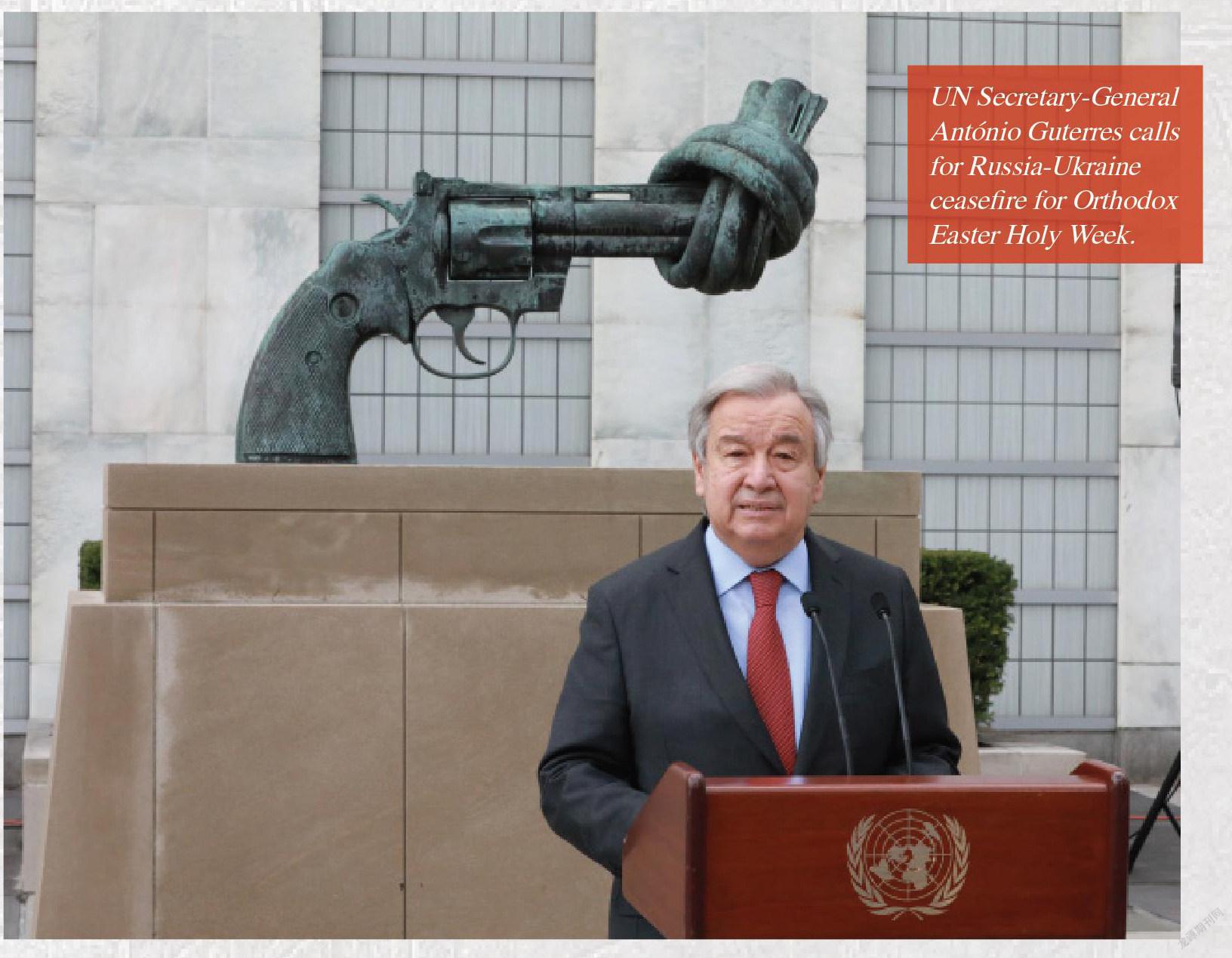
The ongoing Russia-Ukraine conflict is the epitome of the current problems of international security. The root of the crisis is the long accumulated regional security contradictions in Europe, to which the solution is to take into account legitimate security concerns of all countries concerned. The greatest lesson to draw from the Russia-Ukraine conflict is that one country’s security cannot be built at the cost of that of other countries, that regional security cannot be guaranteed by strengthening and even expanding a military bloc, and that all countries or groups of countries should not wantonly impair other countries’ sovereignty and security for the sake of maintaining their own absolute military advantage or absolute security. As it is better for the doer to undo what he has done, a solution to the Russia-Ukraine conflict requires the concerned parties to discard the Cold War mentality, to take seriously and respect legitimate security concerns of all parties, and to build, through negotiations, a balanced, effective and sustainable European security architecture.
Fifth, it is necessary to stay committed to peacefully resolving differences and disputes between countries through dialogue and consultation, support all efforts conducive to the peaceful settlement of crises, reject double standards, and oppose the wanton use of unilateral sanctions and long-arm jurisdiction. Dialogue and consultation are the only and fundamental way to resolving differences and conflicts. When countries have sufficient goodwill and political wisdom, no conflict is too big to settle and no ice is too thick to break. Conversely, resorting to sanctions and even the force of arms can only bring serious difficulties to economy and to people’s livelihood of concerned countries and regions, and ultimately hurt oneself as well as others.
To prop up its declining hegemony and consolidates its global leadership in political, economic, diplomatic and judicial domains, the U.S. imposes its domestic laws above international law and norms, frequently using the club of sanctions, and rudely applying the so called long-arm jurisdiction. In essence, the U.S. overstretches the concept of national security to seek comprehensive competitive advantage, attempt to continue acting as a global sheriff, and hold down countries deemed to be in competitive relationship with it. By disrupting international cooperation, and dividing the international community, it aims to push up tensions and profit from chaos. Such deeds are more and more rejected and disdained by peace loving countries and peoples of the world.
Sixth, it is necessary to stay committed to maintaining security in both traditional and non-traditional domains, and work together on regional disputes and global challenges such as terrorism, climate change, cyber-security, and bio-security. With the deepening economic globalization, the intension and extension of security have extensively broadened, security threats cropping up one after another. Security is more interconnected, transnational and diverse. Traditional security and non-traditional one are interconnected, mutually affecting, and under certain circumstances mutually transforming one another.? It is an issue that cries for solution to maintain security in traditional domain and achieve overall peace and stability in the world on the one hand, and on the other, to maintain security in non-traditional domain and remove security threats to the maxim, and continue to enhance people’s sense of security.
To maintain both traditional and non-traditional security, it is necessary to deeply understand the objective fact that in our times traditional security and non-traditional one are intertwined and integrate one another, which need to be dealt with by comprehensive means. It is necessary to stick to the path of multilateralism, go by the vision of common, comprehensive, cooperative and sustainable security and the global governance vision featuring extensive consultation, joint contribution and shared benefit, and support the role of the United Nations, the World Trade Organization, the World Bank, and the World Health Organization in actively forming international synergy to conduct effective cooperation in non-traditional security domains for the ultimate goal of common security.
China Is an Active Practitioner of the GSI
China has held high the banner of peace, development, and cooperation for win-win results, taking up its responsibility for safeguarding world peace and stability, making positive contributions on a series of traditional and non-traditional security issues, and setting example for promoting and implementing the GSI.
On the Ukraine issue, China has adopted an objective and impartial attitude. It independently assesses the situation and makes its position clear on the basis of the merits of the issue. It pushes for both the Russian and Ukrainian sides to resolve the conflict through negotiations. The Chinese side has also taken the lead in proposing a six-point initiative to prevent a large-scale? humanitarian crisis in Ukraine from happening.
On the Korean Peninsula, China has, being responsible, insisted on the denuclearization of the Peninsula, stressed on maintaining peace and stability of the Peninsula, and following the dual-track approach to address the legitimate concerns of all parties in a balanced way, and called on the American side to take concrete measures to address the legitimate security concerns of the DPRK.
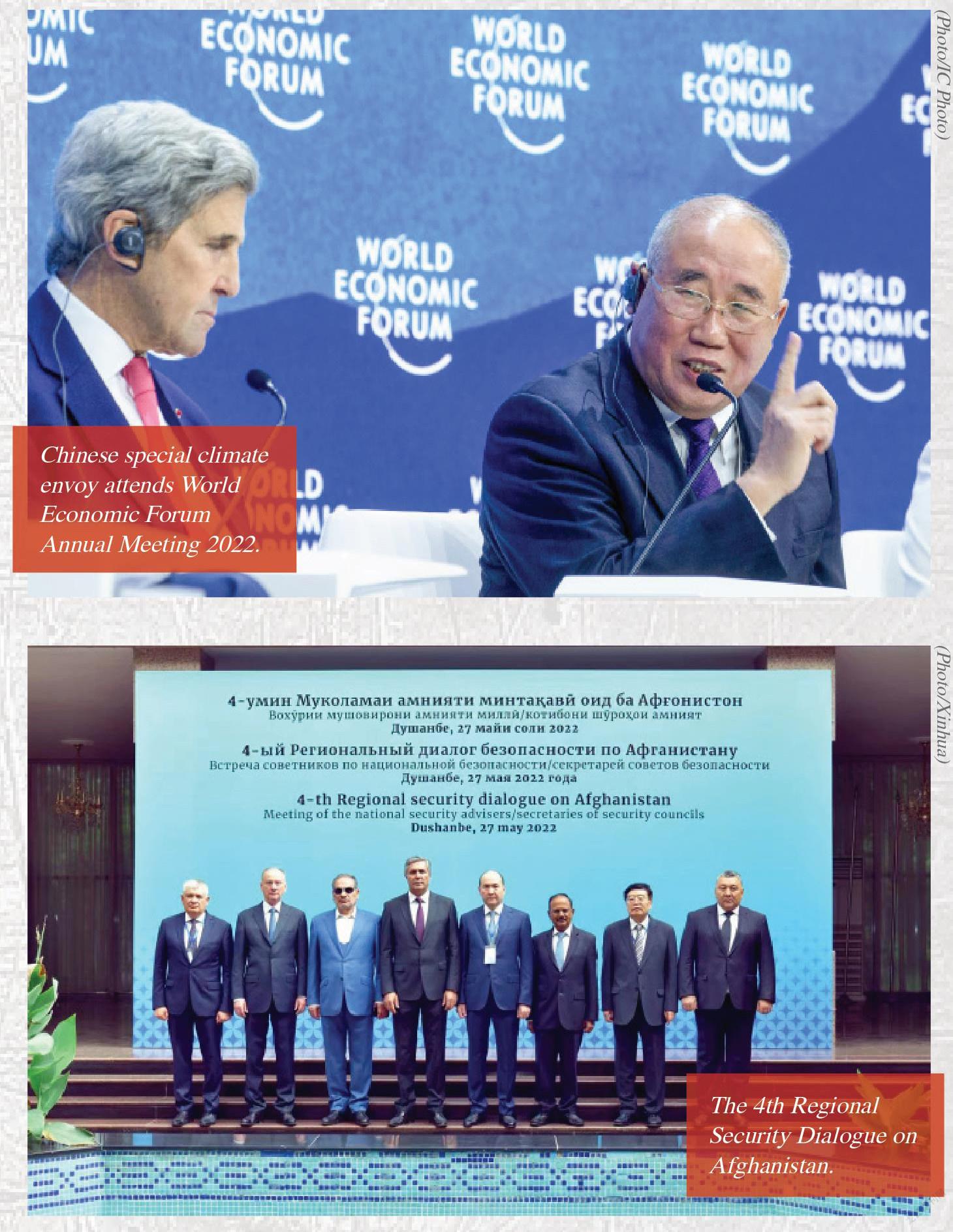
In the Middle East, the Chinese side has put forward a five-point initiative on achieving security and stability, a four-point proposal for the political settlement of the Syrian issue, and a three-point vision for the implementation of the two-state solution between Palestine and Israel. China actively promotes the negotiations to resume compliance with the?Joint Comprehensive Plan of Action on the Iran nuclear issue, and actively mediates to explore solutions to hot spot issue for achieving regional security. In Afghanistan, China has taken the initiative to carry out international coordination, playing a constructive role for the smooth transition of the situation. On March 31st, 2022, China organized the 3rd Foreign Ministers’ Meeting among the Neighboring Countries of Afghanistan and the 1st “Neighboring Countries of Afghanistan Plus Afghanistan” Foreign Ministers’ Dialogue. The meeting issued the Tunxi Initiative in support of economic reconstruction?n?nd practical cooperation with Afghanistan, and played an important role in promoting peaceful reconstruction and stable development of Afghanistan.
On the fight against terrorism and transnational organized crime, China pushed the SCO to take the lead in tackling the “Three Evil Forces”, resolutely suppressing the spreading momentum of drug trafficking, cyberspace crime, and transnational organized crime.
On the fight against COVID-19, China has stood on the forefront of international cooperation against COVID-19, being the first to commit to making vaccines a global public good, and taking the lead in conducting joint vaccine production with developing countries. So far, it has provided over 2.1 billion doses of vaccines to more than 120 countries.
On climate change, China had actively implemented the Paris Agreement, and announced its goals to achieve carbon peaking before 2030 and carbon neutrality before 2060. On cyber-security, it has launched the?Global Initiative on Data Security?as its proposed solution to global digital governance. On UN peacekeeping, China has dispatched over 50,000 peacekeepers to nearly 30 UN peacekeeping missions, and set up an 8,000-troop peacekeeping standby force for UN peacekeeping missions. it has dispatched the most peacekeepers among the permanent members of the UN Security Council. It is the second largest contributor to the UN peacekeeping budget.
Our journey ahead will be a long and arduous one. But as long as we press ahead with a sense of perseverance, there will be much to expect. It is China’s unswerving goal that displays its strong sense of responsibility to promote the implementation of the GSI, and to bring the world more peace, more security, and more prosperity. China will continue to hold the vision of common, comprehensive, cooperative and sustainable security, join hands with all countries in the world in meeting challenges, and make common efforts in building a world with lasting peace and universal security.
——————————————
Authors include Xu Bu, President of the China Institute of International Studies and Secretary-General of the Xi Jinping Thought on Diplomacy Studies Center, and Chen Wenping, Guest Researcher of the Xi Jinping Thought on Diplomacy Studies Center