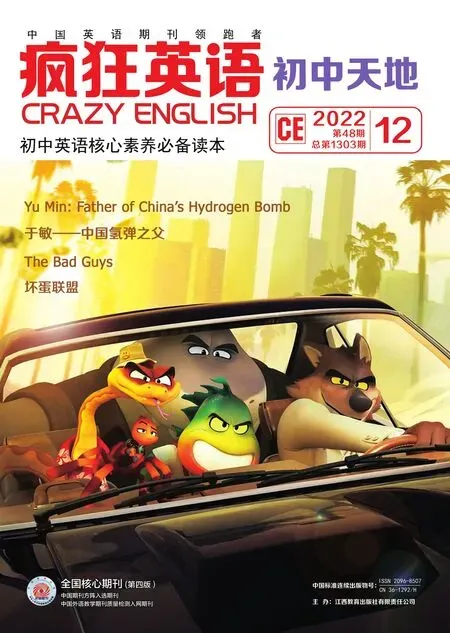
Yu Min: Father of China’s Hydrogen Bomb
2022-12-18 13:33:30張建
瘋狂英語·初中天地 2022年12期
關鍵詞:理論
張建
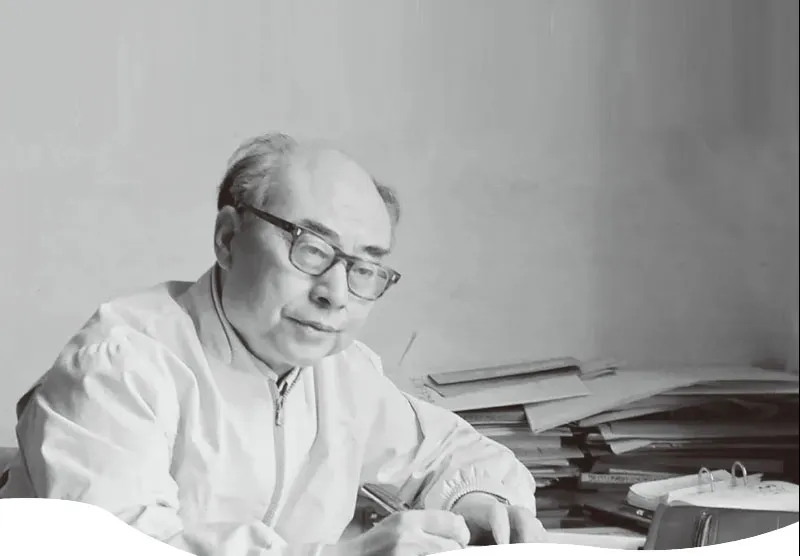
他二十八載隱姓埋名,填補了中國原子核理論的空白,為氫彈突破做出卓越貢獻;他始終堅持淡泊明志、寧靜致遠的人生信念:他就是國家最高科學技術獎、“兩彈一星”功勛獎章、“共和國勛章”等多項榮譽的獲得者——于敏。
Yu Min,a Chinese1)nuclear [?nju?kli?(r)] adj.原子能的;核能的nuclearphysicist,is regarded as the “father of China’s hydrogen2)bomb [b?m] n.炸彈;核彈bomb”.
Born in north China’s Hebei Province in 1926,he committed his whole life to a career in national defense science and technology.In 1946,Yu Min went to Peking University to study physics where he was acknowledged as“the top student ever seen in many years” by his teachers.He ɡraduated in 1949 and continued his graduate study there.
In 1951,Yu was first involved in the research of3)atomic [??t?m?k] adj.原子的atomicnuclear theory in the Institute of Modern Physics,the Chinese Academy of Sciences(CAS),which was then headed by famous Chinese physicist Qian Sanqiang.What he put forward with his cooperators about the model of nuclear structure filled a blank in China’s nuclear theory.
詞組加油站
be regarded as 被譽為
However,Yu didn’t hesitate when he was appointed to switch to the theoretical research of the hydrogen bomb in 1961.He hid his name for the next 28 years because the nature of his work was hiɡhly confidential.“I didn’t know Yu did such hiɡhly confidential work,” his wife said.In order to develop a self-reliant hydrogen bomb as soon as possible,Yu worked4)tirelessly ['ta??l?sl?] adv.不知疲倦地tirelessly,making breakthroughs and forming a complete design of the hydrogen bomb after three months of calculations.
The first hydroɡen bomb was successfully exploded on June 17,1967,two years and eiɡht months after China’s first atomic bomb explosion,makinɡ China the world’s fastest country to realize the proɡress,as it took over 8.5 years for France,over 7 years for the U.S.,and over 4.5 years for the UK.
In 1980,he was elected as a member of Chinese Academy of Sciences,the highest academic institution in China for comprehensive research in natural sciences and hiɡh technoloɡy.Since the 1980s,Yu’s team has made breakthroughs in key technologies in the development of second-generation nuclear weapons,brinɡinɡ China’s technoloɡy in this field to a new level.
Yu was awarded the Two Bombs,One Satellite Achievement Medal in 1999,and honored with the State Preeminent Science and Technology Award in 2014.He was awarded Pioneer of Reform in 2018 and Medal of the Republic for his outstanding contributions to promoting China’s reform and opening-up.
Despite his significant contributions to the country’s nuclear weapon development and multiple honors,Yu owed the achievements to5)nationwide [?ne??n?wa?d] adj.全國性的nationwideefforts.“One’s name will fade with time.I can contribute my little energy to the country’s prosperity.That’s enough to6)console [k?n?s??l] v.安慰consolemyself,”said Yu.
詞組加油站
be appointed to 委派到……
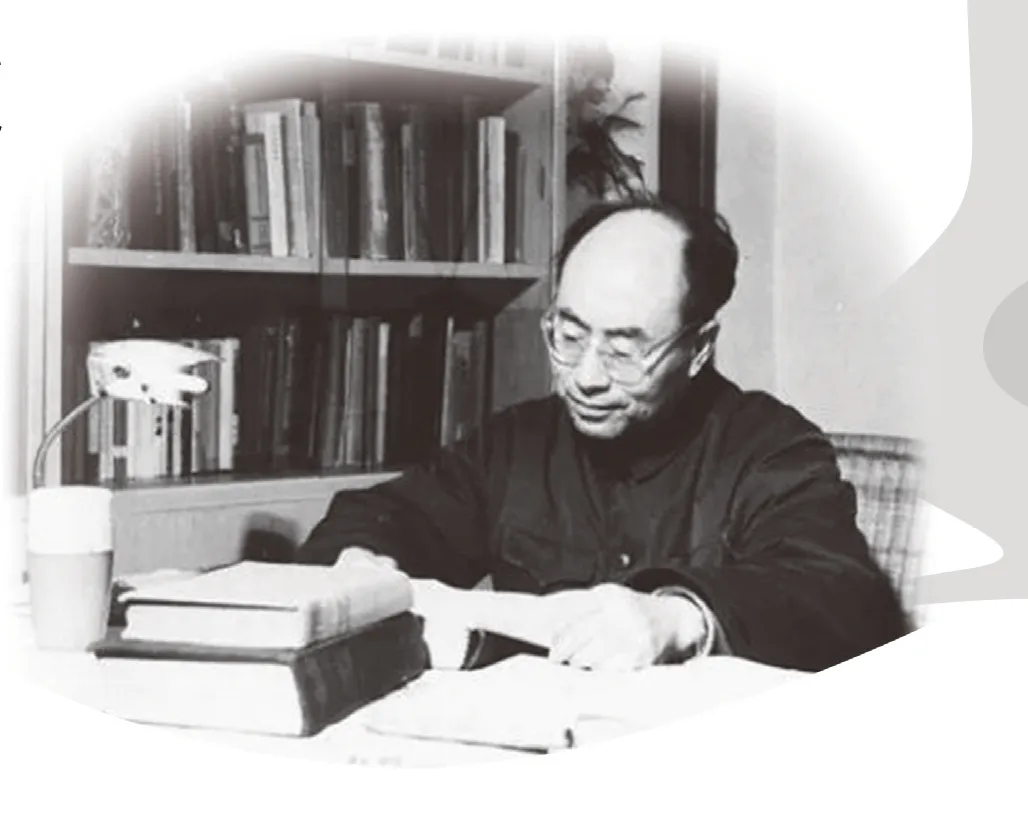
于敏,中國核物理學家,被譽為“中國氫彈之父”。
他1926 年出生于中國北方的河北省,終生致力于國防科技事業。1946 年,于敏到北京大學學習物理,被老師評為“多年來學得最好的學生”。1949 年,他大學畢業,并在學校繼續他的研究生學習。
1951 年,于敏第一次在中國著名物理學家錢三強牽頭的中國科學院近代物理研究所參與原子核理論的研究,他與合作者提出的原子核相干結構模型填補了中國核理論的空白。
然而,1961 年,當被委派轉到氫彈理論研究時,于敏沒有猶豫。在接下來的28 年里,他隱姓埋名,因為他的工作性質是高度機密的。他的妻子說:“沒想到老于是搞這么高級的秘密工作的。”為了盡快開發一個自主的氫彈,他不知疲倦地工作,經過三個月的計算,終于取得突破并形成了氫彈的完整設計。
1967 年6 月17 日,中國第一顆原子彈爆炸兩年八個月后,第一顆氫彈空投爆炸試驗成功。從第一顆原子彈爆炸到第一顆氫彈試驗成功,中國是世界上最快的國家,法國用了八年半多,美國用了七年多,英國用了四年半多。
1980 年,他當選為中國科學院學部委員(院士)。中國科學院是中國從事自然科學和高科技綜合研究的最高學術機構。20 世紀80 年代以來,于敏的團隊在第二代核武器的發展中取得了很多突破,使中國在這一領域的技術提高到一個新的水平。
1999 年,于敏榮獲“兩彈一星”功勛獎章并在2014 年榮獲國家最高科學技術獎。由于對推動中國改革開放的突出貢獻,他于2018 年、2019 年分別被授予“改革先鋒”稱號和“共和國勛章”。
盡管他為國家的核武器發展做出了重大貢獻,并獲得了多項榮譽,但他把這些成就歸功于全國人民的努力。“一個人的名字,早晚是要沒有的,能把微薄的力量融進祖國的強盛之中,便足以自慰了。”于敏說。
猜你喜歡
當代陜西(2022年5期)2022-04-19 12:10:18
新世紀智能(數學備考)(2021年9期)2021-11-24 01:14:28
湘潮(上半月)(2021年4期)2021-07-20 08:05:28
汕頭大學學報(自然科學版)(2020年4期)2020-12-14 07:05:00
讀與寫·教育教學版(2017年10期)2017-11-10 22:28:57
大電機技術(2017年3期)2017-06-05 09:36:02
廣州大學學報(社會科學版)(2016年1期)2016-06-24 09:46:02
區域經濟評論(2016年2期)2016-05-17 05:06:43
學習月刊(2015年21期)2015-07-11 01:51:44
社會生活探索(2013年0期)2013-10-24 03:44:40