文字與面孔識別的半球偏側化互補模式的競爭性發展機制*
2023-11-04 03:25:54蔡厚德齊星亮
心理科學進展 2023年11期
關鍵詞:兒童
高 飛 蔡厚德 齊星亮
文字與面孔識別的半球偏側化互補模式的競爭性發展機制*
高 飛1蔡厚德2齊星亮3
(1山東師范大學心理學院, 濟南 250358) (2南京師范大學心理學院, 南京 210097) (3南京曉莊學院幼兒師范學院, 南京 211171)
成人的大腦左側VWFA對正字法信息更敏感, 而右側FFA優先處理面孔信息。然而, 這種偏側化互補模式的發展機制還亟待闡明。神經元再利用假設認為, 在文字閱讀學習過程中, 文字識別會與面孔表征在左側FG競爭神經加工資源, 導致文字識別出現VWFA的左側化, 并推動了面孔識別FFA的右側化。分布式半球組織的觀點提出了神經計算加工三原則, 試圖系統闡釋文字與面孔偏側化競爭性發展的多層次雙向動態加工機制。近期, FG的結構分區與功能特征研究取得了一些新成果, 并據此構建了一個文字與面孔識別的多維度計算加工模型。因此, 有必要基于神經元再利用假設和分布式半球組織的觀點, 并結合FG的結構與功能特征和近期研究證據, 以系統探討文字與面孔識別的半球偏側化互補模式競爭性發展的認知神經加工機制。未來研究應進一步探究文字與面孔競爭加工的皮層空間位置和功能神經組織學基礎、漢字與面孔競爭的加工機制、面孔識別的右側化發展機制以及數字和音符閱讀學習導致大腦可塑性改變的機制。
視覺詞形區, 梭狀面孔區, 半球偏側化互補模式, 競爭性發展機制, 多層次雙向動態加工
1 引言
人們在識別文字與面孔時都需要利用專家化的視覺加工, 以精細辨別高度相似且差異細微的刺激(Davies-Thompson et al., 2016)。成年人的神經成像研究(Canário et al., 2020; Gerrits et al., 2019)、電生理研究(Inamizu et al., 2020; Sehyr et al., 2020)和神經心理研究(Sabsevitz et al., 2020; Susilo et al., 2015)顯示, 文字與面孔識別的關鍵腦區位于視覺腹側枕?顳皮層(ventral occipito- temporal cortex, vOTC)中梭狀回(fusiform gyrus, FG)的兩個相鄰亞區, 但呈現出互補的半球偏側化模式(complementary pattern of hemispheric lateralization) (Behrmann & Plaut, 2020; Canário et al., 2020; Davies-Thompson et al., 2016; Gerlach et al., 2022), 即左半球的視覺詞形區(visual word form area, VWFA)對正字法信息更敏感, 而右半球的梭狀面孔區(fusiform face area, FFA)優先處理面孔信息(Behrmann & Plaut, 2014; Gerrits et al., 2019; Lochy et al., 2019; Moret-Tatay et al., 2020)。然而, 這種成熟的大腦偏側化互補模式的發展機制還亟待闡明。
值得關注的是, Dehaene等人(Dehaene, 2005; Dehaene & Cohen, 2007, 2011; Dehaene et al., 2015)提出文字閱讀學習的神經元再利用假設(neuronal recycling hypothesis), 試圖解釋VWFA與FFA的半球互補偏側化發展機制。這一假設認為, 在文字閱讀學習過程中, 文字識別可能在左側FG競爭原先用于面孔表征的神經加工資源, 導致VWFA出現左側化, 并推動了面孔識別FFA的右側化。之后, Behrmann和Plaut (2013, 2015, 2020)采用分布式半球組織的觀點(distributed account of hemispheric organization), 系統論述文字與面孔識別的神經計算加工原則, 以闡釋VWFA與FFA偏側化互補模式競爭性發展的神經機制。近期, FG的結構分區與功能特征研究取得了一些有價值的新成果, 為闡明這種競爭性發展機制提供了必要的神經結構與組織學基礎。可見, 針對神經元再利用假設關于文字閱讀學習與面孔表征競爭加工的解釋和分布式半球組織的觀點, 并結合FG的結構和功能特征, 進一步探討文字閱讀學習與面孔識別的半球偏側化互補模式競爭性發展的認知神經機制, 不僅對揭示文字與面孔加工偏側化發展及其相互關系的大腦可塑性機制具有重要意義, 也對指導文字閱讀教學、文字與面孔識別的人工智能模擬和臨床治療實踐有一定價值。
為此, 本文首先介紹神經元再利用假設及其相關證據, 說明文字閱讀學習與面孔表征在左半球FG的競爭性加工可能導致文字與面孔識別出現互補的偏側化模式; 然后闡述文字與面孔識別的神經計算加工三原則, 表明文字與面孔的偏側化競爭是一種發生在vOTC的多層次結構上的雙向(自下而上與自上而下)動態加工; 這之后介紹FG的結構分區與功能特征, 并基于由內?外計算軸與后?前計算軸組成的FG的多維度計算加工模型及其相關證據, 初步闡明VWFA和FFA的偏側化競爭性發展的多層次雙向動態加工的認知神經機制。最后對一些未來需要研究的重要問題或方面進行展望。
2 文字閱讀學習的神經元再利用假設及其相關證據
文字是人類最重要的文化發明之一。在大約5400年前的巴比倫才出現了文字作品(Dehaene & Cohen, 2007); 直到大約200年前, 文字閱讀的掌握和使用還被局限于小范圍的群體中(Behrmann & Plaut, 2020)。Dehaene等人(2005, 2007, 2011, 2015)認為, 大腦并無足夠的時間進化出專門用于文字閱讀的神經系統, 文字閱讀需要重新定位或再利用大腦皮層中負責古老功能的部分區域, 且不涉及任何基因重組, 而是利用了大腦的可塑性。這一理論就是著名的文字閱讀學習的神經元再利用假設(Dehaene et al., 2015)。vOTC是專門識別面孔、位置、身體和物體等不同領域視覺刺激的混合區(Behrmann & Plaut, 2020)。由于面孔選擇區的發展成熟需要更長的時間, 直到成年之前還表現出結構和功能上的變化, 使該區要比其他刺激(如位置)選擇區更具可塑性(Gomez et al., 2017)。因此, 文字閱讀學習可能與面孔加工在左側FG爭奪神經資源, 最終將之前用于面孔識別的神經元重新用于文字識別, 進而出現了VWFA的左側化; 而面孔識別也逐漸位移至右側FG, 導致FFA的右側化(Dehaene et al., 2015)。
大量證據支持文字閱讀學習的神經元再利用假設。第一, 兒童的文字閱讀學習會導致在左側FG出現VWFA, 而FFA則在右側FG發展。功能磁共振成像(functional magnetic resonance imaging,fMRI)研究表明, 當兒童獲得字母知識時左側FG對字母的反應會不斷增強, 但對面孔的反應隨之減弱(Cantlon et al., 2011; Centanni et al., 2018),且隨著閱讀成績的提高, 右側FG對面孔的神經活動顯著增強(Dehaene-Lambertz et al., 2018; Monzalvo et al., 2012)。行為實驗和事件相關電位(event-related potentials, ERPs)的研究還表明, 兒童在閱讀學習早期便表現出對文字處理的右視野?左半球優勢, 而兒童與少年個體的面孔處理左視野?右半球優勢并不明顯, 但偏側化程度卻與閱讀理解能力呈正相關(Dundas et al., 2013); 7~11歲兒童由單詞誘發的左側N170振幅與面孔在右側誘發的N170振幅也呈正相關(Dundas et al., 2014)。因此, 文字與面孔識別的半球偏側化可能是聯合發展的。
第二, 成年期的文字閱讀學習會引起與兒童期類似的文字與面孔識別的半球偏側化改變。Dehaene等人(2010)對成人文盲者、前文盲者(早期教育缺失, 到成年時才習得了基本的閱讀能力)和閱讀熟練者(早期獲得閱讀能力)的fMRI研究顯示, 文盲者的左側VWFA對字符串無反應, 卻對面孔有較強的激活; 伴隨從前文盲者到閱讀熟練者的讀寫能力提高, 左側VWFA對面孔的反應下降, 而右側FFA對面孔的反應隨之增加。Pegado等人(2014)的ERPs研究還顯示, 隨著從成人文盲者、前文盲者到閱讀熟練者的閱讀能力提高, 字符串誘發的N170成分的左側化程度越來越強, 而面孔誘發的N170右側化程度越來越強。
第三, 左利手者的語言偏側化會決定面孔的偏側化發展。Dundas等人(2015)發現, 右利手者的左半球對單詞誘發的N170振幅與面孔在右半球誘發的N170振幅呈正相關, 但左利手者卻無此表現。左利手者一般為右側語言優勢或左側語言弱優勢(Dundas et al., 2015; Gerrits et al., 2019), 由于文字在左側視覺皮層未能給予面孔右側化以足夠的壓力, 因此左利手者的面孔表征傾向于雙側FFA激活(Fr?ssle et al., 2016)。Gerrits等人(2019)利用fMRI技術進一步將左利手者區分為右側語言優勢和左側語言優勢, 發現兩者表現出相反的偏側化模式, 即前者為文字加工右側化和面孔加工左側化, 而后者反之。可見, 當左利手者為右側語言優勢時, 文字與面孔則可能在右側FG爭奪神經加工資源, 提示這種競爭總是發生在語言優勢的一側半球。
第四, 發展性神經障礙或半球損傷會影響文字與面孔的半球競爭加工。對發展性閱讀障礙(developmental dyslexia, DD)和先天性面孔失認癥(congenital prosopagnosia, CP)的ERPs研究(Collins et al., 2017)發現, DDs的文字和面孔的N170均未表現出偏側化優勢, 而CPs僅表現出文字的N170左側優勢。一種可能解釋是, DDs喪失了文字識別能力, 導致隨后的面孔表征得不到來自文字在左側競爭的壓力而未出現右側化, 最終文字與面孔均未出現半球優勢; 而CPs的面孔識別缺陷只會妨礙面孔表征的右側化, 但并不連累文字識別的左側化發展。對一例右側vOTC切除患者(U.D.)的3年縱向fMRI跟蹤研究(Liu et al., 2018)還發現, 在6歲9個月做切除手術之后的第一次(7歲10個月)掃描時, 左側vOTC只檢測到VWFA; 而第四次(10歲10個月)掃描時, 左側vOTC均可檢測到VWFA和FFA。而且, 與對照組被試相比, U.D.的VWFA位置向外側明顯偏移,而FFA的激活程度和范圍隨著年齡增加而不斷增大, 且位置比正常情況更靠內側(Liu et al., 2018)。可見, 當面孔需要重新利用左側FG皮層時, 同樣會與文字爭奪神經加工資源。
上述證據集中反映了文字閱讀學習可能在左側FG與面孔表征競爭神經加工資源, 引起FG在兩半球的結構與功能重構, 最終導致VWFA的左側化與FFA的右側化。但是, 這種偏側化競爭關系的解釋僅停留在FG的整體結構與功能上, 基于VWFA與FFA的偏側化相關性證據對競爭加工機制的闡釋也有較大的推測性。因此, 有必要探究這兩個腦區偏側化競爭的詳盡加工機制。
3 分布式半球組織的觀點
Behrmann和Plaut (2013, 2015, 2020)提出分布式半球組織的觀點認為, 文字與面孔識別的半球組織遵循三個關鍵的神經計算加工原則:(1)表征與知識的多層次分布; (2)表征的競爭與合作共存; (3)腦區空間分布的局域化。首先, 文字與面孔的表征分布在從加工局部視網膜信息的初級視覺皮層(V1區), 到加工更為整體的、基于物體的或意義信息的顳前皮層(Ayzenberg & Behrmann, 2022; Grill-Spector & Malach, 2004)。而且, 兩者相關特征的知識表征依賴于不同層次腦區內和腦區間的突觸連接強度或模式。學習與經驗不僅可以改變突觸連接的強度或表征方式, 還可能通過征用額外的神經元和腦區對表征進行精細化和專門化(Behrmann & Plaut, 2020)。其次, 盡管文字與面孔屬于不同領域的視覺刺激, 但它們的識別都依賴高視敏度視覺(Gomez et al., 2018; Hasson et al., 2002)和過度學習(Gomez et al., 2019)。一方面, 兩者的表征都需要與中央視覺信息表征合作, 導致它們會在與編碼視網膜中央凹信息投射皮層的相鄰區域競爭神經空間資源(Hasson et al., 2002; Roberts et al., 2013; Woodhead et al., 2011); 另一方面, 由于兩者的特征相關知識在不同層次水平上表征的系統性或一致性差異明顯, 當一個皮層區表征面孔信息時, 該區域則不適合表征文字信息, 導致面孔與文字的知識最終被不同的皮層區所表征(Behrmann & Plaut, 2020)。再次, 在進化過程中, 腦組織需要有足夠的神經元連接用于承載必要的信息加工, 但軸突纖維的總量會受腦顱體積的限制。因此, 通過軸突長度最短化實現的空間分布局域化, 不僅可以減少軸突體量, 還能避免因信號傳播距離增加而發生不必要的誤差。因此, 在腦區地形圖上, 鄰近的皮層區之間更可能發展合作表征關系, 而存在競爭表征關系的皮層區之間則保持一定距離。這樣一來, 為了使突觸連接長度最短化, 表征正字法文字的腦區就可能被限制在鄰近表征語言(尤其是語音)相關腦區的一側半球。由于多數個體的語言表征是左側化的, 且文字與語言加工網絡存在共同偏側化(colateralization) (Cai et al., 2010; Gerrits et al., 2019), 因此文字表征也傾向偏側于左半球。最后, 隨著文字閱讀經驗的增加, 左側vOTC (VWFA)會越來越適合于表征文字信息(Nordt et al., 2019), 這也使文字在此區域與面孔的競爭日益加劇, 導致在學前期兒童的雙側面孔表征會隨文字閱讀學習而越來越依賴于右側vOTC (FFA) (Dundas et al., 2014; Lochy et al., 2019)。
從分布式半球組織的觀點可以看出, 文字與面孔的偏側化競爭加工可能是一種發生在半球vOTC的多個層次結構上的雙向動態加工過程, 既受到來自V1區的自下而上感覺傳入信息的制約, 又受到來自高級皮層(如語言區等)的自上而下信息加工的調制。在較低加工層次上, 文字與面孔識別共享了自下而上的高視敏度視覺信息, 因此會競爭早期知覺的皮層空間資源, 進而開始出現VWFA的左側化和FFA的右側化。在較高加工層次上, 文字與面孔的早期競爭會在學習與經驗的驅動下接受自上而下信息加工的調制, 導致文字與面孔識別的偏側化得到發展。值得關注的是, 近期FG的結構分區與功能特征研究取得了一些重要進展, 為闡明這種多層次雙向動態加工的認知神經機制提供了可能。以下將對FG的結構與功能區及其與VWFA和FFA偏側化競爭性發展的關系進行系統探討。
4 FG的結構與功能區及其與VWFA和FFA偏側化競爭性發展的關系
4.1 FG的4個結構與功能區
FG是vOTC上連接腹側枕葉皮層(ventral occipital cortex, VOC)和腹側顳葉皮層(ventral temporal cortex, VTC)的重要結構, 其外側以枕顳溝(occipitotemporal sulcus, OTS)為界, 內側以側副溝(collateral sulcus, CoS)為界, 后側以后部橫向側副溝(posterior transverse collateral sulcus, ptCoS)為界, 中部則以中部梭狀溝(mid-fusiform sulcus, MFS)的前尖端為界(Grill-Spector & Weiner, 2014; Lorenz et al., 2017; Weiner, Natu, & Grill-Spector, 2018) (圖1)。研究發現, MFS可縱向在大范圍上將FG分割為內?外側不同的結構與功能區, 它們與MFS對齊、重疊或嵌套(Grill-Spector & Weiner, 2014) (圖1)。其中, 緊鄰后部枕葉皮層區(human occipital cortex 4 ventral, hOc4v)的FG1位于內側且向CoS延伸, FG2位于外側且向OTS延伸(Caspers et al., 2013) (圖1)。在功能上, FG1是早期視覺皮層(V1、V2/V3和V4)與高級視覺皮層(VTC)之間的過渡區(transitional area), FG2則是視覺皮層聯合區(associative region) (Caspers et al., 2013; Weiner & Zilles, 2016), 負責對刺激進行初步的知覺整合加工(Caspers et al., 2015)。神經組織學和受體檢測還發現, FG的中前部可以由MFS區分出FG3和FG4 (圖1)。FG3位于FG1的前部, 其中包含側副溝地點選擇區(Cos-places) (Weiner, Barnett et al., 2018); FG4位于FG2的前部,主要加工物體身份及其意義(Behrmann & Plaut, 2013; Lorenz et al., 2017; Weiner, 2019)。
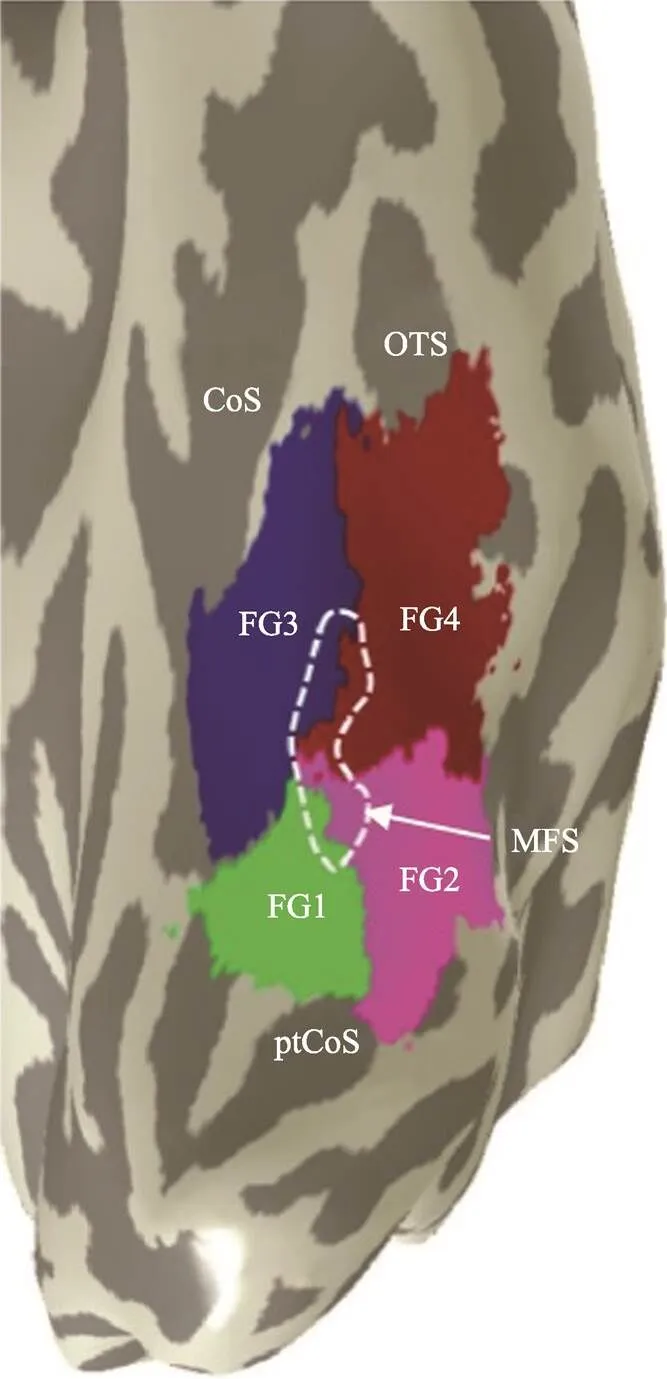
圖1 FG的結構邊界和4個結構與功能區(資料來源:Lorenz, et al., 2017)
值得重視的是, 基于FG的結構分區與功能特征, Weiner, Barnett等人(2017)構建了一個由內?外軸(medial-lateral axis)和后–前軸(posterior-anterioraxis)組成的多維度計算加工模型(圖2)。內?外軸是一個領域特異性計算軸(domain-specific computational axis), 可以將不同領域的加工區域進行物理隔離, 從而有效并行處理各領域的特異性信息; 而后?前軸則是一個領域內加工的層次轉換計算軸(computational axis of hierarchical transformation), 通過跨后?前皮層執行一系列分層次的連續計算, 以實現與行為相關的表征(Weiner, Barnett et al., 2017)。在這一模型中, 面孔與文字的識別區分布在FG外側的FG2和FG4中, 這里偏好處理視網膜中央凹的視覺傳入信息, 適合加工高視敏度視覺信息和對刺激進行精細辨別。具體而言, 位于FG2中的FFA-1與VWFA-1呈內?外交疊分布; 位于FG4中的FFA-2與VWFA-2也呈內?外分布, 但中間由梭狀軀體區(fusiform body area, FBA)分隔(圖2)。基于這一模型, 面孔與文字的視覺信息由早期視覺皮層對感知特征進行初步處理后, 經FG1進入FG2, 隨后從FFA-1和VWFA-1分別傳遞到FFA-2和VWFA-2, 以完成面孔與文字識別的層次性和領域特異性加工(圖2)。可見, 文字與面孔識別區是沿FG的內?外軸與后?前軸逐步出現和動態發展的。
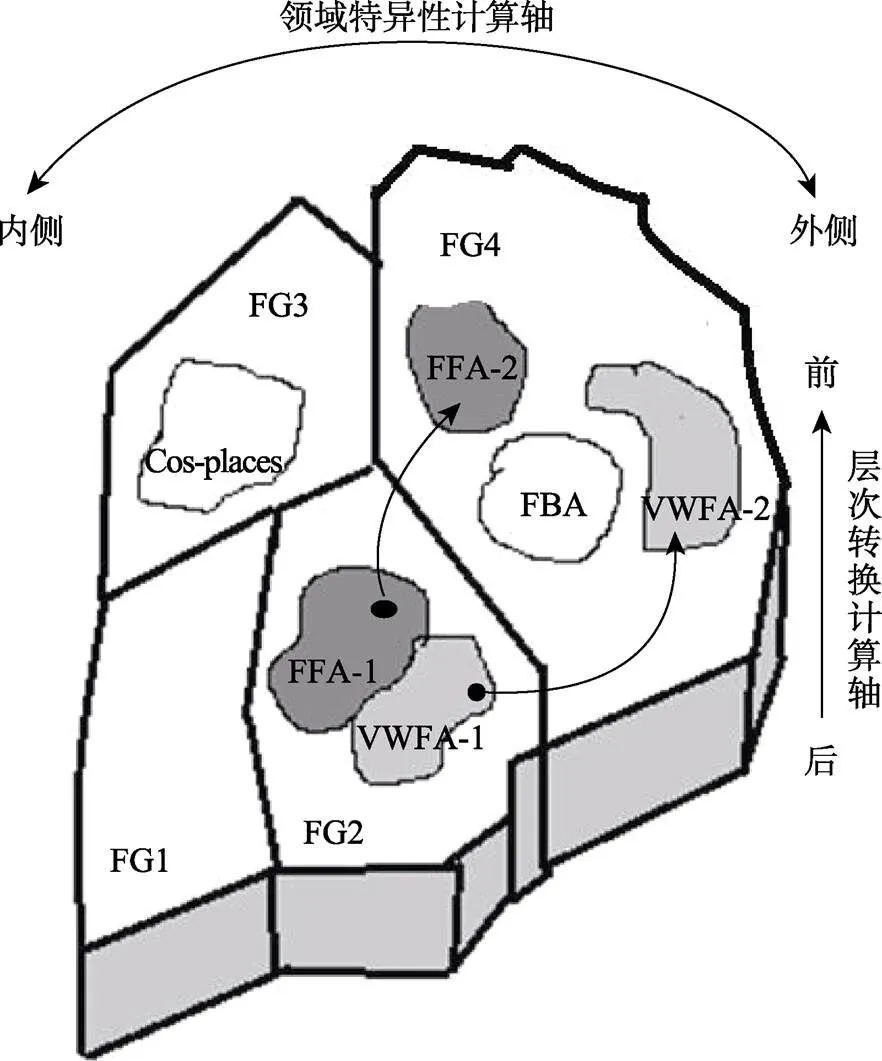
圖2 FG的4個結構與功能分區以及它們在多維度計算加工模型(內?外領域特異性計算軸和后?前層次轉換計算軸)中的分布(資料來源:Weiner, Barnett, et al., 2017)
需要指出的是, FG的多維度的計算模型并未說明這種動態加工如何受到自下而上與自上而下信息加工的調節, 也未涉及它們與VWFA和FFA的半球競爭性偏側化發展的關系。從圖2顯示的分區特點看, 位于FG2中的VWFA-1和FFA-1處在后?前軸的較低層次上, 兩者的皮層空間還存在一定交疊(領域特異性低), 提示它們的加工可能主要受自下而上感覺傳入的制約, 因此FG2可能是文字與面孔出現早期競爭的皮層位置; 比較而言, 位于FG4中的VWFA-2和FFA-2處在后?前軸的較高層次上, 兩者的皮層空間已相互分離(領域特異性高), 提示它們的加工可能發生在知覺的后期, 且主要通過學習與經驗接受自上而下信息加工的調制, 所以這兩個腦區的半球偏側化可能會變強。以下將梳理相關證據, 并對這一機制進行闡述。
4.2 VWFA-1與FFA-1在FG2中的早期競爭加工
FG2接受由FG1傳入的早期視覺皮層信息, 并基于刺激的整體形狀不變性進行知覺表征(Caspers et al., 2015; Dehaene et al., 2015; Op de Beeck et al., 2019)。盡管文字與面孔識別屬于不同刺激領域的認知, 但均需依賴高視敏度的中央凹視覺傳入信息, 以完成高分辨率的形狀不變性知覺(Dehaene, 2005; Dehaene et al., 2015; Op de Beeck et al., 2019)。證據顯示, FG2不僅偏好處理中央凹的視覺信息(Grill-Spector & Weiner, 2014), 對文字和面孔也都有反應(Grill-Spector & Weiner, 2014; Weiner et al., 2014), 且兩者的激活區交疊分布在視網膜中央凹投射皮層的附近區域(Behrmann & Plaut, 2020; Hasson et al., 2002)。重要的是, FG1與早期視覺皮層的協同激活較強, 且半球間功能更對稱(Caspers et al., 2015), 但FG2已開始出現一定程度的文字與面孔的功能非對稱性, 即文字引起左側FG2與閱讀相關腦區的協同激活, 面孔則引起右側FG2與面孔加工相關腦區的協同激活(Grill-Spector & Weiner, 2014; Weiner et al., 2014); VWFA-1定位在左側FG2, FFA-1則更多出現在右側FG2 (Caspers et al., 2015)。可見, 文字與面孔識別在FG2共享了來自視網膜中央凹的精細視覺傳入信息(Gomez et al., 2018; Roberts et al., 2015), 導致文字閱讀學習會與面孔表征競爭早期知覺加工的皮層空間資源(Behrmann & Plaut, 2020; Dai et al., 2022; Dehaene et al., 2015), 這使FG2開始分化出不同的文字與面孔識別的半球偏側化表征系統(Dehaene et al., 2015)。
4.3 VWFA-2與FFA-2與相關腦網絡的偏側化連通性對早期競爭加工的調制
FG2主要受自下而上視覺傳入信息加工的制約, 因此, 由早期競爭導致的VWFA-1的左側化和FFA-1的右側化主要與文字與面孔的感知特征加工相關(Op de Beeck et al., 2019)。與之不同, FG4中的VWFA-2和FFA-2不僅接受VWFA-1和FFA-1傳來的早期偏側化信息, 還會在學習與經驗的驅動下, 通過與相關腦網絡的連通性(connectivity), 接受自上而下信息加工的調制。連通性是指皮層區之間互通信息的程度, 包括結構與功能連通性(Op de Beeck et al., 2019)。在結構上, VWFA-2與FFA-2通過偏側化的領域特異性連通性(domain- specific connectivity)與非視覺系統腦區連接(Op de Beeck et al., 2019)。一方面, VWFA-2通過左側弓狀束(arcuate fasciculus, AF)與口語產生和語音表征相關的額?顳網絡(如布羅卡區和顳平臺)建立強勢連接(Lerma-Usabiaga et al., 2018; Weiner, Yeatman, & Wandell, 2017; Yeatman & White, 2021); 另一方面, FFA-2通過右側下縱束(inferior longitudinal fasciculus, ILF)和額?枕下束(inferior fronto-occipital fasciculus, IFOF)與負責面孔記憶、社會認知和情緒加工的面孔擴展網絡(右側顳前皮層、顳上溝、內側前額皮層和杏仁核等)連接(Gomez et al., 2015; Hadders-Algra, 2022; Pyles et al., 2013)。重要的是, 隨著文字閱讀經驗或能力的提高, VWFA-2不僅與相關腦網絡的偏側化連通性會增強, 對文字的選擇性反應也會變強(Li et al., 2021; Op de Beeck et al., 2019)。例如, 文字閱讀學習會引起左側AF后部的各項異性值(fractional anisotropy, FA)明顯增大(Thiebaut de Schotten et al., 2014), 這不僅與VWFA-2對字母串反應的激活水平相關, 也與口語詞加工中額下皮層和左顳平臺通過自上而下的方式調節VWFA-2的激活水平相關(Dehaene et al., 2015), 且只有左側AF的FA值與閱讀能力呈正相關(Yeatman et al., 2012), 提示左側AF結構的變化可能與文字閱讀學習中詞素?音素轉換通路的發育有關(齊星亮, 蔡厚德, 2019)。再如, 面孔識別能力與連接右側FFA-2的ILF的FA值呈正相關(Gomez et al., 2015), 而CP患者的右側ILF和IFOF的完整性受到破壞, 且僅在右半球表現為FA值與面孔識別錯誤率負相關(Thomas et al., 2009), 提示右側ILF和IFOF可能是面孔整體結構信息與情緒、記憶表征信息整合的兩條關鍵通路(Grossi et al., 2014)。值得關注的是, 在大腦中這些偏側化連接是預置的(pre-existing), 文字或面孔的學習經驗通過改變相關腦網絡的連通性可以塑造文字或面孔選擇區, 因此能夠預測它們在兒童或成人個體腦中出現的皮層位置(Powell et al., 2018; Saygin et al., 2016)。總之, 文字閱讀的學習經驗可以增強VWFA-2與左側化語言網絡的連通性, 進而強化文字與面孔在左側的早期競爭, 導致文字識別左側化的加快建立, 并推動右側FFA-2的發展。同時, 面孔經驗的積累也會增加FFA-2與右側化面孔擴展網絡的聯通性, 導致面孔識別右側化的逐步建立。這種受學習與經驗驅動的加工主要發生在文字或面孔知覺的后期, 并以自上而下的方式影響文字與面孔的競爭性半球偏側化發展。
5 總結與展望
近10~20年來, 文字與面孔識別的半球偏側化互補模式及其發展機制的研究, 引起了人們的極大關注。盡管大量證據支持神經元再利用假設, 即人腦在文字閱讀學習時會與面孔表征競爭左側FG的神經空間資源, 進而出現了左側化的VWFA, 并導致FFA的右側化, 但這種偏側化的皮層競爭加工機制, 到近期才逐漸明晰。一方面, 文字識別與面孔表征的偏側化競爭是一種發生在vOTC的多層次結構上的雙向動態加工; 另一方面, 基于MFS區分出的4個FG結構與功能區, 以及據此構建的多維度計算加工模型, 為闡明VWFA與FFA的互補偏側化發展的雙向競爭加工機制提供了可能。綜合已有的理論模型和研究證據, 本文描繪了一張文字與面孔識別的半球偏側化競爭性發展的多層次雙向動態加工機制圖(圖3)。在FG后?前軸上, 位于FG后部外側的FG2主要接受來自早期視覺皮層的自下而上的傳入信息。由于文字與面孔的精細識別都依賴來自中央凹的高視敏度視覺信息, 所以會共享早期知覺的加工資源, 并在FG2競爭皮層空間, 導致在左半球開始出現VWFA-1 (內?外軸的外側), 而右半球出現FFA-1 (內?外軸的內側)。隨著文字閱讀學習和面孔識別經驗的積累, 文字或面孔信息的加工從FG2中的VWFA-1和FFA-1分別向位于FG中部外側的FG4中的VWFA-2 (內?外軸的外側)和FFA-2 (內?外軸的內側)轉換。由于文字閱讀學習會強化VWFA-2與左半球語言網絡的連通性, 這種自上而下的偏側化調制會強化文字與面孔的競爭加工, 進而導致VWFA-2出現更強的左側化, 并加快FFA-2的右側化; 同時, 面孔的學習經驗使FFA-2與相關腦網絡的右側化連通性也得到加強, 這種自上而下的調制會導致FFA-2出現更強的右側化。可見, 文字與面孔識別的半球偏側化互補模式的競爭性發展是在FG的多個維度上發生的一種雙向動態加工過程。
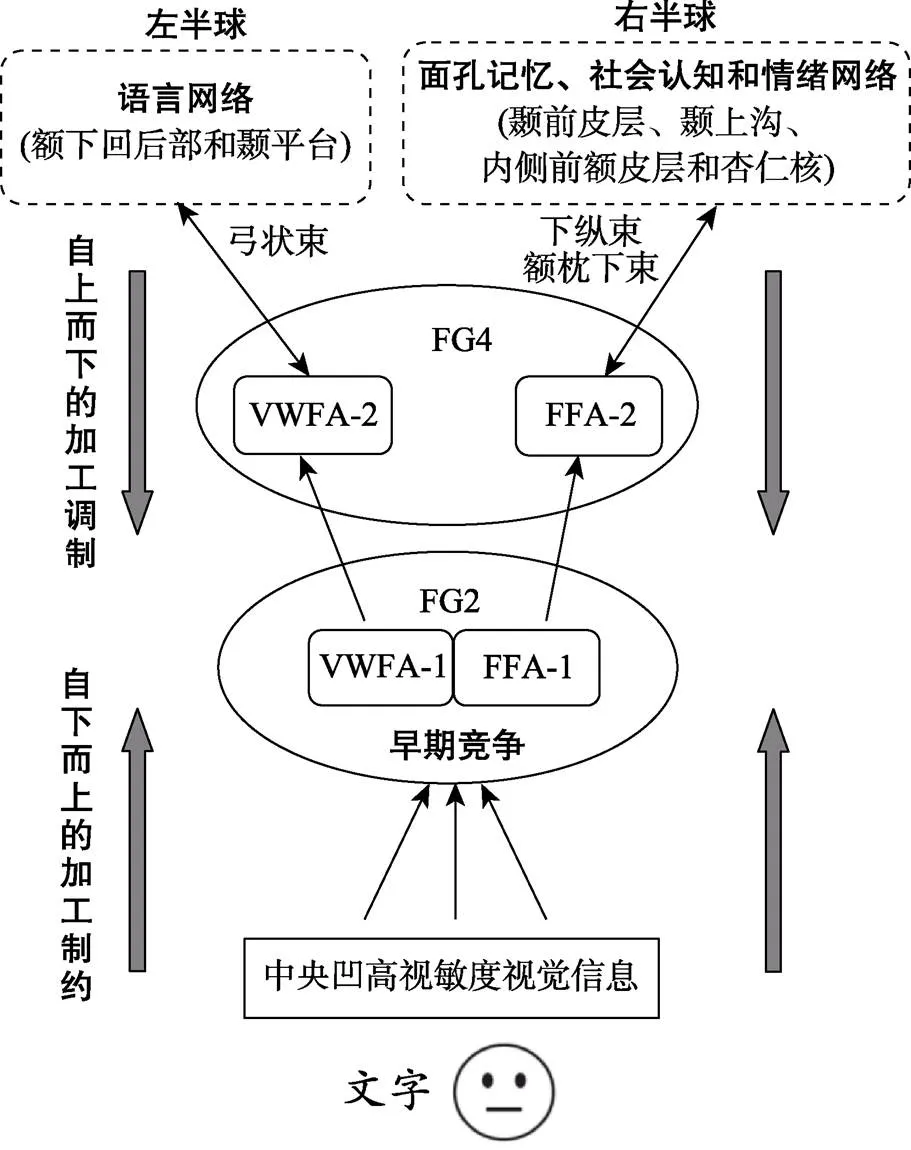
圖3 文字與面孔識別的半球偏側化競爭性發展的多層次雙向動態加工機制圖
盡管文字與面孔識別的半球偏側化互補模式的競爭性發展機制得到初步闡明, 但一些關鍵問題或方向還需深入研究。
第一, 文字與面孔競爭皮層空間的加工機制。大量支持神經元再利用假設的證據都是基于不同年齡段和不同文字閱讀水平被試的組間比較得到的, 其結果可能不夠精確。因為對組內被試數據的平均或平滑處理可能導致對不同范疇刺激的皮層反應區出現交疊, 而實際上在不同個體中這些腦區可能占據著界限分明的區域(Dehaene- Lambertz et al., 2018)。因此, 有必要提供處于不同年齡段的同一組兒童在文字閱讀學習中不同皮層選擇區激活水平發生變化的縱向研究證據。Dehaene- Lambertz等人(2018)對從入學前到入學后第一年的10名兒童進行了共6~7次(間隔約2個月) fMRI掃描, 結果并未發現左半球內VWFA與FFA的激活存在負相關, 但發現右側FFA的激活水平隨閱讀成績的增加而提高。重要的是, 這一過程中VWFA侵占了位于面孔表征區附近的對工具有弱反應的特異性不穩定的神經元斑塊(neuronal patches) (Dehaene-Lambertz et al., 2018)。據此, Dehaene- Lambertz等人(2018)提出了一個修訂的神經元再利用假設, 認為伴隨兒童文字閱讀的學習, 左側FG對文字反應神經元斑塊的數量會不斷增加, 這會阻擋物體或面孔反應斑塊在這里的擴展, 使面孔識別逐漸轉由右側FG所替代。為了進一步考察腦發育成熟和文字閱讀水平對這一效應的影響, Feng等人(2022)還分別對未學習閱讀的6歲兒童、開始學習閱讀的6歲兒童和熟練閱讀的9歲兒童進行fMRI掃描, 結果支持這種阻擋模型(blocking model), 即文字閱讀學習并不與面孔直接競爭, 而是通過間接方式阻擋面孔在左側的緩慢發展, 進而增強了面孔的右側化。這些結果可以更好解釋Dehaene等人(2010)發現的邊緣競爭效應, 即盡管FFA激活峰值并不受文字閱讀能力的影響, 但在距FFA峰值12或16 mm的體素中卻能觀察到競爭效應, 即隨著文字閱讀分數的提高, 左側FFA激活會降低。今后的研究可以采用高分辨率(< 1 mm)的fMRI技術(Dehaene-Lambertz et al., 2018; Feng et al., 2022), 在以FFA峰值為中心的圓環中以1 mm的體素往邊緣變化, 以確定競爭發生的精確皮層空間位置, 進而考察文字究竟是直接與面孔競爭, 還是阻擋了面孔的左側化發展。
第二, 文字與面孔偏側化競爭加工的功能神經組織學基礎。盡管證據顯示FG2和FG4都與文字與面孔識別有關, 但這兩個區域如何參與競爭加工的功能神經組織學, 還需深入研究。首先, FG2包含的高密度大型錐體細胞可能與高視敏度的中央凹計算有關(Weiner et al., 2014), 這也許就是制約高視敏度加工的神經資源(Dehaene et al., 2015)。近期研究(Gomez et al., 2018)發現, 與兒童相比, 成人的VWFA-1與FFA-1的群感受野(population receptive fields, pRFs)分別覆蓋了左、右半球更大范圍的中央凹視野區。而且, FG2的NMDA受體(N-methyl-D-aspartic acid receptor)密度高于FG1 (Caspers et al., 2015)。該受體與學習、記憶和神經元可塑性有關(Collingridge et al., 2013), 可能更適合文字閱讀學習對FG2面孔皮層可塑性的要求。其次, 盡管FG4也偏好編碼中央凹視野的刺激(Weiner, Barnett et al., 2017), 但VWFA-2與FFA-2的偏側化競爭似乎更多受到與相關腦網絡偏側化連通性的影響。FG2和FG4的IIIc層中包含的中、大型錐體細胞顯示出強烈的皮層?皮層連接特征, 這可能提供“自下而上”與“自上而下”加工接口的結構基礎(Lorenz et al., 2017)。重要的是, FG4的V層可細分為Va和Vb兩個亞層, 其功能意義尚不清楚。但是, V層中M2毒蕈堿受體(muscarinic M2 receptors)密度最高(Caspers et al., 2015)。毒蕈堿受體能抑制IV層的微弱感覺輸入, 并增強II、III和V層的輸入, 從而提高皮層對感覺信息的整合加工水平(Eggermann & Feldmeyer, 2009), 這或許能解釋為何FG4與其他腦區有更強的連通性。未來需進一步探明FG2和FG4在細胞類型、分層、密度、突觸連接、髓鞘化和受體等方面的特點, 為闡明文字與面孔偏側化競爭加工機制提供更為堅實的功能神經組織學基礎。
第三, 漢字與面孔的偏側化競爭加工機制。與字母文字與面孔在左側FG爭奪神經加工資源不同, 漢字識別的神經發展與面孔表征的競爭出現了一種不同的表現。對學前期開始學習漢字的兒童(5~6歲)所進行的ERPs和腦電圖(electroencephalography, EEG)γ波的研究(Li et al., 2013; 張文芳, 2020)發現, 漢字誘發的左側化N170振幅與面孔誘發的右側化N170振幅負相關, 表明兒童的早期閱讀經驗不僅會導致漢字識別出現左側優勢, 還在右側與面孔競爭加工資源。研究者推測, 在個體發展的早期文字和面孔存在競爭關系, 而在學齡兒童中則是促進關系(Li et al., 2013; 張文芳, 2020)。然而, 對學前期開始學習字母文字的兒童(4~6歲)所進行的fMRI研究卻發現, 當兒童獲得字母知識時左側FG對面孔的反應隨之減弱(Cantlon et al.,2011; Centanni et al., 2018), 且隨著閱讀成績的提高,右側FG對面孔的神經活動顯著增強(Dehaene- Lambertz et al., 2018; Monzalvo et al., 2012)。可見, 學前與學齡兒童學習字母文字所引起的表現是一致的, 即文字與面孔會在左側競爭, 導致VWFA的左側化, 并推動了FFA的右側化。在本質上, “競爭關系”反映的是一種內在加工機制, 表現為文字可能占用面孔的皮層空間資源, 進而干擾或削弱其加工效率, 導致面孔偏側化在一側半球的減弱; “促進關系”則強調文字在左側與面孔競爭所導致的VWFA左側化會推動FFA的右側化。在學前兒童中漢字閱讀學習所引起的文字與面孔在右側的競爭可能與漢字具有與字母文字相比更復雜的視覺構型特征有關, 這需要擅長視空間辨別能力的右半球的更多參與(Li et al., 2013; 張文芳, 2020)。值得關注的是, Zhao等人(2015)對學前兒童(4~6歲)的ERPs研究發現, 漢字視覺辨認學習訓練會引起漢字在右側誘發更大的N170振幅, 面孔在左側誘發的N170振幅卻變小。這提示在處理早期漢字視覺經驗中右半球起了重要作用, 但漢字還可能在左半球與面孔競爭資源。可以推測, 學前兒童的漢字閱讀學習既要依賴右半球辨別字形, 又要利用左半球通達正字法和字音、字義信息, 所以他們的早期閱讀經驗可能會在右半球和左半球與面孔競爭加工資源。到了學齡期, 隨著兒童閱讀熟練水平的提高, 漢字在左半球與面孔的競爭會愈加激烈, 這會加快文字的左側化, 并推動面孔的右側化。今后的研究有必要采用學前和學齡兒童的跨期研究設計, 利用具有高時間分辨率的ERPs技術和高空間分辨率的fMRI技術, 系統探查兒童早期閱讀經驗影響漢字與面孔偏側化競爭加工的獨特機制。
第四, 面孔識別右側化的發展機制。盡管兒童和成人的研究證據傾向于支持文字閱讀學習可能推動了面孔識別的FFA右側化發展, 但不識字的成年文盲者也有一定程度的右側優勢(Dehaene et al., 2010), 這提示文字閱讀學習只是影響面孔識別右側化發展的因素之一(Dehaene et al., 2015)。文字與面孔識別的偏側化發展都會受學習與經驗的驅動, 但與文字閱讀學習主要依賴外顯的強化教學不同, 個體在生命早期就會自動暴露給面孔(Op de Beeck et al., 2019)。在個體發展中, 面孔識別的右側化呈現出非線性的發展過程(Behrmann & Avidan, 2022; Lochy et al., 2019)。早在嬰兒期面孔識別就出現了右側優勢(de Heering & Rossion, 2015; Leleu et al., 2020; Rekow et al., 2021; Rekow et al., 2020), 這可能與嬰兒的面孔識別主要依賴低空間頻率的視覺信息有關(Johnson, 2005; Johnson et al., 2015)。隨著胼胝體(corpus callosum)的發育成熟(3個月到2歲) (Grand et al., 2003; Yakovlev & Lecours, 1967), 尤其是后部的髓鞘化促進了半球間的視覺信息傳遞(Adibpour et al., 2018), 使得面孔識別逐步依賴兩半球的加工。到了學前兒童(5~6歲) (Lochy et al., 2019; Lochy et al., 2020), 面孔識別的右側優勢便逐步消失了。不過, 從文字閱讀學習開始, 面孔識別的右側優勢又逐漸再現, 且在成年時穩定下來(Behrmann & Plaut, 2020)。可見, 面孔識別的右側化發展會經歷一個較長的時間延遲, 這不僅受腦發育和文字閱讀學習的影響, 也與面孔經驗的緩慢積累過程有關。研究發現, 伴隨兒童和青少年獲得較為熟練的閱讀技能, 面孔識別能力和FFA右側化還需發展相當長一段時間才能達到成人水平(Feng et al., 2022; O'Hearn et al., 2010; Vuontela et al., 2013)。例如, 兒童右側FFA對面孔選擇性激活的體積約是成人的三分之一(Golarai et al., 2007), 且FFA-1在兒童期和青春期的擴展幅度最大(Nordt et al., 2021)。而且, 兒童(7~11歲)和青少年(12~14歲)右側FFA體積的大小與面孔識別記憶能力呈顯著正相關, 而成人卻無這種關系(Golarai et al., 2007)。因此, FFA右側化的發展可能反映了個體對面孔識別和感知經驗的變化。近期研究(Nordt et al., 2021)發現, 隨著兒童的成長發育, FFA-1的選擇性提高與枕顳溝肢體區(occipitotemporal sulcus limbs)的選擇性降低直接相關, 提示面孔識別可能重新利用了右側FG中肢體區的皮層空間。而且, 與文字相似, 面孔感知經驗可能進一步調整右側vOTC沿后?前計算軸不同區域的功能。例如, 成人FFA的激活峰值位于前部區域, 而兒童(5~8歲)FFA的選擇性激活的峰值位于后部區域, 并隨兒童面孔經驗的積累, 激活峰值也由FFA后部轉移到前部(Gathers et al., 2004)。另外, 右側FFA-2也更易受面孔感知經驗的調節(Golarai et al., 2017), 并與個體面孔識別的目的或需要密切相關(Kim et al., 2019)。因此, 今后研究不僅要關注文字閱讀學習如何在左側FG與面孔表征競爭加工資源, 還需探究面孔感知經驗如何影響FFA的右側化發展及其與其他皮層競爭空間資源的加工機制。
總之, 在文字與面孔識別的半球偏側化互補模式的發展中, 盡管文字在左側FG與面孔的競爭加工起了關鍵作用(見圖3), 但這一機制通常發生在學齡期兒童開始學習文字時, 而面孔識別的偏側化則經歷了從嬰兒、學前兒童、學齡兒童到成年人的變化過程。圖4呈現了個體發展中文字與面孔識別半球偏側化動態改變的時間進程。在嬰兒期, 面孔識別表現為右半球優勢; 在學前期, 面孔識別出現了兩側均勢; 在學齡期, 文字閱讀學習導致在左側FG發展出VWFA; 左側FFA由于受到VWFA的阻擋, 其發展逐步轉移到右側FG; 在成年期, 面孔識別的右側優勢出現成熟與穩定的狀態。
第五, 數字和音符閱讀學習的大腦可塑性機制。數字和音符也屬于人類發明的文化產品, 它們的閱讀學習會引起與文字閱讀學習類似的大腦可塑性變化嗎?證據表明, 優先編碼阿拉伯數字的視覺數形區(visual number form area, VNFA)位于FBA的外側, 但比VWFA位置更偏外(Hannagan et al., 2015); 音符視覺選擇區(area of visual selectivity for musical notation)位于VWFA的后部外側(Mongelli et al., 2017; Wong & Gauthier, 2010)。這表明數字與音符的識別占用了FG外側區中緊鄰VWFA的區域, 提示它們的閱讀學習也依賴對中央凹高視敏度視覺信號的加工和形狀不變性知覺(Hannagan et al., 2015; Mongelli et al., 2017; Wong & Gauthier, 2010)。但是, 數字閱讀學習需將數字映射到數量表征上, 這導致 VNFA不僅要與軀體識別區爭奪資源, 還要利用動作和空間表征的右側頂內溝(intraparietal sulcus, IPS)以及額頂數字區(frontoparietal number regions), 以解析數字的抽象信息(Abboud et al., 2015; Hernandez et al., 2019; Klein et al., 2016)。因此, VNFA與右半球的額頂數字處理網絡(Abboud et al., 2015; Kanjlia et al., 2016; Yeo et al., 2017)有較強的偏側化連通性, 這導致VNFA會出現在VWFA更外側(Hannagan et al., 2015), 且表現出右側優勢(Abboud et al., 2015; Shum et al., 2013)。相對而言, 音符的閱讀學習需要更多利用FG到運動執行網絡的神經連接, 以完成視覺?運動的編碼轉換(Stewart et al., 2003; van Vugt et al., 2021; Wong & Gauthier, 2010)。而且, 音符識別區與左側顳葉后部外側有更強的連通性, 這導致音符識別區會出現在VWFA的后部外側, 但表現出左側優勢(Bouhali et al., 2020)。可見, 數字、音符和文字的閱讀學習共享了基本相似的大腦可塑性機制, 即它們需要利用FG中原先可用于表征其它領域客體(如物體、面孔或軀體等)的皮層區域, 并通過與相關腦網絡的偏側化連通性, 以形成各自獨特的皮層定位區和發展不同的半球偏側化效應。
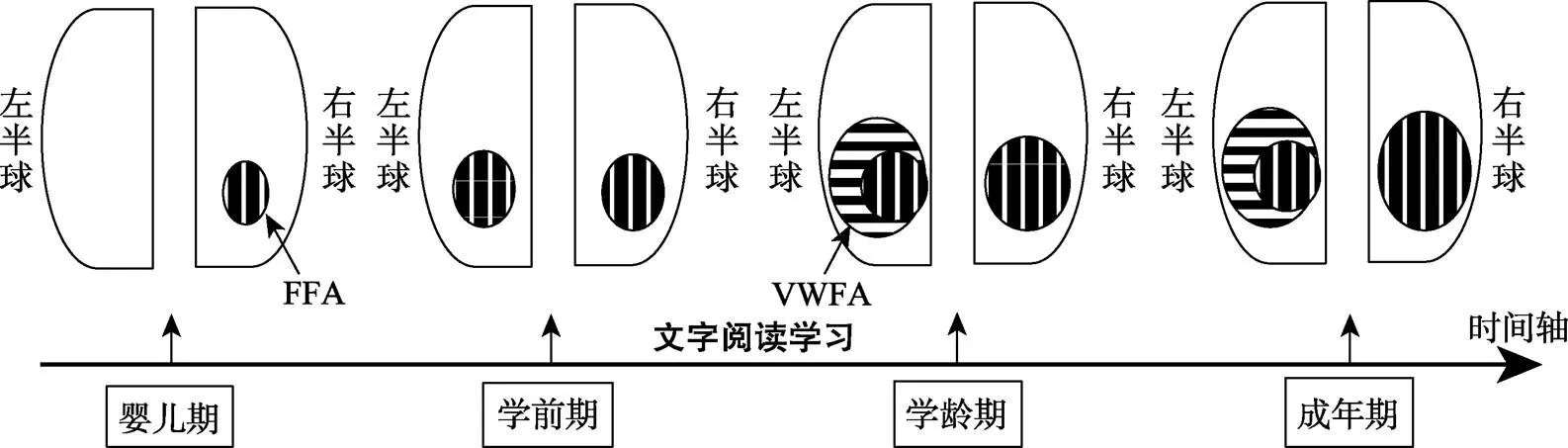
圖4 個體發展中文字和面孔偏側化動態改變的時間進程
未來的研究有必要探究數字、音符與文字閱讀學習的大腦可塑性改變之間的相互關系。例如, 盡管右側VNFA在數字識別中激活程度更強, 但割裂腦和純失讀癥患者的左右半球都能識別阿拉伯數字, 表明VNFA可能是雙側化的(Hannagan et al., 2015)。而且, 左側VNFA不僅對字母表現出較強激活, 還與VWFA高度重疊(Grotheer et al., 2016)。因此, 左側VNFA與VWFA究竟是合并出現的, 還是兩個截然不同的區域, 還亟待確認(Grotheer et al., 2016; Hannagan et al., 2015)。再如, 數字閱讀學習不僅需要激活右側VNFA, 以及右側IPS和額頂數字區, 還需左側化數詞語音加工腦區的參與。因此, 熟練的數字加工技能需要表征數字形狀、數量和數詞腦網絡之間的靈活轉換。這也被稱為數字認知的三重編碼模型(Triple Code Model, TCM) (Skagenholt et al., 2018)。今后的研究需要基于這一模型, 探究兒童數字閱讀學習中這三個網絡之間連通性的可塑性改變及其對數字運算或思維能力發展的影響(Skagenholt et al., 2021, 2022)。還如, 音符閱讀學習不僅強化了左側音符識別區與外側裂周邊語音網絡的結構與功能連通性, 還導致音符識別區的擴大, 而VWFA則向內側前部偏移(Bouhali et al., 2020; Mongelli et al., 2017)。因此, 音符與文字閱讀學習的大腦可塑性機制不僅在左半球共享了同一個結構與功能連通性的目標網絡, 還可能由于這兩個領域之間的皮層空間競爭加工, 導致VWFA出現位置變動(Bouhali et al., 2020; Dehaene et al., 2010; Mongelli et al., 2017)。然而, 目前的證據來自成年音樂家與非音樂家被試的比較。未來的研究需要采用縱向的研究設計, 比較不同文字與音符閱讀水平的兒童, 以探查早期的文字與音符閱讀學習經驗對VWFA與音符識別區之間競爭皮層空間的影響, 以及這兩個腦區的定位與偏側化如何受到來自外側裂周邊語音網絡的自上而下的調制。總之, 文字、數字和音符閱讀學習的腦結構與功能網絡既相互分離, 又相互重疊; 既相互競爭, 又相互協調。重要的是, 兒童閱讀這三種視覺符號的學習在時間上可能是同步或異步發生的。因此, 探明兒童文字、數字和音符閱讀學習相互作用的時間動力學及其腦機制, 不僅對加深文化學習(cultural learning)大腦可塑性的認識有理論意義, 也對指導語言、數學和音樂的早期教學有實踐意義。
齊星亮, 蔡厚德. (2019). 文字閱讀學習的大腦可塑性機制.(5), 1127–1133.
張文芳. (2020).(博士論文). 中國科學院大學, 北京.
Abboud, S., Maidenbaum, S., Dehaene, S., & Amedi, A. (2015).A number-form area in the blind.(1), Article 6026. https://doi.org/10.1038/ncomms7026
Adibpour, P., Dubois, J., & Dehaene-Lambertz, G. (2018). Right but not left hemispheric discrimination of faces in infancy.(1), 67–79.
Ayzenberg, V., & Behrmann, M. (2022). Does the brain's ventral visual pathway compute object shape?(12), 1119–1132.
Behrmann, M., & Avidan, G. (2022). Face perception: Computational insights from phylogeny.(4), 350–363.
Behrmann, M., & Plaut, D. C. (2013). Distributed circuits, not circumscribed centers, mediate visual recognition.(5), 210–219.
Behrmann, M., & Plaut, D. C. (2014). Bilateral hemispheric processing of words and faces: Evidence from word impairments in prosopagnosia and face impairments in pure alexia.(4), 1102–1118.
Behrmann, M., & Plaut, D. C. (2015). A vision of graded hemispheric specialization., 30–46.
Behrmann, M., & Plaut, D. C. (2020). Hemispheric organization for visual object recognition: A theoretical account and empirical evidence.(4), 373–404.
Bouhali, F., Mongelli, V., de Schotten, M. T., & Cohen, L. (2020).Reading music and words: The anatomical connectivity of musicians' visual cortex., Article 116666. https://doi.org/10.1016/j.neuroimage.2020.116666
Cai, Q., Paulignan, Y., Brysbaert, M., Ibarrola, D., & Nazir, T. A. (2010). The left ventral occipito-temporal response to words depends on language lateralization but not on visual familiarity.(5), 1153–1163.
Canário, N., Jorge, L., & Castelo-Branco, M. (2020). Distinct mechanisms drive hemispheric lateralization of object recognition in the visual word form and fusiform face areas., Article 104860. https://doi.org/ 10.1016/j.bandl.2020.104860
Cantlon, J. F., Pinel, P., Dehaene, S., & Pelphrey, K. A. (2011). Cortical representations of symbols, objects, and faces are pruned back during early childhood.(1), 191–199.
Caspers, J., Palomero-Gallagher, N., Caspers, S., Schleicher, A., Amunts, K., & Zilles, K. (2015). Receptor architecture of visual areas in the face and word-form recognition region of the posterior fusiform gyrus.(1), 205–219.
Caspers, J., Zilles, K., Eickhoff, S. B., Schleicher, A., Mohlberg, H., & Amunts, K. (2013). Cytoarchitectonical analysis and probabilistic mapping of two extrastriate areas of the human posterior fusiform gyrus.(2), 511–526.
Centanni, T. M., Norton, E. S., Park, A., Beach, S. D., Halverson, K., Ozernov-Palchik, O., ... Gabrieli, J. (2018). Early development of letter specialization in left fusiform is associated with better word reading and smaller fusiform face area.(5), Article e12658. https://doi.org/10.1111/desc.12658
Collingridge, G. L., Volianskis, A., Bannister, N., France, G., Hanna, L., Mercier, M., ... Jane, D. E. (2013). The NMDAreceptor as a target for cognitive enhancement., 13–26.
Collins, E., Dundas, E., Gabay, Y., Plaut, D. C., & Behrmann, M. (2017). Hemispheric organization in disorders of development.(4-6), 416–429.
Dai, R., Huang, Z., Weng, X., & He, S. (2022). Early visual exposure primes future cross-modal specialization of the fusiform face area in tactile face processing in the blind., Article 119062. https://doi.org/10.1016/ j.neuroimage.2022.119062
Davies-Thompson, J., Johnston, S., Tashakkor, Y., Pancaroglu, R., & Barton, J. J. (2016). The relationship between visual word and face processing lateralization in the fusiform gyri: A cross-sectional study., 88–97.
de Heering, A., & Rossion, B. (2015). Rapid categorization of natural face images in the infant right hemisphere., Article e06564. https://doi.org/10.7554/eLife.06564.001
Dehaene, S. (2005). Evolution of human cortical circuits for reading and arithmetic: The ‘‘neuronal recycling’’ hypothesis. In S. Dehaene, J. R. Duhamel, M. Hauser, & G. Rizzolatti (Eds.),(pp. 133–157). Cambridge, MA: MIT Press.
Dehaene, S., & Cohen, L. (2007). Cultural recycling of cortical maps.(2), 384–398.
Dehaene, S., & Cohen, L. (2011). The unique role of the visual word form area in reading.(6), 254–262.
Dehaene, S., Cohen, L., Morais, J., & Kolinsky, R. (2015). Illiterate to literate: Behavioural and cerebral changes induced by reading acquisition.(4), 234–244.
Dehaene, S., Pegado, F., Braga, L. W., Ventura, P., Nunes Filho, G., Jobert, A., ... Cohen, L. (2010). How learning to read changes the cortical networks for vision and language.(6009), 1359–1364.
Dehaene-Lambertz, G., Monzalvo, K., & Dehaene, S. (2018). The emergence of the visual word form: Longitudinal evolution of category-specific ventral visual areas during reading acquisition.(3), Article e2004103. https://doi.org/10.1371/journal.pbio.2004103
Dundas, E. M., Plaut, D. C., & Behrmann, M. (2013). The joint development of hemispheric lateralization for words and faces.(2), 348–358.
Dundas, E. M., Plaut, D. C., & Behrmann, M. (2014). An ERP investigation of the co-development of hemispheric lateralization of face and word recognition., 315–323.
Dundas, E. M., Plaut, D. C., & Behrmann, M. (2015). Variable left-hemisphere language and orthographic lateralizationreduces right-hemisphere face lateralization.(5), 913–925.
Eggermann, E., & Feldmeyer, D. (2009). Cholinergic filtering in the recurrent excitatory microcircuit of cortical layer 4.(28), 11753–11758.
Feng, X., Monzalvo, K., Dehaene, S., & Dehaene-Lambertz, G. (2022). Evolution of reading and face circuits during the first three years of reading acquisition., Article 119394. https://doi.org/10.1016/j.neuroimage. 2022.119394
Fr?ssle, S., Krach, S., Paulus, F. M., & Jansen, A. (2016). Handedness is related to neural mechanisms underlying hemispheric lateralization of face processing., Article 27153. https://doi.org/10.1038/srep27153
Gathers, A. D., Bhatt, R., Corbly, C. R., Farley, A. B., & Joseph, J. E. (2004). Developmental shifts in cortical loci for face and object recognition.(10), 1549–1553.
Gerlach, C., Kuhn, C. D., Poulsen, M., Andersen, K. B., Lissau, C. H., & Starrfelt, R. (2022). Lateralization of word and face processing in developmental dyslexia and developmental prosopagnosia., https://doi.org/10.1016/j.neuropsychologia. 2022.108208
Gerrits, R., Van der Haegen, L., Brysbaert, M., & Vingerhoets, G. (2019). Laterality for recognizing written words and faces in the fusiform gyrus covaries with language dominance., 196–204.
Golarai, G., Ghahremani, D. G., Whitfield-Gabrieli, S., Reiss, A., Eberhardt, J. L., Gabrieli, J. D., & Grill-Spector, K. (2007). Differential development of high-level visual cortex correlates with category-specific recognition memory.(4), 512–522.
Golarai, G., Liberman, A., & Grill-Spector, K. (2017). Experience shapes the development of neural substrates of face processing in human ventral temporal cortex.(2), 1229–1244.
Gomez, J., Barnett, M., & Grill-Spector, K. (2019). Extensive childhood experience with Pokemon suggests eccentricity drives organization of visual cortex.(6), 611–624.
Gomez, J., Barnett, M. A., Natu, V., Mezer, A., Palomero- Gallagher, N., Weiner, K. S., ... Grill-Spector, K. (2017). Microstructural proliferation in human cortex is coupled with the development of face processing.(6320), 68–71.
Gomez, J., Natu, V., Jeska, B., Barnett, M., & Grill-Spector, K. (2018). Development differentially sculpts receptive fields across early and high-level human visual cortex.(1), Article 788. https://doi.org/ 10.1038/s41467-018-03166-3
Gomez, J., Pestilli, F., Witthoft, N., Golarai, G., Liberman, A., Poltoratski, S., ... Grill-Spector, K. (2015). Functionally defined white matter reveals segregated pathways in human ventral temporal cortex associated with category-specific processing.(1), 216–227.
Grand, R. L., Mondloch, C. J., Maurer, D., & Brent, H. P. (2003). Expert face processing requires visual input to the right hemisphere during infancy.(10), 1108–1112.
Grill-Spector, K., & Malach, R. (2004). The human visual cortex., 649–677.
Grill-Spector, K., & Weiner, K. S. (2014). The functional architecture of the ventral temporal cortex and its role in categorization.(8), 536–548.
Grossi, D., Soricelli, A., Ponari, M., Salvatore, E., Quarantelli, M., Prinster, A., & Trojano, L. (2014). Structural connectivity in a single case of progressive prosopagnosia: The role of the right inferior longitudinal fasciculus., 111–120.
Grotheer, M., Herrmann, K.-H., & Kovács, G. (2016). Neuroimaging evidence of a bilateral representation for visually presented numbers.(1), 88–97.
Hadders-Algra, M. (2022). Human face and gaze perception is highly context specific and involves bottom-up and top-down neural processing., 304–323.
Hannagan, T., Amedi, A., Cohen, L., Dehaene-Lambertz, G., & Dehaene, S. (2015). Origins of the specialization for letters and numbers in ventral occipitotemporal cortex.(7), 374–382.
Hasson, U., Levy, I., Behrmann, M., Hendler, T., & Malach, R. (2002). Eccentricity bias as an organizing principle for human high-order object areas.(3), 479–490.
Hernandez, A. E., Claussenius-Kalman, H. L., Ronderos, J., Castilla-Earls, A. P., Sun, L., Weiss, S. D., & Young, D. R. (2019). Neuroemergentism: A framework for studying cognition and the brain., 49, 214–223.
Inamizu, S., Yamada, E., Ogata, K., Uehara, T., Kira, J.-I., & Tobimatsu, S. (2020). Neuromagnetic correlates of hemispheric specialization for face and word recognition., 108–116.
Johnson, M. H. (2005). Subcortical face processing.(10), 766–774.
Johnson, M. H., Senju, A., & Tomalski, P. (2015). The two-process theory of face processing: Modifications based on two decades of data from infants and adults., 169–179.
Kanjlia, S., Lane, C., Feigenson, L., & Bedny, M. (2016). Absence of visual experience modifies the neural basis of numerical thinking.(40), 11172–11177.
Kim, H., Kim, G., & Lee, S.-H. (2019). Effects of individuation and categorization on face representations in the visual cortex., Article 134344. https://doi.org/10.1016/j.neulet.2019.134344
Klein, E., Suchan, J., Moeller, K., Karnath, H.-O., Knops, A., Wood, G., ... Willmes, K. (2016). Considering structural connectivity in the triple code model of numerical cognition: Differential connectivity for magnitude processing and arithmetic facts.(2), 979–995.
Leleu, A., Rekow, D., Poncet, F., Schaal, B., Durand, K., Rossion, B., & Baudouin, J.-Y. (2020). Maternal odor shapes rapid face categorization in the infant brain.(2), Article e12877. https://doi. org/10.1111/desc.12877
Lerma-Usabiaga, G., Carreiras, M., & Paz-Alonso, P. M. (2018). Converging evidence for functional and structural segregation within the left ventral occipitotemporal cortex in reading.(42), E9981–E9990.
Li, H., Liang, Y., Yue, Q., Zhang, L., Ying, K., & Mei, L. (2021). The contributions of the left fusiform subregions to successful encoding of novel words., Article 105690. https://doi.org/10.1016/j. bandc.2021.105690
Li, S., Lee, K., Zhao, J., Yang, Z., He, S., & Weng, X. (2013). Neural competition as a developmental process: Early hemispheric specialization for word processing delays specialization for face processing.(5), 950–959.
Liu, T. T., Nestor, A., Vida, M. D., Pyles, J. A., Patterson, C., Yang, Y., ... Behrmann, M. (2018). Successful reorganization of category-selective visual cortex following occipito- temporal lobectomy in childhood.(5), 1113–1122.
Lochy, A., de Heering, A., & Rossion, B. (2019). The non- linear development of the right hemispheric specialization for human face perception., 10–19.
Lochy, A., Schiltz, C., & Rossion, B. (2020). The right hemispheric dominance for face perception in preschool children depends on the visual discrimination level.(3), Article e12914. https://doi. org/10.1111/desc.12914
Lorenz, S., Weiner, K. S., Caspers, J., Mohlberg, H., Schleicher, A., Bludau, S., ... Amunts, K. (2017). Two new cytoarchitectonic areas on the human mid-fusiform gyrus.(1), 373–385.
Mongelli, V., Dehaene, S., Vinckier, F., Peretz, I., Bartolomeo, P., & Cohen, L. (2017). Music and words in the visual cortex: The impact of musical expertise., 260–274.
Monzalvo, K., Fluss, J., Billard, C., Dehaene, S., & Dehaene-Lambertz, G. (2012). Cortical networks for vision and language in dyslexic and normal children of variable socio-economic status.(1), 258–274.
Moret-Tatay, C., Baixauli Fortea, I., & Grau Sevilla, M. D. (2020). Challenges and insights for the visual system: Are face and word recognition two sides of the same coin?, Article 100941. https://doi. org/10.1016/j.jneuroling.2020.100941
Nordt, M., Gomez, J., Natu, V., Jeska, B., Barnett, M., & Grill-Spector, K. (2019). Learning to read increases the informativeness of distributed ventral temporal responses.(7), 3124–3139.
Nordt, M., Gomez, J., Natu, V. S., Rezai, A. A., Finzi, D., Kular, H., & Grill-Spector, K. (2021). Cortical recycling in high-level visual cortex during childhood development.(12), 1686–1697.
O'Hearn, K., Schroer, E., Minshew, N., & Luna, B. (2010). Lack of developmental improvement on a face memory task during adolescence in autism.(13), 3955–3960.
Op de Beeck, H. P., Pillet, I., & Ritchie, J. B. (2019). Factors determining where category-selective areas emerge in visual cortex.(9), 784–797.
Pegado, F., Comerlato, E., Ventura, F., Jobert, A., Nakamura, K., Buiatti, M., ... Dehaene, S. (2014). Timing the impact of literacy on visual processing.(49), E5233–E5242.
Powell, L. J., Kosakowski, H. L., & Saxe, R. (2018). Social origins of cortical face areas.(9), 752–763.
Pyles, J. A., Verstynen, T. D., Schneider, W., & Tarr, M. J. (2013). Explicating the face perception network with white matter connectivity.(4), Article e61611. https://doi.org/10.1371/journal.pone.0061611
Rekow, D., Baudouin, J.-Y., Poncet, F., Damon, F., Durand, K., Schaal, B., ... Leleu, A. (2021). Odor-driven face-like categorization in the human infant brain.(21), Article e2014979118. https://doi.org/10.1073/pnas.2014979118
Rekow, D., Leleu, A., Poncet, F., Damon, F., Rossion, B., Durand, K., ... Baudouin, J.-Y. (2020). Categorization of objects and faces in the infant brain and its sensitivity to maternal odor: Further evidence for the role of intersensory congruency in perceptual development., Article 100930. https://doi.org/10.1016/j.cogdev.2020. 100930
Roberts, D. J., Ralph, M. A. L., Kim, E., Tainturier, M.-J., Beeson, P. M., Rapcsak, S. Z., & Woollams, A. M. (2015). Processing deficits for familiar and novel faces in patients with left posterior fusiform lesions., 79–96.
Roberts, D. J., Woollams, A. M., Kim, E., Beeson, P. M., Rapcsak, S. Z., & Ralph, M. A. L. (2013). Efficient visual object and word recognition relies on high spatial frequency coding in the left posterior fusiform gyrus: Evidence from a case-series of patients with ventral occipito-temporal cortex damage.(11), 2568–2580.
Sabsevitz, D. S., Middlebrooks, E. H., Tatum, W., Grewal, S. S., Wharen, R., & Ritaccio, A. L. (2020). Examining the function of the visual word form area with stereo EEG electrical stimulation: A case report of pure alexia., 112–118.
Saygin, Z. M., Osher, D. E., Norton, E. S., Youssoufian, D. A., Beach, S. D., Feather, J., ... Kanwisher, N. (2016). Connectivity precedes function in the development of the visual word form area.(9), 1250– 1255.
Sehyr, Z. S., Midgley, K. J., Holcomb, P. J., Emmorey, K., Plaut, D. C., & Behrmann, M. (2020). Unique N170 signatures to words and faces in deaf ASL signers reflect experience-specific adaptations during early visual processing., Article 107414. https://doi.org/10. 1016/j.neuropsychologia.2020.107414
Shum, J., Hermes, D., Foster, B. L., Dastjerdi, M., Rangarajan, V., Winawer, J., ... Parvizi, J. (2013). A brain area for visual numerals.(16), 6709–6715.
Skagenholt, M., Skagerlund, K., & Traff, U. (2021). Neurodevelopmental differences in child and adult number processing: An fMRI-based validation of the triple code model., Article 100933. https://doi.org/10.1016/j.dcn.2021.100933
Skagenholt, M., Skagerlund, K., & Tr?ff, U. (2022). Neurodevelopmental differences in task-evoked number network connectivity: Comparing symbolic and nonsymbolicnumber discrimination in children and adults., Article 101159. https://doi. org/10.1016/j.dcn.2022.101159
Skagenholt, M., Tr?ff, U., V?stfj?ll, D., & Skagerlund, K. (2018). Examining the triple code model in numerical cognition: An fMRI study.(6), Article e0199247. https://doi.org/10.1371/journal.pone.0199247
Stewart, L., Henson, R., Kampe, K., Walsh, V., Turner, R., & Frith, U. (2003). Brain changes after learning to read and play music.(1), 71–83.
Susilo, T., Wright, V., Tree, J. J., & Duchaine, B. (2015). Acquired prosopagnosia without word recognition deficits.(6), 321–339.
Thiebaut de Schotten, M., Cohen, L., Amemiya, E., Braga, L. W., & Dehaene, S. (2014). Learning to read improves the structure of the arcuate fasciculus.(4), 989–995.
Thomas, C., Avidan, G., Humphreys, K., Jung, K.-J., Gao, F., & Behrmann, M. (2009). Reduced structural connectivity in ventral visual cortex in congenital prosopagnosia.(1), 29–31.
van Vugt, F. T., Hartmann, K., Altenmüller, E., Mohammadi, B., & Margulies, D. S. (2021). The impact of early musical training on striatal functional connectivity., Article 118251. https://doi.org/10.1016/j.neuroimage.2021. 118251
Vuontela, V., Jiang, P., Tokariev, M., Savolainen, P., Ma, Y., Aronen, E. T., ... Carlson, S. (2013). Regulation of brain activity in the fusiform face and parahippocampal place areas in 7-11-year-old children.(2), 203–214.
Weiner, K. S. (2019). The mid-fusiform sulcus (sulcus sagittalis gyri fusiformis).(9), 1491–1503.
Weiner, K. S., Barnett, M. A., Lorenz, S., Caspers, J., Stigliani, A., Amunts, K., ... Grill-Spector, K. (2017). The cytoarchitecture of domain-specific regions in human high-level visual cortex.(1), 146–161.
Weiner, K. S., Barnett, M. A., Witthoft, N., Golarai, G., Stigliani, A., Kay, K. N., ... Grill-Spector, K. (2018). Defining the most probable location of the parahippocampal place area using cortex-based alignment and cross-validation., 373–384.
Weiner, K. S., Golarai, G., Caspers, J., Chuapoco, M. R., Mohlberg, H., Zilles, K., ... Grill-Spector, K. (2014). The mid-fusiform sulcus: A landmark identifying both cytoarchitectonic and functional divisions of human ventral temporal cortex., 453–465.
Weiner, K. S., Natu, V. S., & Grill-Spector, K. (2018). On object selectivity and the anatomy of the human fusiform gyrus., 604–609.
Weiner, K. S., Yeatman, J. D., & Wandell, B. A. (2017). The posterior arcuate fasciculus and the vertical occipital fasciculus., 274–276.
Weiner, K. S., & Zilles, K. (2016). The anatomical and functional specialization of the fusiform gyrus., 48–62.
Wong, Y. K., & Gauthier, I. (2010). A multimodal neural network recruited by expertise with musical notation.(4), 695–713.
Woodhead, Z. V., Wise, R. J., Sereno, M., & Leech, R. (2011). Dissociation of sensitivity to spatial frequency in word and face preferential areas of the fusiform gyrus.(10), 2307–2312.
Yakovlev, P. I., & Lecours, A. R. (1967). The myelogenetic cycles of regional maturation of the brain. In A. Minkowski (Eds.),(pp. 3–70). Oxford: Blackwell Science.
Yeatman, J. D., Dougherty, R. F., Ben-Shachar, M., & Wandell, B. A. (2012). Development of white matter and reading skills.(44), E3045–E3053.
Yeatman, J. D., & White, A. L. (2021). Reading: The confluence of vision and language., 487–517.
Yeo, D. J., Wilkey, E. D., & Price, G. R. (2017). The search for the number form area: A functional neuroimaging meta-analysis., 145–160.
Zhao, P., Li, S., Zhao, J., Gaspar, C. M., & Weng, X. (2015). Training by visual identification and writing leads to different visual word expertise N170 effects in preliterate Chinese children., 106–116.
Mechanism of competitive development of hemispheric lateralization complementary pattern for word and face recognition
GAO Fei1, CAI Houde2, QI Xingliang3
(1School of Psychology, Shandong Normal University, Jinan 250358, China) (2School of Psychology, Nanjing Normal University, Nanjing 210097, China) (3School of Early-Childhood Education, Nanjing Xiaozhuang University, Nanjing 211171, China)
The left visual word form area (VWFA) of the brain in adults is more sensitive to orthographic information, whereas the right fusiform face area (FFA) is preferentially involved in the processing of facial information. However, the developmental mechanism of the complementary pattern of hemispheric lateralization still needs to be clarified. The neuronal recycling hypothesis postulates that learning to read words and face representation compete for neural processing resources in the left fusiform gyrus (FG), which leads to left hemispheric lateralization of the VWFA in word recognition, and drives the right hemispheric lateralization of FFA in face recognition. The distributed account of hemispheric organization of word and face recognition proposes three key neural computational principles to systematically elucidate a multilevel and bidirectional dynamic processing mechanism of the competitive development of word and face lateralization. Based on recent discoveries of cytoarchitectonic areas and functional organizational features of the FG, a multidimensional computational model of word and face recognition is constructed. Therefore, the cognitive neural processing mechanism of the competitive development of the complementary pattern of hemispheric lateralization in word and face recognition is systematically examined using the neuronal recycling hypothesis and distributed account of the hemispheric organization, combined with the structural and functional characteristics of FG and recent evidence. Further studies should explore the cortical spatial sites and the functional neurohistological basis of competitive processing between words and faces, the processing mechanism of competition between Chinese characters and faces, the developmental mechanism of the right hemispheric specialization for face recognition, and the mechanisms of brain plasticity changed by learning to read numbers and musical notations.
visual word form area, fusiform face area, complementary pattern of hemispheric lateralization, mechanism of competitive development, multilevel and bidirectional dynamic processing
2022-09-21
* 山東省社會科學普及應用研究項目(2020-SKZZ-01)、山東省社會科學規劃研究項目(19CSZJ35)資助。
蔡厚德, E-mail: caihoude@163.com
B845
猜你喜歡
少兒美術·書法版(2021年12期)2021-10-24 02:50:16
少兒美術·書法版(2021年9期)2021-10-20 06:35:28
少兒美術·書法版(2021年7期)2021-10-20 06:29:16
少兒美術·書法版(2021年11期)2021-10-20 06:23:28
少兒美術·書法版(2021年10期)2021-10-20 06:14:04
少兒美術·書法版(2021年8期)2021-10-20 06:08:10
少兒美術(2019年8期)2019-12-14 08:07:00
少兒美術(2019年3期)2019-12-14 08:02:56
雜文選刊(2016年7期)2016-08-02 08:39:56
小天使·一年級語數英綜合(2016年6期)2016-05-14 12:21:05