基于四基色的全色域混色模型構(gòu)建及彩色紗紡制
2023-11-22 22:15:25李娟娟薛元徐志武于健曾德軍
現(xiàn)代紡織技術(shù) 2023年6期
李娟娟 薛元 徐志武 于健 曾德軍
摘 要:為了解決色紡紗產(chǎn)品研發(fā)與生產(chǎn)中的顏色模型構(gòu)建等關(guān)鍵共性技術(shù),基于四基色纖維以12.5%的離散梯度網(wǎng)格化混配構(gòu)建全色域混色模型;結(jié)合構(gòu)建的全色域混色模型和三通道數(shù)控紡紗技術(shù),闡述了“多通道牽伸比-色纖維混合比-成型紗線顏色值”的三要素調(diào)控機理,提出了調(diào)控成形紗線色相、明度及彩度的工藝方法,設(shè)計了紡制全色域混色紗的工藝;利用三通道數(shù)碼紡紗機紡制了等明度不同色相、等色相不同明度、等色相不同彩度的三個系列的彩色紗,并對紗線的條干、毛羽及力學(xué)性能進行了測試,將測試數(shù)據(jù)與本色紗性能指標(biāo)進行對比分析。結(jié)果表明:文章提出的基于全色域混色色譜紡制全色域彩色紗線的工藝具有可行性,紡制的彩色紗各項性能指標(biāo)均可達到本色紗的一等品要求。
關(guān)鍵詞:混色紗;四基色;網(wǎng)格化混色;全色域混色模型;性能指標(biāo)
中圖分類號:TS85.1 文獻標(biāo)志碼:A 文章編號:1009-265X(2023)06-0117-13
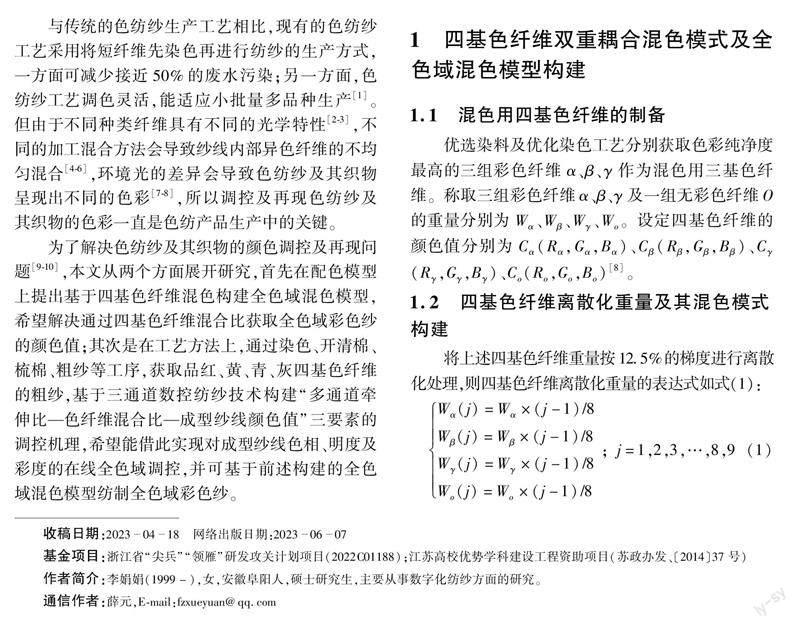
與傳統(tǒng)的色紡紗生產(chǎn)工藝相比,現(xiàn)有的色紡紗工藝采用將短纖維先染色再進行紡紗的生產(chǎn)方式,一方面可減少接近50%的廢水污染;另一方面,色紡紗工藝調(diào)色靈活,能適應(yīng)小批量多品種生產(chǎn)[1]。但由于不同種類纖維具有不同的光學(xué)特性[2-3],不同的加工混合方法會導(dǎo)致紗線內(nèi)部異色纖維的不均勻混合[4-6],環(huán)境光的差異會導(dǎo)致色紡紗及其織物呈現(xiàn)出不同的色彩[7-8],所以調(diào)控及再現(xiàn)色紡紗及其織物的色彩一直是色紡產(chǎn)品生產(chǎn)中的關(guān)鍵。
為了解決色紡紗及其織物的顏色調(diào)控及再現(xiàn)問題[9-10],本文從兩個方面展開研究,首先在配色模型上提出基于四基色纖維混色構(gòu)建全色域混色模型,希望解決通過四基色纖維混合比獲取全色域彩色紗的顏色值;其次是在工藝方法上,通過染色、開清棉、梳棉、粗紗等工序,獲取品紅、黃、青、灰四基色纖維的粗紗,基于三通道數(shù)控紡紗技術(shù)構(gòu)建“多通道牽伸比—色纖維混合比—成型紗線顏色值”三要素的調(diào)控機理,希望能借此實現(xiàn)對成型紗線色相、明度及彩度的在線全色域調(diào)控,并可基于前述構(gòu)建的全色域混色模型紡制全色域彩色紗。
1 四基色纖維雙重耦合混色模式及全色域混色模型構(gòu)建
1.1 混色用四基色纖維的制備
優(yōu)選染料及優(yōu)化染色工藝分別獲取色彩純凈度最高的三組彩色纖維α、β、γ作為混色用三基色纖維。稱取三組彩色纖維α、β、γ及一組無彩色纖維O的重量分別為Wα、Wβ、Wγ、Wo。設(shè)定四基色纖維的顏色值分別為Cα(Rα,Gα,Bα)、Cβ(Rβ,Gβ,Bβ)、Cγ(Rγ,Gγ,Bγ)、Co(Ro,Go,Bo)[8]。
1.2 四基色纖維離散化重量及其混色模式構(gòu)建
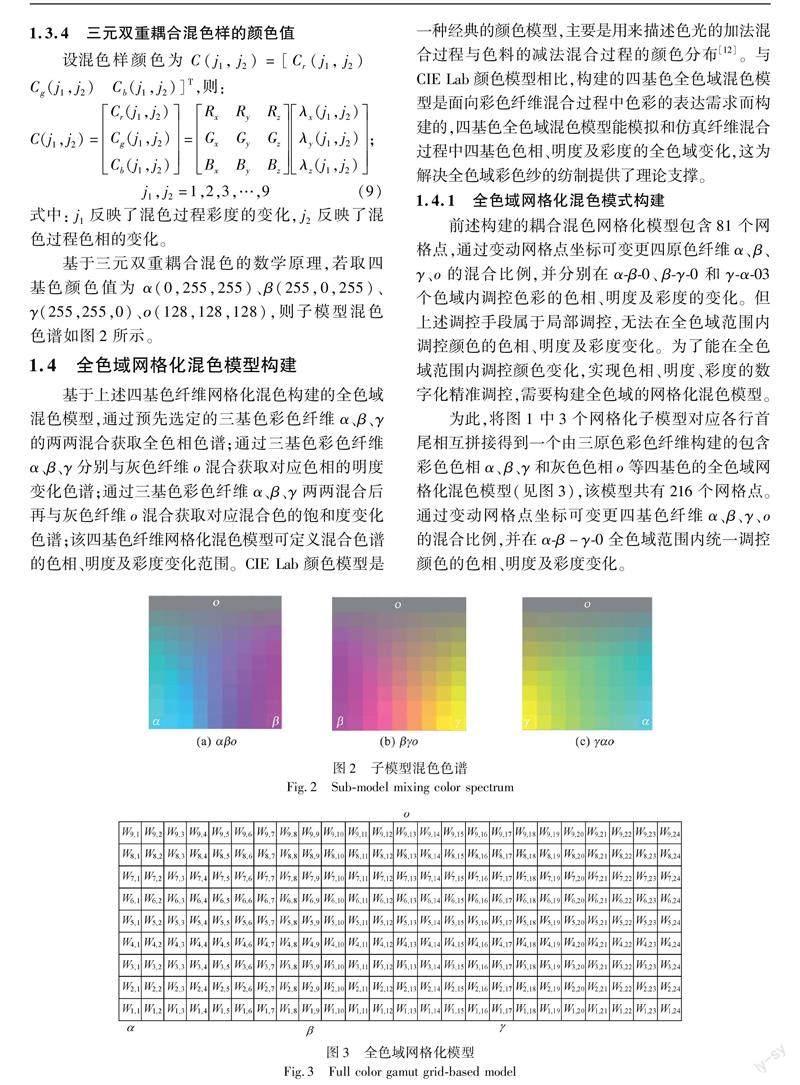
基于三元雙重耦合混色的數(shù)學(xué)原理,若取四基色顏色值為 α(0,255,255)、β(255,0,255)、γ(255,255,0)、ο(128,128,128),則子模型混色色譜如圖2所示。
1.4 全色域網(wǎng)格化混色模型構(gòu)建
基于上述四基色纖維網(wǎng)格化混色構(gòu)建的全色域混色模型,通過預(yù)先選定的三基色彩色纖維α、β、γ的兩兩混合獲取全色相色譜;通過三基色彩色纖維α、β、γ分別與灰色纖維o混合獲取對應(yīng)色相的明度變化色譜;通過三基色彩色纖維α、β、γ兩兩混合后再與灰色纖維o混合獲取對應(yīng)混合色的飽和度變化色譜;該四基色纖維網(wǎng)格化混色模型可定義混合色譜的色相、明度及彩度變化范圍。CIE Lab顏色模型是一種經(jīng)典的顏色模型,主要是用來描述色光的加法混合過程與色料的減法混合過程的顏色分布[12]。與CIE Lab顏色模型相比,構(gòu)建的四基色全色域混色模型是面向彩色纖維混合過程中色彩的表達需求而構(gòu)建的,四基色全色域混色模型能模擬和仿真纖維混合過程中四基色色相、明度及彩度的全色域變化,這為解決全色域彩色紗的紡制提供了理論支撐。
1.4.1 全色域網(wǎng)格化混色模式構(gòu)建
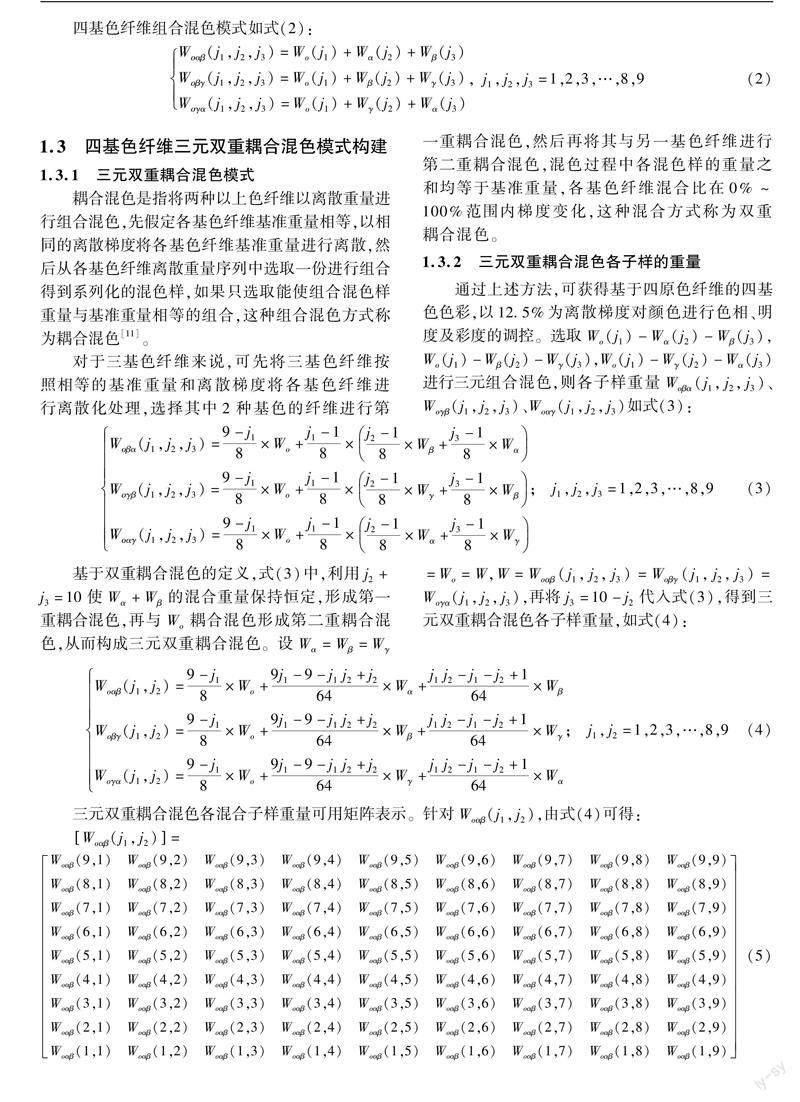
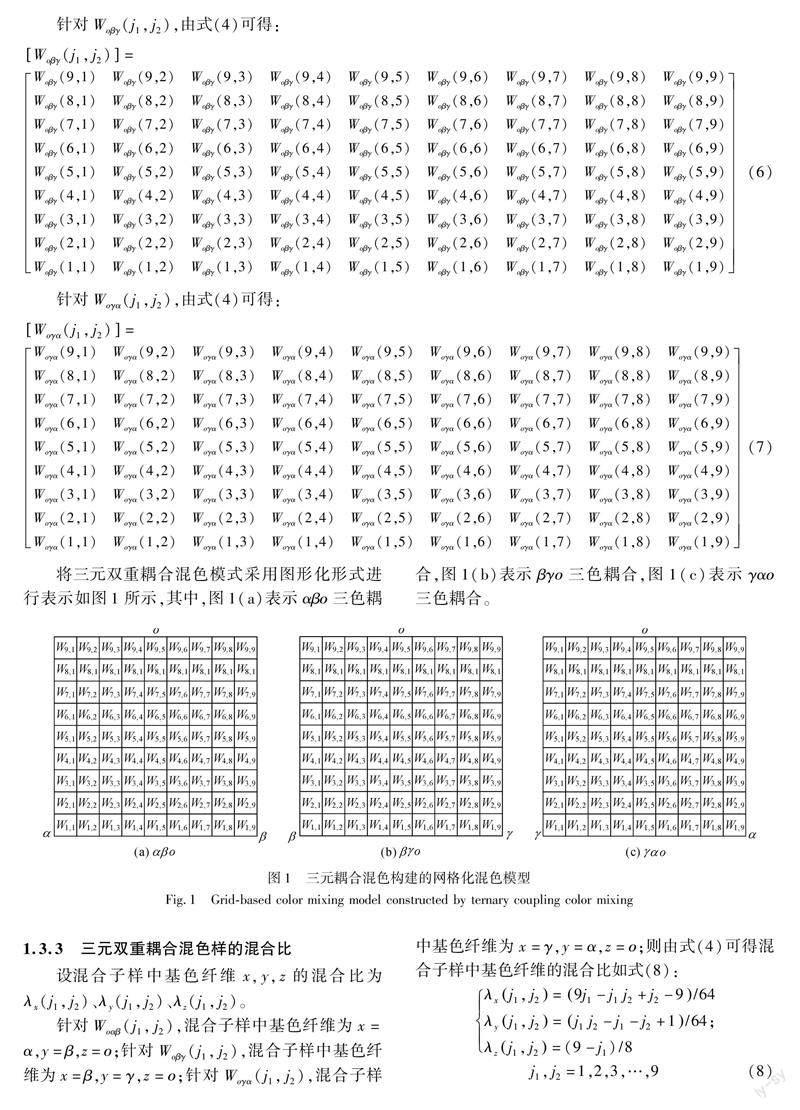
前述構(gòu)建的耦合混色網(wǎng)格化模型包含81個網(wǎng)格點,通過變動網(wǎng)格點坐標(biāo)可變更四原色纖維α、β、γ、o的混合比例,并分別在α-β-0、β-γ-0和γ-α-03個色域內(nèi)調(diào)控色彩的色相、明度及彩度的變化。但上述調(diào)控手段屬于局部調(diào)控,無法在全色域范圍內(nèi)調(diào)控顏色的色相、明度及彩度變化。為了能在全色域范圍內(nèi)調(diào)控顏色變化,實現(xiàn)色相、明度、彩度的數(shù)字化精準(zhǔn)調(diào)控,需要構(gòu)建全色域的網(wǎng)格化混色模型。
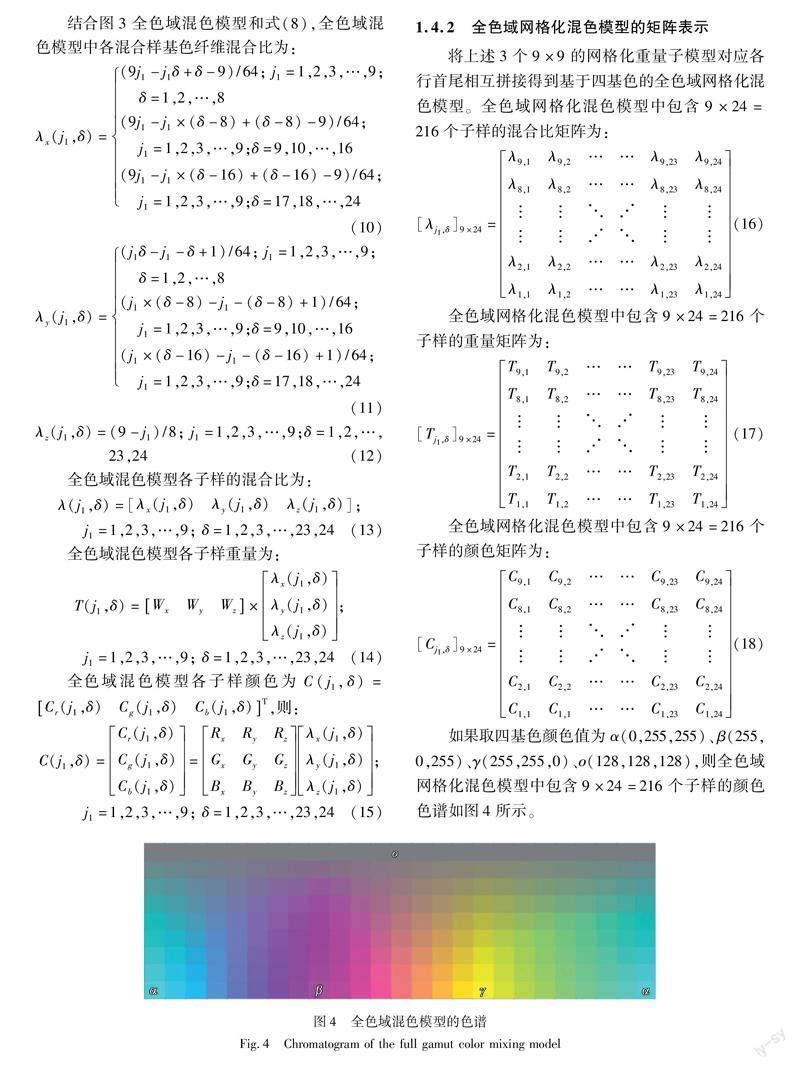
為此,將圖1中3個網(wǎng)格化子模型對應(yīng)各行首尾相互拼接得到一個由三原色彩色纖維構(gòu)建的包含彩色色相α、β、γ和灰色色相o等四基色的全色域網(wǎng)格化混色模型(見圖3),該模型共有216個網(wǎng)格點。通過變動網(wǎng)格點坐標(biāo)可變更四基色纖維α、β、γ、o的混合比例,并在α-β-γ-0全色域范圍內(nèi)統(tǒng)一調(diào)控顏色的色相、明度及彩度變化。
3.2 彩色紗線的紡紗工藝設(shè)計
3.2.1 四基色粗紗的規(guī)格參數(shù)
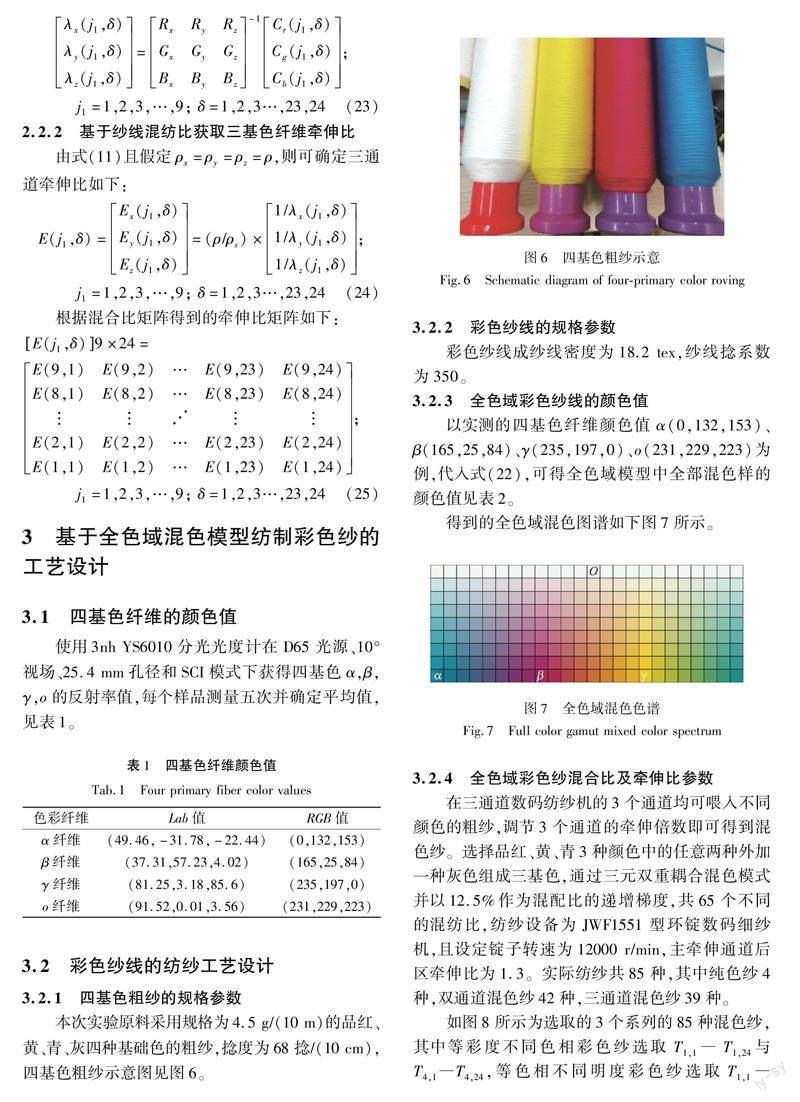
本次實驗原料采用規(guī)格為4.5 g/(10 m)的品紅、黃、青、灰四種基礎(chǔ)色的粗紗,捻度為68捻/(10 cm),四基色粗紗示意圖見圖6。
3.2.2 彩色紗線的規(guī)格參數(shù)
彩色紗線成紗線密度為18.2 tex,紗線捻系數(shù)為350。
3.2.3 全色域彩色紗線的顏色值
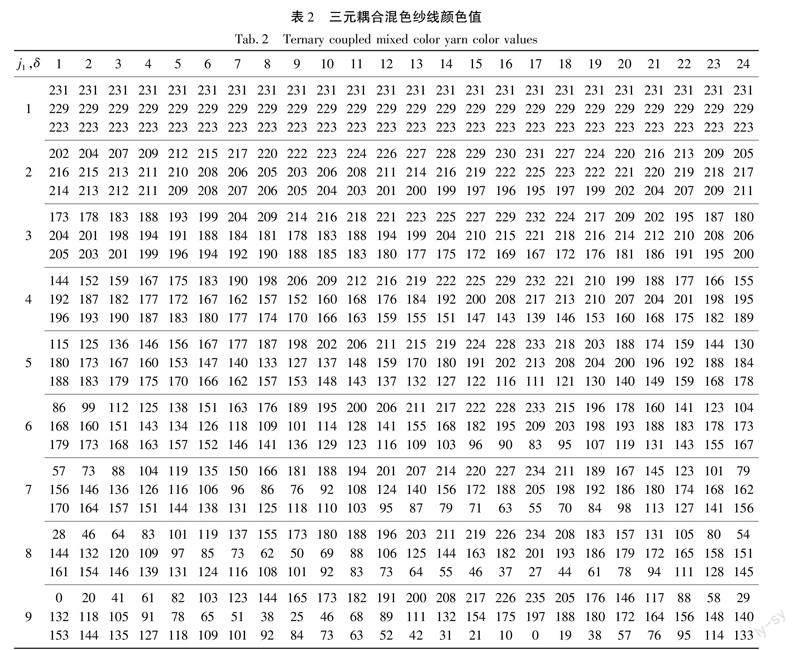
以實測的四基色纖維顏色值α(0,132,153)、β(165,25,84)、γ(235,197,0)、o(231,229,223)為例,代入式(22),可得全色域模型中全部混色樣的顏色值見表2。
得到的全色域混色圖譜如下圖7所示。
3.2.4 全色域彩色紗混合比及牽伸比參數(shù)
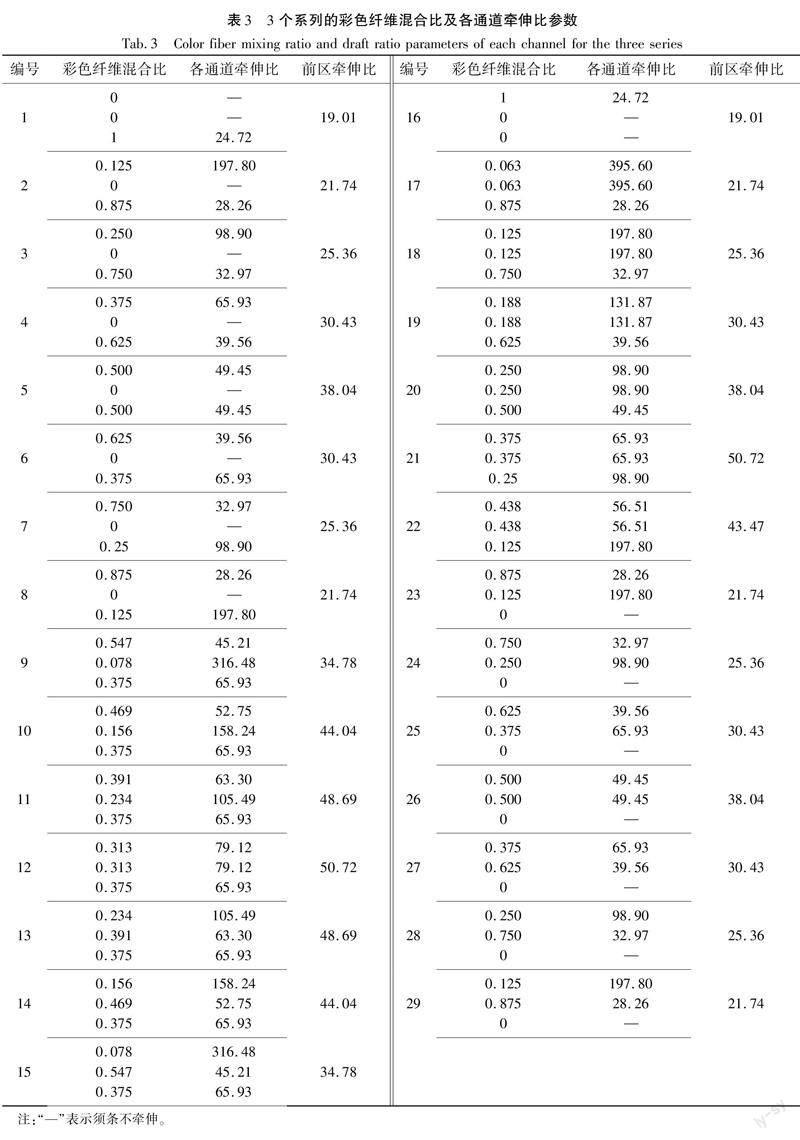
在三通道數(shù)碼紡紗機的3個通道均可喂入不同顏色的粗紗,調(diào)節(jié)3個通道的牽伸倍數(shù)即可得到混色紗。選擇品紅、黃、青3種顏色中的任意兩種外加一種灰色組成三基色,通過三元雙重耦合混色模式并以12.5%作為混配比的遞增梯度,共65個不同的混紡比,紡紗設(shè)備為JWF1551型環(huán)錠數(shù)碼細(xì)紗機,且設(shè)定錠子轉(zhuǎn)速為12000 r/min,主牽伸通道后區(qū)牽伸比為1.3。實際紡紗共85種,其中純色紗4種,雙通道混色紗42種,三通道混色紗39種。
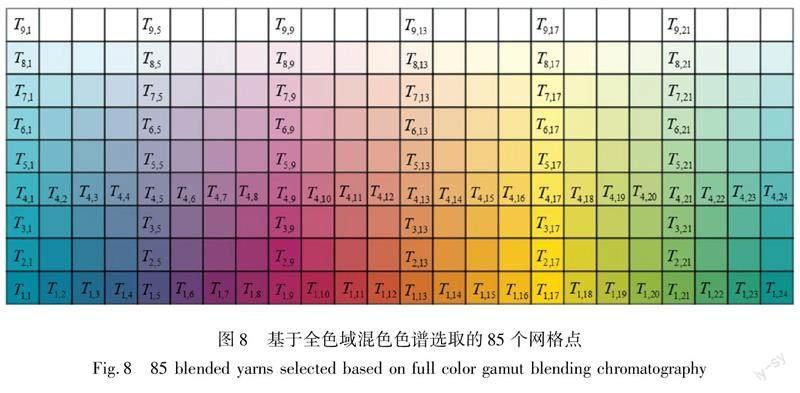
如圖8所示為選取的3個系列的85種混色紗,其中等彩度不同色相彩色紗選取T1,1―T1,24與T4,1―T4,24,等色相不同明度彩色紗選取T1,1―T9,1、T1,9―T9,9與T1,17―T9,17,等色相不同彩度彩色紗選取T1,5―T9,5、T1,13―T9,13與T1,21―T9,21,共紡制85種混色紗。三通道的各區(qū)牽伸比及牽伸比如下表3所示。
3.3 三通道數(shù)碼混色紗織物的制備
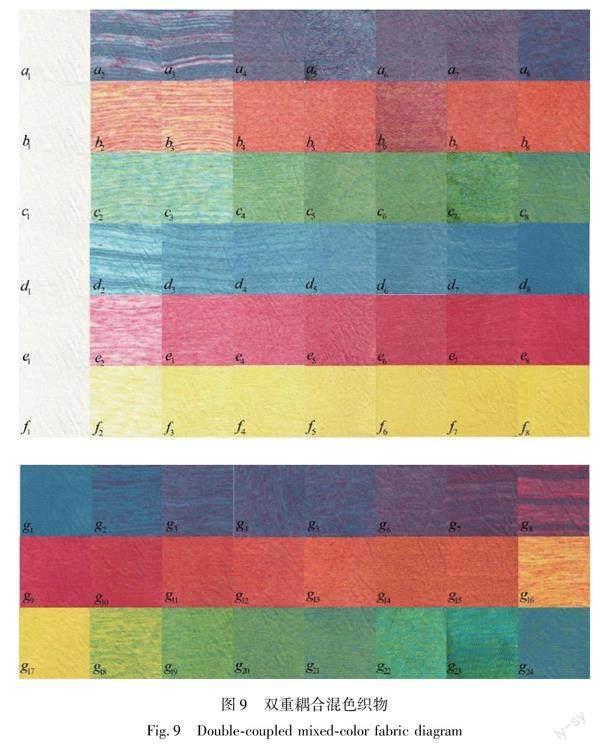
為了能更好地呈現(xiàn)三通道數(shù)碼混色紗的外觀特征與視覺效果,實驗選用16G宏成HC21K型緯編圓機將85種混色紗織造成平針織物。設(shè)計針織物主要規(guī)格如下:線圈長度為0.6 mm;橫向密度為53行/(5 cm);縱向密度為90列/(5 cm)。
如圖9所示,a1-a8、b1-b8、c1-c8為等色相不同彩度織物,d1-d8、e1-e8、 f1-f8為等色相不同明度織物,g1-g24為等彩度不同色相織物。
4 混色紗外觀質(zhì)量與力學(xué)性能測試
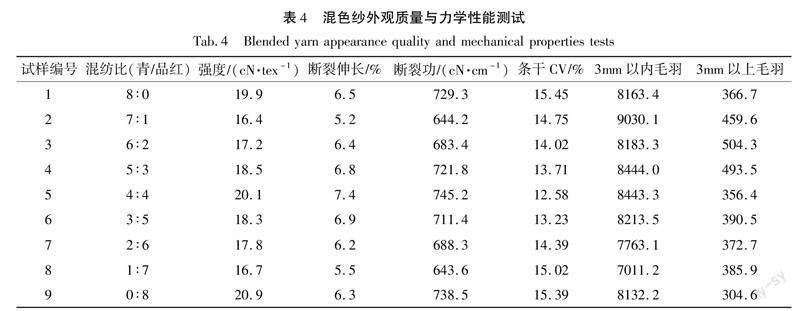
混色紗的力學(xué)性能與外觀品質(zhì)是否優(yōu)良對色紡產(chǎn)品的視覺風(fēng)格有著很大影響,本小節(jié)選取以青、品紅為基色紡制9種不同混配比例、規(guī)格為Z捻向的18.2 tex混色紗,對混色紗的條干、力學(xué)性能及毛羽進行測試,并討論彩色紗的性能是否符合國家標(biāo)準(zhǔn)[13-14]。
4.1 混色紗織物顏色對比
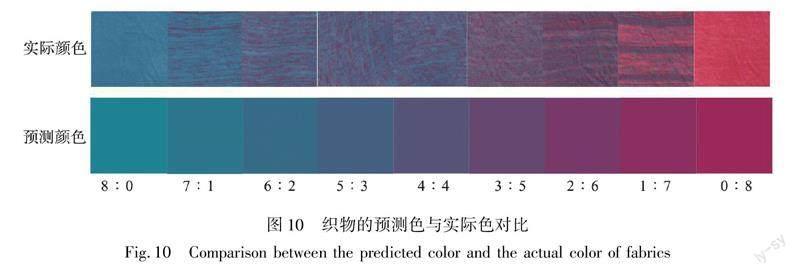
選定的青+品紅混色紗,混紡比分別為8∶0、 7∶1、6∶2、5∶3、4∶4、3∶5、2∶6、1∶7及0∶8,共計9種紡制的針織物經(jīng)掃描儀掃描如圖10。
4.2 混色紗外觀質(zhì)量及力學(xué)性能測試
選用YG135G條干測試儀對紡制的彩色紗進行條干均勻度的測試,每個紗樣測試5次求取平均值;選用YG068C型全自動單紗強力儀對單紗進行斷裂強力、斷裂伸長率等性能測試,拉伸速度250 mm/min,夾持距離為500 mm,每個混紡比測試次數(shù)為15次,取平均值;選用YG172A型紗線毛羽測試儀對紗線進行毛羽測試,測試速度為30 m/min,取10個片段,每個片段為100 m,記錄3 mm以內(nèi)毛羽根數(shù)及3 mm以上毛羽根數(shù),實驗數(shù)據(jù)見表4。
實驗發(fā)現(xiàn),利用三通道數(shù)碼紡紗機可以紡制基于四基色纖維的全色域混合模型的等色相不同明度,等色相不同彩度及等彩度不同色相3個系列的彩色紗,對其中的等彩度不同色相的(青+品紅)混色紗進行強力、條干及毛羽測試,參考GB/T 398—2018《棉本色紗線》精梳棉本色紗的一等品及優(yōu)等品要求,混色紗的斷裂強度均高于精梳棉本色紗的優(yōu)等品要求,條干均勻度也達到了一等品要求,混色紗紡制的9種織物實際色彩與預(yù)測顏色也基本一致,證明基于全色域模型紡制3種系列的彩色紗這一方案是可行的。
5 結(jié) 論
本文以三通道數(shù)控紡紗系統(tǒng)為基礎(chǔ),將品紅、黃、青、灰四基色以雙重耦合模式進行混色,以12.5%的離散梯度構(gòu)建了一個包含216個子樣的全色域混色模型,并定義了四基色纖維網(wǎng)格化混配所構(gòu)建的全色域混色模型的色相、明度及飽和度[15]。例如,色相的定義域:通過(青+品紅)、(品紅+黃)、(黃+青)的二元耦合混色模式所能達到的色相最大變化范圍定義;明度的定義域:通過(青+灰)、(品紅+灰)、(黃+灰)的二元耦合混色所能達到的明度最大變化范圍;飽和度的定義域:通過(青+品紅+灰)、(品紅+黃+灰)、(黃+青+灰)的三元雙重耦合混色所能達到的飽和度最大變化范圍。基于該混色模型216個網(wǎng)格點,可以獲取該網(wǎng)格點的位置坐標(biāo)以及與網(wǎng)格點對應(yīng)的四基色纖維混合比、顏色值和數(shù)控紡紗三通道牽伸比。通過上述工作,構(gòu)建了混色紗線顏色值、四基色纖維混合比、三通道牽伸比、混色空間坐標(biāo)值之間的轉(zhuǎn)換關(guān)系,給出了調(diào)控成型紗線色相、明度及彩度的數(shù)字化加工方法,為實現(xiàn)彩色紡紗奠定了理論基礎(chǔ)。
通過將全色域混色模型與三通道數(shù)碼紡紗技術(shù)結(jié)合,利用品紅、黃、青、灰四基色粗紗紡制了等明度不同色相、等色相不同明度、等色相不同彩度的3個系列合計85種色彩的彩色紗及其針織物,并對紡制彩色紗的條干、毛羽及強力進行了測試分析,驗證了彩色紗的外觀品質(zhì)及力學(xué)性能優(yōu)良,基于全色域色譜紡制的針織物實現(xiàn)了較為明顯的色相、明度及彩度變化效果,為后續(xù)規(guī)模化生產(chǎn)全色域彩色紗線及色織物提供基礎(chǔ)。
參考文獻:
[1]張婷婷,薛元,徐志武,等.三通道數(shù)碼紡混色紗色譜體系構(gòu)建及其彩色紗性能分析[J].紡織學(xué)報,2019,40(9):48-55.
ZHANG Tingting, XUE Yuan, XU Zhiwu, et al. Color system construction of three-channel digital spinning mixed color yarn and performance analysis of colored yarn[J]. Journal of Textile Research,2019,40(9):48-55.
[2]袁理,熊瑩,谷遷,等.染色纖維與色紡紗線間的顏色傳遞規(guī)律及其影響因素[J].紡織學(xué)報,2021,42(5):122-129.
YUAN Li, XIONG Ying, GU Qian, et al. Characteristics and factorial study of color transfer between dyed fiber and colored spun yarns[J]. Journal of Textile Research,2021,42(5):122-129.
[3]張毅,王妮,張瑞云,等.色紡紗成色機理的探討[J].棉紡織技術(shù),2019,47(4):18-24.
ZHANG Yi, WANG Ni, ZHANG Ruiyun, et al. Discus-sion on the coloring mechanism of colored spun yarn[J]. Cotton Textile Technology, 2019, 47(4): 18-24.
[4]劉建農(nóng),鄭敏博,沈均,等.色紡紗混和方式及工藝優(yōu)化[J].棉紡織技術(shù),2021,49(10):59-63.
LIU Jiannong, ZHENG Minbo, SHEN Jun, et al. Blending method and process optimization of colored spun yarn[J]. Cotton Textile Technology, 2021, 49(10): 59-63.
[5]ZHU W S, XUE Y A, XU Z W, et al. Symmetrical circulation gradient color system construction and gradient color yarn spun by a three-channel numerical control spinning system[J]. Textile Research Journal 2022,92(11/12):2046-2060.
[6]王曦,焦國珍,胡力主,等.纖維混合方法和紡紗方法對色紡紗色差的影響[J].上海紡織科技,2022,50(12):49-52
WANG Xi, JIAO Guozhen, HU Lizhu, et al. Effect of fiber blending methods and spinning methods on color differences of colored yarns[J]. Shanghai Textile Science &Technology, 2022, 50(12): 49-52.
[7]何文婧.色紡紗針織物呈色效應(yīng)研究[D].上海,東華大學(xué),2019:19-29.
HE Wenjing. Study on Color Effect of Dyed Knitted Fabric[D]. Shanghai: Donghua University, 2019: 19-29.
[8]SUN X Q, CUI P, XUE Y A. Construction and analysis of a three-channel numerical control ring-spinning system for segment colored yarn[J]. Textile Research Journal, 2021, 91(23/24):2937-2949.
[9]CUI P, XUE Y A, LIU Y X, et al. Intelligent manu-facturing of color blended yarn: Color matching algorithm and manufacturing process through computer numerically controlled ring spinning system[J]. Journal of Engineered Fibers and Fabrics, 2021,16 :155892502110065.
[10]王建坤,蔣曉東,郭晶.色紡紗工藝與性能研究[J].紡織科學(xué)與工程學(xué)報,2018,35(4):10-14,85.
WANG Jiankun, JIANG Xiaodong, GUO Jing. Process and properties of colored spinning[J].Journal of Textile Science and Engineering, 2018, 35(4):10-14, 85.
[11]XUE Y, GAO W D, GUO M R, et al. Method and device for dynamically configuring linear density and blending ratio of yarn through three-ingredient synchronous/synchronous drafting:US15308365[P].2015-07-28.
[12]LI Q Z, ZHANG F Y, JIN X K, et al. Optimal yarn colour combination for full-colour fabric design and mixed-colour chromaticity coordinates based on CIE chromaticity diagram analysis[J]. Coloration Technology, 2014, 130(6): 437-444.
[13]XIA Z G, WANG H S, WANG X, et al. A study on the relationship between irregularity and hairiness of spun yarns[J]. Textile Research Journal, 2011,81(3):273-279.
[14]桂亞夫.色紡紗的質(zhì)量評價[J].棉紡織技術(shù),2019,47(6):43-47.
GUI Yafu. Quality evaluation of color spun yarn[J]. Cotton Textile Technology, 2019, 47(6): 43-47.
[15]SUN X Q, XUE Y A, LIU Y X, et al. Construction of circular-shaped chromatic model and spinning of full color gamut colored yarn by digital blending of three primary colored fibers[J]. Textile Research Journal,2023,93(1/2):140-160.
Construction of a full colorgamut mixing model based on four primary colors and color yarn spinning
LI Juanjuan1, XUE Yuan1, XU Zhiwu2, YU Jian2, ZENG Dejun2
Abstract: Color spinning yarn, as a kind of yarn formed by opening, carding, drawing, roving and spinning process of various colored fibers, has a production history of over 30 years in China. At present, the domestic color spinning yarn has more than 10 million spindles. With the progress of new spinning technologies and the gradual accumulation of production experience, the quality level and technological content of color spinning yarn are also gradually improved. Color spinning technology is a technique of spinning two or more colored fibers into a certain hue, lightness, and saturation according to a certain mixing ratio. The color spinning technology using fiber dyeing before spinning process not only greatly reduces pollution in the production process, which is in line with the green and environmental protection production concept, but also each fiber is dyed separately, reducing problems such as staining that may occur in the subsequent process. Nevertheless, as the yarn color cannot be intelligently controlled at the spinning stage, and its actual product application has great limitations, how to achieve innovation in color spinning technology and products has become a challenge for the color spinning industry.
To achieve key technologies such as precise control of yarn color during the development and production of color spinning yarn products, we, based on the double coupling color mixing model, constructed a full color gamut color mixing model by using a 12.5% discrete gradient grid based on four primary colors, constructed the three-element regulation mechanism of “three-channel draft ratio, color fiber mixing ratio, and yarn color value” based on three-channel digital spinning combined with the full color gamut color mixing model and digital three-channel spinning technology, proposed the process method for regulating the hue, lightness, and saturation of formed yarns, selected a number of grid points in the full color gamut blending chromatography and designed the spinning process for full color gamut blended yarns. To achieve online regulation of the blending ratio of colored fibers in the blended yarn by using a multi-channel digital ring spinning machine for three different color roving asynchronous drafting, gradient color matching, and convergence twisting, we spun three series of colored yarns with different hues of equal lightness, different lightnesses of equal hue, and different saturations of equal hue, and tested the evenness, hairiness, and strength of the colored yarn. The test data were compared and analyzed with the performance indicators of the natural color yarn. The results show that the combination of the full color gamut blending model and digital three-channel spinning technology can spin three series of color yarns of equal saturation and different hues, equal hue and different lightnesses, equal hue and different saturations. Under the same color fiber mixing ratio, the actual spun color yarn is basically consistent with the color comparison in the full color gamut model. The various performance indicators of the actual spun color yarn can meet the first-class requirements of ordinary natural color yarn, proving the feasibility of spinning colored yarn based on the full color gamut mixing model and three-channel digital spinning technology further.
Nowadays, people's requirements for textiles are no longer limited to comfort and durability. Textile products with unique styles and appearance effects are increasingly favored by consumers. As a diverse form of fancy yarn, blended yarn has been a hot spot of many scholars. On the one hand, color is an important appearance indicator, and the construction of full color gamut chromatography further expands the production range of blended yarn. On the other hand, different styles of fancy yarns can also be developed by integrating other spinning technologies, combining different raw materials and optimizing the process, and promoting the development of textiles in the direction of diversification of raw materials, color enrichment and more optimal production.
Keywords: blended yarn; four primary colors; gridded blending; full gamut color mixing model; performance indicators
收稿日期:20230418 網(wǎng)絡(luò)出版日期:20230607
基金項目:浙江省“尖兵”“領(lǐng)雁”研發(fā)攻關(guān)計劃項目(2022C01188);江蘇高校優(yōu)勢學(xué)科建設(shè)工程資助項目(蘇政辦發(fā)、〔2014〕37號)
作者簡介:李娟娟(1999-),女,安徽阜陽人,碩士研究生,主要從事數(shù)字化紡紗方面的研究。
通信作者:薛元,E-mail:fzxueyuan@qq.com