
中國最大的民間救援組織——藍天救援隊
2024-04-24 16:54:28鄭怡雯
漢語世界(The World of Chinese) 2024年1期

Blue Alert
Volunteers with the Blue Sky Rescue Team sacrifice time, money, and sometimestheir lives to help disaster victims
中國最大的民間救援組織——藍天救援隊
By Zheng Yiwen (鄭怡雯)
Images from VCG
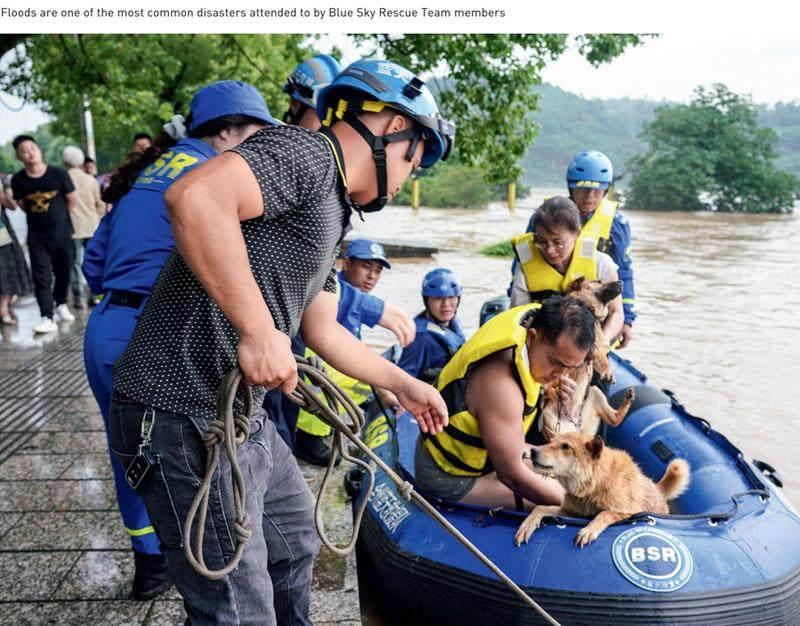
When severe flooding hit the mountainous Mentougou district of Beijing in July 2023, it wasnt only Chinas fire brigade and army that raced to the scene. Volunteers from the Blue Sky Rescue Team, Chinas largest non-government relief organization, traveled from across the city, using their own cars and public transportation, to help flood victims.
Clad in their distinctive blue uniforms, they looked professional, but none of them were being paid for their dangerous work, and some even had to fund their rescue efforts themselves. Two volunteers died during operations that helped rescue over 210 people.
WeChat groups pinged with messages from overstretched Blue Sky volunteers. “Our team dispatched 30 people, but we couldnt carry out the rescue effectively as the paths uphill were blocked,” one Blue Sky member wrote in a WeChat group for trail running enthusiasts. “Although there are many members in Beijings Blue Sky Rescue Team, we lack experienced personnel for such operations. Our team…is overwhelmed,” they wrote, asking for more volunteers to help with relief work.
Founded in 2007, the Blue Sky Rescue Team offers free rescue services to civilians in need. According to the organizations internal documents (seen by TWOC), it boasts a whopping 60,000 full members, with another 140,000 reserves who are in training to become full members. The scale of Blue Sky far exceeds that of other volunteer rescue teams in China. The China Red Arrow Rescue Team, the next largest group established in 2008, has around 10,000 members.
As the only registered China civil society organization under the United Nations International Search and Rescue Advisory Group, Blue Sky attends to all manner of disasters, from typhoons, earthquakes, and floods, to rescuing lost or injured hikers, retrieving drowning victims, providing medical support during sports events, and removing wasp nests from residential areas. They helped pull cars trapped in snowdrifts during blizzards in Harbin, Heilongjiang province, in November last year and joined rescue efforts after a massive earthquake hit Turkey last February. In 2021, over 3,000 Blue Sky members helped evacuate 200,000 people from Weihui, Henan province, after flooding hit the city.
But Blue Sky faces trouble with funding, internal disputes, inconsistent rescue capabilities among different groups, and, most seriously, keeping its members safe. “Our swift growth nationwide was vast but brought underlying risks,” Zhang Yong, the founder of Blue Sky Rescue, told China News Week last October.
During the flooding in Beijing last July, among the five rescue personnel reported to have perished, one was a firefighter, two were government officials, and two were members of Blue Sky teams. While fire service members and government employees were being paid and presumably had social security from their employers, Blue Sky members were volunteers with no salary and little preparation for making the ultimate sacrifice.
Grassroots rescue team
At the start of the 21st century, outdoor activities were gaining popularity among the Chinese public, but emergency response systems struggled to keep up. Hikers who got lost in the wilderness or injured themselves in the mountains relied on fire brigades or impromptu rescue parties made up of locals with little training.
Organizations like Blue Sky aimed to fill this gap. In 2007, military veteran Zhang Yong established the forerunner to Blue Sky, a small-scale, non-profit mountain rescue team composed of volunteers. This team focused on promoting outdoor safety awareness and conducting rescue operations for lost trekkers and fallen rock climbers.
Nowadays, civilians in distress anywhere in the country can ring the Blue Sky teams hotline and ask for assistance, free of charge. A national coordination center forwards the call to provincial officers who coordinate with local team leaders to deploy resources to help. According to a report by The Paper in August 2021, Blue Sky teams had logged over 429,000 hours in water-based rescue operations (like flood relief), over 135,000 hours in missing persons work, and over 28,000 hours in wilderness search and rescue operations since 2007.
In May 2008, the fledgling organization, along with hundreds of others, rushed to Wenchuan, Sichuan province, when an 8.0 magnitude earthquake hit the region, killing 80,000 and leaving 5 million homeless. More than 1.8 million volunteers assisted in the relief efforts, underscoring the potential of Chinas independent civilian organizations. It showed unofficial aid could be a powerful complement to government efforts, and Blue Sky expanded and flourished since.
“Theres no upper limit to the severity of disasters, and its unrealistic for the government to be totally prepared for any catastrophe. This is why civilian rescue forces are so crucial,” says Hao Nan, deputy director of the Earthquake Emergency Rescue Committee of the China Association for Disaster Prevention, another civil society organization. Hao has been active in emergency rescue since volunteering in the 2008 Wenchuan earthquake.
After officially registering as a civil society organization with Beijings Civil Affairs Bureau in 2010, Blue Sky grew to include more than 800 rescue teams covering all of Chinas provinces, municipalities, and autonomous regions by 2020.
In recent years Blue Sky has struggled to keep these disparate groups united. Regulations in China prevent most social organizations from establishing regional branches under a single headquarters, forcing them to open separate, independent entities in different regions or provinces.
“The organizational structure of all civil rescue teams in China is inherently decentralized. Legally, each Blue Sky branch is its own entity, registered as a local civil social organization. They are registered at the local level, which means its institutionally prone to fragmentation,” says Zhang Yuran, an administrative worker for Blue Sky who works closely with founder Zhang Yong. “The relationship between each local team and the [center] is more lateral than hierarchical. The teams operate in parallel, recognizing the conventions of Blue Sky, rather than one governing the other.”
This results in different teams, scattered across the country, having independent sources of funding, various management styles, and even different training regimes, according to Hao. It also makes infighting common. Zhang Yong was dismissed from Blue Sky after a power struggle with Cao Weiwei, his former deputy who has since taken over as leader. The two have previously filed lawsuits against each other.
Blue Skys Wikipedia page lists two different logos for the organization, while incidents where two different teams, both bearing the Blue Sky name, appear at the same rescue site have become increasingly common. When a 4-year-old girl went missing at Shanghais Nanhui New City beach in October 2023, volunteers from two Blue Sky teams arrived on the scene. As one faction called a halt to their search a few days later, the other group pledged unwavering commitment to the rescue, fueling public confusion and controversy about which team was the “real” Blue Sky.
Out-of-pocket saviors
These high-level disputes are “very distant” from regular grassroots members according to Ping Fan, a Blue Sky member from 2015 to 2021 who asked to use a pseudonym for this article. Ping, a civil servant in an eastern Chinese city, saw Blue Sky volunteers offering assistance during a marathon and joined after being inspired by their humanitarian initiatives.
As a non-profit organization, Blue Sky offers no salary to members but continues to attract tens of thousands of people like Ping driven to help others or to add vibrancy to their lives with regular training and meetings. People from all walks of life—teachers, engineers, students—carve out time on weekends and evenings for team training and activities. Ping says Blue Sky was a major source of entertainment away from his routine work in local government and helped him forge valuable friendships.
This came at a considerable personal cost. Internal training offered by Blue Sky “is not sufficient,” says Ping. “To become a qualified senior rescuer, members have to invest their own money to obtain certifications from other professional institutions and, sometimes, even fund their own participation in rescue operations.” Ping spent around 40,000 yuan in total on a scuba diving license, water rescue certifications, and rope rescue certifications over the years. “The assessment for a single certification can cost thousands if not tens of thousands,” Ping tells TWOC. Members must even purchase their uniforms.
Volunteers also commit significant time to Blue Sky. Members must be over 25, actively participate in rescues, have no criminal record, and hold a stable job with income and social insurance. After joining, volunteers undergo a 3-month probation where they must obtain a 65 percent attendance rate at all training and activities to become “reserves.” To graduate from a reserve to a full member, they must log over 200 hours of attendance in a year and obtain radio and first aid certifications, which they must pay for themselves.
“While many possess the eagerness to assist, it doesnt guarantee immediate acceptance as official rescue team members,” says He Yulong, an adventurer who has traversed the Amazon rainforest and climbed some of the worlds tallest mountains. He is also the director of the China Adventure Association, an outdoor activity civil society organization, and an instructor at Blue Sky. To become a member of Blue Sky “involves interviews, assessments, and immersion into a structured training program…It takes over a year to transition to an official team member,” He says.
He joined the Beijing Tongzhou Blue Sky Rescue Team in 2012 after coming across the team conducting rope training in the mountains around the capital. By 2015, he had qualified as an underwater rescue officer for the team, and he has participated in dozens of rescue missions from assisting hikers in difficulty around Beijings Great Wall to relief efforts after the 2015 earthquake in Nepal and during the flooding in Beijing last summer. Altogether, He has logged nearly 5,000 hours of community service with Blue Sky.
During rescue efforts in Nepal in 2015, He and other Blue Sky volunteers had to pay significant money (for their airfare and accommodation) and risked their lives to help trapped individuals. He remembers when team members volunteered to try to save a family of three trapped in perilous ruins that could collapse and kill rescuers without warning. “That moment of volunteering was solemn, yet [the mission] felt absolutely imperative,” he tells TWOC.
He has seen his fair share of tragedy over 11 years of volunteer rescue operations with Blue Sky. “Life is incredibly fragile; a person can perish unexpectedly...Safety must always be the top priority,” he tells TWOC.
The financial, time, and safety burdens cause members to leave some teams. Analysis by The Paper in August 2021 revealed that the Blue Sky team in Tibet had the highest attrition rate in the country at 41 percent. Constant member turnover, despite recruits each year, poses major management challenges for Blue Sky.
Lack of funding affects Blue Skys effectiveness during disasters. In a 2017 article with Southern Weekend, founder Zhang Yong said that high-tech equipment, like thermal imaging cameras or underwater robots that could help locate people trapped underwater, were unaffordable for Blue Sky teams since they could cost hundreds of thousands of yuan.
Blue Sky teams primarily rely on voluntary donations from the public and government project allocations to fund their operations, with money spent on equipment, transportation, and food for rescue team members in action, among other expenses. However, since Blue Sky branches are run separately, the funding each team receives varies significantly. The Xiamen Siming Blue Sky team, for example, ended 2020 with a 217,000-yuan surplus in the bank, while the Lantian team in Shaanxi province lost 1,952 yuan in the same year. Few branches publicly release their financial results, however, leading to speculation about their funding sources.
In December 2020, Zhang Yong accused Cao Weiwei and other members of the Beijing Blue Sky Rescue Teams board of establishing a for-profit training center that benefited from volunteer training fees. Blue Sky said they reported the case to the police, but later withdrew the complaint without explanation, further obscuring the teams financial status.
The ultimate sacrifice
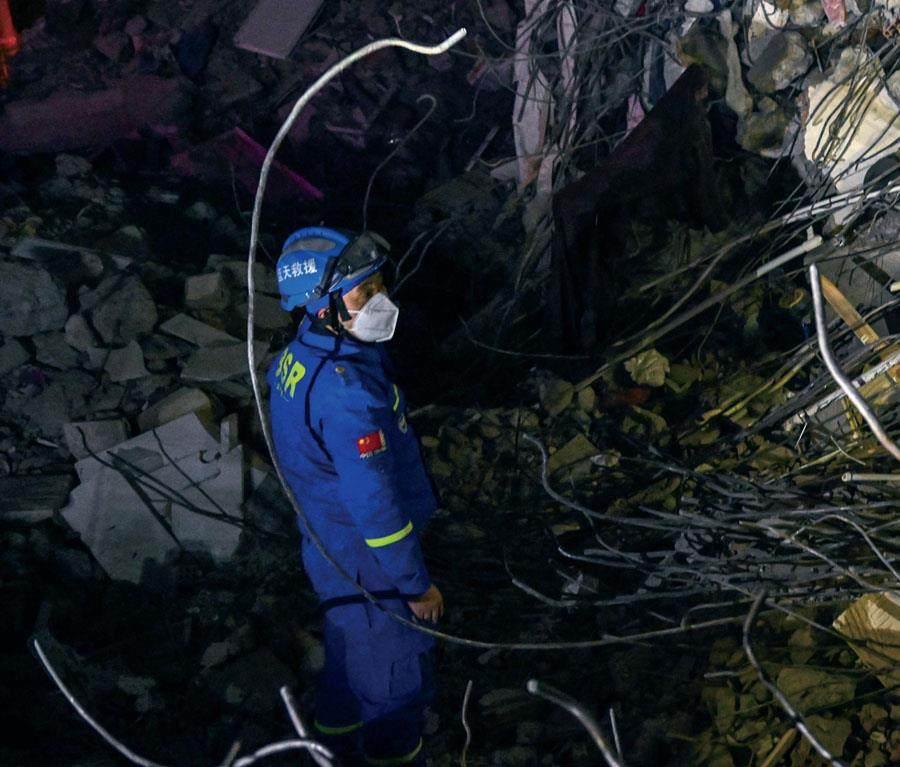
All these problems may contribute to Blue Sky volunteers losing their lives with alarming regularity. Beijing Blue Sky members Wang Hongchun and Liu Jianmin tragically died in July 2023 while trying to evacuate people from a damaged bridge over a river in the citys flood-hit Mentougou district. A surge of water overturned their boat on the river, and the fierce currents swept them away.
At least two other Blue Sky members lost their lives in the same month in different parts of the country. Chen Yuansheng, a member of Quanzhous Blue Sky team, died due to exhaustion after working to relocate trapped residents during flooding in Fujian province, while a member of Baichengs Blue Sky team perished after being swept away by currents while working to close a sluice gate on a river in Jilin province.
Back in November and December 2021, three Blue Sky members died within 10 days of each other on the Zhanghe River in Handan, Hebei province, while searching for a drowning victim, raising questions about the capabilities of Blue Sky and its safety precautions. Following the tragedies, several Blue Sky members argued that outdated equipment and lack of professional training were the main reasons for the fatalities.
The Papers report in August 2021 claimed that less than 40 percent of Blue Sky members are capable of conducting search and rescue operations. Furthermore, the varied levels of capability among different rescue teams at disaster scenes may lead to chaotic situations. In 2021, GQ reported that during flood rescue missions in Henan province, some teams (it didnt specify whether they belonged to Blue Sky or other organizations) stayed at the site for just over two hours before leaving, while other teams forgot to prepare life jackets for themselves.
Hao Nan argues that Chinas entire civilian rescue industry suffers from a lack of unified rescue and training standards, with different groups and members exhibiting highly varied degrees of competence. Training in major disaster relief requires hiring actors and equipment at significant cost, so not all non-profit groups can hold such rehearsals before they encounter real-life disaster situations. “Becoming a qualified team member requires more than just passion. It necessitates systematic training and assessments,” Hao tells TWOC. “Developing civilian rescue teams requires more than just heroic dreams.”
Authorities are trying to improve the situation of non-profit rescue organizations like Blue Sky. At the end of 2022, the Ministry of Emergency Management and other government departments announced plans to hold joint training and drills between professional state-provided rescue teams and volunteer organizations like Blue Sky. It also called for the classification and grading of civilian rescue teams, so that only the most prepared take on dangerous disaster relief projects.
This would help professionalize Blue Sky members and perhaps reduce the chance of tragedy that has befallen dozens of brave volunteers. “We dont want to see any team member make the ultimate sacrifice,” says Zhang Yuran. “Before aiding others, rescuers need to protect themselves first.”
Floods are one of the most common disasters attended to by Blue Sky Rescue Team members (VCG)
Blue Sky Rescue Team members sometimes go abroad to assist during disasters (VCG)
As outdoor activities have grown in popularity, volunteer rescue organizations have become key components in Chinas emergency response system (VCG)
Team members often have to use their own money to pay for specialized training (VCG)
Several Blue Sky Rescue Team members died while on duty in 2023 (VCG)
 漢語世界(The World of Chinese)2024年1期
- 漢語世界(The World of Chinese)的其它文章
- 光影
- 麻煩阿姨
- 學漢語
- 一個漢字,一部文明史
- 職場必修課:招聘廣告和求職簡歷的“語言藝術”
- 辣條:何以成為國民零食?