
現(xiàn)代漢語中的日語詞匯,漂洋過海,落地開花
2024-04-24 19:16:46潘風帆
漢語世界(The World of Chinese) 2024年1期
關(guān)鍵詞:詞匯


Two-Way Communication
In the early 20th century, debate raged in China over whether to accept a deluge of Japanese loanwords
現(xiàn)代漢語中的日語詞匯,漂洋過海,落地開花
By Pan Fengfan (潘風帆)
When Nayuki, a popular Chinese bubble tea brand, changed a single character in its name in December 2022, it was not just a cosmetic change. Amid a wave of political tension between China and Japan, the brand switched the Japanese character の?(pronounced “no”), which indicates possession, in its Chinese name (then, 奈雪の茶) to 的, the Chinese character with the same meaning.
The brand made the change after netizens accused it of hypocrisy over its claim to sell Chinese tea while having a Japanese character in its name. In February 2023, drinks brand Chi Forest followed suit, changing the Japanese character 気?(chi, “spirit”) in its name to the Chinese 氣?(q#). Both were deliberate moves to distance the brands from Japanese culture amid strained relations between the two countries.
However, Japanese influence on the Chinese language is not something that can be easily erased. It has a long and complex history, dating back to at least the late Qing dynasty (1616 – 1911) when a wave of Japanese words referring to modern political and social trends poured into the Chinese lexicon. Before that, linguistic influence had mostly flowed in the other direction. The Japanese adopted Chinese characters as their script in the fifth century (later they invented two other writing systems, hiragana and katakana, based on Chinese characters) and imported countless Chinese words over the next millennium.
By the late nineteenth century, however, Japan had successfully modernized through government, education, and social reforms that imitated those of industrialized European countries. As the only East Asian country to experience such rapid transformation at the time, Japan became a developmental model for many in China who aspired for a similar trajectory in their own country.
Japanese scholars translated countless new words and ideas from the West, with many of them seeping into China. The stream was so torrential that Saneto Keishu, a professor at Waseda University in Tokyo, wrote in his 1960 monographA History of Chinese Overseas Students in Japan that Japanese was “one of the main, even the largest source” of loanwords in modern Chinese, far outstripping English words.
As Sanetos book title suggests, an important channel for the transmission of Japanese loanwords was the Chinese students and intellectuals living overseas in Japan in the late 19th and early 20th centuries—the first batch of 13 students was sent there by the Qing government in 1896, and by 1906, the number grew to over 10,000, though the majority paid their own way.
Liang Qichao (梁啟超) fled to Japan after his attempts, with his mentor Kang Youwei (康有為), to reform the Chinese state into a constitutional monarchy (an effort that became known as the “Hundred Days Reform”) was suppressed by Empress Dowager Cixi in 1898. Liang popularized many Japanese coinages through his writing, including the now ubiquitous 社會主義?(sh-hu# zh^y#, socialism), pronounced “shakai shugi” in Japanese. Zhu Jingwei, a Japanese studies scholar at Beijing Foreign Studies University, labeled Liang “the most important person in actively bringing in and using Japanese loanwords.”
Liangs preference for Japanese loanwords was partly practical. He once wrote that “five to six years of study is needed to begin to understand English…but is still not adequate for understanding books on politics, economics, philosophy, or sociology.” He believed Japanese translations had effectively captured the essence of Western academic works. Around 1900, he even published a primer titledThe Reading Rules of Japanese Texts in Chinese(《和文漢讀法》), claiming that “after 10 days for a brilliant student, or two months for a slower one,” learners could expect to “hold a [Japanese] book in hand and savor it.” Three decades later, Zhou Zuoren (周作人), essayist and brother of Lu Xun (魯迅), wrote that Liangs book “had an immense impact. It encouraged people to learn Japanese.”
However, not everyone was impressed by Liangs use of Japanese loanwords. Shen Bao, a major national news outlet in Shanghai during the late Qing dynasty, published several articles on the influx of Japanese terms from 1901 to 1904. Most of them were criticisms written by conservative royalists supporting the Qing dynasty. One opinion piece published on February 2, 1901, argued Liangs publications were polluting the nation: “Ever since Liang Qichao, the disciple of traitor Kang [Youwei], established Shanghai-based newspaper Shiwu Bao, the deterioration of literary style has been unspeakable…their vocabulary is a ridiculous imitation of Japanese; absurd and nonsensical.” The use of Japanese words played into core debates about Chinas path to development, pitting reformers against conservatives who favored maintaining the traditional structure of Chinese society.
Some tried to create separate Chinese translations for new Western concepts. Yan Fu (嚴復), a Chinese scholar who translated works such asThe Wealth of Nationsby Scottish economist Adam Smith in 1901 andOn Libertyby English philosopher John Stuart Mill in 1903, advocated for translating directly from the original languages, arguing that “even when translating from the original text, a barrier has to be crossed; if translating from translations, the source becomes even more distant.” He preferred two-character words commonly found in classical Chinese over the awkward three-character coinages in Japanese and began creating his own terms. He invented 計學?(j#xu9, study of calculation) for economics (now known as the Japanese-invented 經(jīng)濟學, j~ngj#xu9) and 群學?(q%nxu9, study of groups) for sociology (now known as 社會學, sh-hu#xu9).
Officials also tried to stamp out the trend of using Japanese loanwords. Zhang Zhidong (張之洞), an official in charge of the Department of Scholars around the turn of the century, worried that “Chinas scholarly traditions will be obliterated if the Chinese language is mixed with a foreign one.” In 1903, Zhang drafted theApproved Regulations and Academic Guidelines for Schools, which explicitly banned the use of “foreign terms incompatible with Chinese.” He hated Japanese borrowings so much that he would “erase them with a writing brush and write on top of them ‘Japanese terminology (日本名詞)” every time he saw them in scripts submitted by his inferiors. He later realized that “terminology (名詞)” was also a Japanese invention, and started writing “Japanese vernacular (日本土話)” instead.
But by the early 20th century, Japanese loanwords were pervasive and Yan Fus translations faded into obscurity. In the 1930s, the appendices to eight of Yans works listed 482 Chinese words coined by him. By 1994, only 56 of them were still in use in academia, such as 邏輯?(lu5j!, logic) and 烏托邦?(w$tu4b`ng, utopia) according to research by Xiong Yuezhi, vice president at Shanghai Academy of Social Sciences, inThe Eastward Dissemination of Western Learning and the Late Qing Society.
Beyond the prevalence of Chinese intellectuals in Japan and the amount of translated works published in Chinese, there were other practical reasons why Japanese loanwords gained popularity. Many direct Chinese translations at that time, including Yans, relied heavily on phonetic imitation that obscured any intuitive understanding. Yan translated “bank” as 版克?(b2nk-) and “veto” as 威朵?(w8idu6), while the Japanese words that became widespread were 銀行?(literally “silver institution”) and 否決?(“decision refusal”).
The common Chinese word for “telephone” in the late 1800s was 德律風?(d9l_f8ng), a phonetic mimic of the English word. In the early 1900s, however, students from Shaoxing, Zhejiang province studying in Japan (including Lu Xun), specifically mentioned the word in a letter back home: “We Chinese call it ‘delüfeng, which is not as appropriate as ‘dianhua (電話, electric speech).” The Japanese loan, 電話, quickly became the more popular phrase.
While hundreds of translations of foreign books (from their Japanese versions, rather than the original languages) were entering China, Yans books covered only a tiny portion of foreign works. His obsession with classical references and obscure Chinese characters also inhibited the popularization of some of his translations. Newspapers and popular media quickly began to use the Japanese loanwords too, and the snowball gained momentum.
The substantial number of terms borrowed from Japan during that period has prompted some to suggest that even the name of the country, the Peoples Republic of China (中華人民共和國), largely consists of Japanese-coined terms. But the truth is more nuanced, as many words took a detour between different languages before ending up in Chinese. For example, the Japanese initially used a word similar to the Dutchchemieto represent chemistry, but when they learned about the Chinese translation 化學?(literally “study of transformation”), they quickly adopted it for its more literal, intuitive meaning. But the word, despite first appearing in the Shanghai-based magazine Shanghai Serial in 1857, was niche in China for much of the first half of the nineteenth century. When overseas Chinese students in Japan rediscovered the word years later, many in China mistakenly believed it was a Japanese invention.
While many of the Japanese terms that entered Chinese in the late Qing period have stuck and become part of the common lexicon today, the sharing of linguistic terms has since become more balanced as China and Japans relative development has equalized. While Japanese cultural and culinary influence has brought more new terms like 達人?(expert, Japanese pronunciation “tatsu-jin”) and 壽司?(sushi), Chinese words have also started heading to Japan again.
Japanese nowadays can expect to find some spicy Sichuan 麻婆豆腐?(m1p5 d7ufu, Japanese pronunciation “mabo-dofu”) in Chinese restaurants there. Some may also play mahjong (麻將?in Chinese), known in Japanese as 麻雀?(pronounced “majan”), and spend time sipping 烏龍茶?(烏龍茶, “uron-cha,” in Japanese), or oolong tea. Over 100 years on from when Liang and thousands of other Chinese brought new concepts over from Japan, the flow of linguistic sharing between the East Asian neighbors continues.
Cover illustration by Wang Siqi
Liang Qichao promoted the use of Japanese loanwords in China through his newspaper (Fotoe)
Chinese scholar Yan Fu opposed the use of Japanese loanwords and proposed his own translations, but only a few of them endure in modern China (Fotoe)
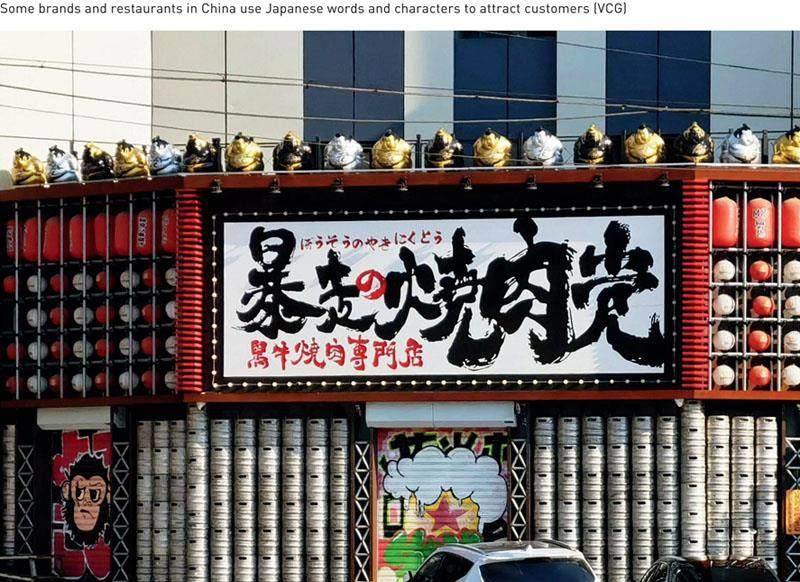
Some brands and restaurants in China use Japanese words and characters to attract customers (VCG)
猜你喜歡
國際醫(yī)藥衛(wèi)生導報(2021年12期)2021-07-06 12:35:40
國際醫(yī)藥衛(wèi)生導報(2021年12期)2021-07-06 12:35:36
中華胰腺病雜志(2021年1期)2021-02-26 11:28:36
山東醫(yī)藥(2020年34期)2020-12-09 01:22:24
中華胰腺病雜志(2019年4期)2019-08-29 08:52:20
山東醫(yī)藥(2017年35期)2017-10-10 02:45:28
山東醫(yī)藥(2017年33期)2017-10-09 12:31:41
文理導航·趣味課堂(2016年3期)2016-04-26 15:42:10
山東醫(yī)藥(2014年48期)2014-12-02 04:34:34
山東醫(yī)藥(2014年34期)2014-12-02 04:33:52
 漢語世界(The World of Chinese)2024年1期
- 漢語世界(The World of Chinese)的其它文章
- 光影
- 麻煩阿姨
- 學漢語
- 一個漢字,一部文明史
- 職場必修課:招聘廣告和求職簡歷的“語言藝術(shù)”
- 辣條:何以成為國民零食?