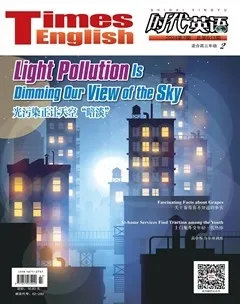
Light Pollution Is Dimming Our View of the Sky
2024-04-29 00:00:00
時代英語·高三 2024年2期

光污染正讓天空“暗淡 ”
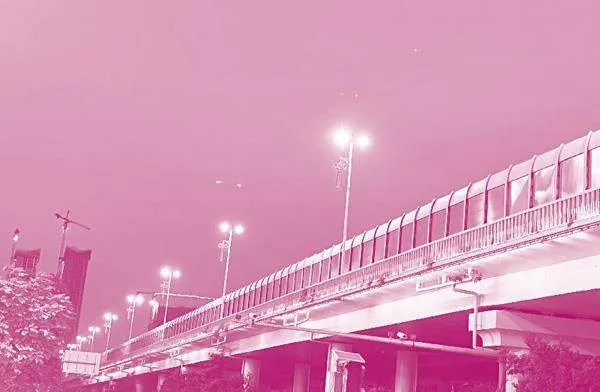
Most stars are invisible against the overhead glare from city lights. At best, there is only a hint of the Milky Way to see: the combined radiance of a hundred billion stars dims to near nothingness by bright streetlamps and storefronts.
This is light pollution—human-generated lights cast up into the heavens—causing the sky itself to glow and washing out the stars. Astronomers have known for years the situation is bad for stargazing, and it also has real and negative effects on the well-being of many living things—plants, animals and even human beings. More than 80 percent of humanity is affected by light pollution, their view of the skies being stolen away.
Christopher Kyba, the light-pollution researcher of the GFZ German Research Center for Geosciences, and his team examined an astonishing amount of data from more than 50,000 citizen scientists from around the world who sampled their local sky brightness from 2011 to 2022. While there was considerable place-to-place variability—for example, on average, Europe saw a 6.5 percent increase in light pollution per year, while North America saw a 10.4 percent increase—the researchers found that globally, light pollution increased by 9.6 percent per year over the time period.
This may not sound like much, but a year-over-year growth of about 10 percent means sky brightness is doubling about every seven years. A moment’s thought should make clear why this is deeply troubling.
在我們頭頂上方的城市強光下,大多數(shù)星星都看不到了。在最好的情況下,我們能看到的也只是銀河光帶的一小部分:一千億顆星星匯合起來的光芒在明亮的路燈和店面的映襯下變得近乎虛無。
這就是光污染,人造光源投射到天空中,導(dǎo)致天空本身發(fā)亮,沖淡了星光。天文學(xué)家多年前就意識到這一情形不利于觀星,它也對許多生物的健康造成了實實在在的負面影響,包括植物、動物甚至人類。超過80%的人類受到光污染的影響,他們欣賞天空的權(quán)利被剝奪了。
德國波茨坦地球科學(xué)研究中心的光污染研究員克里斯托弗·凱巴和他的團隊研究了來自世界各地的5萬多名民間研究人員的大量數(shù)據(jù),這些研究人員從2011年到2022年對當?shù)氐奶炜樟炼冗M行了采樣。盡管存在相當大的地區(qū)間差異(例如,平均而言,歐洲光污染每年增加6.5%,而北美增加10.4%),研究人員發(fā)現(xiàn),在全球范圍內(nèi),光污染在這段時間每年增加9.6%。
這聽起來可能不多,但每年大約10%的增長意味著天空的亮度每7年就會翻一番。稍微思考一下,你就會明白這為什么會令人深感不安。
As Kyba and his co-authors explained in their paper, published in the journal Science, if there are 250 visible stars in the sky when someone is born, by the time they’re 18 they’ll see only 100, and over that same period the sky will have increased in brightness by more than a factor of four.
All this extra light at night has a large effect on the life under it. Researchers have shown that it has negative impacts on many animals and plants; light pollution disrupts the great migrations of birds, the delicate blossoming of flowers, and even the luminous courtship of fireflies, to name just a few examples. It affects humans as well, possibly causing insomnia among many other health problems.
So what can we do about our brightening skies? There is a lot already happening. Groups like the International Dark Sky Association, advocate not for more lighting but for more intelligent lighting; smarter street lights that concentrate their light downward are one example. Because these lights offer more efficient light, they save energy, too, eventually paying for themselves. At the moment, simple awareness is one of our greatest benefits. Turning off your own outdoor lighting at night might not seem like a big deal, but if you tell others, that helps. Awareness grows.
Many people don’t even know that they—and their descendants—are losing this cosmic experience just over their heads. We need the dark night sky, and it’s up to all of us to make sure it’s still there every time the sun goes down.
正如凱巴和合著者發(fā)表在《科學(xué)》雜志上的論文中解釋的那樣,如果一個人出生時天空中有250顆可見的恒星,到他18歲時,他只能看到100顆,而在這一時間段,天空的亮度將增加4倍以上。
夜晚的這些額外的光線對生活在其下的生物有很大的影響。研究人員已經(jīng)證明,夜晚的額外光線對許多動植物都有負面影響;光污染會干擾鳥類的大遷徙,干擾嬌嫩花朵的開放,甚至影響螢火蟲發(fā)光的求偶行為,這只是幾個例子。夜晚的額外光線也會影響人類,可能會引發(fā)失眠和許多其他健康問題。
那我們能做些什么來應(yīng)對過亮的夜空呢?人們已經(jīng)采取了許多措施。國際暗天協(xié)會等組織倡導(dǎo)更智能的照明,而不是更多的照明。例如,智能路燈向下集中光線。因為這些路燈提供了更有效的照明,它們也節(jié)省了能源,最終收回了成本。目前,能清晰地認識這些是我們最大的優(yōu)勢之一。晚上關(guān)掉自己的戶外照明可能是件小事,但如果你告訴別人,那會有所幫助。民眾的意識會增強。
許多人甚至沒有意識到他們和他們的后代正在失去頭頂上的這片星空。我們需要黑暗的夜空,我們所有人都有義務(wù)確保每當太陽落山后夜色仍在。
Word Bank
dim /d?m/ v. 變暗淡;變昏暗
disrupt /d?s'r?pt/ v. 擾亂;打斷
descendant /d?'send?nt/ n. 后代;子孫
cosmic /'k?zm?k/ adj. 宇宙的
猜你喜歡
體育科技文獻通報(2022年3期)2022-05-23 13:46:54
哈哈畫報(2022年4期)2022-04-19 11:11:50
大科技·百科新說(2021年6期)2021-09-12 02:37:27
天津外國語大學(xué)學(xué)報(2021年3期)2021-08-13 08:32:18
遼金歷史與考古(2021年0期)2021-07-29 01:06:54
英語文摘(2021年2期)2021-07-22 07:56:54
好孩子畫報(2020年5期)2020-06-27 14:08:05
科技傳播(2019年22期)2020-01-14 03:06:54
意林·全彩Color(2019年6期)2019-07-24 08:13:50
民用飛機設(shè)計與研究(2019年4期)2019-05-21 07:21:24