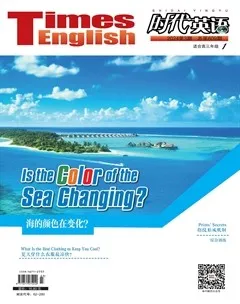
Is the Color of the Sea Changing?
2024-04-29 00:00:00
時代英語·高三 2024年1期


海的顏色在變化?
The color of the ocean has changed significantly over the last 20 years and human-caused climate change is likely responsible, according to a new study.
More than 56% of the world’s oceans have changed color to an extent that cannot be explained by natural variability, said a team of researchers, led by scientists from the National Oceanography Center in the UK and the Massachusetts Institute of Technology in the US, in a statement.
Tropical oceans close to the equator in particular have become greener in the past two decades, reflecting changes in their ecosystems, according to a study published in the journal Nature.
The color of the ocean is derived from the materials found in its upper layers. For example, a deep blue sea will have very little life in it, whereas a green color means there are ecosystems there, based on phytoplankton, plant-like microbes which contain chlorophyll. The phytoplankton form the basis of a food web which supports larger organisms such as krill, fish, seabirds and marine mammals.
It’s not clear exactly how these ecosystems are changing, said study co-author Stephanie Dutkiewicz.
一項新研究發(fā)現(xiàn),海水的顏色在過去20年發(fā)生了顯著改變,這很可能是受到了人為導(dǎo)致的氣候變化的影響。
英國國家海洋中心和美國麻省理工學(xué)院的科學(xué)家?guī)ьI(lǐng)的研究團(tuán)隊稱,全世界超56%的海水顏色在一定程度上發(fā)生了改變,而這一變化無法用自然變異來解釋。
發(fā)表在《自然》雜志上的一篇研究報告指出,特別是靠近赤道的熱帶海洋在過去20年來變得更綠了,反映出這些海域生態(tài)系統(tǒng)的改變。
海洋顏色源于海洋上層的物質(zhì)。舉例而言,深藍(lán)色的海洋上層存在的生物很少,而綠色的海洋意味著有基于浮游植物的生態(tài)系統(tǒng)的存在。浮游植物是含有葉綠素的類似植物的微生物。浮游植物構(gòu)成了食物網(wǎng)的基礎(chǔ),該食物網(wǎng)支持較大的生物,比如磷蝦、魚類、海鳥和海洋哺乳動物。
研究報告的合著者斯蒂芬妮·杜特科維奇表示,目前尚不清楚這些生態(tài)系統(tǒng)產(chǎn)生了怎樣的變化。
Ocean ecosystems are finely balanced and any change in the phytoplankton will send ripples across the food chain. “All changes are causing an imbalance in the natural organization of ecosystems. Such imbalance will only get worse over time if our oceans keep heating,” she told CNN.
It will also affect the ocean’s ability to act as a store of carbon, Dutkiewicz said, as different plankton absorb different amounts of carbon.
While the researchers are still working to unpick exactly what the changes mean, what is clear, they said, is that the changes are being driven by human-induced climate change.
The researchers monitored changes in ocean color from space by tracking how much green or blue light is reflected from the surface of the sea.
They analyzed color variation data from 2002 to 2022 and then used climate change models to simulate what would happen to the oceans both with additional planet-heating pollution and without.
The color changes matched almost exactly what Dutkiewicz predicted would happen if greenhouse gases were added to the atmosphere—that around 50% of our oceans would change color.
海洋生態(tài)系統(tǒng)處于微妙的平衡狀態(tài),浮游植物的任何變化都會在整個食物鏈中產(chǎn)生連鎖反應(yīng)。杜特科維奇在接受美國有線電視新聞網(wǎng)采訪時表示:“所有的變化都會導(dǎo)致生態(tài)系統(tǒng)的自然組織失去平衡。如果我們的海洋繼續(xù)變暖,這種不平衡隨著時間的推移只會變得更糟。”
杜特科維奇稱,這也會影響海洋儲存碳的能力,因為浮游生物的碳吸收量各有不同。
盡管研究人員仍致力于解開海洋顏色變化之謎,但是他們指出,有一點是確定無疑的,那就是海洋顏色的改變是由人為導(dǎo)致的氣候變化引起的。
研究人員通過空間站跟蹤記錄從海面反射的綠光或藍(lán)光量來監(jiān)測海洋顏色的變化。
他們分析了2002年至2022年的海洋顏色變化數(shù)據(jù),然后使用氣候變化模型來模擬海洋在有溫室氣體污染和沒有污染的情況下會發(fā)生什么。
結(jié)果,海洋顏色變化幾乎與杜特科維奇預(yù)測的完全一致——當(dāng)大氣中加入溫室氣體時,大約50%的海洋會改變顏色。
Word Bank
derive /d?'ra?v/ v. 起源于;來自
The word is derived from a Greek word.
ripple /'r?pl/ n. 漣漪;波紋
simulate /'s?mjule?t/ v. 模擬
Computer software can be used to simulate conditions on the seabed.
猜你喜歡
體育科技文獻(xiàn)通報(2022年3期)2022-05-23 13:46:54
天津外國語大學(xué)學(xué)報(2021年3期)2021-08-13 08:32:18
遼金歷史與考古(2021年0期)2021-07-29 01:06:54
小學(xué)科學(xué)(學(xué)生版)(2021年7期)2021-07-28 06:44:32
小學(xué)科學(xué)(學(xué)生版)(2020年6期)2020-08-13 07:47:12
科技傳播(2019年22期)2020-01-14 03:06:54
民用飛機(jī)設(shè)計與研究(2019年4期)2019-05-21 07:21:24
當(dāng)代陜西(2019年7期)2019-04-25 00:22:18
領(lǐng)導(dǎo)決策信息(2018年26期)2018-10-12 02:18:26
汽車工程學(xué)報(2017年2期)2017-07-05 08:13:02