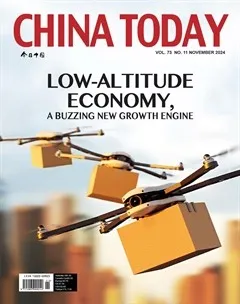
Low-Altitude Economy Gets Wings
2024-12-31 00:00:00ZHAOYANG
CHINA TODAY 2024年11期

AROUND 11.30 AM on a sunny day in July2024, four students participated in a ceremonyin Huangpu, a district in the cityof Guangzhou, Guangdong Province, insouthern China, in which they received drone-deliveredpackages. It was the herald of China’s postalservice making history, jumping from snail mail"into the ranks of drone delivery. The four studentshad been sent letters in distinctive red envelopesby the South China University of Technology inthe city, informing them that their application foradmission had been accepted.
It was the first delivery of college admission lettersby drone, Zou Liwen, general manager of theGovernment and Enterprise Center of China Post’sGuangzhou branch, said at a press conferencelater. With the success of the pilot service, ChinaPost will make low-altitude drone delivery part oftheir air, rail, and road transportation networks toexpand their reach.
From logistics to agriculture, from surveys andmapping to power grid inspection, and from lightshows to aerial photography, today unmannedaerial vehicles (UAVs) are being used for variouspurposes and in different sectors. The trend canbe traced back to 2010, when China launched areform of low-altitude airspace management totap more aerial resources. It unleashed a waveof technological innovations and applicationsthroughout the industrial chain which led to a"boom in low-altitude industries. This March, theterm “low-altitude economy” appeared in thegovernment work report and went viral. Now localgovernments around the country are exploring thenew opportunities it offers.
Trillion-Yuan Market in the Pipeline
According to Li Shipeng, executive directorof the LASER Institute of International DigitalEconomy Academy (IDEA), the factors behind therise of the low-altitude economy are the progressin traditional technologies, such as those for radio,communication, navigation and surveillance, andthe rise of new industries, such as the Internet ofThings and artificial intelligence. “Today, we canuse existing technologies to digitize the entire lowaltitudespace into a computable space … wherewe can compute intelligently, plan routes and airspaceoptimization, and monitor aircraft real-time,which is an important guarantee for the developmentof the industry,” Li said.
Earlier this year, the Ministry of Industry andInformation Technology and three other centralgovernment departments issued a plan for theinnovation and application of general aerial equipmentfor the 2024-2030 period. It says by 2030,the general aviation industry will be developedintelligently and in a green way and general aviationequipment will be widely used in people’s"daily work and life, creating atrillion-yuan market.
This year has seen severaldevelopments. In February,Prosperity, a five-seater electricaircraft which is capableof taking off and landing vertically,and was developed byAutoFlight, a Shanghai-basedhi-tech startup, conductedthe world’s first inter-city airtaxi demonstration flight. It took off from a portin Shenzhen in Guangdong and landed at anotherport in Zhuhai, another city in the province, in 20minutes, compared with three hours by car. The airtaxi service is expected to start in 2026.
In June, at a promotional event for local cherriesin Tianshui, Gansu Province, courier and logisticscompany SF Holding tested its ARK-40 cargodrone. The company says the drone can collect andtransport cherries in mountainous areas and othercomplex terrains, cutting transportation time byhalf. Such services will boost the modernization ofthe agricultural industry.
China’s low-altitude economy has more than57,000 players, with 21,000 of these companiesstarted during the past five years, according to theResearch Report on the Development of China'sLow-Altitude Economy (2024) released by the ChinaCenter for Information Industry Development.
Security Concerns
While the developments indicate that countlessflying machines may be shuttling back and forth inthe sky in the not too distant future, there are alsoquestions about safety and security.
Li is optimistic. “Compared to high-altitudeflights, low-altitude flight routes take more factorsinto account, such as avoiding crowds, densebuildings, and historical sites,” he said. “In emergencysituations, a large number of aircraft canquickly veer to a new route.” Besides, the currentmotor and battery technologies are mature andmany aircraft have backup components to ensuresafe landing in case of mechanical failures.
To manage low-altitude aircraft, the aviationauthorities need to know their location so that"they can be given instructions in case of problems.This is crucial for the safety of the entire airspace.For this, equipment is needed to track theaircraft but the traditional large radars for largevehicles are not suitable for small aerial vehiclesflying at low altitude and speed.
Efforts are being made to find a substitute.Experiments are being conducted to projectpart of communication frequency bands or radiowaves into the sky so that they reflect off the smallvehicles flying at a low altitude back to a receivingantenna.
Logistics and food delivery are among the fieldswhere unmanned drones are used most. Meituan,China’s leading e-commerce platform, stands outfor its use of unmanned drones, having completed250,000 drone deliveries by the end of March thisyear. Its drones use cameras, which while key to thesuccess of the flights, also raises privacy concerns.
This issue can be resolved by setting properstandards and requirements for aerial vehicles, Lisaid. \"Meituan has introduced privacy protectionmeasures for its drones. The function of the frontcamera is limited to detecting obstacles, showingonly image structures without revealing realscenes, while the downward-facing camera is usedonly to scan a QR code on a locker for parcels at the"destination,” he explained.
Consumer service drones mainly operate in thespace 0-120 meters above the ground, with a maximumheight of about 40 floors. In order to minimizesound pollution, Meituan has refined the propellerdesign and route planning. Instead of flying over thebuilding where the customer lives, its drones descendvertically to a site nearby, and then slide to the designatedparcel locker. In this way the noise is greatlyreduced.
As the low-altitude economy grows at full throttle,many technologies are being experimented with andimproved for their practical application. \"Researchand development will make these technologies saferand more efficient,\" Li said.
Machine vs. Man
Chinese tech company Baidu’s driverless robotaxiApollo Go began operating in Wuhan in centralChina in March. It is said there are about 500 of themin the city, with plans to double the number by theend of the year. This has raised concern that the servicemight push human cab drivers out of business.Li thinks public alarm is normal in the early days ofthe application of a technological innovation dueto insufficient understanding of how it works. \"Thisreminds us that in the process of exploring low-altitudeairspace resources, we need to provide scientificguidance to the public,\" he said.
According to him, the biggest obstacle to autonomousdriving is the uncertainty about people andother cars. There is a view that it would be safer ifthe vast majority of automobiles on the road wereself-driving, as they would all follow planned routes.This is exactly the case in the low-altitude airspace.\"The vast majority of aerial vehicles are unmanned,and safety in the low-altitude space can be enhancedthrough effective overall planning,\" Li said.
According to a report on thedevelopment of China's low-altitudeeconomy, China’s low-altitude economyreached RMB 505.95 billion in2023, marking an annual increaseof 33.8 percent. This remarkablegrowth was primarily driven by themanufacturing of aerial vehicles andlow-altitude flight services. However,"the potential of low-altitude infrastructure and flightsupport services is yet to be fully unleashed.
In Li’s opinion, more attention should be paid toinfrastructure and supporting services. \"Industryleaders such as Meituan and SF have built infrastructureto run their respective routes, maintain theirairspace, and provide navigation support. The problemis that their infrastructure is for their exclusiveuse,\" Li said.
To improve communication and coordinationamong the drones of different companies, he has twosuggestions: Enterprises should continue to acceleratescientific and technological innovation to promoteindustry-wide progress; and the governmentshould take the lead to establish a unified managementplatform, encouraging enterprises to shareinfrastructure, integrate databases, and formulaterules. This will ensure unified planning and managementin the sector.
Shenzhen is a pioneer in this. It is working on aninfrastructure network, an air-ground network, an airroute network, and a service network that will coverthe entire city. At the core of these networks is thesmart integrated lower airspace system, which wasdeveloped by IDEA. A new type of infrastructure, itwill provide technology for effective, targeted managementby air traffic control authorities and providedrone operators safe, reliable, efficient, and intelligentservices. This will help Shenzhen's low-altitudeeconomy to scale up and achieve sustainable, highqualitydevelopment.
Guangdong, being part of the Guangdong-HongKong-Macao Greater Bay Area singled out for development,enjoys many preferential and supportivepolicies and strong institutional support from thestate. It began to build a three-dimensional transportationnetwork years ago, and the developedeconomy, robust manufacturing bases and many innovationcenters in the region have laid solid financialand technological foundations for the low-altitudeindustry.
According to data released at a provincial conferenceon the high-quality development of low-altitudeeconomy in July, Shenzhen has more than 1,700enterprises engaged in the low-altitude industry. Lastyear the output value of the city's low-altitude economyexceeded RMB 90 billion, and it led the world in"the number of unmanned drone flights (610,000) andhelicopter flights (23,000).
Li, who is also an adjunct professor at the ChineseUniversity of Hong Kong, Shenzhen and the HongKong University of Science and Technology (Guangzhou),said the regional government of Hong Kongplaces great emphasis on the low-altitude sector andhopes to deepen cooperation with the mainland. TheHKUST maintains close exchanges with its mainlandcounterparts.
\"China will lead the development of the low-altitudeeconomy in the world,\" Li said, predicting thatin 10 years about one-tenth of ground transportationwill move to the air. This will trigger a 50 percent increasein operation and other business activities andlead to vigorous growth of related industries.