
An Access Selection Functional Architecturefor Heterogeneous Multi-Mode Terminals
2008-06-20 08:26:08LiJun
ZTE Communications 2008年3期
Li Jun
(Network Management Center, China Mobile Group Henan Co., LTD, Zhengzhou 450003, China)
Abstract:The convergence of heterogeneous wireless networks is an inevitable trend in broadband wireless communications development.In heterogeneous networks convergence environment,each wireless network can provide ubiquitous,best Quality of Service(QoS)services.The challenge lies in the design of the management system and access selection architecture for heterogeneous multi-mode terminals.A type of management architecture for heterogeneous multi-mode terminal via effective interaction with all protocol layers is adaptable for multi-access standards and technical requirements to achieve seamless access and mobility for multi-mode heterogeneous terminals.As the core subject for research,access selection functional architecture mainly consists of three modules,namely access adaptation,mobility management,and user preference.

T he next generation mobile communications system will be an integration of various kinds of wireless networks,where each wireless access technology has its own features in respect of capacity,coverage,data rate and support to mobility,and any individual wireless access technology cannot meet the demands of allusers.Meanwhile,new wireless access technologies emerge continuously with the evolution of existing ones.All these technologies complement and integrate with each other.The integration of these technologies involves many aspects of a network,and it is achieved in many ways.Of all aspects,the terminalplays a key role.
The future mobile terminals willhave multiple wireless interfaces to access different networks.Therefore,in the research of heterogeneous network convergence,the focus is how to design the functional architecture of access selection for heterogeneous multi-mode terminals,enabling the user to access the optimal network,effectively utilizing the wireless resources of the entire networks as well as integrating different wireless access technologies into a unified network environment[1].
1 Current Research on Heterogeneous Multi-Mode Terminals
The access selection mechanisms of heterogeneous wireless terminals have been extensively studied in the industry.
In the Information Society Technologies(IST)Ambient Network project,sponsored by European Commission within the Sixth Framework Programme(FP6),the researchers propose the concept″Always Best Connected(ABC)″[2],which means each heterogeneous multi-mode mobile terminalis always seamlessly connected to an access network that suits the application requirements best.The ABC solution components include access discovery,access selection,Authentication,Authorization and Accounting(AAA)support,mobility management,profile handling,and content adaptation.As one of the core components,access selection is designed for application traffic streams to select the most suitable access network.
The Moby Dick project under IST suggests a terminal-based end-to-end reconfiguration solution[3].This solution describes the conceptual framework of heterogeneous multi-mode terminals in network convergence environment,and provides a new approach for solving terminal issue in the convergence of heterogeneous networks.But the design and implementation methods of the functional architecture are still under research,and the architecture's mechanism,algorithm and interface definition are to be further improved.According to 3rd Generation Partnership Project(3GPP)R7,the research on System Architecture Evolution(SAE)has clearly identified that seamless mobility between heterogeneous access networks must be supported in the scenarios of future heterogeneous networks.Moreover,the multi-access selection algorithms have been brought forward as an important open subject.
In describing 3G and 4G visions,World Water Rescue Foundation(WWRF)forum[4]points out that the future wireless communications system tends to be broadband,ubiquitous and coordinative.In the future system,the networks of various modes will co-exist,interconnect,complement and coordinate with each other,they will support terminal mobility and gradually evolve into a heterogeneous wireless network.
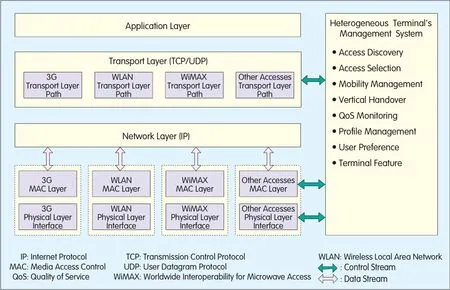
▲Figure 1. Management architecture for heterogeneous multi-mode terminals.
In the environment where heterogeneous networks converge,each wireless network can provide ubiquitous,best Quality of Service(QoS)services,and the mobile users can controltheir accesses to networks based on their requirements or demands.The challenge lies in the design of the management system and access selection architecture for heterogeneous multi-mode terminals.
2 Management System
In heterogeneous networks,terminals will work in a quite different environment.Although their basic components keep unchanged,the interconnection and convergence of heterogeneous networks impose higher requirements on the performances of the terminals.The terminals,without any interference from the users,should autonomously perceive access networks and select the optimal one based on capabilities of various wireless access technologies,network coverage,network utilization,service demands,charges,and user preferences.In heterogeneous network environment,the integrated architecture of various wireless networks requires a new terminal management system for support[5].As a result,it is necessary to design a new management system for heterogeneous multi-mode terminals to allow heterogeneous networks to converge.Figure 1 illustrates such management system.This management system,by effectively interacting with different protocol layers,can meet the requirements of various access standards and technologies,achieving seamless access and mobility of multi-mode terminals.
The main idea in designing the management system for heterogeneous multi-mode terminals is to logically treat all available wireless resources as a whole,and dynamically allocate traffic streams or sessions to different wireless networks based on their QoSrequirements.In this way,reliable QoSis guaranteed and optimal wireless resources are utilized.
The main functions of the management system are as follows:
·Access discovery:to collect the handover-related information in physical and MAC layers,including signal strength,available bandwidth,and latency.
·Access selection:to dynamically select a network interface based on collected network information,application requirements,and user preferences.
·Mobility management and vertical handover:to enable or disable each wireless interface,as well as perform handovers between networks.
·Profile handling:to report user preferences and describe the characteristics of user terminals.
3 Access Selection Functional Architecture
In designing the management system for heterogeneous multi-mode terminals,access selection is a key problem.To solve this problem,one approach is to integrate the access selection function into mobile terminals to simplify the processing at the network side,giving the terminals the capability of selecting access networks intelligently[6].
3.1 Functional Architecture
To support the access selection function of terminals in heterogeneous network environment,one functional architecture is presented here.As shown in Figure 2,this architecture mainly consists of three modules:access adaptation,mobility management and user preference,which serve to obtain link layer parameters from the attachment points of different access networks,process the user's demands and execute access selection respectively.In executing access selection,pre-designed selection algorithm is adopted and such factors as network status,availability of resources,user preference and service requirements are taken into account.As a result,the optimal access network will be selected.

▲Figure 2. Access selection functional architecture of heterogeneous multi-mode terminals.
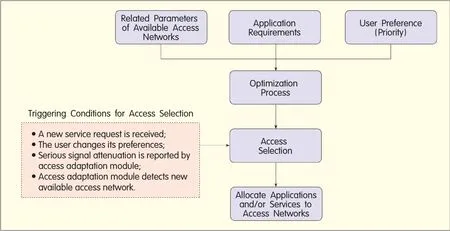
▲Figure 3. Access selection process.
In the functional architecture,the access adaptation module is responsible for providing the terminal with abstract information driven by different access networks,the mobility management module is responsible for processing the mobility events and determining the optimal access network,while the user preference module takes charge of obtaining and processing user preferences and demands.Below is a detailed description of the functions of each module.
(1)Access Adaptation Module
This module identifies all access network interfaces on a terminal,monitors their status,collects required parameters from them,and selects or deselects access on them.The main functions of this module are:
·To perform connection or disconnection operation properly on the terminal's related access network interface during handovers or when the mobile terminal is switched on.
·To obtain datalink layer parameters via the terminal's access network interfaces,and to reflect the signal quality or connection status of each access network interface in an abstract way.
This module can provide the terminals with lists of information about attachment points of available access networks.Each list includes signal strength,available bandwidth,adopted technology and network operator of an attachment point.This module can also use specific network discovery protocols to determine whether there is any new access network or whether the selected network meets the requirements;then it notifies the access selection sub-module in mobility management module of related information so as to trigger new access selection process.
(2)Mobility Management Module
This module processes all events related to mobility management and access selection.It provides the access selection sub-module with necessary input parameters(which are obtained from user preference module and access adaptation module),triggers the decision process of access selection and finally sends its decision to the access adaptation module for executing access selection.Combined with Session Initiation Protocol(SIP)[7]and mobile Internet Protocol(IP)[8],this module aims to offer the best decision algorithm for selecting the optimal access network.
(3)User Preference Module
This module stores,accesses and edits users'profiles.In access selection algorithms,users show their own preferences over decision parameters of network selection.They set priorities of decision parameters via Graphical User Interface(GUI),thus affecting the network access selection process.
In the functional architecture design of heterogeneous multi-mode terminals,the access selection function should enable the terminal to dynamically select the optimal access network.That is to say,the terminal should perceive access technologies and availability of different access networks in the ambient environment,and dynamically change its selection according to the user's preferences and demands.
3.2 Access Selection Process
In the mobility management module,the access selection sub-module is responsible for decision on access selection based on the user's service and application requirements,preferences as well as the availability of current networks.The mobility management module provides the access selection sub-module with necessary input parameters,triggers the decision process of access selection,sends its final decision to the access adaptation module,and performs the access selection process.
The step-by-step access selection process is illustrated in Figure 3.
3.3 Realization of Access Selection Function
Amiddleware is a general method between the platform(hardware and operating system)and specific applications.With standard programming interfaces and protocols[9],it is used to shield heterogeneous operating systems and network protocols in distributed environment.
In heterogeneous multi-mode terminal design,the access selection function can be realized with the middleware technology.Figure 4 illustrates an access selection mechanism that adopts distributed middleware architecture,which automatically adapts access selection to user applications at the hardware level as well as coordinates and manages these applications.In realizing the access selection function,network interface cards perceive triggering condition parameters of available access networks,and send these parameters to the access discovery module via the operating system,which will be treated as inputs of the access selection module.The optimization mechanism of the function,against the predefined access selection strategies,makes a trade-off decision based on the decision parameters,network status and user's application demands,and then selects the optimal access network.The access selection decision is sent to the operating system for controlling different access networks and allocating traffic streams to different interfaces or performing seamless handover of traffic streams between interfaces.
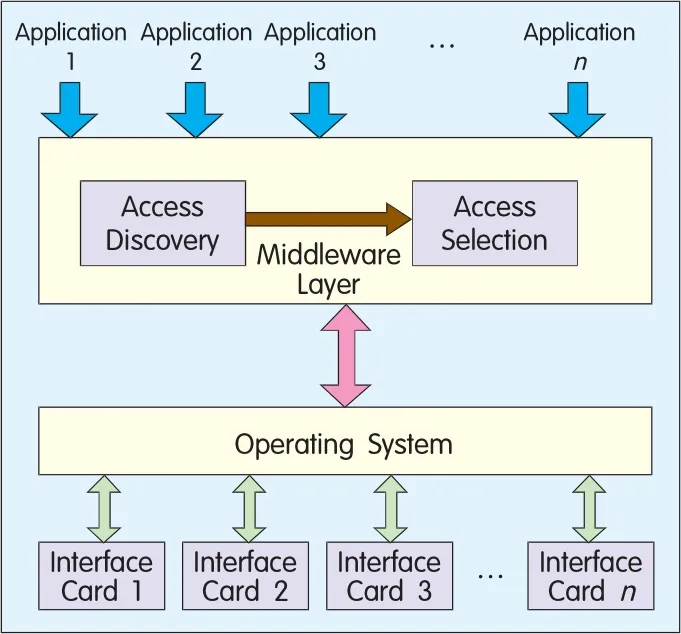
▲Figure 4. Realization of access selection function.
4 Conclusions
In heterogeneous wireless network environment,one challenge is that multi-mode mobile terminals should always be seamlessly connected to the optimal access network that meets the application requirements.To deal with the challenge,this paper presents a functional architecture of access selection for the multi-mode terminals.Under this architecture,the terminalis capable of selecting different networks,allowing the user to access the best suitable network anytime and anywhere.
This architecture also provides a carrier for studying access selection algorithms.In the next step,the research will focus on designing feasible access selection algorithms based on the functional architecture,enabling the terminals to select the optimal access network and be integrated with various wireless access technologies.The final goal of access selection function is to provide the users with the best service experience.

- ZTE Communications的其它文章
- WiMAX and Its Applications (3)
- Redundancy Technologies for Mobile Communication Networks
- Ultra Mobile Broadband Technology Overview and Competitive Advantages
- Ambient Network and Its Key Technologies
- Key Technologies of Wireless Heterogeneous Network Security
- Multi-Radio Cooperation Technology and Heterogeneous Network Convergence