
Comparison and Analysis of the Foreign Ministry Press Conferences between China and the United States in Perspective of Speech Acts
2017-07-13 21:35:19王揚
校園英語·上旬 2017年6期
王揚
I. Introduction
Press conference is an essential medium for information transmission, especially for the Foreign Ministry press conference, which serves as an important source of a countrys policy and position. This paper makes a brief comparison of them between China and the United States based on the theory of speech acts, analyzing the potential reasons and intentions and drawing up some conclusions for reference and practical use.
II. Elaboration of speech act theory
Speech act theory was first established by the British philosopher John Austin (1962). He pointed out that we use language to do things as well as to assert things, which basically forms the speech act theory. Based on his theory, the American philosopher John Searle (1969) then classified illocutionary acts into five types.
2.1 Austins model of speech acts
2.1.1 The theory of performatives
The action which is performed when a ‘performative utterance is issued belongs to what Austin calls a speech act, e.g. “I name this ship the Queen Elizabeth”, “I take this man as my lawfully wedded husband, ” or “I bequeath this watch to my brother”. In these cases, the sentence is not being used to describe or state what one is ‘doing, but being used to actually ‘do it.
2.1.2 Locutionary, illocutionary and perlocutionary acts
Austin then further explained that speech acts can be analyzed on three levels: locutionary act: the performance of an utterance; illocutionary act: the pragmatic ‘illocutionary force of the utterance; perlocutionary act: its actual effect.
2.2 The development of the theory by Searle
2.2.1 The classification of illocutionary acts
According to Searle, under the branch of illocutionary acts, there are five general types of things we do with language: assertives; directives; commissives; expressives; declaratives.
2.2.2 Indirect speech acts
One common way of performing speech acts is to use an expression which indicates one speech act, and indeed performs it, which is a direct speech act. However, the expression may also an indirect one, for instance: “Peter, can you close the window?” thereby asking Peter whether he will be able to close the window, but also requesting that he does so, and it counts as an indirect speech act.
III. Comparison of press conference language between English and Chinese
3.1 Direct speech act
3.1.1 Performative verbs
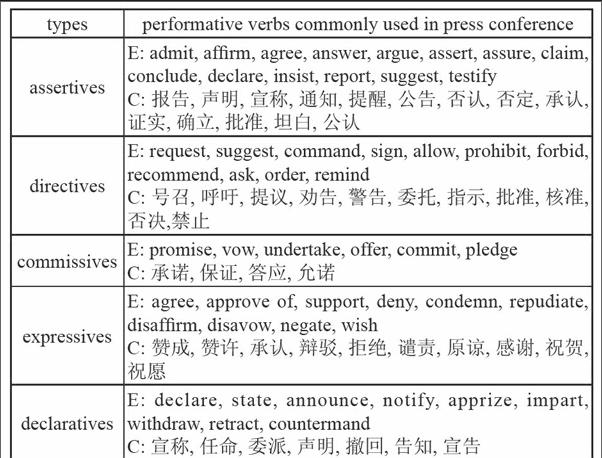
types performative verbs commonly used in press conference
assertives E: admit, affirm, agree, answer, argue, assert, assure, claim, conclude, declare, insist, report, suggest, testify
C: 報告, 聲明, 宣稱, 通知, 提醒, 公告, 否認, 否定, 承認, 證實, 確立, 批準, 坦白, 公認
directives E: request, suggest, command, sign, allow, prohibit, forbid, recommend, ask, order, remind
C: 號召, 呼吁, 提議, 勸告, 警告, 委托, 指示, 批準, 核準, 否決,禁止
commissives E: promise, vow, undertake, offer, commit, pledge
C: 承諾, 保證, 答應, 允諾
expressives E: agree, approve of, support, deny, condemn, repudiate, disaffirm, disavow, negate, wish
C: 贊成, 贊許, 承認, 辯駁, 拒絕, 譴責, 原諒, 感謝, 祝賀, 祝愿
declaratives E: declare, state, announce, notify, apprize, impart, withdraw, retract, countermand
C: 宣稱, 任命, 委派, 聲明, 撤回, 告知, 宣告
3.1.2 Performatives
Expressions and statements can also be easily identified with respective implications.
E.g.
Our Constitution declares that from time to time, the President shall give to Congress information about the state of our union. (Presidents State of the Union Address, Barack Obama, 2011)——assertives
我想強調的是, 在達爾富爾地區實現司法公正離不開地區持久的和平和穩定。(例行記者會, 秦剛, 2010)——assertives
It shows that without active mitigation against the current level of emissions, the worlds temperature will rise by 4 degrees by the end of the century compared to the pre-industrial level. (regular press conference, William Ehrman, 2010)——directives
我們要求印方重視中方嚴正關切, 不在爭議地區挑起事端, 以利中印關系健康發展。(例行記者會, 馬朝旭, 2009)——directives
3.1.3 Reflections and analysis
a. Perfomative expressions of press conference are always complete sentences, both in English and Chinese, while its not the case in oral forms. (compare: “我反對” and “中國政府堅決反對達賴以任何身份和名義到任何國家從事分裂中國的活動”)
b. In performatives, the subjects are mostly nouns or first person plural forms. (e.g. We agreed that the Islamic Republic of Iran must provide assurances to the international community that its nuclear program is peaceful and transparent. / This kind of comprehensive agreement would be an important step forward in the effort to rally the world around a solution to our climate challenge)
3.2 Indirect speech act
3.2.1 Adjustment in strength
According to Searle, illocutionary acts falling into the same type may differ in their strength. Likewise, in press conferences, statements made in less strength are always regarded prudent and agreeable with the cooperative principle and politeness principle.
e.g.
What currency the DPRK uses is its internal affair and I am not in a position to comment.
我們對政策本身不予評論, 但我們必須為了飛行安全而遵守程序.
3.2.2 The delay in reply
Its common that the spokesperson are not prepared to answer all the questions or not allowed to reveal all the details. Under these circumstances, they reply with an ask for delay or later contact, which shows the observance of the cooperative principle, especially the maxim of quality.
e.g.
Up to now I havent got any information available. We will try to contact the office as soon as possible.
問: 關于哥倫比亞外長貝穆德斯訪華的問題。據悉, 他與習近平副主席和楊潔篪外長的會見改在本周五舉行, 你能否證實?
答: 我需要了解一下具體的安排, 隨后電話答復你。
IV. Conclusion
1. The common ground of the speech acts between Chinese and English counts more than the differences, which shows that the restriction of speech acts from diplomatic institutions weighs more than linguistic individuality.
2. The frequency of a certain speech act relates directly to the speakers and their rights of speaking. In press conference, appeal, suggest, propose, etc. are used a lot and we may tell they fully clarifies their rights of making statements.
3. Direct speech acts is in larger amount than indirect ones where every point must be made clearly and precisely, so doubtlessly direct speech acts are utilized more thus the communicative purpose can be realized.
References:
[1]Austin J.L.How to do things with words[M].Cambridge,Mass: Harvard University Press,1962.
[2]Searle J.R.Speech acts:an essay in the philosophy of language [M].Cambridge University Press,1969.
[3]陳佑林,何舉純.普通語言學概論[M].湖北:華中師范大學出版社,2010.
- 校園英語·上旬的其它文章
- Discussion on the Selection of a Company’s Financial Management Goal
- An Analysis of the Image of Room in Pinter’s Plays
- On the way of the black women’s Liberation
- Inevitability of Willy’s Tragedy as Seen from Lacan’s Mirror Stage
- “The Garden Party”: Witness of a Girl’s World and the Real World
- An Analysis of Culture Shock and Adaptation in Film A Grandson from America