
· In this issue ·
2012-04-12 22:14:22
上海精神醫學 2012年4期
· In this issue ·
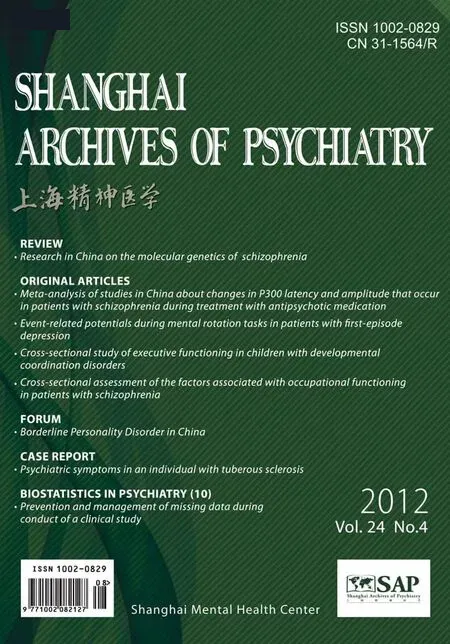
This issue starts with a comprehensive review of molecular genetic research about schizophrenia in China.[1]This field has exploded over the last decade, largely driven by the new technologies that have become available at many centers around the country. Chinese scientists have identified or confirmed a number of candidate susceptibility genes for schizophrenia but despite the availability of relatively large numbers of suitable subjects, the majority of the studies have relatively small samples and many of them are duplicative of studies already done in other countries. Moreover, the two large-sample genome-wide association studies (GWAS) of schizophrenia conducted in China identified two non-overlapping sets of susceptibility genes. Nevertheless, the authors conclude that with the introduction of second-generation sequencing, it will not be long before gene research about schizophrenia in China will be making important breakthroughs of international importance.
The first original paper[2]is a meta-analysis of electrophysiological studies in China on the relationship of changes in the latency and amplitude of P300 (an event-related potential measure) during antipsychotic treatment in patients with schizophrenia. The authors identified 12 studies that made before versus after treatment comparisons with a pooled sample of 512 participants. Unlike western studies (that are primarily cross-sectional) they found that P300 amplitude and latency both change with pharmacological treatment, suggesting that P300 indices — particularly P300 amplitude — could be a biomarker of treatment effectiveness in schizophrenia.
The second research paper[3]is also about eventrelated potentials (ERPs), but this paper assesses them in 32 patients with first-episode depression who are completing a mental rotation task. Compared to control subjects, the patient group had a longer reaction time, made more errors, and had a delayed latency and reduced amplitude of the P500 wave. This confirms work from previous studies and suggests that these measures could be markers of the magnitude of cognitive disturbance in depression. The study also had an interesting secondary finding that merits a replication study: the averaged ERP waveform for the patient group lacked a positive peak at 700 ms that was present in the control group. But before these mental rotation task-related ERP measures can be considered candidate biomarkers of cognitive functioning in depression, long-term follow-up studies are needed to determine how these measures change as cognitive functioning changes during the course of a depressive illness.
The third research paper[4]assesses executive functioning in children with Developmental Coordination Disorder (DCD). Given the overall dearth of child psychiatrists in China, this condition has received very little attention. Comparing the executive functioning of 39 children who met DSM-IV criteria of DCD to that of 39 community controls using the Wisconsin Card Sorting Test (WCST), the study confirms studies from the west which report that DCD patients have significantly impaired executive functioning. Additional work is needed in China to identify the risk factors for this condition and to test methods for reducing the intellectual and social deficits often associated with the disorder.
The last research paper[5]is about the correlates of occupational functioning in patients with schizophrenia in China. The authors use a translated version of the Comprehensive Occupational Therapy Evaluation Scale (COTE) and a variety of clinical and cognitive measures to assess the occupational functioning of 35 inpatients and recently discharged outpatients with schizophrenia. As has been found elsewhere, they found that occupational functioning in these patients was closely related to the severity of psychiatric symptoms and weakly associated with measures of cognitive functioning. Further work is needed to assess the relationship of occupational functioning with clinical and cognitive measures among patients who are in residual phases of their illness and among residents in rural areas for whom ‘occupation’ is working on the family farm.
The Forum[6]discusses a diagnosis that is not yet recognized by most Chinese psychiatrists: Borderline Personality Disorder (BPD). This diagnosis, like other personality disorder diagnoses, is almost never made in China. BPD is not included in the Chinese Classification of Mental Disorders[7]though it is included in the ICD-10[8](which is commonly used to assign diagnoses in clinical settings in China) as one of the subtypes of ‘Emotionally Unstable Personality Disorder’. The low identification rate could be due to three factors: a) the prevalence of BPD in China is, indeed, much lower than elsewhere; b) individuals with BPD are less likely to come to psychiatric attention in China; and c) Chinese clinicians are simply not recognizing BPD in the patients they encounter because the patients already have another mental disorder. The relative importance of these three factors is uncertain but Chinese psychiatrists receive little training about personality disorders and rarely assess their patients for personality disorders, so it is not surprising that they don’t make these diagnoses. However, over the last five years there has been increased interest in BPD; more than 100 papers about BPD have been published in Chinese journals, most of which report high rates of comorbid BPD in clinical samples. The task at hand is how to increase Chinese clinician’s recognition and appropriate management of BPD.
The issue also includes a case report on the psychiatric presentation of a patient with tuberous sclerosis[9]and the second of three installments[10]in the Biostatistics in Psychiatry section on methods of dealing with missing data in clinical research studies.
1. Cui DH, Jiang KD. Research in China on the molecular genetics of schizophrenia. Shanghai Arch Psychiatry 2012; 24 (4): 187-199.
2. Su L, Cai YY, Shi SX, Wang LW. Meta-analysis of studies in China about change in P300 latency and amplitude that occur in patients with schizophrenia during treatment with antipsychotic medication. Shanghai Arch Psychiatry 2012; 24 (4): 200-207.
3. Chen J, Yang LQ, Liu GX, Zhang Y, Wu XQ, Ma WT, Deng ZH. Eventrelated potentials during mental rotation tasks in patients with first-episode depression. Shanghai Arch Psychiatry 2012; 24 (4): 208-216.
4. Zhu S, Tang GZ, Shi JF. Cross-sectional study of executive functioning in children with developmental coordination disorders. Shanghai Arch Psychiatry 2012; 24 (4): 217-221.
5. Li N, Chen Y, Deng H. Cross-sectional assessment of the factors associated with occupational functioning in patients with schizophrenia. Shanghai Arch Psychiatry 2012; 24 (4): 222-230.
6. Wang LL, Xiao ZP. The need to establish diagnostic criteria for borderline personality disorder in China. Shanghai Arch Psychiatry 2012; 24 (4): 231-232.
7. Chinese Society of Psychiatry, Chinese Medical Association. Chinese Classification and Diagnostic Criteria of Mental Diseases, Third edition (CCMD-3). Jinan: Shandong Science and Technology Press; 2001. (in Chinese)
8. World Health Organization. The ICD-10 Classification of Mental and Behavioral Disorders: Diagnostic criteria for research. Geneva: WHO, 1993.
9. Liu QJ, Gao JL. Psychiatric symptoms in an individual with tuberous sclerosis. Shanghai Arch Psychiatry 2012; 24 (4): 233-234.
10. Biswas K. Prevention and management of missing data during conduct of a clinical study. Shanghai Arch Psychiatry 2012; 24 (4): 235-237.
- 上海精神醫學的其它文章
- Prevention and management of missing data during conduct of a clinical study
- Cross-sectional assessment of the factors associated with occupational functioning in patients with schizophrenia
- Cross-sectional study of executive functioning in children with developmental coordination disorders
- Event-related potentials during mental rotation tasks in patients with first-episode depression
- Meta-analysis of studies in China about changes in P300 latency and amplitude that occur in patients with schizophrenia during treatment with antipsychotic medication
- Research in China on the molecular genetics of schizophrenia