
Eigenvalues Detection Based Spectrum Sensing Algorithm for Cognitive Radio*
2012-10-21 03:44:58L,,*,,
傳感技術學報 2012年6期
L,,* ,,
(1.College of Information Science and Engineering,Jishou University,Jishou Hunan 416000,China;2.National Mobile Communications Research Laboratory,Southeast University,Nanjing 210096,China)
In recent years,the governments and researchers have become increasingly interested in CR(Cognitive Radio),which is considered as one of the most promising solutions to deal with the conflict between the enormous spectrum demands of cognitive users(unlicensed users)and the scarcity of radio spectrum resources used by primary users(licensed users)[1-4].In fact,IEEE has formed a working group on wireless regional area networks(IEEE 802.22)whose goal is to develop a standard for cognitive users to access the TV spectrum holes[3].
Spectrum sensing plays a fundamental role in CR,and its task is to use the data collected by wireless sen-sors to decide whether the spectrum holes exist or not.However,detecting the presence of the primary signal is practically difficult due to the low signal to noise ratio(SNR),deep fading and hidden nodes problem[5-6].There are many types of basic sensing algorithms presented in the literature.Among them,the MED[7],also called the blindly combined energy detection(BCED)method in Ref[8],is a preferred technique that can achieve a high probability of detection(Pd)for the correlated primary signal,which is usually the case in most sensing scenarios[6-8].The MED detects the existence of the primary signalin terms with the maximum eigenvalue of the SCM of the received signal.Recently,a new SED sensing algorithm based on the smallest eigenvalue detection has been introduced in Ref[9].The simulation results of Ref[9]also show the SED can perform well for the correlated received signal.However,the determination of the decision thresholds poses a big problem for the applications of the MED and the SED.Firstly,the decision thresholds for them are derived by using the random matrix theory(RMT)under the assumption that both the sample size and the sample dimension are infinite[7,9],which results in that the threshold becomes inaccurate in realistic applications with limited sample size and sample dimension.The results of Ref[10]indicate that the inaccurate threshold may lead to poor performance.Further,the calculation of the asymptotical threshold involves the solving of the inverse cumulative distribution function(CDF)of Tracy-Widom distribution of order 1(for the real data)or order 2(for the complex data)[7,9-12],which requires complicated numerical computation and then cannot meet the real-time requirement in many applications.
Ifthe primary signal is present,then the determinant(i.e.,the product of all eigenvalues)of the SCM for the received signal samples is usually different from that of the statistical covariance matrix of the noise samples.Based on this fact,an alternative sensing algorithm called the eigenvalues detection(ESD)is proposed in this paper.Using all eigenvalues of the SCM as a test statistic,the proposed ESD can execute spectrum sensing without the information about the primary signal and the wireless channel.Besides,the proposed method keeps the same computation complexity as the MED and the SED,while it relaxes the calculation requirement of the threshold by using a simple closed-form expression.Simulation results verify the effectiveness of the ESD.
The notations conform to the following conventions.Vectors are column vectors denoted in lower case bold,e.g.,x.Matrices are denoted by upper case bold,e.g.,A.lPand IPare theP×Pall-one matrix and identity matrix,respectively.The superscript“T”means transpose operator.det(A)is the determinant of A.E{·}denotes the statistical expectation operator.“~ ”and“”mean respectively“distributed as”and“asymptotically distributed as”.WP(N,R)denotes aP×PWishart distribution withNdegrees of freedom(DOF)and covariance matrix Rdenotes a chi-square distribution withnDOF.
1 Spectrum Sensing Algorithm for Cognitive Radio Based on Eigenvalues Detection(ESD)
Considering that there areMantennas at the sensing node andNtime samples can be obtained at each antenna for spectrum sensing,theP×1 received signal sample vector can be written asxm(n)=sm(n)+ηm(n),m=1,…,M,n=1,…,N,wherePdenotes the number of consecutive samples of a sample vector,sm(n)and ηm(n)denote theP×1 sample vectors of the primary signal and noise,respectively.The hypothesis testing problem for spectrum sensing can be represented as

whereH0indicates primary signal does not exist whileH1indicates primary signal exists.Note thatsm(n)denotes the received signal after the primary signal passes through the wireless channel.Without loss of generality,we assume that ηm(n)is a zero mean white Gaussian processwith statisticalcovariance matrixIP.Assuming that the primary signal and noise are statistical independent,theP×Pstatistical covariance matrix of the received signal can then be written as

where Rs?E{sm(n)(n)}is the statistical covariance matrix of the primary signal.If the primary signal is present,then we have

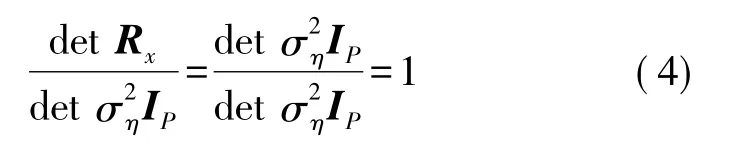
Therefore,the quotient det Rx/detIPcan be viewed as an indicator to decide whether the primary signal is present or not.In practical applications,the exact statistical covariance matrix can only be approximated by the SCM defined as

Hence,a new test statistic can be proposed as
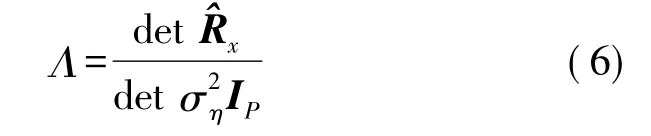
Based on the above analysis,the hypothesis testing problem in Equ(1)can be re-expressed as
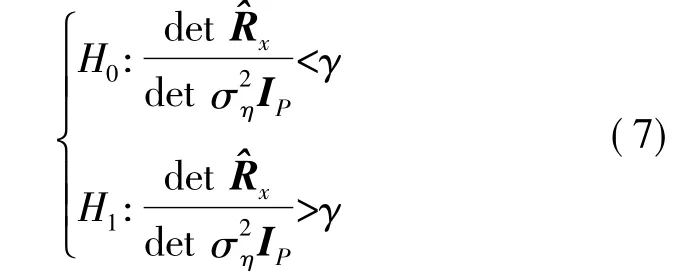
where γ denotes the decision threshold.Denote λ1,λ2,…,λPas the eigenvalues ofordered in decreasing order.Using the equation det,the new statistic can then be equivalently rewritten as
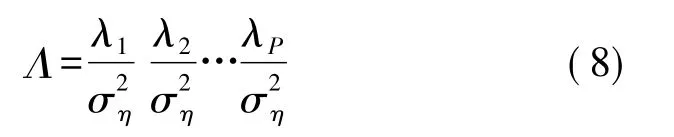
From Equ(8),the proposed statistic uses all the eigenvalues of the SCM as an indicator to detect whether the primary signal is present or not.Consequently,the new sensing algorithm based on the eigenvalues detection can be summarized as follows
Algorithms 1:Spectrum Sensing Algorithm for Cognitive Radio Based on Eigenvalues Detection(ESD)
Input:xm(n),M,N,P,and the targetPf
Output:“yes”if the primary signal is present,otherwise“no”
Step 2 Calculate the statistic Λ using Equ(6);
Step 3 Determine the decision threshold γ using Equ(20)(to be given in the next section);
Step 4 If Λ>γ,return“yes”;If Λ<γ,return“no”.
Remarks:(a)Different from the SED,the proposed ESD uses all eigenvalues of the SCM to construct the test statistic.If all eigenvalues of the SCM are equal,then the ESD reduces to the SED.(b)If the signal subspace is rank-one,i.e.,rank(Rs)=1,then the smallestP-1 eigenvalues ofwill be approximately equal toand the proposed algorithm reduces to the MED.In this sense,the MED can be viewed as a special case of the ESD,(c)The main implementation complexity for the MED,SED,and ESD lies in the computing of the SCM defined in Equ(5)and the eigenvalue decomposition of it.Obviously,the propose ESD has the same computation complexity as the MED and the SED.
2 Analysis of the Probability of False Alarm and the Decision Threshold
Usually,the decision threshold is determined according toPf.Therefore,the distribution function of the test statistic underH0should be firstly derived.WhenMN→ +∞ andPis verysmall,an asymptotic distribution can be given by[13]

Noting that ln(x)is a monotonically increasing function with respect tox>0.Therefore,the false alarm probability can be expressed as

Given a target probability of false alarm,sayPFA,the asymptotic threshold can then be calculated by combining Equ(9)and Equ(10)

where exp(x)andQ-1(x)denote the exponential function and the inverse MarcumQfunction,respectively.As mentioned above,γasyis valid for the applications with a very large sample size and a very small sample dimen-sion.However,it becomes not accurate enough in the practical application with a large sample dimension and would cause the loss of the detection performance(see Table 1 and Fig.1 in Sec.4).In the following,we will give an improved decision threshold for the proposed ESD.

Applying the theorem of Bartlett decomposition yields[13]

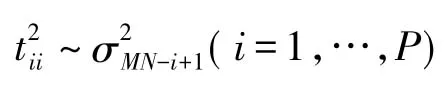

Taking natural logarithm on both sides of Equ(14)yields


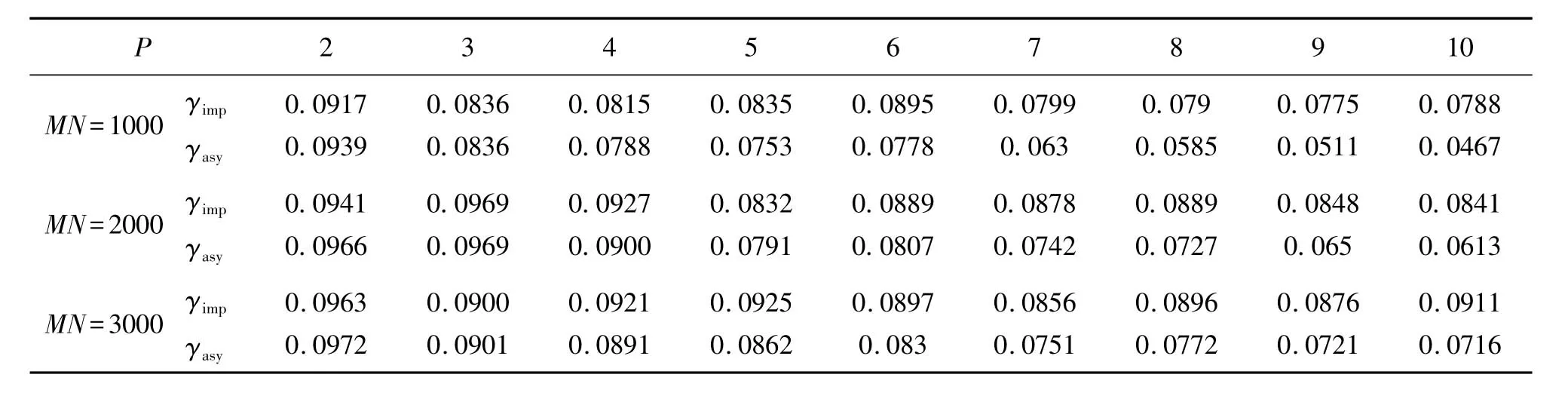
Table 1 Actual for different sample sizes and sample dimensions when and are used

We can prove that the following asymptotic distribution holds as the sample size MN is large(see Appendix)

Using the fact thatvi(i=1,…,P)are all independent of each other,from(17),we can obtain the following distribution

where
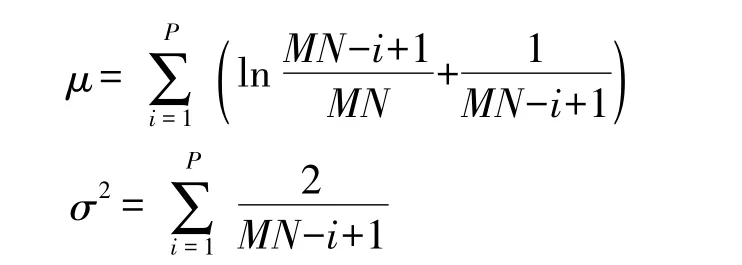
Given the targetPFA,the improved decision threshold can then be determined by combining Equ(10)and Equ(19)

Remarks:(a)WhenMN→+∞ andPis very small,we have μ→0 and σ2→2P/MN,and then γimp→γasy,which means that both γimpand γasyare accurate enough in the scenario with a large sample size and a very small sample dimension.However,ifPbecomes large,then the values of μ and σ2would deviate from the asymptotic ones,and then the asymptotic decision threshold γasywould become invalid while the proposed γimpis still valid.(b)As mentioned before,the determinations of the decision thresholds for both the SED and the MED need to solve the inverse Tracy-Widom distribution.Unfortunately,thisdistribution isdefined by a complex nonlinear PainleveⅡdifferential equation[7],and the solving heavily relies on either complicated programming techniques or a commercial statistical software package[14-15].Compared with the MED and the SED,the determination of the threshold for the ESD does not need complex numerical computation and can meet the realtime requirement in spectrum sensing.(c)Obviously,the computation of the threshold in Equ(20)does not need any information of the primary signal and the wireless channel.For a practical application,the calculation of the threshold is needed only once for given values ofM,N,PandPFA.
3 Simulations
In this section,the proposed ESD is evaluated numerically and compared with the other two eigenvalue based method including the MED and the SED.For illustration,the received primary signal is assumed to be a Gaussian distribution with a statistical covariance matrix ρslP+(1-ρs)IP,where ρsdenotes the correlation coefficient between the primary signal samples.For the real signal,the decision thresholds for the MED and the SED can be respectively computed as[7,9]①In reference[9],the threshold of the SED is derived for the complex signal.For the real signal,the threshold can be calculated by simply replacing(·)with(·)in the complex one(see reference[11]for details)..

where(·)denotes the inverse CDF of Tracy-Widom distribution of order 1.
Firstly,the actual probabilities of false alarm of the proposed ESD for different sample sizes and sample dimensions are given in Table 1,where we setPFA=0.1 and then obtain the thresholds,i.e.,γasyand γimp,using the formulae derived in Equ(11)and Equ(20).Comparing the targetPFA=0.1 with the simulated results,we see that both γasyand γimpbecome more accurate with the increasing sample dimensionMN,while the latter is more robust to the sample dimensionP.We also see that the theoretical threshold is a little bit higher than the expected,which causes the actualPfto be slightly lower thanPFA=0.1.The effects of the thresholds on the detection probability are demonstrated in Fig.1,where we fixMN=1 000 and ρs=0.5.It can be seen that better detection performance can be achieved by using the improved threshold γimp,especially for a large value ofP.
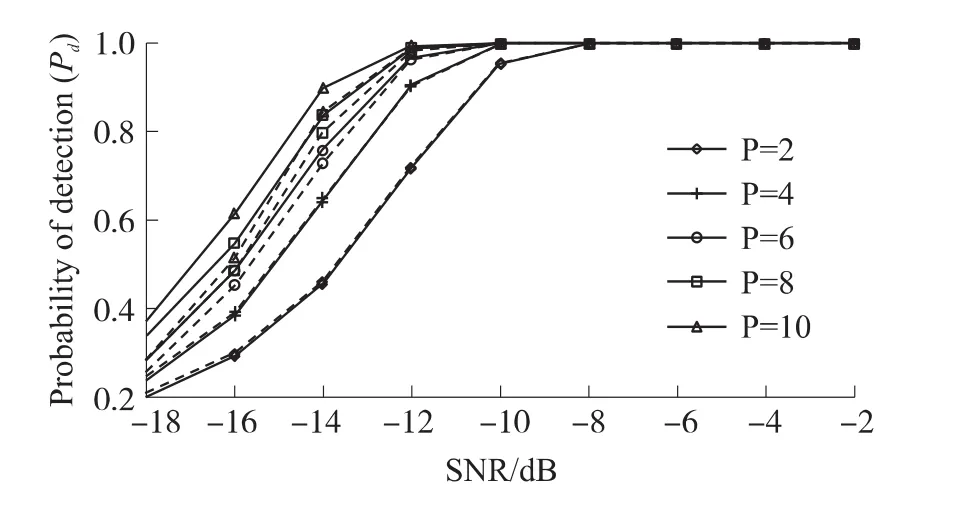
Fig.1 The effects of the theoretical thresholds on the detection performance(dashed lines:γasy,solid lines:γimp)
Secondly,the detection performance of the ESD compared with the MED and the SED for different correlation coefficients is presented in Fig.2,where the improved threshold in Equ(20)is used for the ESD.As can be seen,compared with the MED,the ESD shows better sensing performance under low(ρs=0.1)and moderate(ρs=0.5)correlation coefficients.When the received signals are highly correlated(ρs=0.9),the ESD shows better sensing performance in the low SNR region and slightly worse performance in the high SNR region.Compared with the SED,the proposed ESD can achieve higher detection probability in the high SNR region,especially for the highly correlated signal.On the other hand,from the point of view of the false-alarm probability,the SED yields a far higherPf(about)than the presettingPFA=0.1,which indicates the asymptotic threshold is far lower than the true one.The lower threshold results in the unreliability of the detection performance for the SED and also the reduction of the actual spectral utilization for the cognitive user.Obviously,the proposed ESD almost achieves the desired,which implies the threshold given by Equ(20)is very accurate in practical applications.
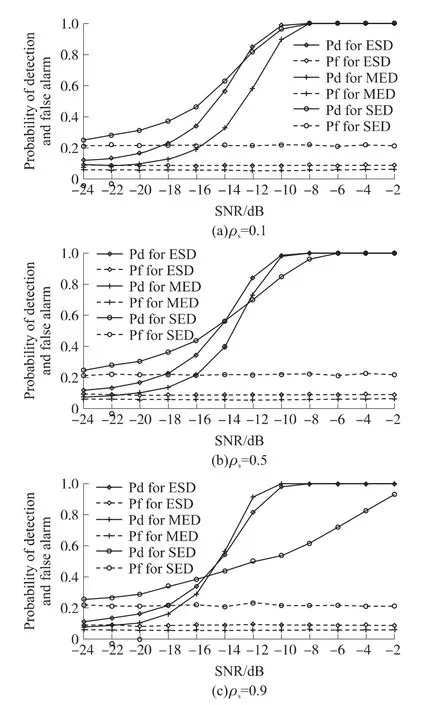
Fig.2 Performance comparison of the ESD with the MED and the SED for different correlation coefficients(MN=1 000,P=3)
Finally,the effects of the sample size and the sample dimension are investigated in Fig.3 and Fig.4,respectively.At first,the detection performance of the new algorithm for different sample sizes is presented in Fig.3,where we fix ρs=0.5,P=3 orP=5,while the sample sizes vary from 100 to 1 000.As expected,the sensing performance for the ESD increases significantly with the increasing sample size.At the same time,the sensing performance of the new algorithm with different sample dimensions is investigated in Fig.4.As expected,we observe that the sensing performance of the new algorithm can be further enhanced via increasing the sample dimension of the received signal vector.For example,the amounts of performance improvement for bothMN=200 andMN=1 000 are about 2 dB when the sample dimension increases from the increasing sample size.

Fig.3 Performance of the ESD for different sample sizes(ρs=0.5,dased lines:P=3,solid lines:P=5)
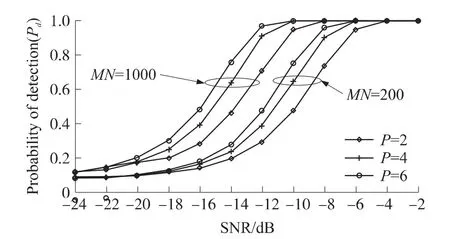
Fig.4 Performance of the ESD for different sample dimensions(ρs=0.5)
4 Conclusion
A spectrum sensing algorithm based on the eigenvalues detection has been introduced in this paper.Correspondingly,the probability of false alarm and the decision threshold are analyzed by using the multivariate statistical theories.The proposed ESD can be used for the sensing scenarios without the information about the primary signal and the wireless channel.More importantly,the proposed ESD keeps the same computation complexity as the MED and the SED,while it relaxes the calculation requirement of the decision threshold by using a simple closed-form expression.Simulation results verify the effectiveness of the proposed sensing method.
5 Appendix
Asymptotic Distribution of vi

The characteristic function ofcan hence be given as


Note thatzi(1≤i≤P)is very large due to the fact that usuallyMNis large whilePis small in practical applications.We can then use the asymptotic expansion of the log gamma function[13]to expand the second and third terms on the right hand side of Equ(22)according tozito get
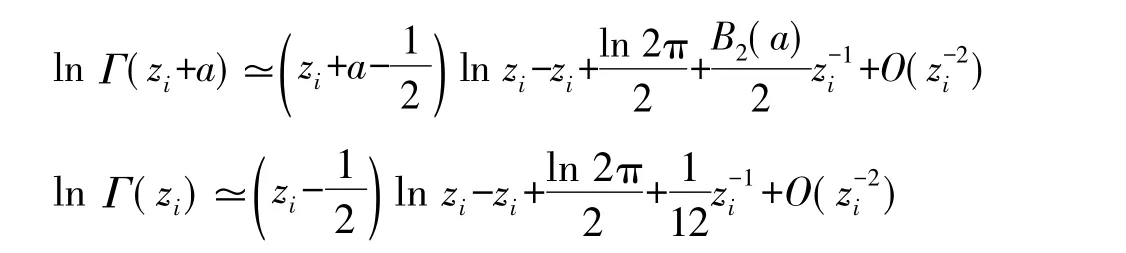

Noting that the right hand side of Equ(23)is just the characteristic function of a Gaussian random variable,we then have

Using the property of the Gaussian random variable,we can easily obtain Equ(18).
[1]Haykin S.Cognitive Radio:Brain-Empowered Wireless Communications[J].IEEE Journal on Selected Areas in Communications,2005,23(2):201-220.
[2]Zhang J W,Zhao Q,Zou J Y.Algorithm of Spectrum Allocation for Wireless Sensor Network Based on Dynamic Spectrum Sensing[J].Chinese Journal of Sensors and Actuators,2009,22(10):1481-1485.
[3]WANG B,Liu K J R.Advances in Cognitive Radio Networks:A Survey[J].IEEE Journal of Selected Topics in Signal Processing,2011,5(1):5-23.
[4]Wei M,Lian Q S.The Wideband Spectrum Covariance Sensing Algorithm Based on Compressed Sensing[J].Chinese Journal of Sensors and Actuators,2011,24(7):1022-1026.
[5]Unnikrishnan J,Veeravalli V V.Cooperative Spectrum Sensing and Detection for Cognitive Radio[C]//Proc.IEEE Global Communications Conference(GLOBECOM).Washington,DC,USA,2007:2972-2976.
[6]Zeng Y H,Liang Y C.Spectrum-Sensing Algorithms for Cognitive Radio Based on Statistical Covariances[J].IEEE Transactions on Vehicular Technology,2009,58(4):1804-1815.
[7]Zeng Y H,Koh C L,Liang Y C.Maximum Eigenvalue Detection:Theory and Application[C]//Proc.IEEE International Conference on Communications(ICC).Beijing,China,2008:4160-4164.
[8]Zeng Y H,Liang Y C,Zhang R.Blindly Combined Energy Detection for Spectrum Sensing in Cognitive Radio[J].IEEE Signal Processing Letters,2008,15:649-652.
[9]Cao K T,Yang ZH.Novel Cooperative Spectrum Sensing Algorithm Based on the Smallest Eigenvalue[J].Chinese Journal of Scientific Instrument,2011,32(4):736-741.
[10]Penna F,Garello R,Spirito M A.Cooperative Spectrum Sensing Based on the Limiting Eigenvalue Ratio Distribution in Wishart Matrices[J].IEEE Communications Letters,2009,13(7):507-509.
[11]FEldheim O N,Sodin S.A Universality Result for the Smallest Eigenvalues of Certain Sample Covariance Matrices[EB/OL].Online,http://arxiv.org/PS_cache/arxiv/pdf/0812/0812.1961v4.pdf.
[12]Yang X,Lei K J,Peng S L,et al.Blind Detection for Primary User Based on the Sample Covariance Matrix in Cognitive Radio[J].IEEE Communications Letters,2011,15(1):40-42.
[13]Muirhead R J.Aspects of Multivariate Statistical Theory[M].Hoboken,New Jersey,USA:John Wiley & Sons,Inc,1982.
[14]Dieng M.RMLab Version 0.02[EB/OL].http://math.arizona.edu/~ momar/,2006.
[15]Andrei Bejan.Largest Eigenvalues and Sample Covariance Matrices[EB/OL].http://www.cl.cam.ac.uk/~ aib29/MScdssrtnWrwck.pdf.
[16]Krishnamoorthy K.Handbook of Statistical Distributions with Applications[M].Boca Raton,FL,USA:Chapman & Hall/CRC,2006.
