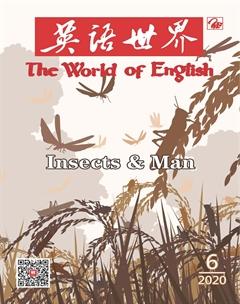
Insects & Man 昆蟲(chóng)與人類
2020-08-07 09:02:32趙喜梅
英語(yǔ)世界 2020年6期
趙喜梅
Insects have an important role as part of the biosphere—the living planet—and they make up four-fifths of all animal species. But what difference do they make to our lives?
Insects can be both a problem, and an opportunity!
Insects as a problem
Many insect species compete with us for food. Many of these have been encouraged due to human activities, but then they become a problem. We plant crops which some insect species love, they thrive on them—and thats when we start to call them pests.
Humans have caused some insect species to be moved from one part of the world to another—deliberately or by accident. The Large White butterfly is an example of a butterfly which was introduced to the USA and is now a pest on cabbages there.
Another example is the European Corn Borer, Ostrinia nubilalis, a Pyralid moth which is an important pest of corn in the Midwest of the USA. The species was introduced there from Europe in the early 20th century and now costs US farmers over a billion dollars a year.
If the introduced insect species has no natural enemies in their new home, they can become a real problem. A recent UK example is the Harlequin ladybird (Harmonia axyridis), which has found its way to Britain and eats other ladybirds. In other countries where it has been deliberately introduced to control insect pests (a process called Biological Control) it has become a real problem, threatening to wipe out many native insects.
Some insects can sting, bite, or transmit disease to humans. Sometimes this is because they find us tasty—mosquitoes for example gain nourishment by sucking blood, and in the process they can transmit diseases, such as malaria—which is caused by the protozoan Plasmodium falciparum being transmitted in the saliva of the Anopheles mosquito.
The flea Chenopsylla cheopsis had a profound effect on human history when it travelled from Africa in the ships of the middle ages, spreading the Black Death (also known as the Bubonic Plague) across Europe. It took four hundred years for the European population to recover from the effects of the Black Death. The illness is now known to be caused by the bacterium Yersinia pestis, which was carried by the flea, which in turn was carried by the black rat on ships.
So, when it comes to insects, its important to understand the consequences of human actions.
Many pests—such as the Colorado Beetle or the Gypsy Moth—can be controlled by spraying with chemical pesticides, which kill most insect species on the crop. But—would you rather eat perfect food sprayed with chemicals, or food where the pests are controlled by more natural means?
Insects as an opportunity
Insects are very important as pollinators. Bees are perhaps the best example of this. Honey Bees arent bred in captivity just for the honey they produce—they are vital to pollinate crops. Without them, many crops would fail, as pollination is needed before many crops and fruits that we eat can be formed.
Not to mention that tiny midge that pollinates the cocoa plant. Without it, there would be no chocolate!
Other examples of useful insects are the Silkworm Moth, Bombyx mori, from which silk is obtained. This species has been reared by humans for such a long time that it has become domesticated—it would be unlikely to survive in the wild if released today.
Insects are also useful as models in scientific research. The Fruit Fly, Drosophila melanogaster, is a good example. It breeds rapidly, and can produce very many generations per year in the laboratory, so it is ideal for the study of genetics and evolution. In fact, many genetic discoveries of great importance to medicine have been made using this little fruit fly.
Insects can be useful to the gardener too—ladybirds, for example, are the gardeners friend because they eat aphids. Hoverflies and wasps also prey on other insects in the garden. These species are called predators. Others that are natural enemies to garden pests include parasitoids, which lay eggs in the host insect so as to provide food for its developing young.
Many kinds of insects are also food for songbirds and other birds and animals. When there arent enough insects around, the result is fewer birds and mammals.
And insects can also be eaten by man! This is called entomophagia.
昆蟲(chóng),作為生物圈這個(gè)地球大家庭的成員,作用不容小覷,而其種群數(shù)量占全部動(dòng)物物種的4/5。昆蟲(chóng)對(duì)人類的生活又有何影響呢?
它們既可能是麻煩,也可能是機(jī)遇!
昆蟲(chóng)是麻煩
許多昆蟲(chóng)物種和人類爭(zhēng)奪食物。這些爭(zhēng)食行為很多是受到人類活動(dòng)的刺激,但后來(lái)變成了麻煩。我們播種的作物受到某些昆蟲(chóng)物種喜愛(ài),它們靠這些作物發(fā)展壯大——于是我們開(kāi)始稱其為害蟲(chóng)。
人類有意或無(wú)意地使得一些昆蟲(chóng)物種在地球上遷移。大白粉蝶就是一例,這種蝴蝶引入美國(guó)后,如今成了破壞甘藍(lán)的害蟲(chóng)。
再舉一例,歐洲玉米螟(拉丁學(xué)名Ostrinia nubilalis),一種螟蛾,是美國(guó)中西部危害玉米的一大害蟲(chóng)。此物種20世紀(jì)初自歐洲引入美國(guó),現(xiàn)今每年給美國(guó)農(nóng)民造成的損失超過(guò)10億美元。
如果引入的昆蟲(chóng)物種在新的生息地沒(méi)有天敵,則可能成為真正的麻煩。有一例近來(lái)發(fā)生在英國(guó)的蟲(chóng)害,一種俗稱小丑瓢蟲(chóng)(拉丁學(xué)名 Harmonia axyridis)的昆蟲(chóng)進(jìn)入英國(guó)后,噬食其他種類的瓢蟲(chóng)。其他國(guó)家專門(mén)引進(jìn)這種小丑瓢蟲(chóng),本是為了控制病蟲(chóng)害(一種生物防治法),結(jié)果卻成了實(shí)實(shí)在在的問(wèn)題,本土的很多昆蟲(chóng)因此面臨著滅絕的威脅。
有些昆蟲(chóng)可能蟄人、叮人或傳播疾病給人類。它們這么做有時(shí)是因?yàn)橛X(jué)得人類對(duì)其口味,比如,蚊子通過(guò)吸食血液攝取營(yíng)養(yǎng),在此過(guò)程中,它們可能傳播疾病,如瘧疾——單細(xì)胞生物惡性瘧原蟲(chóng)引起的疾病,就是通過(guò)按蚊的唾液傳播的。
中世紀(jì)時(shí),印鼠客蚤乘船從非洲出發(fā),將黑死病(又稱腺鼠疫)傳遍了歐洲,對(duì)人類歷史產(chǎn)生了深遠(yuǎn)的影響。黑死病殺傷力巨大,后經(jīng)400年之久,歐洲人口才達(dá)到疫前水平。現(xiàn)在人們知道,黑死病由耶爾森氏鼠疫桿菌引起,這種細(xì)菌由跳蚤傳播,而這種跳蚤的宿主則是船上的黑鼠。
因此,談及昆蟲(chóng)時(shí),了解人類行為可能產(chǎn)生的種種后果至為重要。
很多害蟲(chóng)——比如科羅拉多甲蟲(chóng)或者舞毒蛾——可以通過(guò)噴灑化學(xué)殺蟲(chóng)劑得到控制,作物上的大多數(shù)昆蟲(chóng)也會(huì)被殺死。那么,你是愿意吃噴灑過(guò)化學(xué)殺蟲(chóng)劑的完美無(wú)蟲(chóng)食物,還是愿意吃通過(guò)更自然手段使蟲(chóng)害得到控制的食物呢?
昆蟲(chóng)是機(jī)遇
昆蟲(chóng)是重要的傳粉媒介,其中,蜜蜂是最好的例子。人工養(yǎng)殖產(chǎn)蜜蜜蜂,不僅在于它們產(chǎn)出蜂蜜——更因它們?cè)谧魑锸诜鄯矫姘l(fā)揮著關(guān)鍵作用。沒(méi)有它們,許多作物將結(jié)不出果實(shí),因?yàn)槲覀兯缘募Z食和水果在長(zhǎng)成之前必先經(jīng)過(guò)授粉。
更別提小小的搖蚊了,它會(huì)為可可樹(shù)授粉。沒(méi)有它,就不會(huì)有巧克力!
其他益蟲(chóng),如拉丁學(xué)名為Bombyx mori的家蠶,蠶絲即取自它們。蠶長(zhǎng)久以來(lái)為人類飼養(yǎng),已經(jīng)馴化——如今若將它們放歸自然,它們將無(wú)法在野外生存。
昆蟲(chóng)還可用作科學(xué)研究的樣本。拉丁學(xué)名為Drosophila melanogaster的黑腹果蠅就是很好的例證。這種昆蟲(chóng)繁殖極快,每年在實(shí)驗(yàn)室中能繁衍數(shù)代,所以對(duì)遺傳學(xué)和進(jìn)化研究來(lái)說(shuō)再理想不過(guò)。事實(shí)上,許多對(duì)醫(yī)學(xué)有重大意義的基因發(fā)現(xiàn)都是利用這種小小的果蠅做實(shí)驗(yàn)證明的。
昆蟲(chóng)對(duì)菜農(nóng)也頗有益處——比如瓢蟲(chóng),因捕食蚜蟲(chóng)而成為菜農(nóng)的良伴。花園里的食蚜蠅和黃蜂同樣獵食其他昆蟲(chóng)。此類物種被稱為捕食性昆蟲(chóng)。菜園害蟲(chóng)的其他天敵還有擬寄生昆蟲(chóng),它們將蟲(chóng)卵產(chǎn)在昆蟲(chóng)宿主體內(nèi),孵化出的幼蟲(chóng)以宿主為食。
不少種類的昆蟲(chóng)也是鳴禽、其他鳥(niǎo)類和動(dòng)物的食物。若周?chē)鷽](méi)有足夠的昆蟲(chóng),鳥(niǎo)類和哺乳動(dòng)物將更加稀少。
昆蟲(chóng)也可為人類所食!這種嗜好被稱為食蟲(chóng)癖。? ? ? ? ? □
(譯者單位:北京外國(guó)語(yǔ)大學(xué))
猜你喜歡
課堂內(nèi)外·初中版(科學(xué)少年)(2025年1期)2025-02-28 00:00:00
課堂內(nèi)外·初中版(科學(xué)少年)(2025年2期)2025-02-28 00:00:00
英語(yǔ)世界(2023年10期)2023-11-17 09:18:18
哈哈畫(huà)報(bào)(2022年4期)2022-04-19 11:11:50
大科技·百科新說(shuō)(2021年6期)2021-09-12 02:37:27
英語(yǔ)文摘(2021年2期)2021-07-22 07:56:54
好孩子畫(huà)報(bào)(2020年5期)2020-06-27 14:08:05
意林·全彩Color(2019年6期)2019-07-24 08:13:50
科學(xué)大眾(中學(xué))(2019年3期)2019-05-17 10:04:30
汽車(chē)觀察(2018年10期)2018-11-06 07:05:26