
?In this issue?
2013-04-06 19:22:04
上海精神醫學 2013年6期
?In this issue?
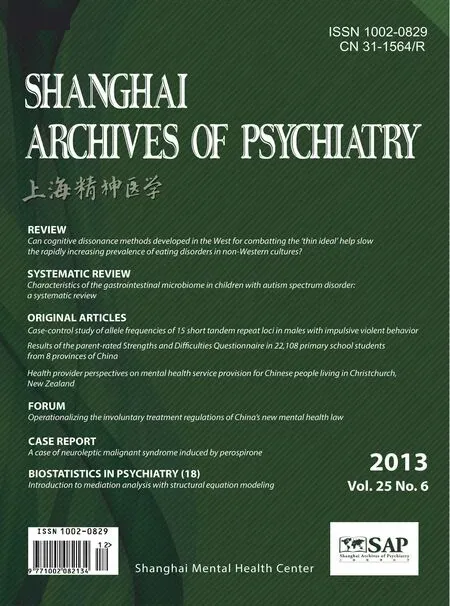
The review article in this issue[1]addresses a relatively new problem in non-Western cultures – eating disorders. Virtually unseen two decades ago, several middle-income countries are now reporting a rapidly increasing prevalence of clinical and sub-clinical forms of anorexia nervosa, bulimia nervosa and other eatng disorders, particularly in young women.[2]The authors relate this to changing women’s roles as countries modernize and urbanize and, perhaps more importantly, to the wholesale importation of the Western ‘thin ideal’ as the rapid penetration of the internet in non-Western urban settings bombards women with global media that promotes the thin ideal. Interestngly, other reports[3]about this phenomenon have suggested that exposure to widely-promulgated American diagnostic criteria for anorexia nervosa and anorexia bulimia have molded the lived experience and presentng symptoms of young women from non-Western cultures who seek treatment for these conditions. The authors of the review describe an approach to preventing these problems that has proven promising in Western setngs– cognitive dissonance interventions – and consider the possibility of adaptng this approach for use in non-Western cultures. This interventon directly combats the media’s thin ideal image by having high-risk individuals participate in exercises that critique the thin ideal. The aim of these exercises is to create psychological discomfort (i.e., dissonance) about participants’acceptance of this ideal; they are then motivated to reduce the discomfort by altering their idealization of the thin. Whether or not this approach can be effectve in disruptng the global media’s transmission of the thin ideal to non-Western cultures remains to be seen, but the rapidly increasing prevalence of eating disorders in these countries and the generally poor outcomes of treatments for these life-threatening conditions make the formal testing of this approach a top research priority in non-Western countries.
The systematc review in this issue[4]is the first report to summarize results of studies about the potential relationship of the prevalence of gastrointestinal microbes and autism spectrum disorders (ASD). There has been a dramatc increase of interest in ASD over the last two decades but researchers have not made much progress in their understanding of the pathogenesis of these profoundly disabling conditions. In casting a wide net to identify potential etiological mechanisms, some researchers have combined reports of frequent gastrointestinal symptoms in children with ASD and the suggestion that intestinal microbiota affect the developing brain[5]to hypothesize a role for the gastrointestnal microbiome in the pathogenesis of ASD. The first step in elaborating such a hypothesis will be to demonstrate that the gastrointestinal microbiome in children with ASD is, in fact, significantly different from that of other children. Afer an exhaustve search of the literature, the authors identified 15 separate studies about this issue. Eleven of the 14 studies that had control groups found significant differences in the prevalence of different gastrointestnal microorganisms in children with ASD than that in controls. However, the generally poor quality of the studies, small sample sizes, lack of standardization of the methods, and heterogeneity of the results made it impossible to pool the results in a meta-analysis. Thus, at present no definitve conclusion can be made about the relatonship of the gastrointestnal microbiome and ASD, but there do appear to be some differences in the gastrointestnal microorganisms of children with ASD. Continuing research with larger samples and standardized methods will be needed to clarify this theoretically important issue about the etology of ASD.
The first original research article in this issue by Yang and colleagues[6]considers the genetic etiology of impulsive violent behavior, a topic of considerable interest in many countries that are trying to reduce the occurrence of non-premeditated attacks in the community. Most authors believe that genetic factors, particularly the genes that affect the metabolism of dopamine, play an important role in impulsivity and aggression, but the specific genes or genotypes have not yet been identified. One promising approach that has not previously been used to assess individuals with impulsive aggression is genetic polymorphism analysis of short tandem repeat (STR) loci (non-coding regions of DNA with multple repeated sequences of base pairs linked with adjacent recombination hotspots). The authors compared genetc polymorphisms of 15 STR loci in 405 non-psychotc males arrested for acts of impulsive violence to those of 415 male controls. They found four specific alleles at three STR loci that were significantly less prevalent in cases than controls and one allele at one of these three STR loci that was significantly more prevalent in cases than controls. To the best of our knowledge, this is the first behavioral genetics study that clearly demonstrates a close relatonship between specific genetic markers and impulsive aggression in non-psychiatric offenders. Prospective studies are needed to identfy the mechanisms that connect these genetc markers to the behavioral phenotypes, but this is clearly an excitng avenue for further study.
The second original research article by Gao and colleagues[7]reports on the results of a study that administered the Chinese version of the Strengths and Difficulties Questionnaire to the parents or guardians of a stratfied random sample of 22,108 primary schoolstudents from eight provinces in China, a sampling frame that included 30% of all primary school children in the country. As expected, boys were more likely to have hyperactivity/inattention problems, girls were more likely to have problems with emotonal symptoms; hyperactivity/inattention problems decreased with age, and peer relationship problems increased with age. Somewhat less expected were the findings that children from rural areas and those whose identified guardian was not a parent were more likely to have emotional symptoms, conduct problems and peer relationship problems. Further work is needed to determine the sensitivity and specificity of this questionnaire as a screening tool to identify children who meet diagnostc criteria for mental disorders and, thus, are in need of clinical services. One of the subscale of the questoinnaire, the subscale that assesses peer relationship problems, had poor internal consistency (alpha=0.22), so further revision of this subscale’s items will be needed to improve its validity in China.
The last original research article by Zhang and colleagues[8]is a qualitative study about the provision of psychological services to the Chinese diaspora, specifically, those who are living in Christchurch, New Zealand. Given the massive migration of mainland Chinese to Western countries for study and work, developing culturally appropriate methods for providing these individuals with mental health services is an increasingly important topic for care providers in these countries. To help clarify some of the important issues that need to be addressed, the authors conducted indepth interviews with nine mental health professionals in Christchurch who regularly provide services of Chinese clients and subsequently conducted a thematc analysis of the transcribed interviews. Several potental approaches for improving services were identified: increased education of non-Chinese providers about culture-specific issues, recruitment of more Chinese providers, targeted mental health literacy campaigns in the Chinese community, development of alternatve (non-mental health) social support networks, and, perhaps most importantly, mobilizing existing Chinese community organizatons to be actvely involved in the organization and provision of mental health services. Given rapid changes in the mental health needs of successive generations of Chinese migrants (and their offspring) ongoing evaluation and re-calibration of the services will be necessary. The extent to which the results of this study can be considered relevant to other high-income countries is uncertain, but it is clear that the conduct of qualitative studies with mental health practitioners who provide services to migrants from China (and with the Chinese clients themselves) can help identfy areas where improved cultural sensitvity would increase the utilization and effectiveness of mental health services for Chinese clients living in Western countries.
The Forum by Shao and Xie[9]discusses some of the difcultes of implementng the involuntary commitment artcles in China’s new mental health law.[10]Previously over eighty percent of psychiatric hospitalizations in China were involuntary (i.e., authorized by patients’family members, not by the patients themselves), but the new law stipulates that most admissions must now be voluntary, that is, the patient must provide consent for the admission. It is likely that it will take several years to fully implement this major revision of the inpatient psychiatric system and to provide the community mental health services that will be needed to augment the voluntary inpatent services. The more immediate problem is operationalizing the articles about involuntary treatment in the law, the treatment provided to individuals who are considered a danger to self or others. Several issues have come to light as Shanghai has worked on developing local regulations to parallel the principles outlined in the national law. (a) How should one operationalize the concept of ‘dangerous to self or others’? Where is the right balance between care and control? (b) If an individual with a mental illness is a clear danger to self or others and, thus, requires hospitalization, who pays for the treatment? (c) The new law allows for the involuntary admission of individuals with suspected mental disorders who are at risk of harming themselves or others, but the duraton of the emergency observatonal detention is unspecified. Moreover, the law stipulates that medication cannot be given to individuals until a formal psychiatric diagnosis has been made, so acutely disturbed individuals without family informants will need to be detained but cannot be treated. (d) Perhaps the most common problem will be the refusal of families and guardians to assume responsibility for involuntarily admitted patients when they no longer meet the criteria of involuntary commitment and, thus, should be discharged. Hospitals in China cannot simply discharge patients to the community, so family members or guardians need to accept the discharge. The law does not clarify what should be done when they refuse to do so. Finally, (e) will it be possible to develop models of community-based involuntary treatment to replace some of the involuntary inpatent treatment?
The case report by Chen and Zhi[11]discusses a case of neuroleptic malignant syndrome (NMS) in a patent receiving perospirone, one of the newer atypical antpsychotc medicatons introduced in Japan in 2001. The patient, a 42-year-old woman who had a 2.5 year history of treatment for schizophrenia, developed NMS after a relatively rapid increase in her dosage of perospirone to 40mg/d. This atypical antipsychotic, which may not be as efficacious as other atypical antipsychotic medications,[12]has extrapyramidal side effects that are intermediate in severity between those seen with the typical antipsychotics and with other atypical antipsychotics. Thus it may need to be prescribed at higher dosages to achieve the same clinical effect and, consequently, have an increased likelihood of inducing NMS. In the reported case the patient progressed from tremor, muscle rigidity andakathisia to full-blown NMS and coma within two days. Rapid identification of the diagnosis and aggressive management of the physical symptoms resolved the crisis over a period of three days. This case again highlights the fact that all clinicians who manage patients taking antipsychotic medication need to be vigilant about NMS: rapid identification and vigorous symptomatc treatment will save lives.
The Biostatistics in Psychiatry contribution by Gunzler and colleagues[13]discusses two topics that should be used more by psychiatric researchers: mediation analysis and structural equation modeling. Mediation analysis assesses the intermediate steps between an intervention and the target outcome and, thus, both helps to clarify the mechanism via which the outcome is achieved and can sometimes help identify alternative interventions that may be more efficacious. Structural equation modeling (SEM) is a powerful multvariate technique that uses a conceptual model and path diagrams to statistically describe the relatonship of both observed and unobserved variables. To clarify these constructs, the article provides an extended example of mediation analysis using SEM to model the relationship of drinking to suicidal risk in which drinking intensity is considered an unobserved (latent) variable and the severity of depression is an observed mediatng variable.
1. Witcomb GL, Arcelus J, Chen J. Can cognitive dissonance methods developed in the West for combatting the ‘thin ideal’ help slow the rapidly increasing prevalence of eatng disorders in non-Western cultures?Shanghai Archives of Psychiatry2013; 25(6): 332-341.
2. Makino M, Tsuboi K, Dennerstein L. Prevalence of eating disorders: a comparison of Western and Non-Western countries.Medscape J Gen Med2004; 6(3): 49.
3. Waters E.Crazy Like Us: The Globalizaton of the American Psyche. New York: Free Press, 2010.
4. Cao XY, Lin P, Jiang P, Li CB. Characteristics of the gastrointestinal microbiome in children with autism spectrum disorder: a systematc review.Shanghai Archives of Psychiatry2013; 25(6): 342-353.
5. Douglas-Escobar M, Elliott E, Neu J. Effect of intestinal microbial ecology on the developing brain.JAMA Pediatr2013; 167(4): 374-379.
6. Yang C, Ba HJ, Gao ZQ, Zhao HQ, Yu HY, Guo W. Case-control study of allele frequencies of 15 short tandem repeat loci in males with impulsive violent behavior.Shanghai Archives of Psychiatry2013; 25(6): 354-363.
7. Gao X, Shi WH, Zhai Y, He L, Zhi XM. Results of the parentrated Strengths and Difficulties Questionnaire in 22,108 primary school students from 8 provinces in China.Shanghai Archives of Psychiatry2013; 25(6): 364-374.
8. Zhang QH, Gage J, Barnet P. Health provider perspectves on mental health service provision for Chinese people living in Christchurch, New Zealand.Shanghai Archives of Psychiatry2013; 25(6): 375-383.
9. Shao Y, Xie B. Operationalizing the involuntary treatment regulations of China’s new mental health law.Shanghai Archives of Psychiatry2013; 25(6): 384-386.
10. Chen HH, Phillips MR, Cheng H, Chen QQ, Chen XD, Fralick D, et al. Mental health law of the People’s Republic of China (English translaton with annotatons).Shanghai Archives of Psychiatry2012; 24(6): 305-321.
11. Chen J, Zhi SL. A case of neuroleptic malignant syndrome induced by perospirone.Shanghai Archives of Psychiatry2013; 25(6): 387-389.
12. Kishi T, Iwata N. Efficacy and tolerability of perospirone in schizophrenia: a systematic review and meta-analysis of randomized controlled trials.CNS Drugs27(9): 731–741.
13. Gunzler D, Chen T, Wu P, Zhang H. Introducton to mediaton analysis with structural equation modeling.Shanghai Archives of Psychiatry2013; 25(6): 390-394.
10.3969/j.issn.1002-0829.2013.06.001
- 上海精神醫學的其它文章
- Introduction to mediation analysis with structural equation modeling
- A case of neuroleptic malignant syndrome induced by perospirone
- Operationalizing the involuntary treatment regulations of China’s new mental health law
- Results of the parent-rated Strengths and Difficulties Questionnaire in 22,108 primary school students from 8 provinces of China
- Case-control study of allele frequencies of 15 short tandem repeat loci in males with impulsive violent behavior
- Characteristics of the gastrointestinal microbiome in children with autism spectrum disorder: a systematic review