
毛里塔尼亞:撒哈拉的奴隸在哭泣
2013-07-17 06:53:44byMonicaMark
瘋狂英語·閱讀版
2013年5期
關(guān)鍵詞:國家
by Monica Mark
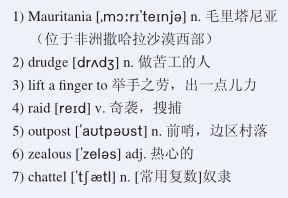


Mbarka Mint Aheimed first met her father on the day he forced her into slavery. The man who dragged her from her mother when she was five-year-old needed “a 2)drudge” in his wifes mansion.
“Because my mother was her husbands slave, his wife saw us all as personal property. It was completely normal for her to do what she wanted with us,” Aheimed would later tell antislave activists in Mauritania. Living in a tiny hut, open to the fierce heat of the orange dune-swept deserts, she worked from dawn to dusk. For 15 years, she never had a day off. “The family lived in a mansion, but I was the only person who 3)lifted a finger to work.” she said.
Once she was old enough to start covering her head—but forced, against tradition, to leave her arms bare to carry out heavy lifting—one of the slaveowners sons drove her miles into the desert and raped her. Later he would only take her far enough to collect firewood for making tea on their return.
瑪卡·米恩特·安赫米德第一次見到自己的父親是在他逼她為奴的那天。在她五歲那年,她父親妻子家中需要一名苦工,他便把她從生母那里拽走,她從此被迫淪為奴隸。
“因為我母親是我爸的奴隸,他的正室便視我們?yōu)槠鋫€人財產(chǎn)。他的妻子想對我們做什么就做什么,那都是完全正常的,”安赫米德后來對毛里塔尼亞的廢奴運動者這么說。她住在一個窄小的棚屋里,承受著滿布沙丘的黃色沙漠里的酷熱,每天起早貪黑地干活。15年來,她從沒休息過一天。“他們一家子都住在一個大屋子里,但只有我一個人干活。”她說道。
當(dāng)她到了一定年齡,需要開始戴頭巾時,她卻不得不,反傳統(tǒng)地,赤裸著雙臂,來干粗重活。這個奴隸主的其中一個兒子把她載到幾英里外的沙漠中,強(qiáng)暴了她。之后,他只會是又把她帶到足夠遠(yuǎn)的地方撿木柴,好讓他們回去的時候有柴火沏茶。
Aheimeds story isnt uncommon. In 1981 Mauritania became the last country to abolish slavery, although it was only criminalised in 2007. Officials repeatedly denied it existed and refused to talk about slavery. But activists and former slaves spoke of a centuries-old practice, a relic of the trans-Sahara slave trade, when Arabic-speaking Moors 4)raided African villages, flourishing in remote 5)outposts of this vast desert country.
A rigid caste system that favours those of“noble-birth”, and 6)zealous efforts to brand the country an Arab republic, concentrates power and wealth among the overwhelmingly lighterskinned Moors, leaving slave-descended darkerskinned Moors and black Africans on the edges of society. Up to 800,000 people in a nation of 3.5 million remain 7)chattels, according to activists who routinely document cases like Aheimeds.
But slavery is often harder to pin down. With almost half the population living on less than $2 a day, many slaveowners work alongside their slaves.
Boubacar Messaoud grew up in a grey area between slavery and freedom, paid a token salary in return for farming. “One day when we were about seven, the slaveowners son, whose name was also Boubacar, said I should be called Boubacar abd [the black slave], so people didnt confuse us. That was when I understood.”
安赫米德的故事并不少見。1981年,毛里塔尼亞成為最后一個廢除奴隸制的國家,盡管蓄奴在這個國家直到2007年才被認(rèn)定為違法。政府官員屢次否認(rèn)奴隸制的存在并拒絕談?wù)摯嗽掝}。但是廢奴運動者和曾當(dāng)過奴隸的人都在講著這種沿襲了好幾百年,因跨撒哈拉沙漠奴隸交易而生的舊習(xí),那時,說阿拉伯語的摩爾人突襲非洲人的村落,在這個廣闊的沙漠國家的邊陲上落地生根。
嚴(yán)格的等級制度有利于那些“生而高貴”且熱衷于把國家打造成一個阿拉伯共和國的人,權(quán)力和財富都集于占大多數(shù)的淺膚色摩爾人身上,把淪為奴隸的深膚色摩爾人和非洲黑人棄置于社會的邊緣。……
登錄APP查看全文
猜你喜歡
環(huán)球時報(2022-12-14)2022-12-14 16:46:27
加油站服務(wù)指南(2021年8期)2021-11-04 08:19:06
學(xué)生天地(2020年22期)2020-06-09 03:07:52
青春期健康(2019年23期)2019-12-19 08:45:06
當(dāng)代水產(chǎn)(2019年4期)2019-05-16 03:04:56
小天使·一年級語數(shù)英綜合(2018年6期)2018-06-22 10:25:54
華人時刊(2017年23期)2017-04-18 11:56:38
中國現(xiàn)當(dāng)代社會文化訪談錄(2016年0期)2016-09-26 08:46:12
小學(xué)閱讀指南·低年級版(2016年1期)2016-09-10 07:22:44
上海國資(2015年8期)2015-12-23 01:47:33
