
DNA—納米粒子自組裝膠體可帶來智能材料
2013-11-04 07:09:42
中國科技信息 2013年13期
關(guān)鍵詞:智能
瑞士聯(lián)邦理工學(xué)院(EPFL)和英國劍橋大學(xué)科學(xué)家最近合作開發(fā)出一種技術(shù),用DNA鏈給納米粒子涂上一層涂層,能控制并引導(dǎo)兩種不同膠體的自動組裝。這種膠體粒子可用于制造新奇的自組裝材料,如智能遞藥補(bǔ)丁、隨光變色的新奇涂料等。相關(guān)論文發(fā)表在《自然·通訊》雜志上。
膠體是一種物質(zhì)在另一種物質(zhì)中均勻分布而形成的。日常生活中人們能看到許多膠體,如牛奶、泡沫塑料、發(fā)膠、涂料、泡沫刮胡膏、膠水甚至灰塵、泥漿、煙霧等。膠體有很多獨(dú)特的性質(zhì),如布朗運(yùn)動、電泳、丁達(dá)爾效應(yīng)(光進(jìn)入膠體發(fā)生散射并呈現(xiàn)出不同色彩)等,但更特殊的性質(zhì)在于它們的自組裝能力:只在本身粒子的相互作用下,就能自然地聚集在一起,形成一種穩(wěn)定的結(jié)構(gòu)性排列,而無需外力干預(yù)。通常只要溫度、光照等外部環(huán)境因素發(fā)生變化,膠體就會作出反應(yīng)而發(fā)生這種自組裝。在生物性膠體中,如DNA、蛋白質(zhì)及其他大分子,自組裝通常是自組織的第一步,支撐著許多分子結(jié)構(gòu)。但就技術(shù)方面來說,自組裝膠體用途更廣泛,人們對其研究得也更多。
如果兩種或更多種不同的膠體在一起,它們的自組裝會怎樣?瑞士聯(lián)邦理工學(xué)院約瑟佩!弗菲的小組與劍橋大學(xué)埃利卡·艾瑟的小組合作,共同解決了這一問題。艾瑟小組用不同的DNA鏈給熒光聚苯乙烯小球涂上一層涂層,讓小球外表變得毛毛的,作為粒子相互作用的手段,也可以用于標(biāo)記不同的粒子,還能利用DNA序列的適配性給粒子間的相互作用編程。
利用DNA—涂層膠體,研究人員能控制兩種不同膠體微粒的自組裝進(jìn)程。兩種膠體以一種“雙混”的形式混合在一起,最終形成了新的結(jié)構(gòu),并且它們聚集得更快,由此生成一種結(jié)構(gòu)性“基架”,可以在上面裝配其他東西。利用DNA堿基對的選擇性,研究人員對膠體外形的控制達(dá)到了前所未有的程度。
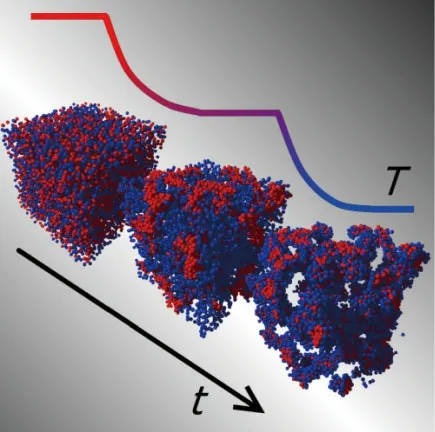
此外他們還發(fā)現(xiàn)了一種獲得自組裝結(jié)構(gòu)的方法。由于膠體微粒對溫度變化的反應(yīng)提供了高度特異性和可編程性,自組裝結(jié)構(gòu)在很大程度上取決于溫度變化。弗菲說:“從某種意義上說,新結(jié)構(gòu)保留著它們制備歷史的‘記憶’。”
根據(jù)膠體外形數(shù)據(jù)和粒子相互作用的動態(tài)數(shù)據(jù),研究人員推斷,這種方法并不局限于納米級物體,還可用于整個(gè)膠體范圍。此外他們預(yù)測,這種方法還有許多應(yīng)用,如光反應(yīng)涂料或智能補(bǔ)丁,智能補(bǔ)丁里填充著裝有抗體或退燒藥的粒子,并能隨體溫或pH值變化起反應(yīng),釋放出這些粒子。
DNA brings materials to life
DNA-coated colloids have been used to create novel self-assembling materials in a breakthrough experiment by EPFL and University of Cambridge scientists.
A colloid is a substance spread out evenly inside another substance.Everyday examples include milk,styrofoam,hair sprays,paints,shaving foam,gels and even dust,mud and fog.One of the most interesting properties of colloids is their ability to self-assemble–to aggregate spontaneously into well-defined structures,driven by nothing but local interactions between the colloid's particles.Self-assembly has been of major interest in industry,since controlling it would open up a whole host of new technologies,such as smart drug-delivery patches or novel paints that change with light.In a recent Nature Communications publication,scientists from EPFL and the University of Cambridge have discovered a technique to control and direct the self-assembly of two different colloids.
Contrary to solutions that are made up of discrete molecules,colloidal solutions are made up of large particles,dispersed in a liquid solvent.This unusual structure gives colloids unique properties such as Brownian motion (the random zig-zag movement of particles as they collide with the molecules of the dispersion medium),electrophoresis (the unidirectional movement of particles under and electric current)and optical properties such as the Tyndall effect(light entering a colloid scatters and exits as a different color).It is because of such properties that colloids are so commonplace in everyday life;but one particular property holds special interest:selfassembly.
Self-assembly refers to the ability of a colloid's particles to spontaneously form a kind of stable structural arrangement as a result of the shape and direction of the colloid's particles as theyinteract with the dispersal medium.Although no external force is required,self-assembly generally takes place as a response to a change in an environmental factor such as temperature,light,etc.In biological colloids like DNA,proteins and other macromolecules,self-assembly is usually the first step to self-organization,which underlies many cellular structures.But in terms of technology,selfassembling colloids could have a wide range of applications,fuelling much research in the field.
But what about selfassembly of two– or more–species of different colloids? This is the question addressed by Giuseppe Foffi's group at EPFL,working in collaboration with Erika Eiser's group at the University of Cambridge.
The scientists showed that when the interactions between the particles of two different colloids are carefully designed,they result in the formation of new structures.Specifically,they have discovered a ways to obtain self-assembled structures that depend strongly on temperature changes.Giuseppe Foffi says:"In a sense,the new structures have a 'memory' of their preparation history."
猜你喜歡
開放教育研究(2021年3期)2021-05-25 02:41:06
小學(xué)科學(xué)(學(xué)生版)(2020年12期)2021-01-08 09:28:04
裝備制造技術(shù)(2020年4期)2020-12-25 05:26:24
表面工程與再制造(2019年6期)2019-08-24 06:40:04
文苑(2018年23期)2018-12-14 01:06:06
文苑(2018年19期)2018-11-09 01:30:14
文苑(2018年17期)2018-11-09 01:29:26
文苑(2018年21期)2018-11-09 01:22:32
商周刊(2018年18期)2018-09-21 09:14:46
能源(2018年4期)2018-05-19 01:53:44
