三種菊科入侵植物的生長與化學防御的關系研究
2014-02-07 06:31:43倪廣艷朱麗薇牛俊峰趙秀華張振振趙培強
生態環境學報 2014年1期
倪廣艷,朱麗薇,牛俊峰,趙秀華,張振振,趙培強
中國科學院華南植物園,中國科學院退化生態系統植被恢復與管理重點實驗室,廣東 廣州 510650
三種菊科入侵植物的生長與化學防御的關系研究
倪廣艷*,朱麗薇,牛俊峰,趙秀華,張振振,趙培強
中國科學院華南植物園,中國科學院退化生態系統植被恢復與管理重點實驗室,廣東 廣州 510650
“生活史理論”認為,植物可利用的資源總量是有限的,在植物的不同功能之間存在著此消彼長的權衡關系。入侵植物的生長和化學防御一般優于本地植物,那么其生長與化學防御之間是否存在權衡及其權衡關系怎樣,目前尚不清楚。以廣東省3種菊科入侵植物[三裂葉蟛蜞菊(Wedelia trilobata (L.) Hitchc.)、飛機草(Eupatorium odoratum)和薇甘菊(Mikania micrantha)]為研究對象,并分別以近緣或伴生的本地植物[蟛蜞菊(Wedelia chinenses)、華澤蘭(Eupatorium chinense)和雞矢藤(Paederia scandens)]為對照,研究入侵植物的生長特性(相對生長率和比葉面積)與化學防御物質(縮合單寧和總酚)含量,并基于這2種光合碳分配的主要形式,探討入侵植物生長與化學防御之間的權衡關系。結果表明:3種入侵植物的相對生長率均高于本地對照種;薇甘菊的比葉面積大于對照種,而其他2種無明顯優勢。薇甘菊和三裂葉蟛蜞菊的縮合單寧顯著高于對照種,飛機草的總酚含量高于對照種。我們的結果顯示,入侵植物的生長和化學防御均優于本地植物,但它們的碳同化能力相近;因此,入侵植物特殊的內在資源分配與利用機制可能是其成功入侵的關鍵。
菊科入侵植物、相對生長率、比葉面積、總酚、縮合單寧
外來生物入侵(biological invasion)影響和改變陸地生態系統的生物多樣性和功能過程,破壞生態系統的生產力與穩定性,已成為全球性的環境問題(Dukes和Mooney,1999)。從根本上控制外來種入侵,認識和掌握“什么樣的物種更易成為入侵種”是入侵生態學、森林管理學研究和園林引種的關注熱點。已有研究表明,外來植物成功入侵與其自身的生物學特性有關,表現為強競爭力、強繁殖力、強化感作用及寬生態幅等,而這些均涉及植物生長最初的過程-碳元素的獲取與分配。Leishman等(2007,2010)比較研究了全球范圍內近百種入侵植物與本地植物葉片的碳獲取特征發現,兩者在碳獲取方面差異并不顯著。然而,目前關于外來植物光合碳分配策略的研究則較少見。
“生活史理論”認為,植物體內可利用的資源總量是有限的,投入到某一功能(性狀)資源量的增加必然會導致其投入到其它功能(性狀)資源量的減少,即在植物的不同功能之間存在著“此消彼長”的權衡關系(trade-off)(Smith和Fretwell, 1974; Arendt, 1997;Paul-Victor等,2010)。然而,眾所周知,在入侵地多數入侵植物具有明顯的生長優勢(Blossey和N?tzold, 1995; Vilà和Weiner, 2004; Bossdorf等, 2004; Ni等, 2010)。同時,入侵植物還通過多種途徑如降低適口性、分泌化感物質、揮發油等,降低或避免其他生物(植物、微生物、昆蟲等)的侵害,甚至排斥其他生物的生長(Callaway和Aschehoug, 2000; Prati和Bossdorf, 2004; Cappuccino和Arnason, 2006)。但是,這些研究結果多來自不同入侵物種,即便是同一入侵物種也是來自不同時間、不同地點。因此,簡單地認為入侵植物具有高生長和強防御并不嚴謹,有必要在同一環境下研究同一無性系繁衍的入侵植物的生長特性與防御能力。
菊科植物是入侵植物的重要來源(朱世新等,2005;Ni等, 2012),它在繁殖上具有諸多優勢,如有效的擴散機制、良好的集群能力,以及不需要專化傳粉者等,因此它能夠快速蔓延,成為入侵植物最多的類群之一(郝建華等,2009)。目前,對于菊科入侵植物的生長和防御國內外已有較多文獻報道,但對于其生長與化學防御之間是否存在權衡及其權衡關系怎樣,還未見相關報導。為此,本研究以華南地區3種菊科入侵植物為研究對象,并以其近緣或伴生植物為對照,研究同一生境下,入侵植物的生長特性和化學防御物質含量,并探討生長與化學防御之間的權衡關系。
1 研究材料與實驗方法
1.1 植物材料
本研究所用植物材料為三裂葉蟛蜞菊(Wedelia trilobata (L.) Hitchc.)與其近緣種本地蟛蜞菊(Wedelia chinenses)、飛機草(Eupatorium odoratum)與華澤蘭(Eupatorium chinense)、薇甘菊(Mikania micrantha)與其生態型接近的雞矢藤(Paederia scandens)。實驗材料均采自中國科學院華南植物園游覽區(23°10′22.65″N, 113°21′29.75″E)。取樣時遵循的原則為,配對比較的兩組植物伴生在同一樣地。
1.2 實驗方法
盆栽試驗在華南植物園科研區溫室內進行。根據不同植物的莖節特點,分別剪取5~10 cm長帶芽莖段沙培扦插繁殖。經14 d預培養后,選取生長健壯且長勢一致的再生小苗,移栽至小花盆(直徑20 cm,高16 cm)內。每種植物種植10盆,每盆定植兩株。培養基質采用河沙和塘泥混合物(體積比為4∶1)。同時,選取10株大小近似的扦插苗帶回實驗室洗凈、烘干(65°,4 d)、稱質量,獲取初始生物量。盆栽苗每2 d澆水1次,每2周施肥1次(Miracle-Gro,1 g·L-1,100 mL),105 d后,收獲植物并烘干(45°,5 d)、稱質量,研磨后過80目篩,用于測定化學防御物質。
1.2.1 生長指標
一盆內的2株植物視為一個樣本。葉面積使用葉面積儀測定(Li-3100A,Licor,美國)。相對生長率(relative growth rate,RGR)根據Imaji和Seiwa(2010)的方法計算,即RGR=(ln W2-ln W1)/t,W1為扦插苗移植時的平均生物量,W2為收獲時每個樣本的生物量,t為移植和收獲之間的時間間隔(d)。
比葉面積(specific leaf area,SLA)為葉面積與生物量之間的比值。
1.2.2 化學防御指標
1.2.2.1 總酚提取與測定
取250 mg干燥樣品于干凈試管,加入80%甲醇10 mL,微波振蕩5 min,1600 r·min-1離心10 min,取上清液置于干凈試管,使用氮吹儀吹至1 mL。殘渣重復提取1次。
采用Folin-Ciocalteu法測定總酚含量(Singleton和Rossi, 1965)。取100 μL樣品置于干凈試管,加入0.5 mL Folin-Ciocalteu試劑(Sigma),0.4 mL Na2CO3溶液(7.5%),靜置30 min。取溶液于765 nm測吸光值(Perkin-Elmer λ15 UV-vis spectrophotometer,美國)。以沒食子酸(gallic acid equivalent,GAE)為標準品作標準曲線,得到回歸方程y=1.8917 x+0.0025(r2=0.9920)。樣品中的總酚以沒食子酸的質量分數表示(mg·g-1)。
1.2.2.2 縮合單寧提取與測定
縮合單寧的提取與測定,主要依據袁紅娥等(2009)的方法,略作改動。準確稱取50 mg樣品,放入具塞試管中,加入5 mL 70%甲醇,封口搖勻,室溫下放置24 h,5000 r·min-1離心10 min,取上清液備測。把4 g香草醛溶于100 mL純甲醇中,配制成4%的香草醛甲醇溶液。取4%的香草醛甲醇溶液3 mL、濃鹽酸1.5 mL和待測提取液0.5 mL加入以鋁箔遮光的具塞試管中,搖勻,水浴20 min(20 ℃)。在510 nm下比色(Lambda 650,美國),重復3次,記錄吸光值。以4%的香草醛甲醇溶液3 mL、濃鹽酸1.5 mL和70%的甲醇0.5 mL作空白對照。以兒茶素為標準樣品(Sigma公司),繪制標準曲線,根據其標準曲線計算出提取液縮合單寧含量。兒茶素標準曲線的繪制:取1.0 g·L-1兒茶素溶液配制質量濃度梯度標準溶液,分別在510 nm處測定吸光值,以兒茶素濃度為橫坐標,吸光值為縱坐標繪制標準曲線。測定的標準曲線方程為:y=1.4719x+0.0941(r2=0.9941),y為吸光值,x為質量分數(mg·g-1)。
1.3 數據統計
數據統計使用SPSS 13.0軟件(SPSS, 美國),差異顯著性檢測采用獨立樣本T檢驗進行,使用Pearson correlation分析入侵植物、本地植物的化學防御與植物生長之間的權衡關系。
2 結果與分析
2.1 入侵植物與本地植物的生長
經過105 d溫室內栽培,入侵植物飛機草和薇甘菊的相對生長速率均顯著高于本地對照植物(p<0.05,圖1A)。三裂葉蟛蜞菊的相對生長率極顯著高于本地蟛蜞菊(p<0.01)。說明在生長環境、基質等一致的條件下,入侵植物更容易快速生長,造成入侵。
比葉面積是指單位生物量上的葉片面積,體現了植物進行光合固碳的能力。我們的研究結果顯示,入侵植物薇甘菊的比葉面積明顯大于其伴生植物雞矢藤(p<0.05),而另兩組入侵植物與對照植物之間無顯著差異(p>0.05)(圖1B),說明這兩組入侵植物與對照植物之間的碳同化能力相近。
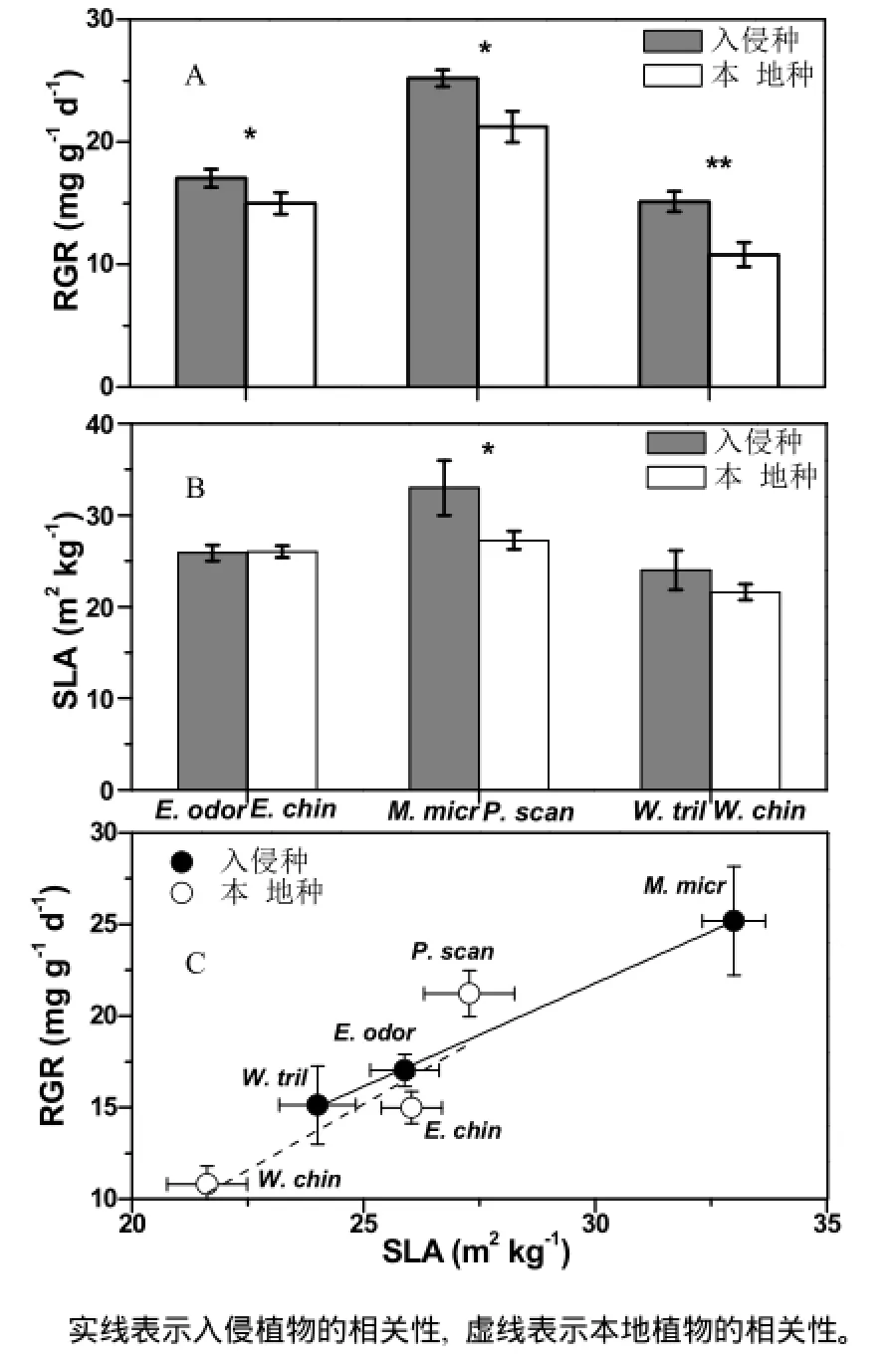
圖1 入侵植物與本地植物的相對生長率、比葉面積及二者的關系比較Fig. 1 Comparisons of relative growth rate (A, RGR, mg·g-1·d-1) and specific leaf area (B, SLA, m2·kg-1) between invasive and native plant species; and C) the relationship of RGR and SLA of both the species. Bars represent means ± SEs, and asterisks indicate the significant differences
通過分析入侵種與本地種相對生長速率與比葉面積的關系(圖1C)發現,無論是入侵種還是本地種其比葉面積和相對生長速率均呈顯著正相關(p<0.05);而且還發現,本地植物RGR/SLA比值(斜率)較入侵植物高,揭示了本地植物光合產生的有機碳可能較入侵植物被更有效地用于生長。
2.2 三裂葉蟛蜞菊與本地蟛蜞菊的化學防御
總酚和縮合單寧是植物體內基于碳的、與抗蟲性相關的重要次生代謝物質,它能夠抑制昆蟲對蛋白的消化(Bryant等, 1987; Matsuki等, 2004; Waterman和Mole, 1994; Nomura和Itioka, 2002)。我們的結果顯示,入侵植物薇甘菊和三裂葉蟛蜞菊總酚的含量與本地植物差異并不明顯(p>0.05),但是縮合單寧含量均顯著高于其對照的本地植物(p<0.001)(圖2A);入侵植物飛機草的總酚含量顯著高于本地植物華澤蘭(p<0.05),但二者縮合單寧含量差異不顯著(p>0.05)(圖2B)。
通過分析入侵植物與對照植物相對生長率的差值(生長能力)與其葉片縮合單寧含量的差值(化學防御能力)之間的關系,發現二者相對生長速率差值越大、縮合單寧含量的差值越大,呈顯著正相關關系(圖3),說明入侵植物的生長優勢越強,其依賴縮合單寧的化學防御能力越強。
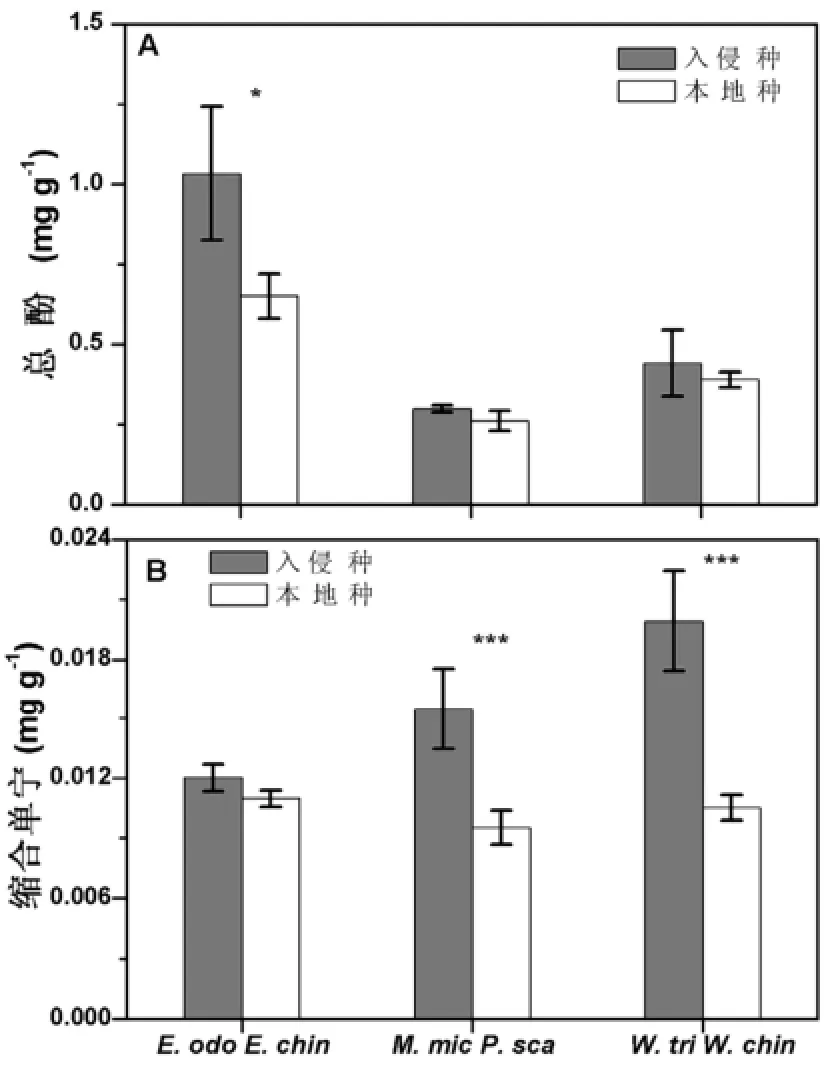
圖2 入侵植物與本地植物縮合單寧含量的比較Fig. 2 Comparisons of total phenolics (A, mg·g-1) and condensed tannin (B, mg·g-1) between invasive and native plants. Bars represent means±SEs,and asterisks indicate the significant difference
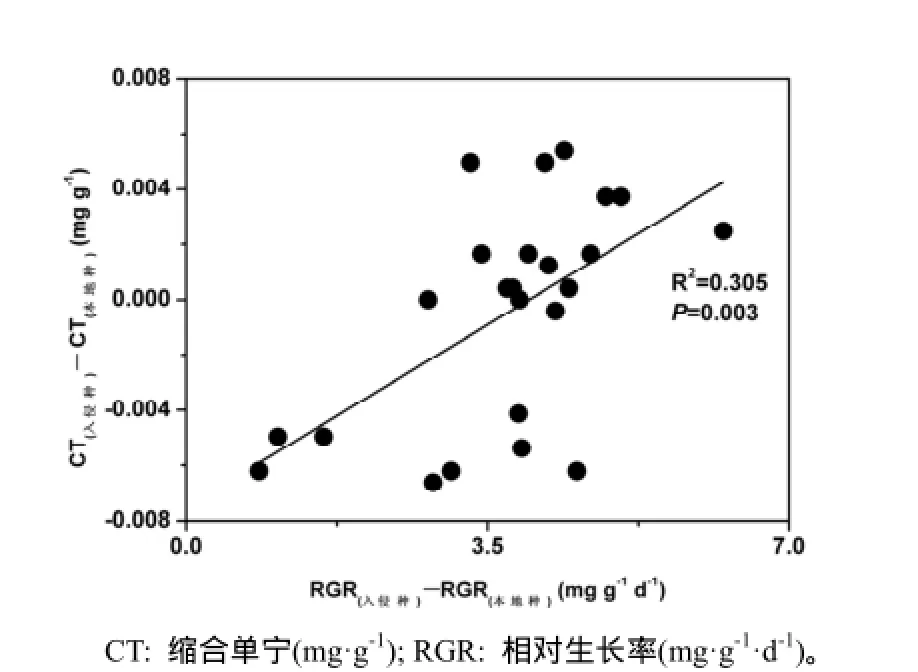
圖3 入侵植物與本地植物之間相對生長率差與縮合單寧含量差的關系Fig. 3 Relationship of relative growth rate difference and condensed tannin difference between invasive and native plants
3 討論
生長與防御是植物繁衍過程中光合碳進行分配的兩個重要方面(Mooney,1972)。本研究結果顯示,三種菊科入侵植物均具有明顯的生長優勢,同時,其化學防御能力也高于本地植物,而且生長優勢越強、依賴縮合單寧的化學防御能力越強。我們的研究結果與前人得出的入侵植物生長強,其化學防御能力也強的結論一致(Ridenour等, 2008)。Almeida-Cortez等(1999)研究了31種草本菊科植物的生長與化學防御之間的權衡關系,結果也發現,菊科草本植物具有較高的相對生長率,其葉片的酚類物質含量也高。Imaji和Seiwa(2010)研究表明,蒙古櫟(Quercus mongolica var. grosseserrate)幼苗的縮合單寧濃度與生長速率呈明顯正相關。
相對生長率是指示植物生長的重要指標,已有研究表明,較高相對生長率有利于外來植物的成功入侵(Grime和Hunt, 1975; James和Drenovsky, 2007)。與前人的研究結果一致,本研究中涉及的3種菊科入侵植物均具有較高相對生長率(圖1A)。比葉面積(SLA)反映了植物碳同化能力,是碳分配的重要前提(Reich等, 2003)。高SLA表示在相同的單位質量下,植物具有更大的葉片面積進行光合作用,進一步影響植物生長,因此也可用來判斷植物的入侵性。然而,前人對入侵植物的SLA研究得出了不一致的結論。多數研究認為,入侵植物的SLA高于本地植物(Leishman等, 2007; Baruch和Goldstein, 1991; Baruch和Goldstein, 1999; Daehler, 2003; Osunkoya等, 2010);Feng等(2007)報道,在歐洲入侵的大葉醉魚草(Buddleja davidii)與當地對照植物歐洲紅瑞木(Cornus sanguinea)、西洋接骨木(Sambucus nigra)、垂枝樺(Betula pendula)等的SLA無明顯差異。本研究中入侵植物三裂葉蟛蜞菊和飛機草和本地對照種的SLA近似,與Feng等(2007)的研究結果一致。薇甘菊的SLA明顯大于對照種雞矢藤,與Song等(2007)對相同植物研究得到的結果一致。我們的研究結果說明,三裂葉蟛蜞菊和飛機草的碳同化能力與本地對照種近似,薇甘菊的碳同化能力強于對照種。另外,前人的研究表明,SLA與RGR具有正相關關系(Lambers和Pooter, 1992; Reich等, 1997),本研究得出了一致的結果。
植物通過分泌次生代謝物進行化學防御,而這些物質絕大部分以碳元素為構建骨架(Rice,1984),因此,分泌化學物質是植物進行碳投資的重要方面(Orians等, 2010)。通常,入侵植物具有較強的化學防御能力,如散發揮發油(凌冰等,2003),釋放化感物質等(Ni等, 2010; 倪廣艷和彭少麟,2007;Chen等, 2009)。Cappuccino和Arnason(2006)研究認為,從入侵植物得到的一些化學物質更集中于某些種、屬或科,而本地植物并無這種化學物質集中分布的現象。Kim和Lee(2011)發現,入侵植物的總酚含量約是本地植物的2.6倍。本研究結果顯示,入侵植物薇甘菊和三裂葉蟛蜞菊均具有較高縮合單寧含量,飛機草具有較高總酚含量,顯示這些菊科入侵植物具有較好的化學防御能力,可以抵御天敵昆蟲啃食。
實際上,入侵植物具有較強的強化學防御能力不僅體現在其與入侵地的本地種比較上,也存在于其與原產地自身或其他本地種的比較上。如入侵我國華南地區的薇甘菊揮發油內普遍存在β-cadinene、allo-aromadendrene、β-caryophyllene及5-(1,1-dimethylethyl)-2,3-1H-Inden-1-one等多碳化合物,而生長在原產地秘魯的薇甘菊檢測不到這些物質,說明在入侵地入侵植物次生代謝物種類發生了改變,而且含量也明顯增加(Ni等, 2007)。Pollock等(2009)的研究也表明,入侵植物斑點矢車菊(Centaurea diffusa)在入侵地分泌的化感物質(±)-catechin較原產地多。
盡管本研究未發現入侵菊科植物生長與化學防御之間存在明顯的權衡關系,然而,這并不表示它們之間不存在權衡關系。影響入侵植物的防御與生長之間碳權衡分配的可能原因:1)入侵植物的建成成本低(Constructive Cost),不同植物構建相同生物量所需的碳量不同,建成成本較低的植物通常具有較高的生長速率(Lambers和Pooter, 1992)。Baruch和Gómez(1996)提出了入侵植物的低建成成本理論,認為構建相同生物量,入侵植物所需成本較低。如夏威夷群島入侵植物的平均葉片建成成本較本地種低3%(Baruch和Goldstein, 1999)。入侵植物薇甘菊、三裂葉蟛蜞菊等的生物量建成成本低于本地植物肖梵天花(Urena lobata)和馬纓丹(Lantana camara)等(Song等, 2007)。2)形成化學防御物質的成本,以本研究的縮合單寧和總酚為例,它們的形成亦需要成本,其高低與各自的分子量有關。一般而言,縮合單寧的分子量大,因此需要花費更多成本進行生產和保存(Briggs和Schultz, 1990);總酚是一類物質的總稱,化學分子量各異,因此其生產和保存所花費的成本各異。3)有些酚類物質,如木質素(lignin),其作為生理結構的作用要遠大于其作為化學防御物質的作用(Almeida-Cortez等, 1999),因此,出現防御物質與生長的正相關關系是可以預見的。4)化學防御物質的更有效性,在入侵地,由于本地生物(如植物、土壤微生物、昆蟲等)與入侵植物缺乏長期協同進化的進程,因此本地生物對后者的化學防御物質反應敏感。如入侵地本地植物對入侵植物俄羅斯矢車菊(Acroptilon repens)的化學防御較原產地本地植物敏感(倪廣艷和彭少麟,2007)。雖然本研究結果顯示入侵植物具有生長和化學防御均優于本地植物,但是其內在生理學機制如何,是否是上述的某種或多種原因,還需要更多的研究深入探索。
參考文獻:
ALMEIDA-CORTEZ J S, SHIPLEY B, ARNASON J T. 1999. Do plant species with high relative growth rates have poorer chemical defences?[J]. Functional Ecology, 13: 819-827.
ARENDT J D. 1997. Adaptive intrinsic growth rates: an integration across taxa[J]. Quarterly Review of Biology, 72: 149-177.
BARUCH Z, GOLDSTEIN G. 1999. Leaf construction cost, nutrient concentration and net CO2assimilation of native and invasive species in Hawaii[J]. Oecologia, 121: 183-192.
BARUCH Z, GóMEZ J A. 1996. Dynamics of energy and nutrient concentration and construction cost in a native and two alien C4grasses from two neotropical savannas[J]. Plant and Soil, 181: 175-184.
BLOSSEY B, N?TZOLD R. 1995. Evolutionary of increased competitive ability in invasive non-indigenous plants: a hypothesis[J]. Journal of Ecology, 83: 887-889.
BOSSDORF O, PRATI D, AUGE H, et al. 2004. Reduced competitive ability in an invasive plant[J]. Ecology Letters, 7: 346-353.
BRIGGS M A, SCHULTZ J C. 1990. Chemical defense production in Lotus corniculatus L. II. Trade-offs among growth, production and defense[J]. Oecologia, 83: 32-37.
BRYANT J P, CHAPIN III F S, REICHARDT P B, et al. 1987. Response of winter chemical defense in Alaska paper birch and green alder to manipulation of plant carbon/nutrient balance[J]. Oecologia, 72: 510-514.
CALLAWAY R M, ASCHEHOUG E T. 2000. Invasive plants versus their new and old neighbors: a mechanism fro exotic invasion[J]. Science, 290: 521-523.
CAPPUCCINO N, ARNASON J T. 2006. Novel chemistry of invasive exotic plants[J]. Biology Letters, 2: 189-193.
CHEN B M, PENG S L, NI G Y. 2009. Effects of the invasive plant Mikania micrantha H.B.K. on soil nitrogen availability through allelopathy in South China[J]. Biology Invasions, 11: 1291-1299.
DAEHLER C C. 2003. Performance comparisons of co-occurring native and alien invasive plants: implications for conservation and restoration[J]. Annual Review of Ecology, Evolution, and Systematics, 34: 183-211.
DUKES J S, MOONEY H A. 1999. Does global change increase the success of biological invaders?[J]. Trends in Ecology and Evolution, 14: 135-139.
FENG Y L, AUGE H, EBELING S K. 2007. Invasive Buddleja davidii allocates more nitrogen to its photosynthetic machinery than five native woody species[J]. Oecologia, 153: 501-510.
GRIME J P, HUNT R. 1975. Relative growth-rate: its range and adaptive significance in a local flora[J]. Journal of Ecology, 63: 393-422.
IMAJI A, SEIWA K. 2010. Carbon allocation to defense, storage, and growth in seedlings of two temperate broad-leaves tree species[J]. Oecologia, 162: 273-281.
JAMES J J, DRENOVSKY R E. 2007. A basis for relative growth rate differences between native and invasive forb seedlings[J]. Rangeland Ecology and Management, 60: 395-400.
KIM Y O, LEE E J. 2011. Comparison of phenolics compounds and the effects of invasive and native species in East Asia: support for the Novel weapons hypothesis[J]. Ecological Research, 26: 87-94.
LAMBERS H, POOTER H. 1992. Inherent variation in growth rate between higher plants: a search for physiological causes and ecological consequences[J]. Advances in Ecological Research, 23: 188-261.
LEISHMAN M R, HASLEHURST T, ARES A, et al. 2007. Leaf trait relationships of native and invasive plants: community-and global-scale comparisons[J]. New Phytologist, 176: 635-643.
LEISHMAN M R, THOMSON V P, COOKE J. 2010. Native and exotic invasive plants have fundamentally similar carbon capture strategies[J]. Journal of Ecology, 98: 28-42.
MATSUKI S, SANO Y, KOIKE T. 2004. Chemical and physical defense in the early and late leaves in three heterophyllous birch species native to northern Japan [J]. Ann. Bot.-Lon, 93:141-147.
MOONEY H A. 1972. The carbon balance of plants[J]. Annual Review of Ecology and Systematics, 3: 315-346.
NI G Y, LI F L, SONG L Y, et al. 2007. Allelopathic plants Mikania micrantha H.B.K[J]. Allelopathy Journal, 19: 287-295.
NI G Y, Schaffner U, Peng S L, et al. 2010. Acroptilon repens, an Asian invader, has stronger competitive effects on species from America than species from its native range[J]. Biological Invasions, 12: 3653-3663.
NI G Y, ZHAO P, HUANG Q Q, et al. 2012. Exploring the novel weapons hypothesis with invasive plant species in China[J]. Allelopathy Journal, 29: 199-214.
NOMURA M, ITIOKA T. 2002. Effects of synthesized tannin on the growth and survival of a generalist herbivorous insect, the common cutworm, Spodoptera litura Fabricius (Lepidoptera: Noctuidae) [J]. Applied Entomology and Zoology, 37: 285-289.
ORIANS C M, HOCHWENDER C G, FRITZ R S. 2010. Growth and chemical defense in willow seedlings: trade-offs are transient[J]. Oecologia, 163: 283-290.
OSUNKOYA O O, BAYLISS D, PANETTA F D, et al. 2010. Leaf trait co-ordination in relation to construction cost, carbon gain and resource-use efficiency in exotic invasive and native woody vine species[J]. Annuals of Botany, 106: 371-380.
PAUL-VICTOR C, Züst T, REES M, et al. 2010. A new methods for measuring relative growth rate can uncover the costs of defensive compounds in Arabidopsis thaliana[J]. New Phytologist, 187: 1102-1111.
POLLOCK J L, CALLAWAY R M, THELEN G C, et al. 2009. Catechin-metal interactions as a mechanism for conditional allelopathy by the invasive plant Centaurea maculosa[J]. Journal of Ecology, 97: 1234-1242.
PRATI D, BOSSDORF O. 2004. Allelopathic inhibition of germination by Alliaria petiolata (Brassicaceae) [J]. American Journal of Botany, 91: 285-288.
REICH P B, WALTERS M B, ELLSWORTH D S. From tropics to tundra: global convergence in plant functioning[J]. Proceedings of the national academy of sciences of the United States of America, 1997, 94: 13730-13734.
REICH P B, WRIGHT I J, CAVENDER-BARES J, et al. 2003. The evolution of plant functional variation: traits, spectra and strategies[J]. International Journal of Plant Science, 164: S143-164.
RICE E L. 1984. Allelopathy[M]. 2nd edn. Academic Press, Orlando.
RIDENOUR W M, VIVANCO J M, FENG Y, et al. 2008. No-evidence for trade-offs: Centaurea plants from America are better competitors and defends[J]. Ecological Monographs, 78: 369-386.
SINGLETON, V L, ROSSI JR J A. 1965. Colorimetry of total phenolics with phosphomolybdic-phosphotungstic acid reagents[J]. American Journal of Enology and Viticulture, 16: 144-158.
SMITH C C, FRETWELL S D. 1974. The optimal balance between size and number of offspring[J]. American Naturalist, 108: 499-506.
SONG L Y, NI G Y, CHEN B M, et al. 2007. Energetic cost of leaf construction in the invasive weed Mikania micrantha H. B. K. and its co-occurring species: implications for invasiveness[J]. Botanical Studies, 48: 331-338.
VILà M, WEINER J. 2004. Are invasive plant species better competitorsthan native plant species? Evidence from pair-wise experiments[J]. Oikos, 105: 229-238.
WATERMAN P G, MOLE S. 1994. Why are phenolic compounds so important[C]//Waterman P G, MOLE S. Analysis of phenolic plant metabolites. Blackwell Scientific Publications, Boston, USA: 44-65.
郝建華, 劉倩倩, 強勝. 2009. 菊科入侵植物三葉鬼針草的繁殖特征及其與入侵性的關系[J]. 植物學報, 44: 656-665.
凌冰, 張茂新, 孔垂華, 等. 2003. 飛機草揮發油的化學組成及其對植物、真菌和昆蟲生長的影響[J]. 應用生態學報, 14: 744-746.
倪廣艷, 彭少麟. 2007. 外來入侵植物化感作用與土壤相互關系研究進展[J]. 生態環境, 16: 644-648.
袁紅娥, 袁善春, 佟麗麗, 等. 2009. 剪葉損傷與昆蟲取食對興安落葉松(Larix gmelinii) 針葉中縮合單寧誘導作用的差異[J]. 生態學報, 29: 1415-1420.
朱世新, 覃海寧, 陳藝林. 2005. 中國菊科植物外來種概述[J]. 廣西植物, 25: 69-76.
Growth and chemical defense in three Asteraceae invasive weeds in lower subtropical China
NI Guangyan*, ZHU Liwei, NIU Junfeng, ZHAO Xiuhua, ZHANG Zhenzhen, ZHAO Peiqiang
South China Botanical Garden, Chinese Academy of Sciences, Key Laboratory of Vegetation Restoration and Management of Degraded Ecosystems, Chinese Academy of Sciences, Guangzhou 510650, China
A universal theory in ecology is that the allocations of limited resources to growth and defense are trade-off, while this theory appeared not to hold for invasive plants according to the previous studies. In this study, three invasive Asteraceae plant species in the Guangdong province i.e., Eupatorium odoratum, Mikania micrantha, Wedelia trilobata, and their congeneric or co-occurring native plant species i.e., Eupatorium chinensis, Paederia scandens, Wedelia chinensis were used to detect if there is a trade-off between growth and chemical defenses on the basis of carbon allocation, and investigate the trade-off relations between them. All the three invasive Asteraceae had higher relative growth rate (RGR) as compared to their related native counterparts, and M. micrantha had higher specific leaf area (SLA) as well. Two invasive Asteraceae (i.e., M. micrantha and W. trilobata) had higher condensed tannin content, while the other invasive species E. odoratum had higher total phenolics content, as compared to their native species. Our results indicate that the invasive plants have similar carbon assimilation but different carbon allocations between the growth and chemical defense, thus implying that the special underlying carbon utilization mechanism may be a key for their successful invasions.
Asteraceae invasive plants; Relative growth rate; Specific leaf area; total phenolics; condensed tannin
Q948
A
1674-5906(2014)01-0001-06
倪廣艷,朱麗薇,牛俊峰,趙秀華,張振振,趙培強. 三種菊科入侵植物的生長與化學防御的關系研究[J]. 生態環境學報, 2014, 23(1): 1-6.
NI Guangyan, ZHU Liwei, NIU Junfeng, ZHAO Xiuhua, ZHANG Zhenzhen, ZHAO Peiqiang. Growth and chemical defense in three Asteraceae invasive weeds in lower subtropical China [J]. Ecology and Environmental Sciences, 2014, 23(1): 1-6.
國家自然科學基金項目(31200380);廣東省自然科學基金(S2011040000331;S2013010012054);中國科學院知識創新工程項目(KSCX2-EW-J-28)
倪廣艷(1978年生),女,助理研究員,博士,從事植物生理生態學研究。E-mail: guangyan.ni@scbg.ac.cn *通信作者
2013-10-11
猜你喜歡
小讀者(2021年2期)2021-03-29 05:03:48
華人時刊(2019年13期)2019-11-17 14:59:54
文苑(2018年22期)2018-11-19 02:54:14
紅領巾·萌芽(2017年5期)2017-06-23 10:35:59
科技知識動漫(2017年5期)2017-05-11 21:34:16
科技知識動漫(2017年4期)2017-04-15 22:24:55
爆笑show(2016年7期)2017-02-09 09:36:13
科技知識動漫(2017年2期)2017-02-06 20:59:46
科技知識動漫(2016年10期)2016-10-18 20:35:00
紅領巾·萌芽(2016年1期)2016-09-10 07:22:44