
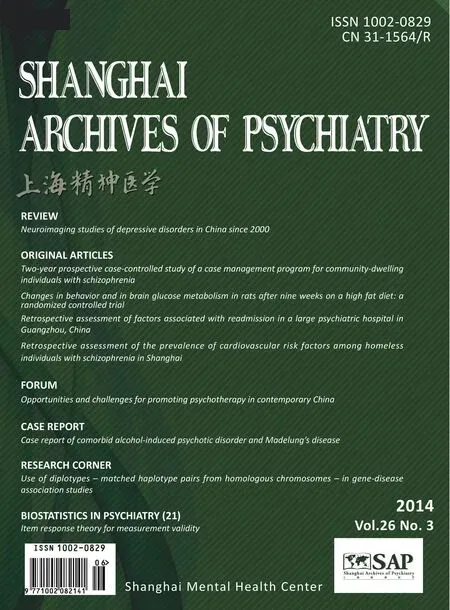
Use of diplotypes-matched haplotype pairs from homologous chromosomes-in gene-disease association studies
2014-03-29 06:00:46LingjunZUOKeshengWANGXingguangLUO
上海精神醫(yī)學(xué) 2014年3期
關(guān)鍵詞:關(guān)聯(lián)分析
Lingjun ZUO, Kesheng WANG, Xingguang LUO*
Use of diplotypes-matched haplotype pairs from homologous chromosomes-in gene-disease association studies
Lingjun ZUO1,2, Kesheng WANG3, Xingguang LUO1,2*
Summary: Alleles, genotypes and haplotypes (combinaons of alleles) have been widely used in gene-disease association studies. More recently, association studies using diplotypes (haplotype pairs on homologous chromosomes) have become increasingly common. This article reviews the rationale of the four types of associaon analyses and discusses the situaons in which diplotype-based analyses are more powerful than the other types of associaon analyses. Haplotype-based associaon analyses are more powerful than allelebased associaon analyses, and diplotype-based associaon analyses are more powerful than genotype-based analyses. In circumstances where there are no interaction effects between markers and where the criteria for Hardy-Weinberg Equilibrium (HWE) are met, the larger sample size and smaller degrees of freedom of allele-based and haplotype-based associaon analyses make them more powerful than genotype-based and diplotype-based association analyses, respectively. However, under certain circumstances diplotype-based analyses are more powerful than haplotype-based analysis.
diplotype, haplotype, association analysis, genotypes, interaction effects, Hardy-Weinberg equilibrium
1. Introducon: de fi nion and composion of diplotypes
Humans are diploid organisms; they have paired homologous chromosomes in their somatic cells, which contain two copies of each gene. An allele is one member of a pair of genes occupying a specific spot on a chromosome (called locus). Two alleles at the same locus on homologous chromosomes make up the individual’s genotype. A haplotype (a contracon of the term ‘haploid genotype’) is a combinaon of alleles at mulple loci that are transmied together on the same chromosome. Haplotype may refer to as few as two loci or to an enre chromosome depending on the number of recombinaon events that have occurred between a given set of loci. Genewise haplotypes are established with markers within a gene; familywise haplotypes are established with markers within members of a gene family; and regionwise haplotypes are established within different genes in a region at the same chromosome. Finally, a diplotype is a matched pair of haplotypes on homologous chromosomes.[1](see Figure 1).
Traditionally, the expectation-maximum (EM) algorithm has been used to estimate haplotype frequencies.[2,3]This algorithm assumes Hardy-Weinberg Equilibrium (HWE).[4]However, if the genotype frequency distribuons of individual markers are not in HWE, the assumption of the EM algorithm will be violated. The magnitude of the error of the EM estimates is greater when the HWE violaon (the so-called Hardy-Weinberg Disequilibrium [HWD]) is attributable to a greater expected heterozygote frequency than the observed heterozygote frequency.[4]
Several programs can be used to construct both haplotypes and diplotypes. The HelixTree program[5]is based on the EM algorithm. New-generaon programs such as the PHASE program are based on the Bayesian approach and the Partition Ligation algorithm; their proponents claim that they are more accurate in constructing haplotypes than the traditional programs based on the EM algorithm.[6-8]Both HelixTree and PHASE can estimate the diplotype frequency distributions among a population and estimate the diplotype probabilities for each individual. The probabilies of unambiguously observed diplotypes for each individual estimated by these programs should be 1.0; the probabilies of inferred diplotypes for each subject will be between 0.0 and 1.0.
2. Diplotype-based associaon analysis: applicaon and interpretaon
Haplotype-based and diplotype-based association analyses are more powerful than allele-based and genotype-based analyses.[9-11]Under certain circumstances (reviewed below), diplotype-based analysis is more powerful than haplotype-based analysis. Under these speci fi c circumstances, diplotypebased association analysis is the most powerful of the four types of association analyses, a finding that has been confirmed in about 200 studies since 2002.[12,13]For example, Lee and colleagues[14]found that the 111 haplotype of theCalpain-10gene was associated with an increased risk of polycystic ovary syndrome (PCOS) (OR=2.4; 95% CI 1.8–3.3), the 112 haplotype was associated with a decreased risk of PCOS (OR=0.6; 95% CI 0.4–0.8), and the 121 haplotype was not associated with PCOS; however, the 111/121 diplotype was more strongly associated with increased suscepbility to PCOS than any of the haplotypes (OR=3.4; 95% CI 2.2–5.2). Luo and colleagues[15-22]reported that the diplotypes atADH1A, 1B, 1C, 4and7, CHRM2, OPRM1, OPRD1andOPRK1were much more strongly associated with alcohol dependence, drug dependence and personality factors than the alleles, genotypes and haplotypes at these sites. And Li and colleagues[23]found that speci fi c growth traits were significantly associated with the diplotypes of four individual SNPs atIGF-IIbut not with the haplotypes of these SNPs. Similar findings have been reported in other studies.[24,25]
There are several possible interpretaons of these fi ndings:
2.1 Haplotypes and diplotypes contain more informaon than alleles and genotypes
As shown in Figure 1, a haplotype is a combination of alleles from multiple loci on a single chromosome, a genotype is composed of two alleles on homologous chromosomes, and a diplotype is composed of two haplotypes (i.e., multiple genotypes) on homologous chromosomes. Theorecally, the informaon contained in a multi-locus haplotype is greater than that in a single-locus allele and the information contained in a mul-locus diplotype is greater than that contained in a single-locus genotype. Similarly, haplotypes with more alleles contain more information than those with less alleles and diplotypes with more genotypes contain more informaon than those with less genotypes.
A multi-locus haplotype is a specific variant of all possible combinations of single-locus alleles on the chromosome; both alleles and haplotypes reflect the features of chromosomes in the populaon. A diplotype is a specific variant of all possible combinations of single-locus genotypes on the paired chromosomes; both genotypes and diplotypes represent the types of chromosome pairs in each individual (see Table 1). A diplotype can also be conceptualized as a specific variant of all possible combinaons of haplotypes from the two participating chromosomes. So haplotypebased analyses are equivalent to a strafi ed analysis of all alleles (at all loci), and diplotype-based analyses are equivalent to both strafi ed analysis of all genotypes at all loci, and to strafi ed analysis of all haplotypes. Thus, when the sample size is sufficiently large, haplotypeand diplotype-based analyses should be more powerful than allele-based and genotype-based analyses. Similarly, the analysis of an individual diplotype should be more informave than analysis of the corresponding individual haplotype.
Two alleles at one biallelic marker can divide the chromosomes in a population into two categories; these two alleles would result in three genotypes at the specified marker on homologous chromosomes and, thus, could be used to divide the individuals in a population into three categories. Assuming n independent biallelic markers, up to 2nhaplotypes constructed by these n markers can divide the chromosomes in a population into 2ncategories. At the same time, n independent biallelic markers would result in up to 2n(2n+1)/2 diplotypes on the paired chromosomes, dividing the individuals in a population into 2n(2n+1)/2 categories. (Note: each of these 2n(2n+1)/2 diplotype categories is a subset of one of the 2nhaplotype categories.) When the sample size is large enough, dividing a sample into more categories increases the ability to identify meaningful variance between different subgroups in the sample, so haplotype-based and diplotype-based analyses are more powerful than allele-based and genotypebased analyses and an individual’s diplotype is more informative than an individual’s haplotype. However, the overall diplotype-based analysis may not be more powerful than the corresponding haplotype-basedanalysis because in some situations the much greater degrees of freedom in a diplotype-based analysis than in the corresponding haplotype-based analysis weakens the strength of the idenfi ed associaons.
Table 1. Comparison of haplotype-based and diplotype-based associaon analyses

Table 1. Comparison of haplotype-based and diplotype-based associaon analyses
Haplotype-based associaon analysis Diplotype-based associaon analysis Composion A haplotype is a subset of all alleles on speci fi c chromosomes in the populaon. A diplotype is a subset of all genotypes on homologous chromosome pairs in the populaon. A speci fi c diplotype is one variant of all possible combinaons of the haplotypes that exist in the populaon. Feature Both alleles and haplotypes re fl ect the components of chromosomes in individuals and in the populaon. Both genotypes and diplotypes re fl ect the components of chromosome pairs in individuals and in the populaon. n independent single-nucleode polymorphisms (SNPs) At most 2nhaplotypes At most 2n(2n+1)/2 diplotypes Degrees of freedom in analysis 2n-1 [2n(2n+1)/2]-1 Markers not in Hardy-Weinberg Equilibrium (HWE) Less powerful predictor of disease status More powerful predictor of disease status Recessive genec model Less powerful predictor of disease statusMore powerful predictor of disease status With interacon Less powerful predictor of disease status More powerful predictor of disease status Without interacon More powerful predictor of disease statusLess powerful predictor of disease status Sample size (n individuals) 2n n Frequency of rare categories Less common More common (decrease power)
The multi-locus haplotype and diplotype are composed of multiple markers that are in linkage disequilibrium (LD). They contain information from all of these individual markers and from several unknown flanking markers on the same chromosome. They are, therefore, usually more informative and closer to representing a ‘whole gene’ than single-marker alleles and genotypes. This is parcularly the case when several of the known and unknown markers are etiologically related to the disease(s) of interest.[9-11]
2.2 Genotype-based and diplotype-based analyses remain valid in the presence of Hardy-Weinberg Disequilibrium
When the genotype frequency distributions of some markers are not in Hardy-Weinberg Equilibrium the allele-based and haplotype-based analyses become less powerful and may be invalid, but the genotypebased and diplotype-based analyses are still valid. When there is Hardy-Weinberg Disequilibrium the marker alleles and haplotypes are not independent of each other so the effects of disease predisposing alleles and haplotypes may be ‘masked’ by other nondisease predisposing alleles and haplotypes[25]or, in the case of a recessive condion, by the presence of a dominant allele on the homologous chromosome. This weakens or invalidates the strength of the association between the allele or haplotype and the disease(s) of interest. However, genotype-based and diplotype-based associaon analyses remain valid even in the presence of strong Hardy-Weinberg disequilibrium. This has been demonstrated in several studies.[15-18,27-30]
2.3 Haplotype and diplotype analyses incorporate interacon e ff ects and, thus, are more informave when interacon between assessed markers is present
The haplotypes or diplotypes incorporate information on linkage disequilibrium among markers; so information on the multivariate interaction effects between markers are incorporated into haplotypebased and diplotype-based analyses.[31]In most cases[18,20-22]reported interacon e ff ects between alleles and between genotypes are similar to those seen with corresponding multi-locus haplotype-based and diplotype-based analyses; this supports the contenon that diplotype-based analyses incorporate information on the interactions between different markers and between di ff erent haplotypes. The interacon e ff ect is oen a more powerful predictor of disease status thanthe main effect,[32]especially when the main effects are marginal,[33]so when interaction effects occur diplotype-based association analyses would likely be more informative than association analyses based on haplotypes, genotypes or alleles.
Programs implementing the Bayesian approach can estimate the probabilities of all possible pairs of haplotypes (i.e., a ‘full model’ in which the probabilies of all diplotype categories are assessed) or the probabilities of the most relevant subset of diplotype categories (i.e., a “reduced” model) for each individual. The estimated diplotype probabilities are quantitative measures so they usually preserve more information than the original categorical list of the different diplotype categories. Thus the analyses are more powerful if they employ diplotype probabilies instead of diplotype categories.[17]
When testing the association between single markers and a phenotype, multiple independent tests are required so the analysis needs to be adjusted for mulple tesng, which reduces the power of the analysis to identify significant differences between groups. But there is no need to adjust for multiple testing when incorporang mulple markers into haplotype-based or diplotype-based analyses, preserving the power of the analysis.[34]This is another reason that haplotype-based and diplotype-based association analyses are more powerful than single-locus analyses.
3. Discussion: conclusion and future aspects
This review shows that haplotype-based association analyses are more powerful than allele-based association analyses and that diplotype-based associaon analyses are more powerful than genotypebased analyses. Moreover, under certain circumstances, diplotype-based analyses are more powerful than haplotype-based analysis. Thus, in circumstances where very large sample sizes are available, diplotype-based association analysis is the most powerful of the four potenal analyc strategies.
The sample sizes of association analyses based on alleles and haplotypes are twice those of the corresponding associaon analyses based on genotypes and diplotypes. And the degrees of freedom in allelebased and haplotype-based analyses are much less than the degrees of freedom of the corresponding genotype-based and diplotype-based analyses. Thus in circumstances where there are no interaction effects between markers and where the criteria for Hardy-Weinberg Equilibrium are met, allele-based associaon analyses are more powerful than genotype-based analyses and haplotype-based association analyses are more powerful than diplotype-based analyses.[9,33]However, in several other circumstances the diplotypebased analysis is more powerful than haplotypebased analyses: (a) when there are interaction effects between haplotypes, (b) when there is Hardy-Weinberg Disequilibrium, and (c) when considering a recessive model of inheritance.[33]
One disadvantage of diplotype-based analysis compared to haplotype-based analysis is that there are typically a greater number of rare diplotype categories (i.e., categories with few individuals) than the number of rare haplotype categories. For each category, no maer how small, an additional degree of freedom needs to be included in the analysis, so this results in a greater decrease in the power of diplotype-based association tests compared to haplotype-based association tests. Strategies to deal with rare observations include excluding such categories or merging them with other categories.[29,33]
Con fl ict of interest
Authors declare no conflict of interest related to this arcle.
Funding
This work was supported in part by NIH grants R01 AA016015, K01 DA029643, R21 AA021380 and R21 AA020319, the National Alliance for Research on Schizophrenia and Depression (NARSAD) Award 17616 and the ABMRF/The Foundation for Alcohol Research grant award.
2. Excoffier L, Slatkin M. Maximum-likelihood estimation of molecular haplotype frequencies in a diploid population.Mol Biol Evol.1995; 12(5): 921-927. doi: http://dx.doi. org/10.1002/gepi.10323
3. Fang M. A fast expectation-maximum algorithm for finescale QTL mapping.Theor Appl Genet. 2012; 125(8): 1727-1734. doi: hp://dx.doi.org/10.1007/s00122-012-1949-9
4. Fallin D, Schork NJ. Accuracy of haplotype frequency esmaon for biallelic loci, via the expectaon-maximizaon algorithm for unphased diploid genotype data.Am J Hum Genet. 2000; 67(4): 947-959. doi: http://dx.doi. org/10.1086/303069
5. Available at: http://www.goldenhelix.com/News/ pressrelease20050914_a ff ymetrix.html
6. Stephens M, Donnelly P. A comparison of bayesian methods for haplotype reconstruction from population genotype data.Am J Hum Genet. 2003; 73(5): 1162-1169. doi: hp:// dx.doi.org/10.1086/379378
7. Stephens M, Smith NJ, Donnelly P. A new stascal method for haplotype reconstruction from population data.Am J Hum Genet. 2001; 68(4): 978-989. doi: http://dx.doi. org/10.1086/319501
8. Niu T, Qin ZS, Xu X, Liu JS. Bayesian haplotype inference for multiple linked single-nucleotide polymorphisms.Am J Hum Genet. 2002; 70(1): 157-169. doi: http://dx.doi. org/10.1086/338446
9. Akey J, Jin L, Xiong M. Haplotypes vs single marker linkage disequilibrium tests: what do we gain?Eur J Hum Genet. 2001; 9(4): 291-300. doi: http://dx.doi.org/10.1038/ sj.ejhg.5200619
10. Mao WG, He HQ, Xu Y, Chen PY, Zhou JY. Powerful haplotypebased Hardy-Weinberg equilibrium tests for tightly linked loci.PLoS One. 2013; 8(10): e77399. doi: http://dx.doi. org/10.1371/journal.pone.0077399
11. Chapman JM, Cooper JD, Todd JA, Clayton DG. Detecting disease associations due to linkage disequilibrium using haplotype tags: a class of tests and the determinants of statistical power.Hum Hered. 2003; 56(1-3): 18-31. doi: hp://dx.doi.org/10.1159/000073729
12. Yang CM, Chen HC, Hou YY, Lee MC, Liou HH, Huang SJ, et al. A high IL-4 production diplotype is associated with an increased risk but better prognosis of oral and pharyngeal carcinomas.Arch Oral Biol. 2014; 59(1): 35-46. doi: hp:// dx.doi.org/10.1016/j.archoralbio.2013.09.010
13. Cusinato DA, Lacchini R, Romao EA, Moysés-Neto M, Coelho EB. Relaonship of Cyp3a5 genotype and Abcb1 diplotype to Tacrolimus disposion in Brazilian kidney transplant paents.Br J Clin Pharmacol. 2014; doi: http://dx.doi.org/10.1111/ bcp.12345 (in press)
14. Lee JY, Lee WJ, Hur SE, Lee CM, Sung YA, Chung HW. 111/121 diplotype of Calpain-10 is associated with the risk of polycystic ovary syndrome in Korean women.Fertil Steril. 2009; 92(2): 830-833. doi: hp://dx.doi.org/10.1016/ j.fertnstert.2008.06.023
15. Luo X, Kranzler HR, Zuo L, Lappalainen J, Yang BZ, Gelernter J. ADH4 gene variaon is associated with alcohol dependence and drug dependence in European Americans: results from HWD tests and case-control association studies.Neuropsychopharmacology. 2006; 31(5): 1085-1095. doi: hp://dx.doi.org/10.1038/sj.npp.1300925
16. Luo X, Kranzler HR, Zuo L, Lappalainen J, Yang BZ, Gelernter J. CHRM2 gene predisposes to alcohol dependence, drug dependence and affective disorders: results from an extended case-control structured association study.Hum Mol Genet. 2005; 14(16): 2421-2434. doi: http://dx.doi. org/10.1038/sj.npp.1300925
17. Luo X, Kranzler HR, Zuo L, Wang S, Schork NJ, Gelernter J. Diplotype trend regression analysis of the ADH gene cluster and the ALDH2 gene: mulple signi fi cant associaons with alcohol dependence.Am J Hum Genet. 2006; 78(6): 973-987. doi: hp://dx.doi.org/10.1086/504113
18. Luo X, Kranzler HR, Zuo L, Wang S, Schork NJ, Gelernter J. Mulple ADH genes modulate risk for drug dependence in both African- and European-Americans.Hum Mol Genet. 2007; 16(4): 380-390. doi: http://dx.doi.org/10.1093/hmg/ ddl460
19. Luo X, Kranzler HR, Zuo L, Zhang H, Wang S, Gelernter J. CHRM2 variation predisposes to personality traits of agreeableness and conscientiousness.Hum Mol Genet. 2007; 16(13): 1557-1568. doi: http://dx.doi.org/10.1093/ hmg/ddm104
20. Luo X, Kranzler HR, Zuo L, Zhang H, Wang S, Gelernter J. ADH7 variation modulates extraversion and conscientiousness in substance-dependent subjects. Am J Med Genet B Neuropsychiatr Genet. 2008; 147B(2): 179-186. doi: hp://dx.doi.org/10.1002/ajmg.b.30589
21. Luo X, Zuo L, Kranzler H, Zhang H, Wang S, Gelernter J. Multiple OPR genes influence personality traits in substance dependent and healthy subjects in two American populaons.Am J Med Genet B Neuropsychiatr Genet. 2008; 147B(7): 1028-1039. doi: http://dx.doi.org/10.1002/ajmg. b.30701
22. Zuo L, Gelernter J, Kranzler HR, Stein MB, Zhang H, Wei F, et al. ADH1A variaon predisposes to personality traits and substance dependence.Am J Med Genet B Neuropsychiatr Genet. 2009; 153B(2): 376-386. doi: http://dx.doi. org/10.1002/ajmg.b.30990
23. Li X, Bai J, Hu Y, Ye X, Li S, Yu L. Genotypes, haplotypes and diplotypes of IGF-II SNPs and their associaon with growth traits in largemouth bass (Micropterus salmoides).Mol Biol Rep.2012; 39(4): 4359-4365. doi: hp://dx.doi.org/10.1007/ s11033-011-1223-2
24. Tou J, Wang L, Liu L, Wang Y, Zhong R, Duan S, et al. Genec variants in RET and risk of Hirschsprung’s disease in Southeastern Chinese: a haplotype-based analysis.BMC Med Genet. 2011; 12: 32. doi: http://dx.doi.org/10.1186/1471-2350-12-32
25. Cordell HJ. Epistasis: what it means, what it doesn’t mean, and statistical methods to detect it in humans.Hum Mol Genet. 2002; 11(20): 2463-2468. doi: http://dx.doi. org/10.1093/hmg/11.20.2463
26. Chen Y, Li X, Li J. A novel approach for haplotype-based associaon analysis using family data.. 2010; 11 Suppl 1: S45. doi: hp://dx.doi.org/10.1186/1471-2105-11-S1-S45
27. Nielsen DM, Ehm MG, Weir BS. Detecting marker-disease associaon by tesng for Hardy-Weinberg disequilibrium at a marker locus.Am J Hum Genet. 1998; 63(5): 1531-1540. doi: hp://dx.doi.org/10.1086/302114
28. Sasieni PD. From genotypes to genes: doubling the sample size.Biometrics. 1997; 53(4): 1253-1261. doi: hp://dx.doi. org/10.2307/2533494
29. Jannot AS, Essioux L, Clerget-Darpoux F. Association in multifactorial traits: how to deal with rare observations?Hum Hered. 2004; 58(2): 73-81. doi: http://dx.doi. org/10.1159/000083028
30. Lin WY, Schaid DJ. Power comparisons between similaritybased multilocus association methods, logistic regression, and score tests for haplotypes.Genet Epidemiol. 2009; 33(3): 183-197. doi: hp://dx.doi.org/10.1002/gepi.20364
31. Hu Y, Jason S, Wang Q, Pan Y, Zhang X, Zhao H, et al. Regression-based approach for testing the association between mul-region haplotype con fi guraon and complex trait.BMC Genet. 2009; 10(1): 56. doi: http://dx.doi. org/10.1186/1471-2156-10-56
32. Marchini J, Donnelly P, Cardon LR. Genome-wide strategies for detecng mulple loci that in fl uence complex diseases.Nat Genet. 2005; 37(4): 413-417. doi: http://dx.doi. org/10.1038/ng1537
33. Sha Q, Dong J, Jiang R, Zhang S. Tests of associaon between quantave traits and haplotypes in a reduced-dimensional space.Ann Hum Genet. 2005; 69(Pt 6): 715-732. doi: hp:// dx.doi.org/10.1111/j.1529-8817.2005.00216.x
34. Bardel C, Danjean V, Hugot JP, Darlu P, Génin E. On the use of haplotype phylogeny to detect disease susceptibility loci.BMC Genet. 2005; 6(1): 24. doi: http://dx.doi. org/10.1186/1471-2156-6-24
(received: 2014-04-16; accepted: 2014-05-12)

Dr. Zuo graduated from Shanghai Medical University in 1991 and obtained her PhD from Fudan University School of Medicine in 2001. She is currently an assistant professor and the Director of the Psychiatric Genecs Lab(Zuo) at the Department of Psychiatry, Yale University School of Medicine. Her research interests are the genecs and epigenecs of psychiatric disorders and related behaviors.
雙體型-同源染色體中配對的單體型對-在基因-疾病中的關(guān)聯(lián)分析中的應(yīng)用
左玲郡, 王克勝, 羅星光
概述:等位基因,基因型和單體型(等位基因組合)已被廣泛應(yīng)用于基因-疾病的關(guān)聯(lián)研究。最近,使用雙體型(同源染色體單體型對)的關(guān)聯(lián)研究已經(jīng)越來越普遍。本文綜述了四種關(guān)聯(lián)分析類型的基本原理,并探討了為什么以雙體型為基礎(chǔ)的關(guān)聯(lián)分析比其他類型的關(guān)聯(lián)分析更高效。單體型關(guān)聯(lián)分析比基于等位基因的關(guān)聯(lián)分析更高效,以雙體型為基礎(chǔ)的關(guān)聯(lián)分析比基于基因型的關(guān)聯(lián)分析更高效。在標記之間沒有交互作用并且符合Hardy-Weinberg平衡(HWE)標準的情況下,以等位基因和單體型為基礎(chǔ)的關(guān)聯(lián)分析樣本量較大、自由度較小,使它們分別比基因型和雙體型為基礎(chǔ)的關(guān)聯(lián)分析更高效。然而,在某些情況下以雙體型為基礎(chǔ)的關(guān)聯(lián)分析比單體型關(guān)聯(lián)分析更高效。
雙體型,單體型,關(guān)聯(lián)分析,基因型,交互作用,Hardy-Weinberg平衡
hp://dx.doi.org/10.3969/j.issn.1002-0829.2014.03.009
1Department of Psychiatry, Yale University School of Medicine, New Haven, Conneccut, United States
2VA Conneccut Healthcare System, West Haven Campus, Conneccut, United States
3Department of Biostascs and Epidemiology, College of Public Health, East Tennessee State University, Johnson City, Tennessee, United States *correspondence: Xingguang.Luo@yale.edu
A full-text Chinese translaon of this arcle will be available at www.saponline.org on July 25, 2014.
本文全文中文版從2014年7月25日起在www.saponline.org可供免費閱覽下載
猜你喜歡
新世紀智能(數(shù)學(xué)備考)(2021年9期)2021-11-24 01:14:30
當代陜西(2021年17期)2021-11-06 03:21:36
民用飛機設(shè)計與研究(2020年4期)2021-01-21 09:15:02
當代陜西(2019年15期)2019-09-02 01:52:00
電子制作(2018年18期)2018-11-14 01:48:24
學(xué)苑創(chuàng)造·A版(2018年11期)2018-02-01 06:29:20
讀者(2017年5期)2017-02-15 18:04:18
山東工業(yè)技術(shù)(2016年15期)2016-12-01 05:31:22
中國中醫(yī)藥現(xiàn)代遠程教育(2014年11期)2014-08-08 13:23:44
終身教育研究(2014年5期)2014-02-28 01:23:06
- 上海精神醫(yī)學(xué)的其它文章
- Item response theory for measurement validity
- Use of diplotypes – matched haplotype pairs from homologous chromosomes – in gene-disease association studies
- Case report of comorbid alcohol-induced psychotic disorder and Madelung’s disease
- Opportunities and challenges for promoting psychotherapy in contemporary China
- Retrospective assessment of the prevalence of cardiovascular risk factors among homeless individuals with schizophrenia in Shanghai
- Retrospective assessment of factors associated with readmission in a large psychiatric hospital in Guangzhou, China