
CVD生長多壁碳納米管的拉曼光譜徑向呼吸振動模式觀察
2015-03-15 07:24:58ValeriyBolotovVasiliyKanEgorKnyazevPeterKorusenkoSergeyNesovYuriyStenkinViktorSachkovIrinaPonomareva
新型炭材料
2015年5期
Valeriy V.Bolotov, Vasiliy E.Kan, Egor V.Knyazev, Peter M.Korusenko, Sergey N.Nesov, Yuriy A.Sten`kin, Viktor A.Sachkov, Irina V.Ponomareva
(Omsk Scientific Center of Siberian Branch Russian Academy of Sciences,Karl Marx Avenue,15,Omsk 644024,Russian Federation)
CVD生長多壁碳納米管的拉曼光譜徑向呼吸振動模式觀察
Valeriy V.Bolotov, Vasiliy E.Kan, Egor V.Knyazev, Peter M.Korusenko, Sergey N.Nesov, Yuriy A.Sten`kin, Viktor A.Sachkov, Irina V.Ponomareva
(Omsk Scientific Center of Siberian Branch Russian Academy of Sciences,Karl Marx Avenue,15,Omsk 644024,Russian Federation)
采用拉曼光譜儀、透射電鏡、俄歇能譜儀、X射線光電子能譜儀等研究在SiO2/Si基底上化學沉積的多壁碳納米管(MWCNTs)經390℃的空氣中熱處理120 min前后與HCl溶液化學處理前后的結構變化情況。拉曼光譜集中測試低頻(250-300 cm-1)帶。結果表明,經熱處理和化學處理后,在250-300 cm-1形成的拉曼帶在峰位和半寬幾乎沒變。由透射電鏡可知,小直徑碳納米管的內徑值與拉曼光譜測試結果一致。這些結果表明,低頻帶產生于小直徑碳納米管的內壁中碳原子的徑向呼吸振動。
碳納米管;徑向振動模式;拉曼;化學氣相沉積;顯微鏡
1 Introduction
The properties of CNT layers are in many respects defined by the properties of graphene layers forming CNT walls.Yet,the 1D structure of carbon nanotubes brings about additional individual features. For instance,the Raman spectrum of single-walled CNTs(SWCNTs)normally exhibits a characteristic intricately shaped G-band,and it also points to the presence of the so-called Radial Breathing Mode (RBM)in the CNT oscillation spectrum[1].In the previously reported studies,the RBM Raman band of SWCNTs was given special attention.This band,originating from the silent A1gtangential mode of graphene,becomes Raman-active in curved graphene sheets and in particular,in graphene sheets rolled up in nanotubes.Theoretical calculations and experimental studies show that the spectral position of the band varies in inverse proportion to nanotube diameter[1]. The RBM band appears not only in the Raman spectra of SWCNTs,but it was also observed in the Raman spectra of multi-walled carbon nanotubes(MWCNTs)[2-5].
RBM band has been observed in the Raman spectra of high quality MWCNTs grown by arc-discharge for example[2,3].However,the low-frequency band originating from radial modes has been observed also in the Raman spectra of MWCNTs grown by chemical vapor deposition(CVD)[4,5].At present, the interest to understanding of the origin and properties of the radial modes in MWCNT still remains[6].
We detected the low-frequency band at 250-300 cm-1in the Raman spectra of an oriented CVD-grown MWCNTs.Our samples were grown using iron as catalyst.It is known that the CVD-grown MWCNTs are more defective as compared with those grown by arc-discharge ones.Moreover,characteristic Raman peaks of iron oxides lie in the same spectral region.This fact impedes analysis of the MWCNT Raman spectra.The earlier investigations devoted to the study of the low-frequency band in the MWCNT Raman spectra[2-5]were performed with the MWCNT grown by arc-discharge,or didn`t take into account of a presence of catalyst particles,or used the individual purified MWCNT.
The purpose of the present study was to examine the nature of the 250-300 cm-1Raman band in CVD-grown nitrogen-doped MWCNT layers with complex composition of MWCNTs,iron catalyst and contaminants.
2 Experimental
The MWCNT layers were grown on SiO2/Si substrates with CVD method that was proposed by Kudashov et al.at the Nikolaev Institute of Inorganic Chemistry SB RAS.Detailed experimental procedures are given elsewhere[7].In this method,acetonitrile was used as the carbon and nitrogen precursor,and Fe particles obtained via ferrocene decomposition as the catalysts.As-grown MWCNT layers were doped with nitrogen up to a concentration of 1-2 at.%[7].
A thermal annealling was performed in a tubefurnace in air ambient at 390℃.A chemical treatment was used to purify the MWCNTs by immersing them in a concentrated HCl acid solution(30%)for 60 h,followed by rinsing with distilled water and drying in air.
The Raman spectra of the samples were obtained from a Bruker RFS 100/S Fourier spectrometer(Nd: YAG laser,excitation wavelength λ=1.064 μm). The measurement was performed with 3 cm-1spectral resolution in a backscattering mode at room temperature.In analysing the low-frequency region of the spectra,the spectra were normalized by the intensity of the most intense peak at 287 cm-1.
The morphology and structure of the MWCNT layers were investigated using a JEOL JSM 6610-LV scanning electron microscope(SEM)and a JEOL JEM 2100 transmission electron microscope(TEM). Energy-dispersive spectra(EDS)were obtained using an INKA-250 Oxford Instruments equipped with a JEOL JEM 2100 microscope.
2.1 兩組營養指標變化情況 術后第4 d、第7 d ERAS組白蛋白值較傳統組高,且差異具有統計學意義(P<0.05)。術后第4 d ERAS組前白蛋白值較傳統組高,且差異具有統計學意義(P<0.05)。兩組病人的血紅蛋白值,差異無統計學意義(P>0.05)。具體見表2~表4。
The element analysis was performed under ultrahigh vacuum conditions on an OPC 200 Auger spectrometer and on an EA-150 X-ray photoelectron spectrometer(XPS)with AlKα-radiation.Both spectrometers were component parts of a Riber analytical complex.
3 Results and discussion
The SEM image taken from our samples shows the presence of 10 to 15 μm thick CNT layers formed by CNTs oriented normal to the substrates.The diameters of CNTs are from 5 to 100 nm(Fig.1).
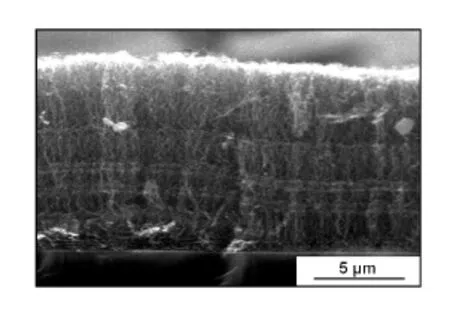
Fig.1 SEM image of an as-grown MWCNT layer.
The high-resolution TEM(HR-TEM)image reveals a bamboo-like multi-walled structure of the nanotubes(Fig.2).This structure is characteristic for nitrogen-doped CNTs[8].The outer surface of the MWCNTs is covered by amorphous carbon uniformly distributed over the nanotube surface.Also,a large amount of round particles is observed at the ends of MWCNTs(Fig.2).The EDA analysis of the particles has proved the presence of iron in them.So the catalyst iron particles are involved in the CNT growth process.
Apart from the 250-300 cm-1Raman band,the Raman spectra of MWCNT layers exhibit the socalled D-and G-bands at 1 270 and 1 592 cm-1,respectively,in the 1 000-3 000 cm-1region,and the defect-induced M-band at 1 740 cm-1and G′-band at 2 540 cm-1(Fig.3)[9,10]are also observed.In the middle range of the spectrum,a broad band at 1 070 cm-1is observed in Fig.3,this band is not shown as it is subtracted from the measured spectrum for making other features visible more distinctly.Most likely,the band at 1 070 cm-1is due to the presence of amorphous carbon in the MWCNT layers[11], and also to the presence of contaminating products from an incomplete pyrolysis of precursor[12,13].In the low-frequency region,a sharp band at 250-300 cm-1is detected.The Raman spectra of the heat-treated samples exhibit a sharp peak at 303 cm-1due to light scattering by acoustic phonons in silicon substrate[14].
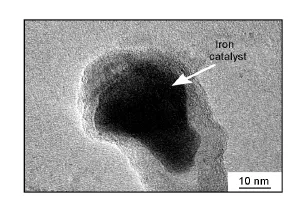
Fig.2 HR-TEM image of an as-grown MWCNT.
There are many peaks involved in the low frequency range(250-350 cm-1)of the spectrum.The most prominent one is located at about 287 cm-1(Fig. 3 and Table 1).It should be noted here that the RBM is normally manifested in the Raman spectra of singlewalled CNTs[1]while our samples,according to SEM and TEM data,are multi-walled CNTs with outer CNT diameters ranging from 5 to 100 nm(Fig.2). It is known,however,that the RBM band can be observed in the Raman spectrum of MWCNT layers, too.In the latter case,this band is due to radial oscillations of inner or outer CNT walls[2],which allows an estimation for the diameter of single-walled nanotubes with the equation:

Where ω0iis the spectral position of the RBM peak and diis the nanotube diameter.
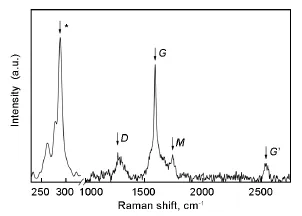
Fig.3 Raman spectrum of an as-grown
MWCNT layer.Symbol*indicates the investigated band.
In the model yielding the latter relation,oscillations of an SWCNT are adopted as a basis for the description of the oscillations of the inner graphene wall in isolated MWCNTs.The impact of other graphene layers on the oscillations of the inner MWCNT wall is assumed to be roughly the same as the impact produced on such oscillations by the neighboring nanotubes in SWCNT bundles.This assumption yields a diameter estimation error of 0.3 nm[1].
The RBM band in the Raman spectra of MWCNT layers was previously observed in good-quality samples obtained by the arc-discharge method[2].The structure of arc-discharge grown MWCNTs noticeably differs from the CVD grown ones.The CVD grown ones contain a significant amount of defects and contaminants.Furthermore the nitrogen-doping of MWCNTs result in a characteristic bamboo-like structure of the walls[15].Since our MWCNT samples were obtained with CVD method,they could also contain iron particles.Iron and iron oxides display characteristic peaks in the low-frequency range ofthe spectrum[16-18].Below,we discuss the origin of the 250-300 cm-1Raman band in our samples based on the following experimental observations:
The component peaks forming the 250-300 cm-1band are sharp,with their full-widths at half maximum(FWHM)varying between 5 and 10 cm-1(Table 1)and with their spectral positions clearly differing from the spectral position of the Raman peaks due to iron oxide(hematite,α-Fe2O3)at 245,294 and 299 cm-1[16-18].The iron oxide peak positions differ from the peak positions in the band under study (Table 1).
The TEM images demonstrate the presence of catalyst iron particles coated with amorphous carbon in our samples(Fig.2).The Auger and XPS study of as-grown MWCNT layers reveals the presence of carbon(92.5 at.%),iron(5.0 at.%),nitrogen (1.8 at.%)and oxygen(0.7 at.%).It also reveals the presence of non-oxidized iron in the MWCNT layers(Table 2).Since iron is a very active element prone to easily activated migration,this observation can be explained by the confinement and isolation of iron particles within carbon layers from the ambient.
The Auger and XPS spectra of MWCNT layers annealed at 390℃ for 120 min in air show an increase of oxygen concentration from 0.7 up to 4.1 at.%,and a shift of iron-induced peaks.This shift points to an iron oxide formation in the annealed samples(Table 2).Indeed,Raman spectra of such samples were found to display new peaks at 249 and294 cm-1due to iron oxides[17,18].Simultaneously, the low-frequency band at 250-300 cm-1retains its position(within the spectral resolution of 3 cm-1)and FWHM value after the annealing in the Raman spectra (Fig.4 and Table 1).
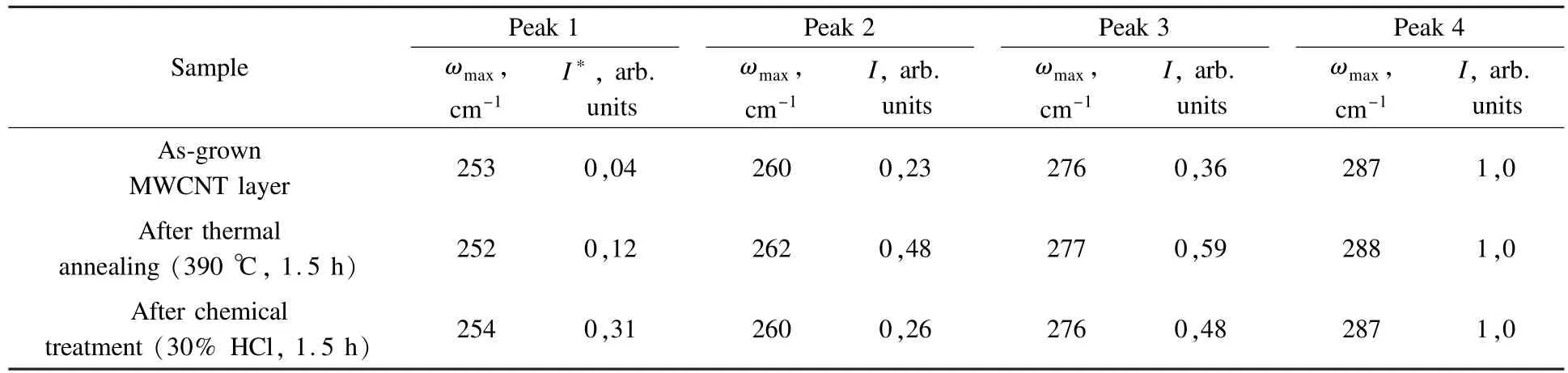
Table 1 Low-frequency peaks in the Raman spectra of annealed and chemically treated MWCNT layers(Fig.4).

Table 2 Results of analysis of Fe peak in the XPS spectra of the thermo-treated MWCNT layer.
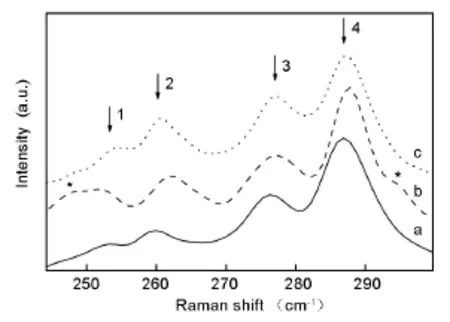
Fig.4 Raman spectra of(a)an as-grown MWCNT layer,(b) an annealed MWCNT layer,and(c)an MWCNT layer treated in HCl.Symbols*mark the Raman peaks due to iron oxides[13,14].
The chemical treatment of the MWCNT layers with HCl(30%)for 60 h led to a removal of catalyst particles from the walls and end faces of nanotubes (TEM data,Figs.2&5).Yet,the Raman spectra of the HCl-treated MWCNT layers exhibit the same peak position and FWHM in the low-frequency band (Fig.4 and Table 1).
The above experimental data are indicative of substantial modifications in the amount and state of iron impurities contained in the annealed MWCNTs. So the spectral positions of the 250-300 cm-1band keep essentially unchanged after the modifications with HCl treatment or annealing.We can therefore conclude that the 250-300 cm-1band very probably originates from the RBM of nanotubes,and it depends neither on the presence or absence of catalyst iron in our samples,nor on the particular state of the iron particles.This conclusion permits an estimation of the diameter of CNTs in the examined samples from the spectral position of RBM peaks(Table 1)and the estimation yields values of 0.8 to 0.9 nm.Since the low-frequency Raman spectra exhibit a band at 250-300 cm-1only,with no other bands observed at higher frequencies,we can put forward a hypothesis that this band could originate from the RBM of carbon atoms forming the inner walls of the small-diameter MWCNTs.The occurrence of the small-diameter MWCNTs with inner diameters of 1 nm in our samples is confirmed by TEM images.Indeed,the HRTEM image of Fig.6 shows a small-diameter(about 5 nm)MWCNT with its inner diameter in accordance with that of the estimated one from the spectral position of the RBM peaks(0.8-0.9 nm,Fig.3,6 and Table 1).Since the outer diameter of the small-diameter MWCNTs in our samples is about 5 nm and the inter-wall separation is about 3.4 nm[1],it can easily be deduced from here that such MWCNTs are formed by 6 to 7 graphene layers.
The intensity of the component peaks forming the RBM band is defined by the amount of defects and impurities contained on the outer surface of nanotubes and in between their walls.This fact points to an insignificant change of defect and impurity concentrations in CNT walls and in the inter-wall space of CNTs after the annealing or HCl treatment.The data in Table 1 indicate invariable position of the peaks in our samples after the annealing or HCl treatment (Fig.4,Table 1).From the data,however,the integral intensities of component peaks clearly change after the treatments(peaks 2 and 3 in Fig.4 and Table 1).This is probably related to the removal of amorphous carbon from the MWCNT layers duringthe annealing and to the removal of metal particles from the MWCNT inter-wall space during the HCl treatment[19,20].
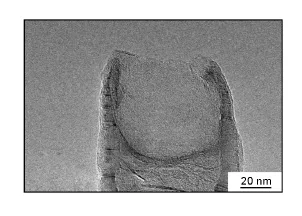
Fig.5 HR-TEM image of an MWCNT after treatment in HCl(30%,60 h).
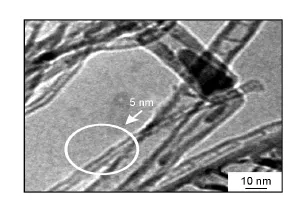
Fig.6 HR-TEM image of an as-grown multi-walled carbon nanotubes.A small-diameter MWCNT with 5 nm outer diameter is indicated.
4 Conclusions
The low-frequency(250-300 cm-1)band in the Raman spectra of CVD-grown MWCNTs was investigated before and after the annealing at 390℃ for 120 min in air or the HCl treatment.The annealing has a profound influence on the state of catalyst iron particles in the samples,while the HCl treatment removes the majority of such particles from MWCNTs. The Raman spectra of MWCNT layers are independent of the spectral position of the low-frequency band of the state of catalyst iron particles in our samples. Simultaneously,TEM data prove the presence of small-diameter MWCNTs in the examined MWCNT layers,which agree well with the estimated inner diameter of the small-diameter MWCNTs from Raman spectroscopy.We therefore put forward a hypothesis that the observed 250-300 cm-1Raman band is probably originated from the radial breathing oscillations of carbon atoms in the inner walls of small-diameter MWCNTs.
Acknowledgements
This work was partly supported by the Russian Foundation for Basic Research(15-48-04134-r-Sibira,14-08-31448-md-a).
[1] Dresselhaus M S,Eklund P C.Phonons in carbon nanotubes[J].Adv Phys,2000,49(6):705-814.
[2] Benoit J M,Buisson J P,Chauvet O,et al.Low-frequency Raman studies of multiwalled carbon nanotubes:Experiments and theory[J].Phys Rev,2002,66:073417(1)-073417(4).
[3] Zhao X,Ando Y,Qin L C,et al.Radial breathing modes of multiwalled carbon nanotubes[J].Chem Phys Lett,2002,361: 169-174.
[4] Spudat C,Muller M,Houben L,et al.Observation of Breathinglike Modes in an Individual Multiwalled Carbon Nanotube[J]. Nano Lett,2010,10:4470-4474.
[5] Gupta R,Singh B P,Singh V N,et al.Origin of radial breathing mode in multiwall carbon nanotubes synthesized by catalytic chemical vapor deposition[J].Carbon,2014,66:724-726.
[6] Sbai K,Rahmani A,Fakrach B,et.al.Modelling and simulation of vibrational breathing-like modes in individual multiwalled carbon nanotubes[J].Physica E,2014,56:312-318.
[7] Kudashov A G,Okotrub A V,Yudanov N F,et al.Gas-phasesynthesis of nitrogen-containing carbon nanotubes and their electronic properties[J].Phys Sol State,2002,44(4):652-655.
[8] Ninga G,Xua C,Zhua X,et al.MgO-catalyzed growth of N-doped wrinkled carbon nanotubes[J].Carbon,2013,56:38-44.
[9] Jorio A,Pimenta M A,Souza Filho A G,et al.Characterizing carbon nanotube samples with resonance Raman scattering[J]. New J Phys,2003,5:139.1-139.17.
[10] Jorio A,Saito R,Dresselhaus G,et al.Raman Spectroscopy in Graphene-related Systems[M].Willey-VCH,Berlin,2011.
[11] Ferrari A C,Robertson J.Resonant Raman spectroscopy of disordered,amorphous,and diamondlike carbon[J].Phys Rev B,2001,64:075414(1)-075414(14).
[12] Yoon O J,Kang S M,Moon S M.Deposition of iron nanoparticles onto multiwalled carbon nanotubes by helicon plasma-enhanced,chemical vapor deposition[J].Journal of Non-Crystalline Solids,2007,353(11-12):1208-1211.
[13] Fantini C,Jorio A,Souza M,et al.Steplike dispersion of the intermediate-frequency Raman modes in semiconducting and metallic carbon nanotubes[J].Phys Rev B,2005,72: 085446-1-085446-5.
[14] Temple P A,Hathaway C E.Multiphonon Raman spectrum of silicon[J].Phys Rev B,1973,7:3685-3697.
[15] Zhang Y,Liu C,Wen B,et al.Preparation and electrochemical properties of nitrogen-doped multi-walled carbon nanotubes. Materials Lett,2011,65:49-52.
[16] Jorge J,Flahaut E,Gonzalez-Jimenez F,et al.Preparation and characterization of α-Fe nanowires located inside double wall carbon nanotubes[J].Chem Phys Lett,2008,457:347-351.
[17] Wang S,Wang W,Wang W,et al.Characterization and gassensing properties of nanocrystalline iron(III)oxide films prepared by ultrasonic spray pyrolysis on silicon[J].Sens Actuat B,2000,69:22-27.
[18] de Faria D L A,Silva S V,de Oliveira M T.Raman microspectroscopy of some iron oxides and oxyhydroxides[J].J Raman Spect,1997,28(11):873-878.
[19] Okotrub A V,Yudanov N F,Chuvilin A L,et al.Fluorinated cage multiwall carbon nanoparticles[J].Chem Phys Lett, 2000,322(3-4):231-236.
[20] Bolotov V V,Kan V E,Korusenko P M,et al.Formation mechanisms of nanocomposite layers based on multiwalled carbon nanotubes and non-stoichiometric tin oxide[J].Phys Sol State,2012,54(1):166-173.
An observation of the radial breathing mode in the Raman spectra of CVD-grown multi-wall carbon nanotubes
Valeriy V.Bolotov, Vasiliy E.Kan, Egor V.Knyazev, Peter M.Korusenko, Sergey N.Nesov, Yuriy A.Sten`kin, Viktor A.Sachkov, Irina V.Ponomareva
(Omsk Scientific Center of Siberian Branch Russian Academy of Sciences,Karl Marx Avenue,15,Omsk 644024,Russian Federation)
MWCNTs grown by chemical vapor deposition on SiO2/Si substrates were investigated by Raman spectroscopy,transmission electron microscopy(TEM),Auger spectroscopy,and X-ray photoelectron spectroscopy before and after an annealing at 390℃ for 120 min in air or chemical treatment with a HCl solution.The Raman spectroscopy was focused on the low-frequency (250-300 cm-1)band.It is found that the positions and full widths at half maximum of the peaks forming the 250-300 cm-1Raman band change little with the annealing or chemical treatment.The measured inner diameters of small-diameter CNTs from TEM agree well with those from Raman spectroscopy.These indicate that the low-frequency band originates from the radial breathing oscillations of carbon atoms in the inner walls of small-diameter MWCNTs.
Carbon nanotube;Radial breathing mode;Raman;Chemical vapor deposition;Microscopy
Vasiliy E.Kan.E-mail:kan@obisp.oscsbras.ru.
TQ127.1+1
A
Vasiliy E.Kan.E-mail:kan@obisp.oscsbras.ru.
1007-8827(2015)05-0385-06
10.1016/S1872-5805(15)60197-4
Received date:2015-05-08; Revised date:2015-10-10
English edition available online ScienceDirect(http://www.sciencedirect.com/science/journal/18725805).
登錄APP查看全文
猜你喜歡
音樂探索(2022年2期)2022-05-30 21:01:37
小天使·一年級語數英綜合(2019年8期)2019-08-27 02:23:00
中國特種設備安全(2018年11期)2019-01-08 02:08:32
小學科學(學生版)(2018年7期)2018-08-13 09:33:04
鄭州大學學報(醫學版)(2015年2期)2015-02-27 14:50:46
山東女子學院學報(2014年6期)2014-03-01 02:24:55
棋藝(2001年19期)2001-11-25 19:55:34
