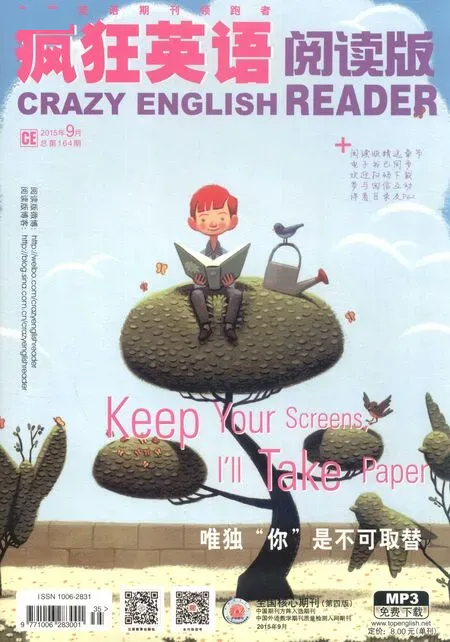
閱讀教給我的人生
2015-03-29 09:02:35byEveChase
瘋狂英語·新策略
2015年9期
by Eve Chase
小狐譯
閱讀教給我的人生
Reading Taught Me All about Life
by Eve Chase
小狐譯

N ature. Nurture. Novels. If you grew up preinternet—we’re talking the 70s and 80s (“the olden days”, as my daughter calls it) —books brought you up,1)exerting as much influence on who you were and who you became as anything, or anyone. My school friends and I, some bookish, others not, all read ourselves into being and navigated our way through the wilds of childhood and adolescence with2)dog-eared novels as maps. There wasn’t much else to do. And you had to get your information from somewhere.
自然。滋養(yǎng)。小說。如果你成長于互聯(lián)網(wǎng)誕生前的時代——我們說的是70年代和80年代(“舊時代”,就像我女兒說的那樣)——書籍伴你成長,就像其他任何東西或任何人一樣,影響著你的性格,還有你的人生路。我和學(xué)校里的朋友們,有些是書癡,有些不是,都通過閱讀來造就性格,并用被翻得卷角的小說作為地圖,指引我們安全地行駛過童年期和青少年時期的狂野時光。沒有太多別的事情可做。而你又不得不通過某種途徑來獲取信息。

在網(wǎng)絡(luò)無處不在的今天,我們的工作、生活幾乎離不開網(wǎng)絡(luò)。90后、00后這些“網(wǎng)絡(luò)原住民”甚至想象不出沒有電腦的生活是怎樣的。那時候,書籍可以說是我們最忠誠的伙伴。
1) exert [?g'zз?t] v. 發(fā)揮(威力等),使受(影響等)
2) dog-eared adj. 卷角的,翻舊了的
3) laissez-faire adj. 自由放任主義的
4) helicopter parenting 直升機式教育(指家長過度關(guān)注孩子,就像直升機的螺旋槳一樣盤旋在上方)
Parents—3)laissez-faire baby boomers (4)helicopter parenting hadn’t been invented)—weren’t particularly interested and, if asked, would usually send you off in the wrong direction, to the wrong bookshelf, to something dusty—“Oh, I loved Vanity Fair at your age!” —not understanding our craving for fat books with silver-5)embossed covers, smelling of hormones and airports and America, page corners sticky from rereading, books that showed us dazzling new worlds—outside the suburb, beneath our skirts—and had all the best lines.
At a time when TV was rubbish, the local library was a refuge and a computer game meant6)Pac Man, we read7)ferociously, without cynicism or snobbery, inhabiting every page, dream readers—frst as kids, then under the8)duvet with a camping torch, then as young teens—and it infuenced who we were, who we became.
It’s all still there: we are what we read. The current teen generation will leave behind a huge digital footprint—endless mortifying photos, videos, texts—but we left little, a few red-eyed snaps, some scratched9)vinyl records and a long, beloved reading list spanning Malory Towers to Sweet Valley High, Adrian Mole to Anne of Green Gables.
At a time when talking to children about emotions was seen as largely unnecessary—“Nope, life’s not fair,”distracted parents would shrug—books flled in childhood’s lonelier gaps, made us feel better, a little more understood.
父母親們——嬰兒潮時期出生的自由主義者們(“直升機父母”尚未出現(xiàn))——對孩子們并不是特別感興趣,而且,如果被問及的話,常常會給你指錯方向,指錯書架,指到某些故紙堆里去——“噢,我在你這個年齡的時候喜歡看《名利場》!”——不明白我們的渴望,我們渴望那些銀色浮雕封面的大部頭作品,那些荷爾蒙、機場和美國的氣息,那些因反復(fù)閱讀變得黏糊的書角,那些向我們展示閃亮新世界的書籍——郊區(qū)之外,裙子之下——還有著一切最美的文字。
曾幾何時,電視節(jié)目一文不值,本地的圖書館是人們……
登錄APP查看全文