水稻最佳作物管理技術的增產增效作用
2015-06-12 12:37:20范明生張福鎖
植物營養與肥料學報 2015年4期
安 寧, 范明生, 張福鎖
(中國農業大學資源與環境學院,北京 100193)
水稻最佳作物管理技術的增產增效作用
安 寧, 范明生*, 張福鎖
(中國農業大學資源與環境學院,北京 100193)

最佳作物管理技術; 產量; 氮肥利用率; 干物質積累; 產量構成
隨著我國人口的不斷增長,對稻谷的需求也日益增加。按照目前我國稻米的年消費量預測, 到2030年我國的水稻需求量需增加30%以上[16]。為了滿足未來水稻生產需求,必須通過在現有甚至減少的種植面積的條件下大幅度提高單產,同時應提高養分資源,尤其是氮肥的利用效率,從而減少對環境的影響[3]。目前我國水稻產量徘徊不前的主要原因可能是: 1)農民傳統生產方式下的水稻平均產量已經達到可實現產量的70%以上[17],進一步提高產量需要更加精細的管理技術,但這往往在經濟和實踐中的可行性低; 2)目前農戶不合理的管理措施仍然是增產和增效的限制因子,如水稻栽插密度低、 水分管理不合理 (大多數農民采用淹水—中期烤田—淹水的灌溉方式)、 養分管理不合理等,如氮肥投入量過大,農民一般分兩次施用(基肥和蘗肥)且基肥施用多,這樣會造成更大的氮的損失,同時不能滿足高產水稻的需求。而最近的研究表明,水稻的吸氮高峰期出現在幼穗分化期,而在水稻生長后期光照更加充足的年份,增加粒肥能促進籽粒灌漿和增產,因此,增加中后期的施用比例(穗肥和粒肥)是水稻高產和氮肥高效利用的基礎[18-20]。
本研究在我國水稻主產區403個農民田塊的試驗示范基礎上,利用試驗示范數據,比較了最佳作物管理技術和農民傳統方式兩種管理模式下的水稻產量、施氮量、氮肥利用率以及生長動態 (作物吸氮量和干物質積累) 的差異,在現有品種條件下,針對水稻生產的主要限制因子,通過管理技術的優化,明確增產與增效的實現程度,旨在為我國水稻生產實踐提供理論與技術支撐。
1 材料與方法
1.1 試驗設計
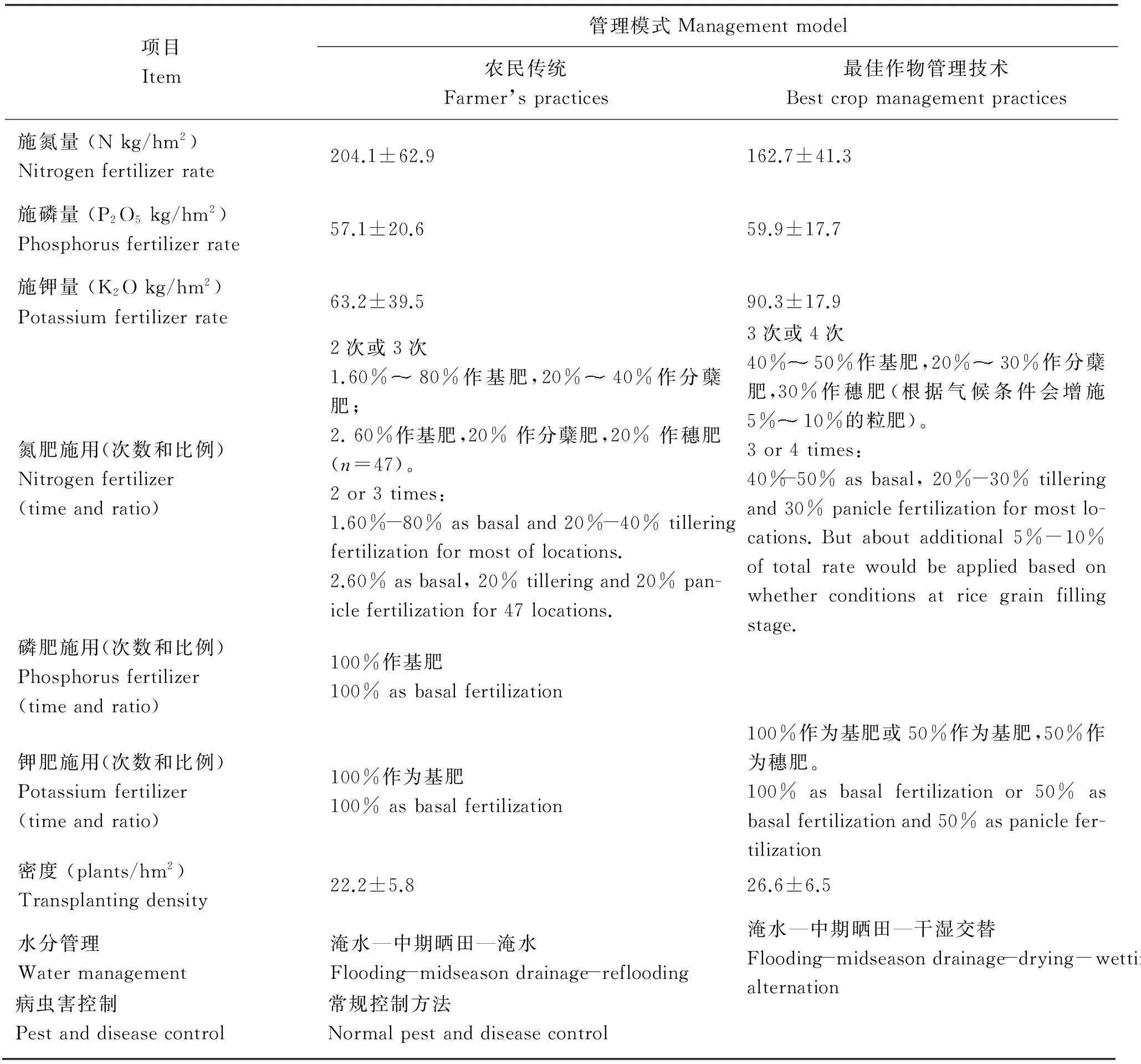
表1 田間試驗中農民傳統處理和最佳作物管理技術處理的管理信息Table 1 Detailed information in management for farmer’s practices and best crop management practices in 403 on-farm trials
1.2 測定項目與方法
1.2.2 水稻吸氮量和干物質積累量 在12個試驗點(其中包括南方雙季早稻、雙季晚稻和單季稻),分別于分蘗期、穗分化期、抽穗期和成熟期取植株樣品。每個點在各地塊取 0.5 m2的植株樣,于105℃烘箱殺青30 min,80℃烘72 h后稱重,并折算成每公頃干重。樣品經粉碎過篩,采用H2S04-H202消化,以半微量凱氏定氮法測定植株氮含量。
1.3 計算方法和數據處理
氮肥利用率的計算公式為[23]:
氮肥偏生產力 (PFP,kg/kg) =施氮小區水稻籽粒產量(kg/hm2)/施氮量(N kg/hm2)
氮肥農學利用率 (AE,kg/kg) =[施氮小區水稻籽粒產量(kg/hm2)-空白小區水稻籽粒產量(kg/hm2)]/施氮量(N kg/hm2)
氮肥回收利用率 (RE,%)=[施氮小區水稻吸氮量(N kg/hm2)-空白小區水稻吸氮量(N kg/hm2)]/施氮量(N kg/hm2) ×100
試驗數據采用EXCEL、SPSS軟件進行處理與分析。
2 結果與分析
2.1 施氮量、產量和氮肥利用率
表2顯示,最佳作物管理技術表現出良好的減氮、增產和增效潛力。農民傳統處理的平均施氮量為204.1 kg/hm2,最佳作物管理技術處理氮肥用量減少了20.3%;氮肥的減少并沒有使水稻的產量下降,反而表現出較大的增產效應。農民傳統處理的平均產量為7226.4 kg/hm2,最佳作物管理技術處理的平均產量為7917.0 kg/hm2,增長率為9.6%;由于氮肥施用量的減少和產量的增加,最佳作物管理技術處理的氮肥利用率大幅度增加,顯著高于農民傳統處理,農民傳統處理和最佳作物管理技術處理的氮肥偏生產力(PFP)、農學利用率(AE)和氮肥回收率(RE)分別為37.3 kg/kg和50.8 kg/kg,8.5 kg/kg和14.9 kg/kg,28.7%和42.3%,增長率分別為36.2%、75.3%和13.6個百分點,AE的增長幅度最大,其次為PFP和RE。
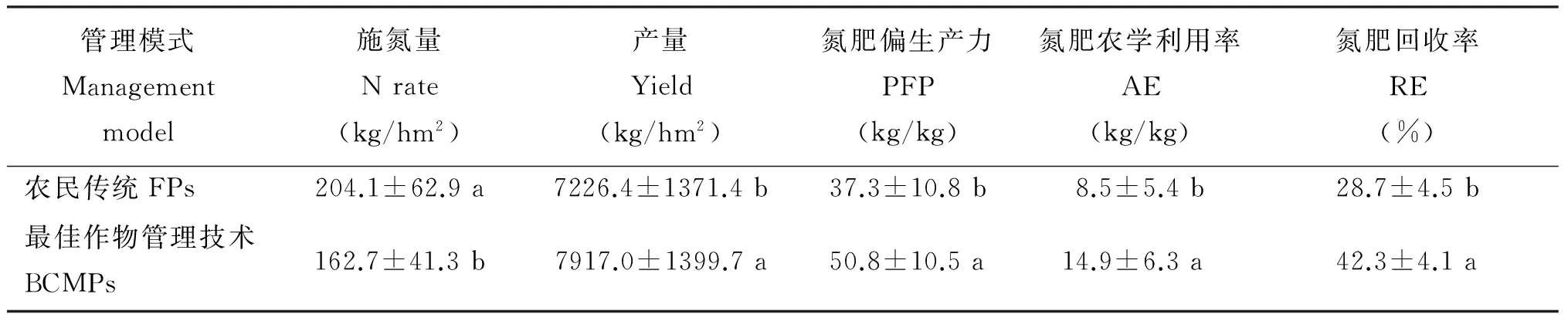
表2 農民傳統處理和最佳作物管理技術處理的施氮量、產量、氮肥效率和減氮、增產、增效的百分比Table 2 N rate, yield, nitrogen use efficiency under farmer’s practices(FPs) and best crop management practices(BCMPs)
注(Note): FPs—Farmer’s practices; BCMPs—Best crop management practices; PFP—Partial factor productivity; AE—Agronomic efficiency; RE—Recovery efficiency. 同列數據后不同字母表示處理間差異達5%顯著水平 Values followed by different letters in a column are significantly different among treatments at the 5% level.
2.2 水稻的氮素吸收動態
農民傳統和最佳作物管理技術處理的氮素吸收在水稻整個生長期表現出相似的規律,齊穗期之前氮素迅速累積,到齊穗期之后氮素的吸收速率下降,但具體在各個時期的累積吸氮量和階段吸氮量不同,從圖1可以看出,農民傳統和最佳作物管理技術處理的累積吸氮量,在分蘗期分別為39.8 kg/hm2和40.2 kg/hm2,占作物收獲期吸氮量的26.2%和24.2%;在穗分化期分別為88.2 kg/hm2和81.6 kg/hm2,占作物收獲期吸氮量的58.1%和49.2%;在齊穗期分別為134.9 kg/hm2和147.7 kg/hm2,占作物收獲期吸氮量的88.9%和89.0%;在成熟期分別為151.7 kg/hm2和165.9 kg/hm2。兩種管理措施下,水稻的階段氮素吸收量也存在差異:從分蘗期到穗分化期,農民傳統和最佳作物管理技術處理的階段吸氮量分別為48.4 kg/hm2和41.4 kg/hm2,占作物收獲期吸氮量的31.9%和24.9%;穗分化期到齊穗期,階段吸氮量分別為46.7 kg/hm2和66.1 kg/hm2,占作物收獲期吸氮量的30.8%和39.8%;齊穗期到成熟期,階段吸氮量分別為16.8 kg/hm2和18.2 kg/hm2,占作物收獲期吸氮量的11.1%和11.0%。農民傳統處理在生育前期表現出較大的氮吸收能力,但從齊穗期開始,最佳作物管理技術處理的氮吸收能力要大于農民傳統處理。由于試驗點分布在不同的水稻種植地區,土壤供氮能力不同,不同地區的水稻累積吸氮量和階段吸氮量也有一定差異,雖然沒有達到差異顯著水平,但總體趨勢明顯。
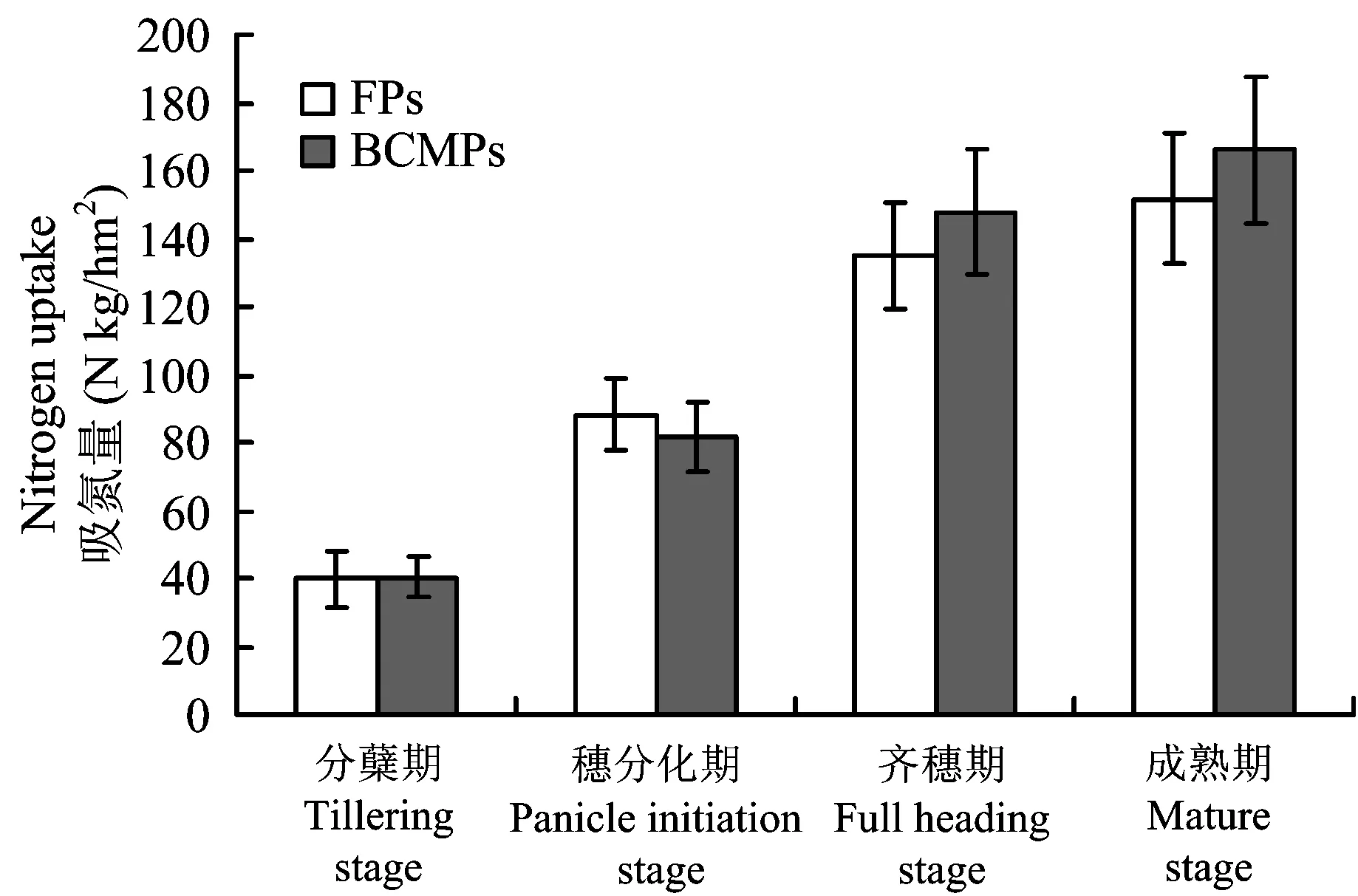
圖1 農民傳統處理(FPs)和最佳作物管理技術 處理(BCMPs)水稻不同生育期的吸氮量Fig.1 Nitrogen uptake of farmer’s practices (FPs) and best crop management practices (BCMPs) at different rice growth stages
2.3 水稻的干物質累積動態
農民傳統和最佳作物管理技術處理水稻的干物質累積與氮素吸收的趨勢類似。穗分化期之前干物質累積相對緩慢,到穗分化期之后干物質的積累開始迅速上升,但在各個時期的干物質積累的絕對值不同。圖2顯示,農民傳統和最佳作物管理技術處理的干物質累積量,在分蘗期分別為1399.9 kg/hm2和1524.0 kg/hm2,占作物收獲期干物質累積量的10.8%和11.0%;在穗分化期分別為3875.0 kg/hm2和3856.4 kg/hm2,占作物收獲期干物質累積量的30.0%和28.0%;在齊穗期分別為8869.0 kg/hm2和9141.6 kg/hm2,占作物收獲期干物質累積量的68.7%和66.3%;成熟期時別為12914.2 kg/hm2和13796.1 kg/hm2,在收獲期,干物質的累積量表現出顯著差異 (P<0.05)。同時,農民傳統和最佳作物管理技術處理的花后干物質積累量分別為4045.2 kg/hm2和4654.5 kg/hm2,二者差異顯著(P<0.05)。
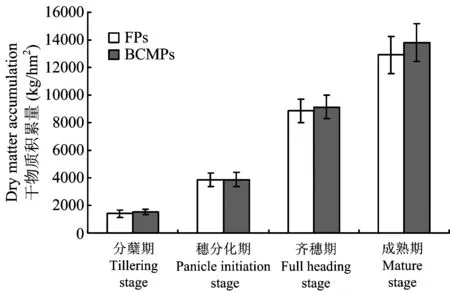
圖2 農民傳統處理(FPs)和最佳作物管理技術處理 (BCMPs) 水稻不同生育期干物質累積量Fig.2 Dry matter accumulation of farmer’s practices (FPs) and best crop management practices (BCMPs) at different rice growth stages
2.4 產量構成
不同管理措施對水稻的產量構成因素有明顯影響,從表3可以看出,最佳作物管理技術處理的每平方米平均穗數為243.2,顯著大于農民傳統處理的231.7 (P<0.05);最佳作物管理技術處理的平均穗粒數為154.2,顯著大于農民傳統處理的150.0 (P<0.05);同時,最佳作物管理技術處理的平均千粒重為26.9 g,顯著大于農民傳統處理的26.6 g (P<0.05)。

表3 農民傳統處理和最佳作物管理技術處理的產量構成Table 3 Yield components of farmer’s practices (FPs) and best crop management practices (BCMPs)
注(Note): 同列數據后不同字母表示處理間差異達5%顯著水平 Values followed by different letters in a column are significantly different among treatments at the 5% level.
3 討論與結論
盡管我國水稻種植歷史悠久,種植技術相對成熟,農民的水稻平均產量達到可實現產量的70%以上[17],但是,不合理的水肥以及作物管理仍然是水稻高產高效的限制因子。目前的研究表明,我國的水稻仍然能夠通過優化水肥以及作物管理技術實現增產10%,增產的原因可能是:1)氮肥施用量和時期匹配高產水稻的生理需求,減少早衰,促進干物質累積,尤其是后期干物質的累積,促進了氮素吸收和千粒重的增加[18, 24-25]。增加生物產量是獲得高產的物質基礎,且經濟產量主要決定于齊穗后群體的光合生產量,即花后期的干物質積累量[26-27]。在本研究條件下,最佳作物管理技術的水稻花后干物質積累量為4655 kg/hm2,占總干物質積累的34%; 2)增加鉀肥的施用,尤其是增加抽穗期鉀肥的施用,這可能增加水稻根系的活力,促進對養分的吸收,有利于形成高產群體[28-29]; 3)個別點(n=43)施用硅肥或微量元素,可能也有一定的增產效果;4)增加栽插密度,保障了合理的群體數量和穗數;5)后期的干濕交替灌溉,促進了弱勢粒灌漿,增加每穗粒數[30]。同時,本研究也表明,最佳作物管理技術可以實現在增產的基礎上同時減少氮肥施用量,即與農民傳統的管理方式相比,氮肥用量節省20%,氮肥偏生產力、農學利用率和氮肥回收利用率分別增加36.2%、75%和13.6個百分點。由此可見,我國的水稻生產系統有更大的節氮和增效的潛力。
[1] Frolking S, Qiu J J, Boles Setal. Combining remote sensing and ground census data to develop new maps of the distribution of rice agriculture in China[J]. Global Biogeochemical Cycles, 2002, 16: 1091-1101.
[2] FAO. http://faostat.fao.org. 2010.
[3] Fan M S, Shen J B, Yuan L Xetal. Improving crop productivity and resource use efficiency to ensure food security and environmental quality in China[J]. Journal of Experimental Botany, 2012, 63(1): 13-24.
[4] Heffer P. Assessment of fertilizer use by crop at the global level: 2006/07-2007/08[R]. Pairs, France: International Fertilizer Industry Association, 2009.
[5] Roelcke M, Han Y, Schleef K Hetal. Recent trends and recommendations for nitrogen fertilization in intensive agriculture in eastern China[J]. Pedosphere, 2004, 14: 449-460.
[6] Peng S B, Buresh R J, Huang J Letal. Improving nitrogen fertilization in rice by site-specific N management. A review[J]. Agronomy for Sustainable Development, 2010, 30: 649-656.
[7] 彭少兵, 黃見良, 鐘旭華, 等. 提高中國稻田氮肥利用率的研究策略[J]. 中國農業科學, 2002, 35(9): 1095-1103. Peng S B, Huang J L, Zhong X Hetal. Research strategy in improving fertilizer nitrogen use efficiency of irrigated rice in China[J]. Scientia Agricultura Sinica, 2002, 35(9): 1095-1103.
[8] 林葆. 提高作物產量, 增加施肥效應[A]. 中國土壤學會. 中國土壤科學的現狀與前景[M]. 江蘇: 江蘇科學技術出版社,1991. 29-36. Lin B. Make the most efficient use of fertilizers in increasing crop production [A]. Soil science society of China. Soil Science in China. Present and future[M]. Jiangsu: Jiangsu Science and Technology Press, 1991. 29-36.
[9] 李慶逵. 中國農業持續發展中的肥料問題[M]. 南昌: 江西科學技術出版社, 1997. Li Q K. Fertilizer issues in the sustainable development of China agriculture[M]. Nanchang: Jiangxi Science and Technology Press, 1997.
[10] Cassman K G, Gines H C, Dizon M Aetal. Nitrogen-use efficiency in tropical lowland rice systems: contributions from indigenous and applied nitrogen[J]. Field Crops Research, 1996, 47: 1-12.
[11] Cassman K G, Dobermann A R, Walters D T. Agroecosystems, nitrogen-use efficiency, and nitrogen management[J]. AMBIO: A Journal of the Human Environment, 2002, 3(2): 132-140.
[12] Vitousek P M, Aber J D, Howarth R Wetal. Human alteration of the global nitrogen cycle: sources and consequences[J]. Ecological Application, 1997, 7: 737-750.
[13] Zhu Z L, Xiong Z Q, Xing G X. Impacts of population growth and economic development on the nitrogen cycle in Asia[J]. Science in China (Series C: Life Science), 2005, 48: 729-737.
[14] Guo J H, Liu X J, Zhang Yetal. Significant acidification in major Chinese croplands[J]. Science, 2010, 327: 1008-1010.
[15] Zheng X H, Han S H, Huang Yetal. Re-quantifying the emission factors based on field measurements and estimating the direct N2O emission from Chinese croplands[J]. Global Biogeochemical Cycles, 2004, 18: GB2018, doi: 10.1029/2003GB002167.
[16] Shen J B, Cui Z L, Miao Y Xetal. Transforming agriculture in China: From solely high yield to both high yield and high resource use efficiency[J]. Global Food Security, 2013, 2(1): 1-8.
[17] Wart J V, Christian Kersebaum K, Peng S Betal. Estimating crop yield potential at regional to national scales[J]. Field Crops Research, 2013, 143: 34-43.
[18] Fan M S, Lü S H, Jiang R Fetal. Triangular transplanting pattern and split nitrogen fertilizer application increase rice yield and nitrogen fertilizer recovery[J]. Agronomy Journal, 2009, 101(6): 1421-1425.
[19] 張福鎖, 范明生. 主要糧食作物高產栽培與資源高效利用的基礎研究[M]. 北京: 中國農業出版社, 2013. 199-204. Zhang F S, Fan M S. The basic research of high yield and high resources use efficiency of the main food crops[M]. Beijing: China Agriculture Press, 2013. 199-204.
[20] 申建波, 張福鎖. 水稻養分資源綜合管理理論與實踐[M]. 北京: 中國農業出版社, 2006. 37-43. Shen J B, Zhang F S. Theory and practice of rice nutrient integrated management[M]. Beijing: China Agriculture Press, 2006. 37-43.
[21] Zhang H, Chen T T, Wang Z Qetal. Involvement of cytokinins in the grain filling of rice under alternate wetting and drying irrigation[J]. Journal of Experimental Botany, 2010, 61: 3719-3733.
[22] Doberman A, Fairhurst T H. Rice: Nutrient disorders and nutrient management[M]. Singapore: Potash and Phosphate Institute, and Manila, IRRI, 2000.
[23] Cassman K G, Peng S B, Olk D Cetal. Opportunities for increased nitrogen-use efficiency from improved resource management in irrigated rice systems[J]. Field Crops Research, 1998, 56: 7-39.
[24] 肖恕賢, 覃步生, 陳盛球. 等. 雜交早稻需肥特性和施肥技術研究[J]. 作物學報, 1982, 8(1): 23-32. Xiao S X, Qin B S, Chen S Qetal. Studies on the characteristics of fertilizer requirement of hybrid rice and the application technique[J]. Acta Agronomica Sinica, 1982, 8(1): 23-32.
[25] 石慶華, 潘曉華, 鐘旭華. 等. 雜交早稻的吸氮特性與產量形成的初步研究[J]. 江西農業大學學報, 1989, 11(l): 18-24. Shi Q H, Pan X H, Zhong X Hetal. Studies on the characteristics of nitrogen absorption and the yield formation in early hybrid rice[J]. Acta Agriculturae Universitatis Jiangxiensis, 1989, 11(l): 18-24.
[26] 陳溫福, 徐正進, 張文忠, 等. 水稻新株型創造與超高產育種[J]. 作物學報, 2001, 27(5): 665-672. Chen W F, Xu Z J, Zhang W Zetal. Creation of new plant type and breeding rice for super high yield[J]. Acta Agronomica Sinica, 2001, 27(5): 665-672.
[27] 凌啟鴻. 作物群體質量[M]. 上海: 上海科學技術出版社, 2001. 16-42. Lin Q H. Crop population quality[M]. Shanghai: Shanghai Scientific and Technical Publishers, 2001. 16-42.
[28] 何電源, 呂龍石, 李桂花, 等. 中國南方土壤肥力與栽培植物施肥[M]. 北京: 科學出版社, 1994. He D Y, Lü L S, Li G Hetal. Soil fertility and fertilization of cultivated plant in South China[M]. Beijing: Science Press, 1994.
[29] 胡泓, 王光火. 鉀肥對雜交水稻養分積累以及生理效率的影響[J]. 植物營養與肥料學報, 2003, 9(2): 184-189. Hu H, Wang G H. Influence of potassium fertilizer on nutrient accumulation and physiological efficiency of hybrid rice[J]. Plant Nutrition and Fertilizer Science, 2003, 9(2): 184-189.
[30] 楊建昌.水稻弱勢粒灌漿機理與調控途徑[J]. 作物學報, 2010, 36(12): 2011-2019. Yang J C. Mechanism and regulation in the filling of inferior spikelets of rice[J]. Acta Agronomica Sinica, 2010, 36(12): 2011-2019.
[31] 吳良泉, 蔡國學, 石孝均, 等. 水稻配方肥與機插秧集成技術應用效果研究[J]. 中國農技推廣, 2013, 29 (1): 35-36. Wu L Q, Cai G X, Shi X Jetal. The agronomical effects of formulated fertilizer and mechanical transplanting of rice[J]. China Agricultural Technology Extension, 2013, 29 (1): 35-36.
[32] Zhang F S, Fan M S, Zhao B Qetal. Fertilizer use, soil fertility and integrated nutrient management in China [A]. Zhang F S, Fan M S. Improving plant nutrient management for better farmer livelihoods[C]. Beijing: Food Security and Environmental Sustainability Proceeding of a Regional Workshop, 2005.
[33] 許迪, 康紹忠. 現代節水農業技術研究進展與發展趨勢[J]. 高技術通訊, 2002, 12: 103-108. Xu D, Kang S Z. Research progress and development trend on modernized agriculture water-saving technology[J]. High Technology Letters, 2002, 12: 103-108.
[34] Zou J W, Huang Y, Qin Y Metal. Changes in fertilizer-induced direct N2O emissions from paddy fields during rice-growing season in China between 1950s and 1990s[J]. Global Change Biology, 2009, 15: 229-242.
[35] 石生偉, 李玉娥, 劉運通, 等. 中國稻田CH4和N2O排放及減排整合分析[J]. 中國農業科學, 2010, 43(14): 2923-2936. Shi S W, Li Y E, Liu Y Tetal. CH4and N2O emission from rice field and mitigation options based on field measurements in China: An integration analysis[J]. Scientia Agricultura Sinica, 2010, 43(14): 2923-2936.
[36] Fan M S, Lal R, Cao Jetal. Plant-based assessment of soil productivity and contributions to China’s cereal crop yield increase since 1980[J]. Plos One, 2013, 8 (9): e74617. doi: 10.1371/journal.pone.0074617.
Best crop management practices increase rice yield and nitrogen use efficiency
AN Ning, FAN Ming-sheng*, ZHANG Fu-suo
(CollegeofResourcesandEnvironmentalScience,ChinaAgriculturalUniversity,Beijing100193,China)
【Objectives】Rice is one of the main staple crops in China. In order to meet the increasing demand of rice production for growing population with even reduced rice cultivation area, rice farming systems must be managed to achieve the goal of high rice productivity and primary resources (e.g. nitrogen and water) use efficiency while without further degradating environmental integrity. 【Methods】 Based on 403 on-farm trails conducted in China’s major rice producing provinces (Including Hunan, Hubei, Guangdong, Anhui, Jiangsu and the Great Chongqing Area) from 2008 to 2011, nitrogen application rate, rice yield, nitrogen use efficiency (partial factor productivity, agronomic efficiency and recovery efficiency), nitrogen uptake and dry matter accumulation dynamics of rice plant during the main period of rice growth (tillering stage, panicle initiation stage, full heading stage and mature stage) were compared between treatments of conventional farmers’ practices (FPs) and the best crop management practices (BCMPs). The main technology of best crop management practices was optimum nitrogen management with side dressing while control the total amount of application, customized application rate of phosphorus and potassium by monitoring available phosphorus and potassium in the soil, increased transplanting density and optimized water management through controled dry and irrigation cycles after midseason drainage. 【Results】 Compared with FPs, the yield of BCMPs was 7917.0 kg/hm2and increased significantly by 690.6 kg/hm2(9.6%) (P<0.05) while nitrogen fertilizer application was significantly reduced by N 41.4 kg/hm2(20.3%) (P<0.05). The nitrogen partial factor productivity, agronomic efficiency and recovery efficiency of BCMPs were significantly higher than those of FPs by 36.2%, 75.3% and 13.6 percentage points,respectively (P<0.05). Nitrogen uptake and dry matter accumulation of rice plant under FPs were greater than those of BCMPs during earlier stage. After full heading stage, nitrogen uptake and dry matter accumulation of rice plant under treatment of BCMPs were greater than those of FPs. During mature stage, the nitrogen uptake of rice plant under treatment of FPs and BCMPs were 151.7 kg/hm2and 165.9 kg/hm2, and dry matter accumulation were 12914.2 kg/hm2and 13796.1 kg/hm2, respectively (P<0.05). The dry matter accumulation after flowering was significantly different between FPs and BCMPs, which was 4045.2 kg/hm2and 4654.5 kg/hm2, respectively (P<0.05). Panicles number per square meter, spikelet number per panicle and 1000-grain weight of BCMPs were 243.2, 154.2 and 26.9 g respectively, which were significantly greater than those of FPs (P<0.05). 【Conclusions】 Improved crop management practices as BCMPs could increase yield by 9.6% while reduce nitrogen and water use. These best crop management techniques are convenient and easily adopted practices that may be applied widely in rice cropping systems. This study provides the guide for sustainable rice-based cropping systems.
best crop management practices;yield;nitrogen use efficiency;dry matter accumulation;yield components
2014-04-13 接受日期: 2014-06-04 網絡出版日期: 2015-05-06
農業部公益型行業專項 “最佳養分管理技術”項目(201103003)資助。
安寧(1985—),女,內蒙古巴彥淖爾市人,博士研究生,主要從事養分資源管理方面的研究工作。E-mail: anning1011@163.com * 通信作者 Tel: 010-62731661, E-mail: fanms@cau.edu.cn
S511.06
A
1008-505X(2015)04-0846-07
猜你喜歡
青少年科技博覽(中學版)(2022年6期)2022-12-27 19:44:27
今日農業(2022年15期)2022-09-20 06:56:20
礦山安全信息(2022年40期)2022-04-07 02:16:52
當代水產(2021年10期)2021-12-05 16:31:48
軍事文摘(2021年22期)2021-11-26 00:43:51
今日農業(2020年20期)2020-11-26 06:09:10
文苑(2020年6期)2020-06-22 08:41:52
文苑(2019年22期)2019-12-07 05:29:00
聚氯乙烯(2018年9期)2018-02-18 01:11:34
雜文月刊(2016年1期)2016-02-11 10:35:51