
流化床法制備多晶硅過程研究進展
2015-07-10 13:05:57李超杰王偉文張自生
當代化工
2015年9期
李超杰 王偉文 張自生


摘 要: 介紹了國內外對于流化床法制備多晶硅過程中無定形硅粉成核機理、反應器加熱方式的研究。隨著研究的不斷深入,經典成核理論與基于聚合反應的成核機理已成為目前兩種比較成熟的機理,但同時又存在著缺陷。為了抑制壁面硅沉積的發生和無定形硅粉的形成,研究者先后提出外加熱、內加熱、微波加熱等加熱方式及相應的流化床反應器結構。
關 鍵 詞:流化床;化學氣相沉積;無定形硅粉;加熱方式
中圖分類號:TQ 028 文獻標識碼: A 文章編號: 1671-0460(2015)09-2235-04
Abstract: The nucleation mechanism of amorphous silicon powder and the heating method of reactor during production of polysilicon by the fluidized bed chemical vapor deposition (FBCVD) method were reviewed. As the research going, the classical nucleation theory and the nucleation mechanism based on polymerization reaction have been widely adopted, but they still have defects. To avoid the polysilicon deposition on the wall of the heater and the amorphous silicon powder formation, new heating methods including external heating, internal heating and microwave heating were studied as well as corresponding partition structure of FBCVD reactor.
Key words: Fluidized bed; Chemical vapor deposition; Fine particles; Heating method
多晶硅是單質硅的一種形態,熔融的單質硅在過冷條件下凝固時,硅原子以金剛石晶格形態排列成許多晶核,若這些晶核長成晶面取向不同的晶粒,這些晶粒結合起來,就結晶成多晶硅。多晶硅按純度分類可以分為太陽能級和電子級,前者是生產太陽能光伏電池的基礎材料;后者主要用于半導體工業和電子信息產業。隨著石化能源的逐漸枯竭和環境問題的日益突出,尋找一種符合可持續發展戰略的清潔可再生資源代替石油化學資源的趨勢越來越明顯。由于太陽能發電的安全性、清潔性、充足性,光伏產業近年來以每年15%~30%[1]的增長速度快速發展,其對多晶硅的需求量也日益增加。而作為一種具有反應溫度低、還原能耗低、沉積效率高、反應副產物簡單易處理等優點的多晶硅制造技術,流化床法成為目前研究的熱點[2]。
1 流態化多晶硅CVD原理
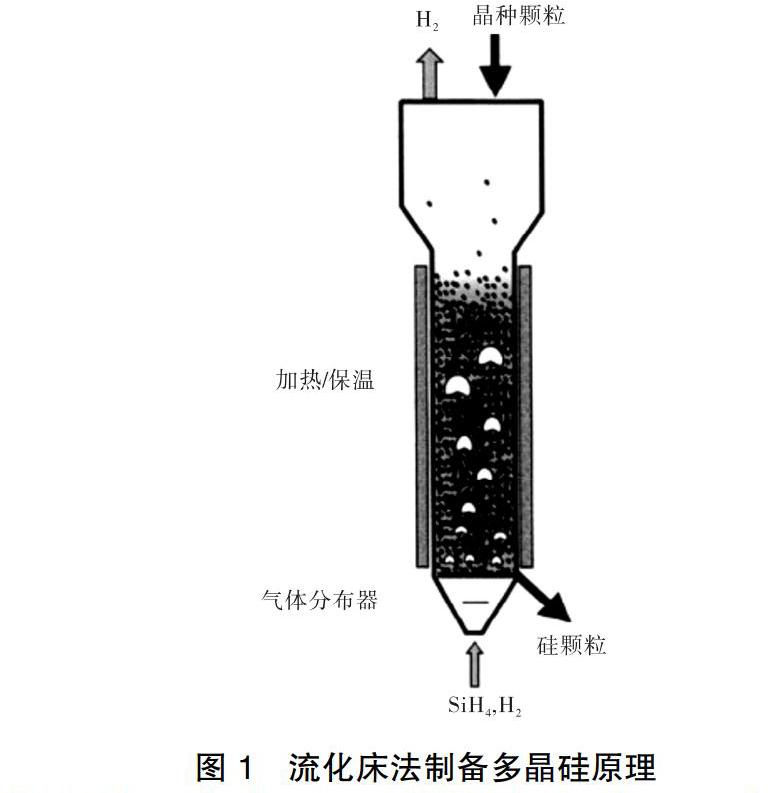
流態化多晶硅制備技術原理如圖1所示,細硅顆粒以一定的速率加入到流化床反應器中,在加熱器和預熱氣體的雙重作用下把床層溫度提高到反應所需溫度。……
登錄APP查看全文
