
Chinese Expeditionary Force in Burma
2015-08-17 15:50:29byNancyGong
China Pictorial 2015年8期
by+Nancy+Gong
During World War II, British-held Burma (todays Myanmar) was a strategic zone linking the China Theater and the Pacific Theater, two major battlefields where Allied forces fought Japan. Even before Japan arrived, it was identified as an important territory of Southeast Asia. In early 1941, China and Britain planned a military alliance to defend Burma. On December 23, 1941, just after the outbreak of the Pacific War, the two countries signed the Sino-British Agreement on the Joint Defense of the Yunnan-Burma Highroad, marking the formation of the Sino-British military alliance. To back British troops anti-Japanese campaigns in Burma and defend Chinas southwestern border areas, the Chinese government deployed the Chinese Expeditionary Force to Burma twice to fight the invading Japanese army, setting an example for military cooperation between China and other Allied countries.
On January 4, 1942, Japanese troops began to invade Burma. The defending British Burma Army was pushed into a continued retreat, and Japanese forces soon closed in on Rangoon. Britain asked China to send troops to support its forces. On February 16, the Military Commission of the National Government of China ordered the 5th Route Army and the 6th Route Army garrisoning the border between Burma and Chinas Yunnan Province to march towards southern and eastern Burma, where they joined the antiJapanese campaigns commanded by Thomas Hutton, commanderin-chief of the British Burma Army.
After Japans attack on Burma, Britain shifted its Far East strategic focus from Singapore to Burma. However, India remained the top priority of its defense plan. For this reason, the British Burma Army chose to retreat when facing Japanese attacks, and never organized effective resistance. In this context, the Chinese Expeditionary Force received no backing from the British Burma Army during their march towards southern Burma. In early May of 1942, the Chinese Expeditionary Force was also forced to retreat because of monsoon season. The retreating Chinese troops had to trek muddy tracks in dense forests and lofty mountains while lacking supplies, resulting in heavy casualties. Some 103,000 Chinese troops initially entered Burma, but only about 40,000 successfully retreated to India and western Yunnan by early August.
During the expedition, the Chinese Expeditionary Force suffered 56,480 fatalities, while the Japanese saw about 45,000 and the British Burma Army over 13,000. The Chinese Expeditionary Force didnt successfully defend Burma, but it did help the British Burma Army win time to retreat to India and organize defense there.
Later, the Chinese troops retreating to India formed the Chinese India Garrison Army. The army was reinforced with newly recruited forces and equipped with American weapons. After specialized training for jungle battles and survival tactics, the fighting strength of the army was considerably enhanced.
In October 1943, the Chinese India Garrison Army began to counterattack Japanese troops in northern Burma. After fierce battle, the army recaptured more than 50 towns in northern Burma and liberated some 80,000 square kilometers of Burmese territory.
Several months after the Chinese India Garrison Army launched the counterattack, the Chinese Expeditionary Force in western Yunnan also began to attack. On May 11, 1944, the Chinese Expeditionary Force crossed the Nujiang River and retook Yunnans Tengchong County on September 14. Later, it recaptured all lost land in western Yunnan. On March 30, 1945, the Chinese Expeditionary Force recaptured Qiaomei in Yunnan, where it met the British army in victory. Later, the Chinese India Garrison Army returned to China in triumph.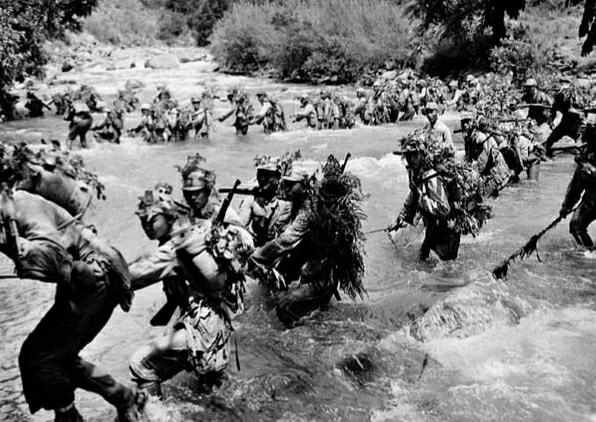
During its expedition to Burma, the Chinese India Garrison Army killed 48,000 Japanese troops but lost 18,000 of its own. Meanwhile, the Chinese Expeditionary Force in western Yunnan killed 21,057 Japanese troops and lost 67,403.
Thanks to the victorious counterattacks launched by the Chinese India Garrison Army and the Chinese Expeditionary Force, the China-Burma-India transport route reopened, through which supplies from the international community arrived in China. The Japanese troops were driven out of southwestern China, heralding the beginning of full-scale counterattack against Japan on the frontline battlefields. Moreover, the Chinese India Garrison Army and the Chinese Expeditionary Force dealt a heavy beating to the Japanese troops in northern Burma and western Yunnan, paving the road for Allied forces to recover the entire territory of Burma.
