暗能量方程
2015-12-11 08:56:41陳建和
湖南師范大學學報·自然科學版 2015年6期
摘要根據ChevallierPolarskiLinder參數化,w(a)=w0+wa(1-a),提出了暗能量壓強方程,p(a)=p0+pa(1-a),由此導出了暗能量密度ρDE、狀態方程(EoS)w、哈勃參數H以及光度距離DL的數學表達式. 所得的定性結果均與當今宇宙學觀測結果一致,而定量結果的誤差小于1%.
關鍵詞暗能量;紅移;光度距離;CPL參數化;暗能量壓強
In1998,Saul, Adam and Brian discovered the accelerating expansion of the universe through observations of distant supernova[12].The dark energy is the most accepted hypothesis to explain the observations since 1990s, indicating that the universe is expanding at an accelerating rate[35].Two proposed forms of dark energy are the cosmological constant and scalar fields[6]. How do dynamical dark energy vary? Measuring the equation of dark energy is one of the biggest efforts in observational cosmolgy[45,710].
Scientists proposed the equation of state (EoS) parameterization.ChevallierPolarskiLinder parameterization is famous. From a joint analysis of the Planck+WMAP+BAO+JLA, scientists obtained best fit parameters for CPL parametrization:w0=-0.957±0.124, wa=-0.336±0.552, see Ref.[3].The uncertainty is great.
In the paper, we proposed an expression for the pressure of dark energy, p=p0+pa(1-a). A series of results we obtained are consistent with the results of current cosmological observations. As for theoretic quantitative results, compared with the observation results, the errors are less than 1%.
1The pressure of dark energy and the results
How evolve the pressure of dark energy with the expansion of the universe?
For the equation of state (EoS)w, the expression of ChevallierPolarskiLinder parameterization is w(a)=w0+wa(1-a), where a is the scale factor of the universe.
We proposed the expression about the pressure of dark energy, p(a)=p0+pa(1-a), where p is the pressure of dark energy and a is the scale factor of the universe.
According to the expression of dark energy pressure, we derived the expression of dark energy density.
Due to p(a)=p0+pa(1-a), so p(a)=p0+pa-paa. While a being zero, the pressure of dark energy is P0. It is obvious P0=p0+pa. While the pressure of dark energy being zero, the scale factor of the universe is A. Then we obtain pa=P0/A.
湖南師范大學自然科學學報第38卷第6期陳建和:暗能量方程We have a new expression of the pressure of dark energy,
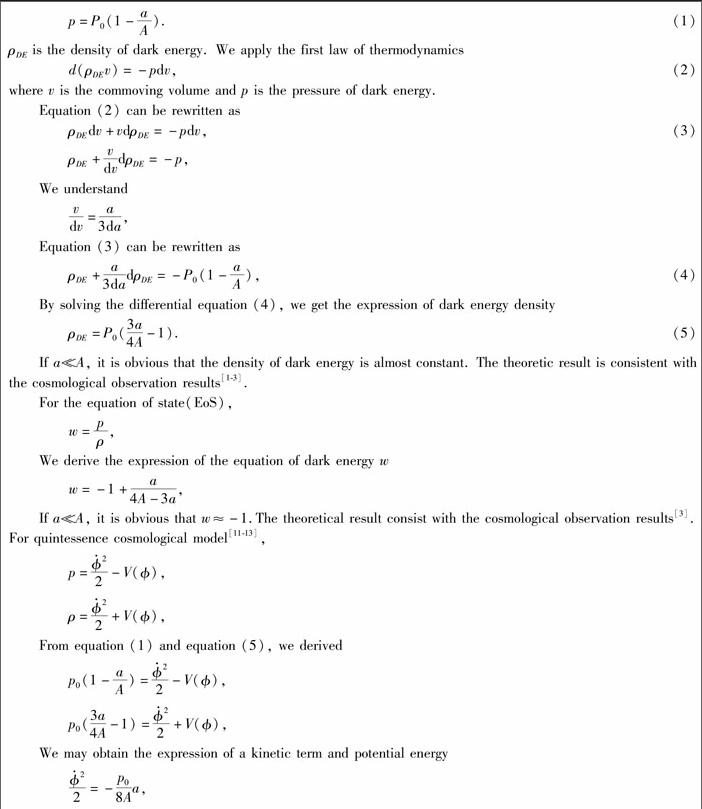
p=P0(1-aA). ?(1)
ρDE is the density of dark energy. We apply the first law of thermodynamics
d(ρDEv)=-pdv, (2)
where v is the commoving volume and p is the pressure of dark energy.
Equation (2) can be rewritten as
ρDEdv+vdρDE=-pdv, (3)
ρDE+vdvdρDE=-p,
We understand
vdv=a3da,
Equation (3) can be rewritten as
ρDE+a3dadρDE=-P0(1-aA),(4)
By solving the differential equation (4), we get the expression of dark energy density
ρDE=P0(3a4A-1).(5)
If aA, it is obvious that the density of dark energy is almost constant. The theoretic result is consistent with the cosmological observation results[13].
For the equation of state(EoS),
w=pρ,
We derive the expression of the equation of dark energy w
w=-1+a4A-3a,
If aA, it is obvious that w≈-1.The theoretical result consist with the cosmological observation results[3]. For quintessence cosmological model[1113],
p=·22-V(),
ρ=·22+V(),
From equation (1) and equation (5), we derived
p0(1-aA)=·22-V(),
p0(3a4A-1)=·22+V(),
We may obtain the expression of a kinetic term and potential energy
·22=-p08Aa,
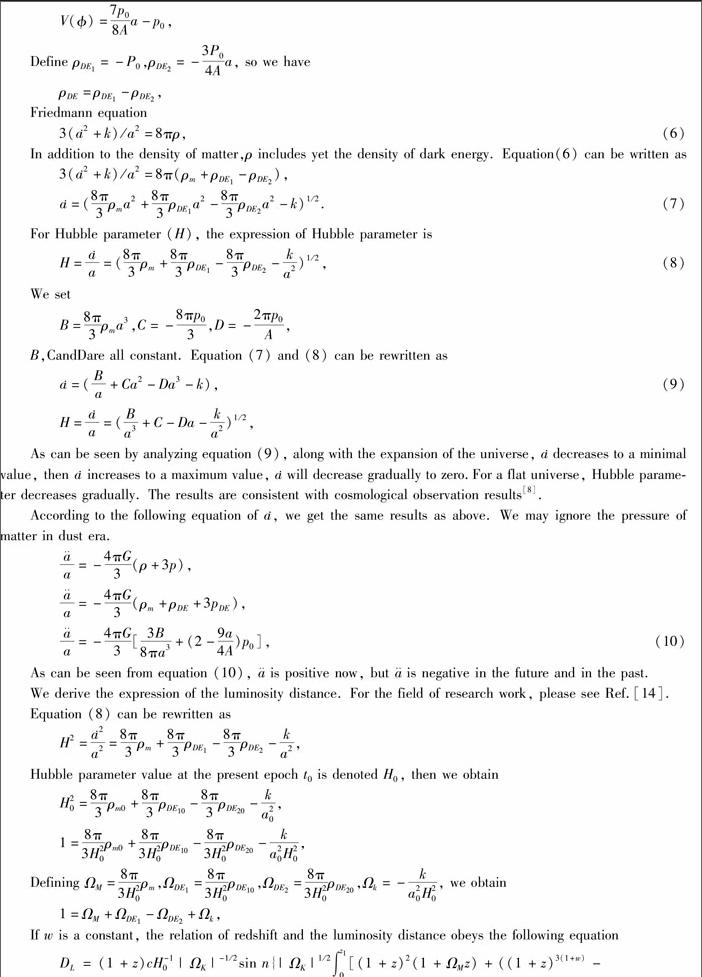
V()=7p08Aa-p0,
Define ρDE1=-P0,ρDE2=-3P04Aa, ?so we have
ρDE=ρDE1-ρDE2,
Friedmann equation
3(2+k)/a2=8πρ,(6)
In addition to the density of matter,ρ includes yet the density of dark energy. Equation(6) can be written as
3(2+k)/a2=8π(ρm+ρDE1-ρDE2),
=(8π3ρma2+8π3ρDE1a2-8π3ρDE2a2-k)1/2.(7)
For Hubble parameter (H), the expression of Hubble parameter is
H=a=(8π3ρm+8π3ρDE1-8π3ρDE2-ka2)1/2,(8)
We set
B=8π3ρma3,C=-8πp03,D=-2πp0A,
B,CandDare all constant. Equation (7) and (8) can be rewritten as
=(Ba+Ca2-Da3-k),(9)
H=a=(Ba3+C-Da-ka2)1/2,
As can be seen by analyzing equation (9), along with the expansion of the universe, ?decreases to a minimal value, then ?increases to a maximum value, ?will decrease gradually to zero.For a flat universe, Hubble parameter decreases gradually. The results are consistent with cosmological observation results[8].
According to the following equation of , we get the same results as above. We may ignore the pressure of matter in dust era.
aa=-4πG3(ρ+3p),
aa=-4πG3(ρm+ρDE+3pDE),
aa=-4πG3[3B8πa3+(2-9a4A)p0],(10)
As can be seen from equation (10), a is positive now, but a is negative in the future and in the past.
We derive the expression of the luminosity distance. For the field of research work, please see Ref.[14].
Equation (8) can be rewritten as
H2=2a2=8π3ρm+8π3ρDE1-8π3ρDE2-ka2,
Hubble parameter value at the present epoch t0 is denoted H0, then we obtain
H20=8π3ρm0+8π3ρDE10-8π3ρDE20-ka20,
1=8π3H20ρm0+8π3H20ρDE10-8π3H20ρDE20-ka20H20,
Defining ΩM=8π3H20ρm,ΩDE1=8π3H20ρDE10,ΩDE2=8π3H20ρDE20,Ωk=-ka20H20, we obtain
1=ΩM+ΩDE1-ΩDE2+Ωk,
If w is a constant, the relation of redshift and the luminosity distance obeys the following equation
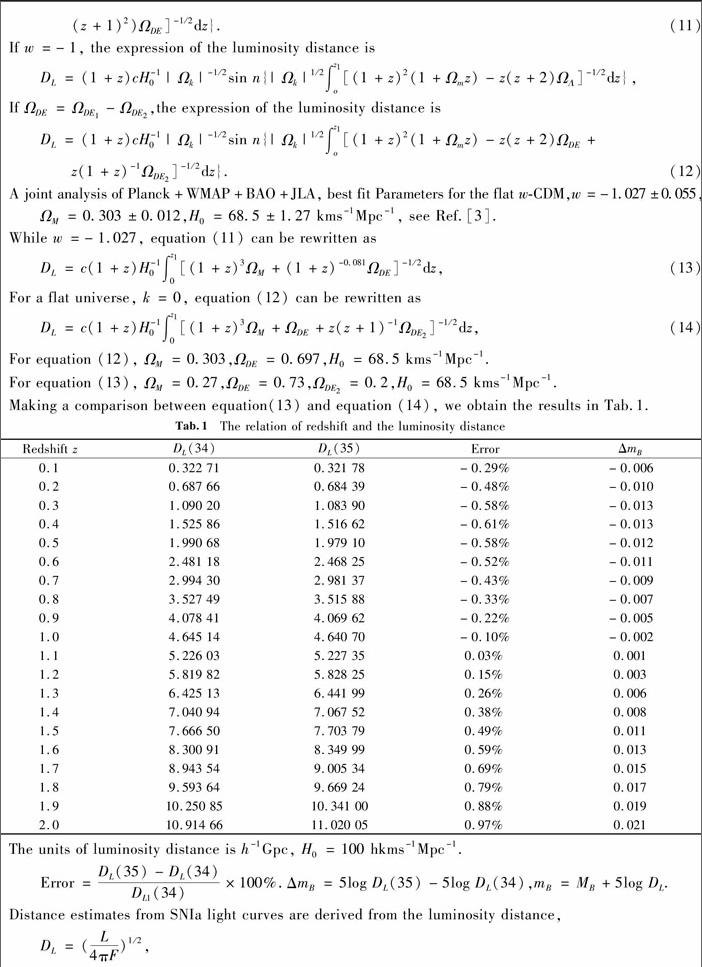
DL=(1+z)cH-10|ΩK|-1/2sin n{|ΩK|1/2∫z10[(1+z)2(1+ΩMz)+((1+z)3(1+w)-
(z+1)2)ΩDE]-1/2dz}. (11)
If w=-1, the expression of the luminosity distance is
DL=(1+z)cH-10|Ωk|-1/2sin n{|Ωk|1/2∫z1o[(1+z)2(1+Ωmz)-z(z+2)ΩΛ]-1/2dz},
If ΩDE=ΩDE1-ΩDE2,the expression of the luminosity distance is
DL=(1+z)cH-10|Ωk|-1/2sin n{|Ωk|1/2∫z1o[(1+z)2(1+Ωmz)-z(z+2)ΩDE+
z(1+z)-1ΩDE2]-1/2dz}.(12)
A joint analysis of Planck+WMAP+BAO+JLA, best fit Parameters for the flat wCDM,w=-1.027±0.055,
ΩM=0.303±0.012,H0=68.5±1.27 kms-1Mpc-1, see Ref.[3].
While w=-1.027, equation (11) can be rewritten as
DL=c(1+z)H-10∫z10[(1+z)3ΩM+(1+z)-0.081ΩDE]-1/2dz,(13)
For a flat universe, k=0, equation (12) can be rewritten as
DL=c(1+z)H-10∫z10[(1+z)3ΩM+ΩDE+z(z+1)-1ΩDE2]-1/2dz,(14)
For equation (12), ΩM=0.303,ΩDE=0.697,H0=68.5 kms-1Mpc-1.
For equation (13), ΩM=0.27,ΩDE=0.73,ΩDE2=0.2,H0=68.5 kms-1Mpc-1.
Making a comparison between equation(13) and equation (14), we obtain the results in Tab.1.
Tab.1The relation of redshift and the luminosity distance
Redshift zDL(34)DL(35)Error ΔmB0.10.322 710.321 78-0.29%-0.0060.20.687 660.684 39-0.48%-0.0100.31.090 201.083 90-0.58%-0.0130.41.525 861.516 62-0.61%-0.0130.51.990 681.979 10-0.58%-0.0120.62.481 182.468 25-0.52%-0.0110.72.994 302.981 37-0.43%-0.0090.83.527 493.515 88-0.33%-0.0070.94.078 414.069 62-0.22%-0.0051.04.645 144.640 70-0.10%-0.0021.15.226 035.227 350.03%0.0011.25.819 825.828 250.15%0.0031.36.425 136.441 990.26%0.0061.47.040 947.067 520.38%0.0081.57.666 507.703 790.49%0.0111.68.300 918.349 990.59%0.0131.78.943 549.005 340.69%0.0151.89.593 649.669 240.79%0.0171.910.250 8510.341 000.88%0.0192.010.914 6611.020 050.97%0.021The units of luminosity distance is h-1Gpc, H0=100 hkms-1Mpc-1.
Error=DL(35)-DL(34)DL1(34)×100%.ΔmB=5log DL(35)-5log DL(34),mB=MB+5log DL.
Distance estimates from SNIa light curves are derived from the luminosity distance,
DL=(L4πF)1/2,
where L and F are the supernova intrinsic luminosity and the observed flux, respectively. ΔmB is the difference of theoretic flux.
In 2004, scientists found the equation of state had possibly crossed the cosmological constant boundary (w=-1) from above to below[15]. In 2013, according to more observations results, they thought the equation of state had possibly crossed the cosmological constant boundary (w=-1) from below to above[16]. Crossed way is different.
In 2014, the observation results from PanSTARRS1 Survey indicated that the value of w was inconsistent with the cosmological constant of -1 at the 2.3σ level, see Ref.[17].
According to Tab.1, we can see that the curve of redshift and luminosity distance by equation(14) crosses the curve of wCDM by equation (13) from below to above, and the curve of redshift and the luminosity distance by equation (14) crosses the curve of redshift and luminosity distance by ΛCDM from below to above. This conclusion is consistent with the result of observations[3,15,17].
2Conclusions
We propose the equation for the pressure of dark energy, a series of results we obtained are consistent with the results of cosmological observations. We found a function p(a) to describe the pressure of dark energy. The results by equation (13) and (14) are very close, so highprecision measurements are required in the future.
3Acknowledgement
I am thankful for professor Zhang Xinmins discussion about crossed the cosmological constant boundary.
References:
[1]RIESS A G, FILIPPENKO A V, CHALLIS P, et al. Observational evidence from supernova for an accelerating universe and a cosmological constant[J]. Astron J, 1998,116(3):10091038.
[2]PERLMUTTER S, ALDERING G, GOLDHABER G, et al. Measurements of omega and lambda from 42 highredshift supernovae[J]. Astrophys J, 1999,517(2):565586.
[3]BETOULE M, KESSLER R, GUY J, et al. Improved cosmological constrains from a joint analysis of the SDSSII and SNLS supernova samples[OL]. arXiv:astroph/1401. 4064 v2.
[4]KOMATSU E, SMITH K M, DUNKLEY J, et al.Sevenyear Wilson microwave anisotropy probe (WMAP) observations[OL]. arXiv:astroph/1001. 4538v3.
[5]PERCIVAL W J, REID B A, EINSENSTEIN D J, et al. Baryon acoustic oscillations in the Solan digtal sky survey date release 7 galaxy sample[J]. Royal Astron Soc, 2010,401(4):21482168.
[6]WEINBERGE D H, MORTONSON M J, EISENSTEIN D J, et al. Observation probes of cosmic acceleration [OL]. arXiv:astroph/1201. 2434v2.
[7]RIESS A G, STROLGER L G, TONRY J, et al. Type Ia supernova discoveries at z>1 [J]. Astrophys J, 2004,607(2):665687.
[8]RIESS A G, STROLGER L G, CASERTANO S, et al. New Hubble space telescope discoveries of type Ia supernovae at z>1:narrowing constrains on early behavior of dark energy[J]. Astrophys J, 2007,659(1):98121.
[9]RIESS A G, MACRI L, CASERTANO S, et al. A redetermination of the Hubble constant with the Hubble space telescope from differential distance ladder[J]. Astrophys J, 2009,699(1):539563.
[10]RIESS A G, MACRI L, CASERTANO S, et al. A 3% solution: determination of the Hubble space telescope and wild field camera 3 [J]. Astrophys J, 2011,730(2):119145.
[11]ALBRECHT A, BURGESS C P, RAVNDAL F, et al. Natural quintessence and large extra dimensions, [J]. Phys Rev D, 2002,65(12):123507.
[12]BARREIRO T, COPELAND E J, NUNES N J. Quintessence arising from exponential potentials[J]. Phys Rev D, 2000,61(12):127301.
[13]ZLATEV L, WANG L M, STEINHARDT P J. Quintessence, cosmic coincidence,and the cosmological constant[J]. Phys Rev Lett, 1999,82(2):896899.
[14]CARROLL S M, PRESS W H, TURNER E L.The cosmological constant [D]. Annu Rev Astron astrophys, 1992,30(1):499542.
[15]FENG B,WANG X L, ZHANG X M. Dark energy constraints from the cosmic age and supernova[J]. Phys Lett B, 2005,607(12):3541.
[16]XIA J Q, LI H, ZHANG X M. Dark energy constraints after planck [OL]. arXiv:astroph/1308, 0188v2.