KIN GDOM OF LINGERIE
2016-01-10 12:15:40ByDavidDawson
漢語世界(The World of Chinese) 2016年3期
By David Dawson

What the Chinese bra market reveals about cultural trends
時尚內衣設計中的女性文化潮流
When Britpop band Suede—arguably the first major Western rock band to perform in China—played their legendary 2003 gig in the capital, a piece of lingerie was thrown onstage, according to Tian Yuan, who was the lead singer for Hopscotch (the now defunct band that supported Suede at the gig).
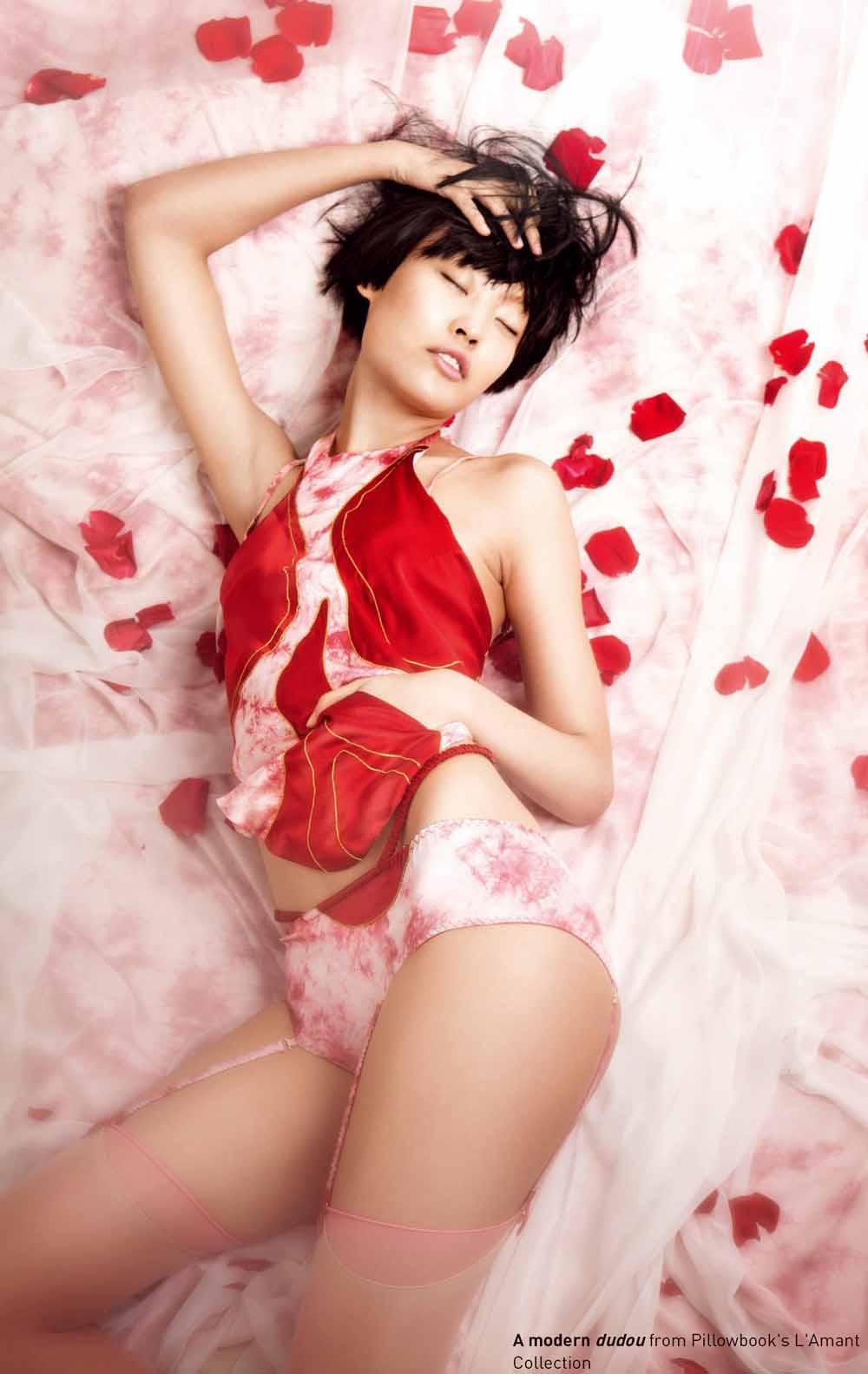
An unremarkable occurrence at many concerts, perhaps, but unheard of in China at the time and still incredibly rare today. Other witnesses report that the precise lingerie thrown may not have been your ordinary cup bra, but a dudou (肚兜), Chinas own unique answer to sexy undergarments—though it is difficult to prove the exact nature of the piece of 13 years later.
Chinese feminists may not have burned bras in defiance of the patriarchy as their 1960s American counterparts did, but China was a very different place at that time. It would, however, be a lazy generalization to imply that the role of Chinese lingerie has remained out of sight entirely in Chinese society, buried beneath layers of clothing and conservatism. The many sex shops that line the streets of Beijing tell a different story and so too do the Chinese companies making massive profits from lingerie being sold not just in China, but also in the developed West and as far away as stallholders in dusty Egyptian towns. While the market in China is set in certain ways, it is the exceptions that make it that much more interesting.
REVEALING HISTORY
Despite its status as a homegrown item of lingerie, the dudou, or literally “belly cover” is a relatively rare garment in modern Chinese society, having long been jettisoned in favor of certain imported aspects of Western lingerie culture—it has, however, lived on as a form of backless top that sometimes contradicts the original designs by exposing the belly.
But evolution is in the very fabric of the garment, having changed multiple times over its very long history. A China Daily report put the origins of the dudou at the Qin Dynasty (221 BCE – 206 BCE), though arguably the report was using the interpretation that gave it the longest possible history, as multiple designs proliferated in the Ming Dynasty (1368 – 1644), and it didnt really become what is generally considered the modern belly cover dudou until the Qing Dynasty (1616 – 1911), when it took the form of the diamond with straps for the neck and back.
Chen Lihua, a Beijing-based clothing designer, told the China Daily that “Young women often wore brightly-colored brocades of red, pink or blue, as well as embroidered flowers, butterflies or mandarin ducks, which symbolize love, on the front of dudou.” He also said that “Many ancient folk designs could be found on a dudou, including peonies, lotuses, cyprinoids, magpies and mythical creatures. The themes were mainly about keeping good fortune and warding off disaster.”
ZhengZhenze, a professor at the Chinese Folklore Society, points out that its modern evolution into something akin to a halter top would have been beyond the pale for those who had worn it in the Qing Dynasty, and been considered “loose women” because it was strictly an underwear item in a conservative era. It would certainly have turned heads at the time, but likely brought about unpleasant repercussions.
The dudou as a lingerie item still has its contemporary devotees. Although niche lingerie designer Irene Lu is not from China herself, when she encountered the dudou she developed an affection for it. “Personally, I think its a beautiful cut,” she told TWOC, indicating that it makes a nice antidote to the “euro-centric” market in China.
Her lingerie company, Pillowbook, frequently uses the dudou as a central design in a deliberate move to differentiate itself from the heavily-padded, less comfortable alternatives that are commonplace throughout China. Indeed, it is the homogeneity of the lingerie market—with Chinese characteristics of course—that drove Lu to start her own company.
UNCOMFORTABLE MARKET
The lingerie market in China is fairly evenly divided between Chinese and Western-owned brands and it is incredibly fragmented, with leading brands occupying four percent of the market at most, according to some frequently-cited estimates from market analysts. But these small pieces can still represent a massive amount of revenue—enough for one of the leading players, Aimer, to invest in a gargantuan factory with fancy architecture near the capital and set up research arrangements with a tertiary education facility.
In Guangdong Province, long Chinas manufacturing hub, the town of Gurao relies upon bra manufacturing. A recent The Economist profile indicated that underwear made up 80 percent of its industrial output, with 350 million bras produced annually as one part of that. As the economy slows down, times are looking grim for these underwear producers clustered around Guangdong, with many factories closing shop.
Citing market research company Frost and Sullivan, The Economist report stated that China makes 60 percent of the worlds bras, producing 2.9 billion in 2014. That number would be roughly enough to provide every single adult woman in the world a bra.
But its important to differentiate between various sections of the market—the purchases of standard bras and underwear for comfort represent very different market trends to racy lingerie items. It is interesting to note that Chinas ongoing corruption crackdown hit many luxury products hard—expensive baijiu liquor saw massive declines, premium cigarette brands suffered and so too did flashy car sales. But racy lingerie sales skyrocketed, likely in large part due to their very nature; while expensive liquor and cigarettes were bought to be passed around at banquets and potentially seen by graft investigators, lingerie was only seen in the bedroom.
Thus, racy undergarments have been seeing solid sales. Aimer, for example, has been known to target well-heeled consumers in malls, using displays complete with customer support via app, and activities like “guess your partners bra size.” These sizes are believed to have increased in recent decades, with most commentators attributing this to coming-of-age of women raised in a healthier economy.
But the sheer size of the market and its fragmentation does not necessarily lead to diversity in terms of form. “When I came to China, I was surprised to find that in such a huge market everything was so similar,” Lu says, adding that from time to time she visits stores specifically to see if anything new has emerged, though it seems rare for that to occur. “Everything has padding” she points out. “I was tired of not being comfortable.”
The Chinese lingerie market is geared toward heavily padded underwire bras to boost bust-lines.? Its a common sentiment, as Chinese pop and sex culture are no less fixated on large breasts than their Western counterparts.
“It can get fairly monotonous with all these heavily padded push-up bras,” Lu says, “Its all about enhancing [bust] rather than embracing.”
In terms of style, colorful, exuberant bra designs are common, particularly in bright colors or patterns like leopard print, in contrast to Western customers looking for lacier designs. When Victorias Secret entered the Chinese market with a local presence in 2015, it stuck strictly to the lower half of the lingerie equation as well as fragrances and beauty products, so it could conduct more research on customer preferences and ensure it didnt miss its mark and dissuade future customers. This comes as UK retailer Agent Provocateur launched its first store in Hong Kong, after already opening several in large mainland cities.
EVOLVING GARMENTS
Lu points out that underwear has changed along with historical trends and that the US market has gone through periods where padded bras were heavily favored as well. “Think about the 1920s, when there was this emphasis on flattened chests, right through to women burning bras in the 1960s. Theres always a link with how women perceive themselves.”
“A lot of it comes down to feminism and women embracing their bodies…These are often highly educated women who are looking for something different.”
She does admit with a laugh, however, that when she decided to launch a lingerie company that moves a bit away from padded designs, “I was told it was impossible.”
She turned her attention toward creating a very niche product—designs made to order from customer preferences, on a much smaller scale than the behemoths with massive factories around Guangdong, and increasingly, in countries in Southeast Asia with lower labor costs.
“Leftover women”(single women over 25 years old who are often put under pressure from meddling parents to get married) are a key market for more creative lingerie ventures, given their growing disposable incomes.
TURNING HEADS
The ways in which businesses explore the changing politics of lingerie, however, arent always sophisticated. In November of 2015, a wily entrepreneur sought to distance himself from his rivals by creating a lingerie-themed bar, photos of which were circulated by the Peoples Daily Online. The bar was filled with various inflatable sex-dolls, all covered with lingerie, and bright pink and black ropes of bras covered the walls and ceilings. Most customers however, appeared to come to have a drink, gawk at the scenery, and leave, rather than it becoming a local cultural icon.
This business move, at least, was more tactful than the plastic surgery clinic which categorized parking spaces by bra cup size, generating more than a little mirth and outrage.
Not all recent projects have created an impression of half-baked get rich-rich-quick schemes, however. In a far more artful presentation, the Peoples Daily early this year reported on the work of artist/jeweler QuanQingsong, who created a wearable bra sculpture made entirely of jade and gemstones, a project that took over three years.
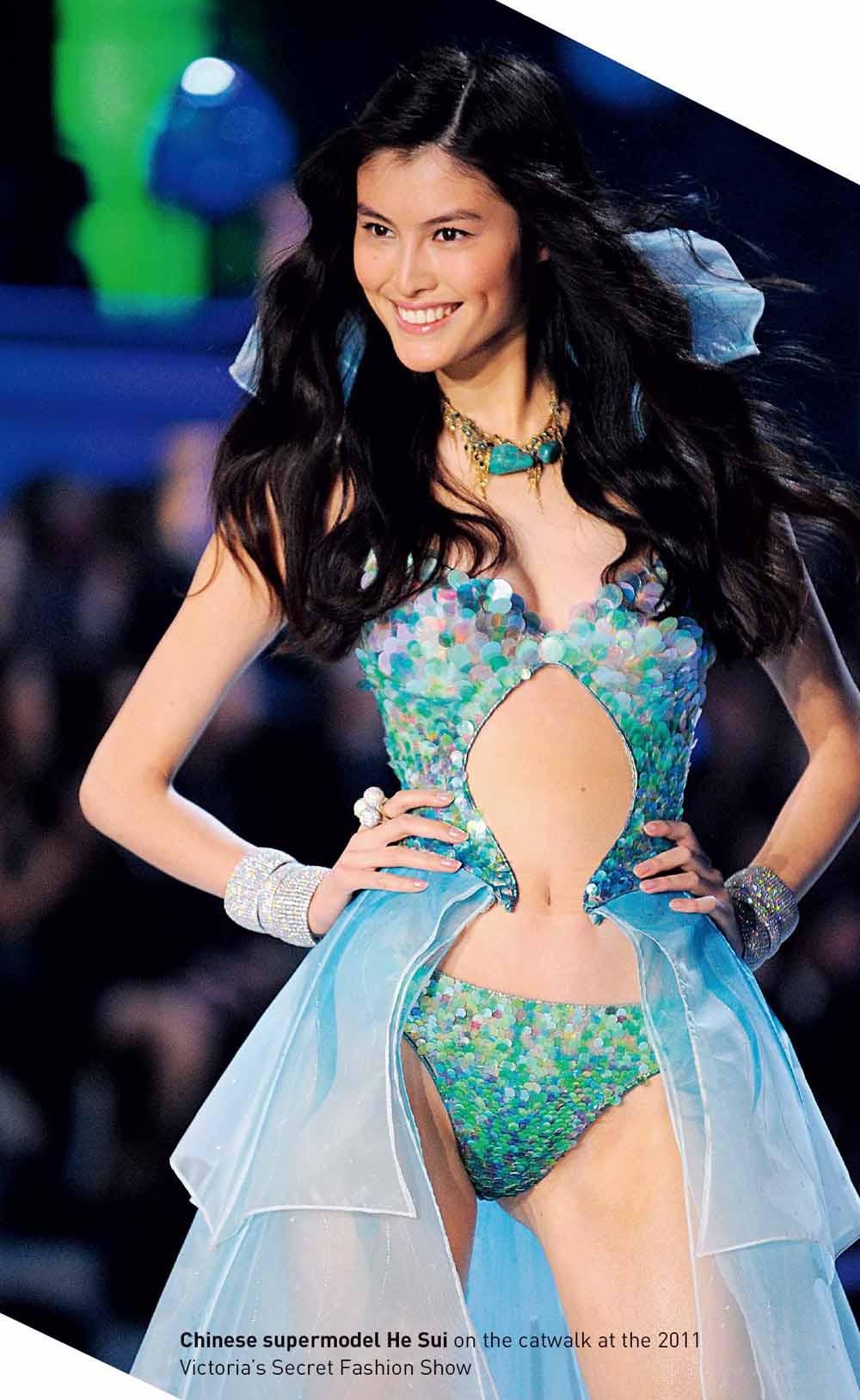
The use of jade put a distinctively Chinese stamp on this piece of lingerie, though arguably, the most visible example of Chinas role in the global lingerie market comes, somewhat ironically, at the US dominant lingerie display, the Victorias Secret Fashion Show. It is now common practice to include Chinese fashion models such as He Sui and Liu Wen on the catwalk, with the company no doubt eyeing the rapid growth and gains to be made in China.
And as the Chinese market grows and evolves so too will its mark on global lingerie culture.
猜你喜歡
中國德育(2022年12期)2022-08-22 06:16:18
湖北教育·綜合資訊(2022年4期)2022-05-06 22:54:06
金橋(2022年2期)2022-03-02 05:42:50
金橋(2022年1期)2022-02-12 01:37:04
現代裝飾(2020年7期)2020-07-27 01:27:42
流行色(2020年1期)2020-04-28 11:16:38
小天使·一年級語數英綜合(2018年9期)2018-10-16 06:30:16
藝術啟蒙(2018年7期)2018-08-23 09:14:18
海峽姐妹(2017年7期)2017-07-31 19:08:17
Coco薇(2017年5期)2017-06-05 08:53:16