
How and Why Sony has expanded its Business in the International Market
2016-04-18 09:11:32YuJian
校園英語·下旬 2016年3期
Yu Jian
1. Introduction
Founded in 1964 in Tokyo, Sony Corporation is one of the world's largest companies. Sony is one of the leading manufacturers of electronics, communication technology, video, video games and various kinds of other products for the consumer and professional markets. Among the most popular products are the TVs, cameras, eBooks, computers, play stations, and home and portable audio devices. From first to last more than sixty years of its development and as a highly responsible global company, Sony has optimal factors of production with which it has been inventing and offering excellent products and services in the international market. Because of this, it has become one of largest, globally accepted entertainment and electronic goods companies, with more than 120 international companies across the world. These include America, the UK and China. Till now, Sonys customers around the world with 70% of sales are from international markets other than Japan(Sony, 2011).
The appropriate choice of Sonys entry into the international market has had a major influence on the success of its international operations. Not only has the company made use of its great potentials in each country, but it has also required a large investment in order to do so, such as financial, human capital, and many other resources. Several factors influence choice when it comes to market entry modes, such a countrys economic environment (taxes), culture, legal obligations and even the companys international strategy (Edwards and Rees, 2006).
This essay mainly focuses on the discussion of how and why Sony has established its current international presence. Particular emphasis will be given to describing and discussing the entry modes of Sony in obtaining access to the markets of America, the UK and China, respectively. Therefore, the rest of the report is organized as follows: After the introduction, the second section will give some information as to why multi-national companies consider it profitable to expand via performing international trade, and the various entry modes associated with it. Sonys past and present entry mode and strategy into America will be discussed. Afterwards, the same will be done for the UK and China. Finally, a conclusion shall be given.
2. The reason of a business likes to expand internationally
There are a lot of reasons that a business organization deems it profitable and beneficial to expand internationally. According to Luo (2003), expanding internationally could give companies the opportunity to acquire more and better quality resources and capital, such as cheaper labour (even if they are unskilled or semi skilled). Similarly, having a global value chain may provide the company with factor endowments and division of labour. Moreover, a business may comprehend customers better by developing market knowledge of foreign and domestic countries as well as receiving customer opinions (through surveys, for example) in order to expand and penetrate foreign markets. Since company domestic markets were saturated, it was a prudent decision for the company to expand internationally and seize new market opportunities that were available.
3. Entry mode for Multi-national Company
In general, a companys entry into a foreign market affects both the companys economic status and that of the country it wishes to invest in to various degrees. It also affects other multinational companies that may want to invest in that country. According to Shenkar and Luo (2004), potential companies that wish to have an international presence, are likely to have the choice between a vast array of entry modes, ranging from non-equity modes such as direct and indirect exporting, contractual forms such as licensing, franchising or creating branches that support equity-based undertakings, such as international joint ventures or wholly owned subsidiaries. The export modes, intermediate modes and hierarchical modes, each of these entry modes differs in terms of risk and profit prospects and thus offers a unique mix of advantages and shortcomings (Anderson and Gatignon, 1986). In general, foreign direct investment involves more input of resources, higher risk, low flexibility, and management has a high level of control over the company whereas non-equity entry modes for companies involve less investment of resources, less risk and much flexibility, but management controls much less than Foreign direct investment (FDI).
4. Sony in the USA
After World War II, Japan had an economic recession, but the economy developed rapidly in the United States (U.S.) at that time period. The American standard of living and income were high which increased their purchase power, resulting in their want to accumulate new and attractive products. Hence, Sonys founder Morita believed that diminutive and practical transistor radios would appeal to Americans. Sony initially was unable to sell its products in the US. That meant that Sony utilized, “dealers” during its venture into the American market, and was able to integrate this product during 1955. However, Sonys growth in the U.S. was not very smooth and there were been some conflicts with dealers. This made Sony consider it necessary to establish their own sales methods. Hence, Sony Corporation of America was established in the United States in February 1960. Then, Sony began and continued on taking upon itself a crazy international role. In 1961, Sony released the American Depositary Receipt (ADR). In addition, Sony built factories in San Diego during 1972 and established assembly lines (Sony America, 2011).
5. Why Sony chose different entry modes in America
Initially, Sony used exports since it was a small company at the time. They needed to sell their products and make the market viable for strategic expansion and create active business opportunities in the U.S. exporting, assisted in achieving this. Sony believed that the profits of establishing manufacturing operations in the U.S. would be greater than the costs. Also, they believed that it would assist them in achieving an economic and experience advantage over their competition. Secondly, Sony stabilised subsidiaries in America even though the company had a great deal of risk in its endeavours, and also possible economic problems resulting from them. However, there was no risk of losing technological and technical competence to competitors. Therefore, Sony constructed a factory, since America sued Sony for using dealers to sell their products in the United States. Also, transporting products to the U.S. market was a huge expense for Sony. Furthermore, the effects of pressure and discontent with their method of exporting (from Internal and external sources) lead the company to perform direct investment in the form of creating a factory. Finally, after the subsidiary companys birth (around 20 years ago), Sony established a strategic foothold in the electronics market of North America.
6. Sony in the UK
According to Root (1987), during the decade of 1960-1970, the British political, economic and social standards were high. This lead to an efficient legal system that ensured a competitive business environment. In addition, foreign investors and local companies in the UK were treated equally. Hence, Sony performed foreign direct investment into the UK market. Specifically, the company used a green-field. Sony UK was established in 1968 in London. In addition, Sony set up factories in the UK. To date, there are two factories, both in Wales, at Bridgend and Pencoed, which, between them, manufacture broadcast cameras, television sets and components. These factories export to other countries around the world.
7. Why Sony chose Foreign Direct Investment in the UK
There are many reasons as to why Sony chose to risk direct investment in the United Kingdom (UK). Firstly, Sony from a small company became a multi-national company around that time. The robust, influential economies as well as the lack of restrictions for foreign companies, made it unnecessary for Sony to form joint ventures with local companies. Secondly, the business environment in the UK provided good competition and development opportunities for foreign companies in the international market. These opportunities include low cost of public facilities, low taxes, a flexible labour market system and quite competitive staff costs. Also, there existed a free motorway, multiple well-structured road networks, undersea tunnels, airports and seaports in the UK to form a fast and efficient transportation system for multinational trading opportunities to be realised and seized. These conditions lead to great benefits for multi-national companies that performed foreign direct investment in the UK. These transportation-facilitating factors made it easy for them to establish operating and transport routines. The key benefit is that Sonys business became localized – Sonys products for customers in the market in which you are trading, become trustworthy and well known. Sony also gained local market knowledge and was able to adapt its products and services to the needs of local consumers. The downside was that the company took on the great risk associated with the local domestic market. Said risk is the great competition between Sony and domestic products at the time.
8. Sony in China
According to Sonys annual reports, Sony is the first Japanese company that entered the Chinese market. Export was the first entry mode that Sony used for some of its professional marketing, in order to make its products and home appliances available internationally, when performing entry to the Chinese market in 1978. That year, China changed its trading policy and allowed foreign imports. After Sony performed entry into China it was able to utilise a vast array of resources available to the company from China. After that, Sony established an office in Beijing, in 1980 in order to coordinate and manage its operations there. This set the foundations for future developments in Sonys expansion into China. One year later, Sony started assembling and fitting units, components and parts of video recorders in Beijing and Shanghai. Following this, Sony performed a joint venture with a local electronics manufacturing company. Sony and Shanghai General Electronics Corporation Limited (Co. Ltd) established a singular company using joint ventures. This company was named soughing factory(Sony invested more than 70% of its resources in its creation). Production lines for consumer products were moved to China rather than just creating a simple assembly in China. Until November 1995, Sonys foreign direct investment only built Sony precision parts in Guangzhou. The situation of “global localization” offered Sony the capability to seize the market opportunity that was available. Sony set up Sony China in order to establish unified management and coordination of business activities in China (during October 1996). This helped the company invest in the electronic information industry, product marketing, customer services and the establishment of a presence in China's domestic market (David, Pan and Kevin, 1997).
9. The reason of Sony into Chinese Market
According to Moore (1963), Sony entered the Chinese market, as they knew it had great size, and thus great potential for profitability. It was also useful for acquiring resources for multiple multi-national companies. Sony also observed that Chinas labour force was much cheaper and had better education compared to all other Asian countries. China had a market of great significance. It had been an indispensable market for the development of Sony throughout its history.
10. Why Sony used different entry modes in China
Sony has utilised both simple and complex methods when it comes to distributing its most popular products to the Chinese market. For instance, exporting, joint ventures and foreign direct investment have been performed in order to achieve Sonys sales expectations. Sony has used a vast array of marketing methods that appeal to customers depending on the economic climate of the time and the business environment associated with it. They acted in this manner because of the following: Firstly, the Chinese government believed that the increase of exports and lessening of imports is a viable method of protecting Chinese enterprises during the 1980s. Hence, exporting was the only way Sony could perform entry to the Chinese market at that time. In addition, Sony formed joint venture operations with local companies in China and invested more than 70% of its resources in the 1990s. However, Sony did not invest fully through foreign direct investment. This happened as there existed restrictions by the Chinese governments policy. During that time, foreign direct investment was not allowed. Compared with developed countries at the time, China industrially could be considered a child and other countries in the world could be considered a strong young man. If all of the foreign multi-national companies entered the Chinese industrial environment, it was believed that they would have dominated the Chinese industry, and influenced it greatly via foreign direct investment and not domestic. This would lead to a lack of control over the industrial resources of China, by the Chinese. The Joint-venture entry mode for Sony has had three main advantages: The local companys cooperation, the low risk of said venture and improved communication and input from local consumers. When Sony entered China, the local companys cooperation was necessary. For example, the Chinese company was capable of negotiating with the government agency (Daniel and Zhang, 2009) and could support Sony in terms of gathering information, creating a better relationship with employees, local partner companies and the present political system. Moreover, the Chinese government lessened their restrictions on foreign investments after the 1990s when international economic integration was becoming more and more important. Sony has had to adapt to the Chinese market and the consumers demand. The only way of doing this was the implementation of the localization strategy. Sony had a position of power and influence in China. This lead Sony to perform its first foreign direct investment into China in order to build a factory. This was the best way for Sony to acquire greater profits, cheaper human resources and reduce its expenditure, despite this endeavour having a high risk factor associated with it (Luo and OConnor, 1998).
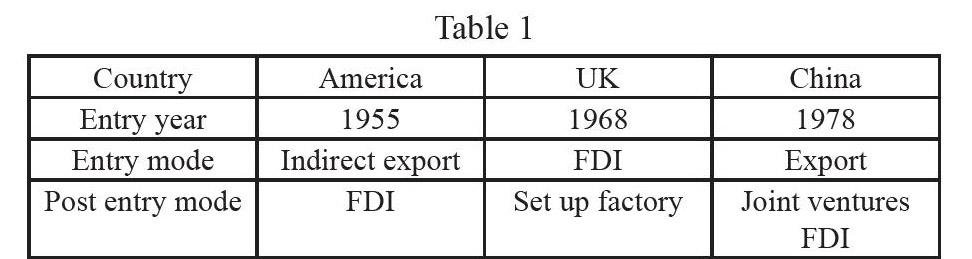
As table 1 shows, Sony has considered the key modes of entry into international markets. On the one hand, Sony's entry into the United States, Britain, and China adopted different modes of entry as countries have different business environments and the required commodities and risks differ vastly. If Sony uses exactly the same entry mode for every country, they will fail in their endeavours. Furthermore, there are three factors that affected Sony in choosing its entry modes in those countries. First of all, the risk of differing investment, legislation and business environments associated with each country. When a country has a high-risk investment and management environment associated with it, Sony would select the entry mode of investing fewer resources to reduce risk associated with its discourse. For example, Sony formed joint ventures with Chinese local companies. Secondly, an Inter-regional difference has always existed between the companys host countries and domestic country (such as culture, religion, work tendencies). When such large differences between regions are apparent, Sony will generally choose a flexible resource-allocation model that adheres to less input in order to reduce the possibility of failure and uncertainty associated with the social and cultural differences in the systems. Thirdly, the intensity of competition is taken into account, when the host countrys market is highly competitive. Then, the firm's profit margins are generally lower. Therefore, Sony has allocated fewer resources to countries that have a high degree of competition for electronic products.
11. Conclusion
The mode of entry is a fundamental decision a firm makes when it enters a new market. This is because the choice of entry automatically constrains the marketing and production strategy of Sony. The mode of entry also affects how Sony faces the challenges of entering a new country and deploying new skills to successfully market its product (Gillespie, Jeannet and Hennessy, 2007). Concluding, the entry mode of a company has a huge impact connected with the host country's political, economic, cultural and business environment. Multinational companies must create and implement marketing strategies that adapt to host countrys environment and possibly even change the existing business model in said countries to suit their purposes.
References:
[1]The information about Sony Corporation[http://www.sony.co.uk/section/about-sony,accessed 15th December,2015].
[2]The information about Sony Corporation of America[http://en.wikipedia.org/wiki/Sony_Corporation_of_America,accessed 15th December,2015].
[3]Anderson,E.and Gatignon,H.(1986)‘Modes of Foreign Entry:A Transaction Cost Analysis And Propositions. Journal of International Business Studies,Vol.17,No.3,pp.1-26.
[4]Daniel,A.and Zhang,Y.(2009)Business Law In China:trade,investment,operations and finance.Second,Revised Edition.
[5]David K.and Pan,Y and Kevin Y.Au.(Winter 1997)‘How MNCs choose entry modes and form alliances:the China experience. Journal of International Business Studies,v28,n4, p779(27).
[6]Gillespie,K.,Jeannet,J.P.and Hennessey,H.D.(2007)Global marketing,second edition,Houghton Miffin Company,Boston.
[7]Luo,Y.(May 2003)‘Market-Seeking MNEs in an Emerging Market:How Parent-Subsidiary Links Shape Overseas Success.Journal of International Business Studies,Vol.34,No.3,pp290-309.
[8]Luo,Y.D.and OConnor,N.(June 1998)‘Structural change to direct investment in China:an evolutionary perspective. Journal of Applied Management Studies,Vol.7,No1,p95.
[9]Moore,T.(1963)China in the world market:Chinese industry and international sources of reform in the post-Mao era / Thomas G.Moore.Cambridge University Press,2002.
[10]ROOT(1987)Entry strategy for international market,2 edition.
[11]Edwards,T.and Rees,C.(2006)International Human Resource Management.
[12]Shenkar,O.and Luo,Y.(2004)International Business.Chapter, 4,96-7.

- 校園英語·下旬的其它文章
- A Discussion on Women’s Right of Disposition on Real Properties in Ming and Qing Dynasties
- 淺談町人社會身份的確立
- The Exploration on the Formation of Wordsworth’s View on Nature
- International Brand Marketing
- A Primary Study on Christian Aesthetic Thoughts of St Augustine
- A Narratological Study of the Book of Job