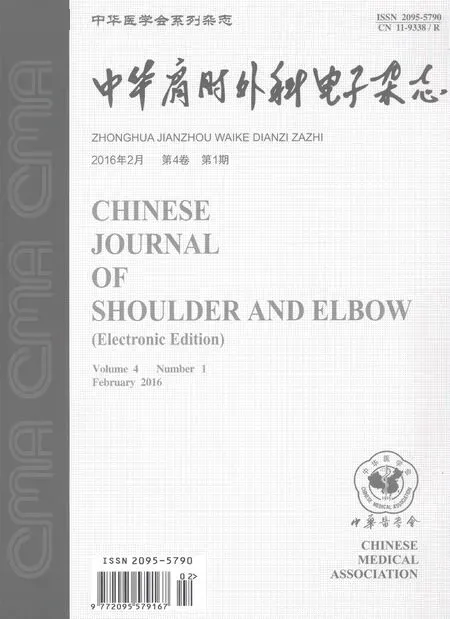
人工肱骨頭置換治療老年肱骨近端陳舊性骨折的療效分析
2016-06-27 08:16:23劉大海李開南母建松蘭海
中華肩肘外科電子雜志 2016年1期
關鍵詞:手術
劉大海 李開南 母建松 蘭海
·論著·
人工肱骨頭置換治療老年肱骨近端陳舊性骨折的療效分析
劉大海 李開南 母建松 蘭海
目的 探討人工肱骨頭置換治療老年肱骨近端陳舊性骨折的手術特點及療效。方法 回顧性分析成都大學附屬醫院2009年1月至2013年12月采取人工肱骨頭置換治療22例肱骨近端粉碎陳舊性骨折患者(陳舊性骨折組),同期治療68例新鮮肱骨近端粉碎性骨折患者(新鮮骨折組),兩組患者進行對比。陳舊性骨折組:Neer三部份骨折6例,四部分骨折16例;骨折時間3~6個月12例, 6~9個月8例,9~12個月2例。新鮮骨折組:Neer三部分骨折23例,四部分骨折45例,其中28例患者伴有肱骨頭脫位。兩組患者均采用同一品牌的骨水泥型人工肱骨頭假體。采用Neer及UCLA肩關節功能評分標準對兩組患者手術前、后隨訪進行評價對比。結果 兩組患者均獲得隨訪,隨訪時間2~6年,平均3.87年。陳舊性骨折組:術后Neer評分平均 82.4分,優良率77.27%;UCLA評分平均 28.9分,優良率72.73%。新鮮骨折組:術后Neer評分平均84.7分,優良率80.88%;UCLA評分平均 30.8分,優良率77.94%。所有患者術后肩關節功能明顯改善,陳舊性骨折組與新鮮骨折組功能評分相比,差異無統計學意義(P>0.05),但陳舊性骨折組患者滿意度比新鮮骨折組高,陳舊性骨折組骨折時間越久,術后肩關節功能越差。結論 人工肱骨頭置換治療老年肱骨近端粉碎陳舊性骨折可取得較好的療效,認真清理肩袖內骨折塊、仔細松解關節囊、精確重建肩袖對肩關節功能的恢復十分重要。
人工肱骨頭;肱骨近端骨折;陳舊性;肩袖
老年陳舊性肱骨近端骨折導致肩關節疼痛、活動功能障礙等問題,嚴重影響患者的生活質量。不管是保守治療還是手術治療,都具有肱骨頭進行重建、并發癥多、發生骨不愈合、肱骨頭壞死的可能性極大等弊端。老年陳舊性肱骨近端骨折常常由于保守治療不當或初次手術失敗所致。對于新鮮的骨折,Wong等[1]用帶鎖髓內釘對二、 三部分肱骨近端骨折進行治療,但骨折塊移位、缺血壞死等發生率仍較高,往往需要二次手術,并且不能應用于四部分骨折。也有學者用閉合復位、微創經皮內固定治療肱骨近端骨折,雖然這樣可以減少對局部血運的破壞,但是并不能減少翻修、二次骨折移位、局部缺血壞死的發生,非計劃性二次手術發生率達到40%[2-4]。而用角鋼板及經皮克氏針鋼絲治療肱骨近端粉碎性骨折,雖然療效前者好于后者,但都因并發癥的出現而停止應用[5]。在陳舊性肱骨近端骨折當中,Parada等[6]用同種異體股骨頭干骺端移植重建肱骨近端進行探索,但由于尺寸不匹配、免疫排除反應及生物力學的問題,治療失敗是不可避免的。
對于關節盂及其軟骨面完整的患者,人工肱骨頭置換則可以起到快速恢復肩關節完整性的作用,它對老年新鮮肱骨近端粉碎性骨折已經取得了肯定的療效[7-8],但對于老年陳舊性肱骨近端骨折的療效報道較少。本研究回顧性分析2009年1月至2013年12月本院采取人工肱骨頭置換手術治療22例老年陳舊性肱骨近端粉碎性骨折患者(陳舊性骨折組),并與同期采取人工肱骨頭置換手術治療68例老年新鮮肱骨近端粉碎性骨折的患者(新鮮骨折組)進行對比,現報道如下。
資 料 與 方 法
一、一般資料
2009年1月至2013年12月,本院選取肱骨近端粉碎性骨折、無關節盂及軟骨面破壞的患者共90例。其中,陳舊性骨折組患者22例,男13例、女9例。年齡70~85歲,平均77.0歲。肱骨近端骨折時間3~6個月12例, 6~9個月8例,9~12個月2例。Neer分型:三部分骨折6例,四部分骨折16例。其中11例患者伴有肱骨頭脫位,5例患者肋骨骨折伴肺挫傷,3例腹部臟器挫傷,1例硬膜外血腫;15例患者有肩部肌肉萎縮,有2例肱骨頭壞死;6例患者有2型糖尿病,都在用口服降糖藥或胰島素治療,其中2例近期血糖控制欠佳,診斷出 1例新糖尿病患者;有7例患者有高血壓,其中5例按規定服用降壓藥,2例間斷服用,所有患者收縮壓均未超過170mmHg;有3例患者同時有上訴兩種內科疾病,2例患者出現過腦中風病史,現遺留有輕度殘疾。新鮮骨折組患者68例,男37例、女31例;年齡70~83歲,平均76.3歲;Neer分型:三部分骨折23例,四部分骨折45例,其中28例患者伴有肱骨頭脫位。術前所有患者肩關節Neer評分均<70分(平均62.3分)、UCLA評分<29分(平均17.1分),內科疾病控制穩定。
二、手術方法
患者仰臥于手術臺,頭側抬高約25°,用軟墊墊于肩胛區及肩胛間區。上臂外展30°,自肩峰與喙突之間,沿三角肌內側緣做一直切口,向下延長至三角肌指點上方2cm處。鈍性分離皮下脂肪組織及淺筋膜,顯露胸大肌及三角肌,沿肌間溝辨認出頭靜脈并加以保護,分離三角肌與胸大肌之間的筋膜,使胸大肌牽向內側,頭靜脈與三角肌一起牽向外側;分離三角肌與鎖骨外側段的附著處,可以更好的顯露肩關節;顯露喙突、前方關節囊、肩胛下肌及其下方的血管,結扎并切斷肩胛下血管。外旋肩關節,于肩胛下肌止點內側2.5cm處縱行切斷肩胛下肌,用縫線標記肌腹,防止肌肉回縮,有利于識別及重新縫合。切開關節囊,找到并暴露肱骨頭,保護好周圍組織,去除肱骨頭及仔細清理關節腔內的碎骨片,修整肱骨殘端及周圍的骨贅,用生理鹽水沖洗干凈。用鈍性分離器分離關節囊與肩袖之間、肩袖肌腱之間的粘連帶,探查周圍肩袖的損傷情況;此手術部分有別于新鮮骨折組。如果大結節或小結節嚴重畸形愈合,則通過截骨,待假體安裝完畢后來恢復結節的位置(此時不離斷肩胛下肌);新鮮骨折組中,即使是大、小結節骨折,也無需截骨。暴露肱骨近端殘端,用手動擴髓鉆將髓腔擴至髓內骨皮質,避免暴力,以免造成肱骨骨折;沖洗干凈后,選取合適尺寸的試模進行預裝,預裝成功以復位后假體后傾約30°,尺寸以活動時肩關節松緊度適中、不脫位為準,取出試模。徹底沖洗后,植入髓腔栓,將調和好的骨水泥灌注入髓腔,采用相同尺寸的Zimmer人工半肩關節,假體柄保持后傾角約30°植入,去除多余骨水泥;再次沖洗關節腔(保證關節腔內無骨水泥及碎骨片),用干紗布包好人工肱骨頭安置在假體柄上,復位人工肱骨頭,將大、小結節骨塊用0.8mm鋼絲固定在肱骨柄假體外側孔,用不可吸收線修復肩胛下肌及岡上肌,對肌腱止點斷裂的部分及斷裂的肱二頭肌肌腱長頭縫在大、小結節復合體上,對肩關節外旋受限者,可在肱骨近端鉆孔將肩胛下肌止點內移固定,修復三角肌鎖骨段;檢查肩關節的活動范圍及松緊度,安置橡膠引流管,逐層縫合傷口,用紗布、繃帶包扎傷口,肩肘帶固定。
三、術后處理
術后第2天根據引流情況拔出引流管,并鼓勵患者下床活動;3d后去除肩肘帶,改用前臂吊帶固定;術后第8天開始在前臂吊帶的保護下,指導患者施行無痛性被動鍛煉及肌力等長收縮鍛煉;術后第4周去除前臂吊帶做肩部鐘擺式活動,逐漸增加被動運動的幅度及肌力鍛煉的強度,但不能主動前屈、外展肩關節;術后6周開始適當主動鍛煉,逐漸增加強度,到半年時達到正常。
四、療效評價
(一)Neer評分
Neer評分為百分制,其中疼痛35分,功能30分,活動度25分,解剖位置10分。90~100分為優,80~89分為良,70~79分為可,<70分為差。
(二)UCLA肩關節評分
UCLA肩關節評分總分為35分,其中疼痛10分,功能10分,活動度5分,力量5分,滿意度5分。34~35分為優,29~33分為良,<29分為差。
五、統計學分析

結 果
一、隨訪結果
本組研究90例患者中有2例出現淺表感染征象,經清創、抗感染處理后痊愈,無1例關節腔感染,住院時間1~3周。所有患者出院后均獲得了門診隨訪,隨訪時間2~6年,平均3.87年,第1、3、6、12個月門診復診,1年后定期電話復診。定期拍攝X線片,1年時X線片顯示有31例患者假體周圍出現了不同程度的透明帶,但假體位置均保持良好,未出現假體松動或假體斷裂的現象,所有病例均未出現脫位表現。在影像學上,陳舊性骨折組中僅有12例患者的大小結節與肱骨近端形成的骨性連接,而新鮮骨折組中有51例患者形成了不同程度的骨性連接。其中陳舊性骨折組有2例、新鮮骨折組有5例沒有達到自身期望值,但術后肩關節疼痛及功能較術前都有明顯的改善,其余均自主滿意。
二、Neer及UCLA肩關節功能評分結果
采用Neer及UCLA肩關節功能評分標準,最后一次評分情況為:(1)陳舊性骨折組:Neer評分優6例,良11例,可3例,差2例,平均 82.4分,優良率77.27%;UCLA評分優4例, 良12例,差6例,平均28.9分,優良率72.73%。(2)新鮮骨折組:Neer評分 優21例,良34例,可9例,差4例,平均84.7分,優良率80.88%;UCLA評分優17例, 良36例,差15例,平均30.8分,優良率77.94%。陳舊性骨折組優良率相近于新鮮骨折組,兩組患者療效差異無統計學意義(P=0.1>0.05,表1、2)。兩組患者手術前、后疼痛及活動度比較見圖1、2。

表1 兩組患者手術前、后Neer評分比較±s)

表2 兩組患者手術前、后UCLA肩關節功能評分比較±s)

圖1 陳舊骨折組與新鮮骨折組手術前、后肩關節前屈(A)、外展(B)活動度比較

注:VAS為視覺模擬評分法圖2 陳舊骨折組與新鮮骨折組手術前、后肩關節疼痛比較
討 論
對于肱骨近端陳舊性骨折患者,由于肩關節長時間制動,損傷的肩袖已經與周圍組織發生粘連,骨質疏松的存在,肩肘肌肉費用性萎縮,大、小結節解剖結構破壞并且畸形愈合,損傷的肩袖及肱二頭肌腱往往被畸形愈合的骨折卡壓等,使肩關節功能受到嚴重影響[9]。因此,陳舊性骨折的手術較新鮮骨折的手術更為復雜。如果上述的問題沒有得到合理的解決,肩關節術后的康復鍛煉幾乎不能實施,手術治療的療效也得不到保證[10]。
陳舊性肱骨近端骨折,如果用鎖定鋼板手術的方式對肱骨近端及肱骨頭進行結構的重建固定,創傷更大且手術困難、骨不愈合風險大[11]。目前,治療該類骨折的手術方式,學者們主要從單純肱骨頭置換和全肩關節置換中選擇[12]。Mercer等[13]提出應考慮肱骨頭置換的情況:(1)肱骨頭關節面粗糙不平,肩胛盂軟骨面完整,有足夠的肩胛盂弧度穩定人工肱骨頭;(2)缺乏足夠的骨質支撐肩胛盂假體;(3)相對于肩胛盂,肱骨頭存在固定上移;(4)對關節功能要求較高,需要負重。相對于全肩關節置換,肱骨頭置換手術有操作難度低、手術出血少、手術時間短、費用低等優點。對于有骨質疏松的患者,肩胛盂的骨質不能支撐關節盂假體。本組病例觀察:陳舊性肱骨近端骨折患者的肩胛盂軟骨面完整,軟骨面周圍有滑膜增生,三角肌攣縮及肩袖損傷、粘連等,具備有單純人工肱骨頭置換的選擇條件。Adams等[14]回顧性研究自1976年至2000年行全肩關節置換術患者65例和行肱骨頭置換的患者45例。全肩關節置換當中骨性關節炎患者占48例(48/65),肱骨頭置換中急性骨折的患者占27例(27/45),全肩關節置換患者的優良率為92%,而肱骨頭置換患者中只有56%滿意,而肱骨頭置換效果不好的原因可能是創傷引起肩關節周圍組織損傷所致。所以,要掌握好肱骨頭置換的適應證,在進行肱骨頭置換或全肩關節置換時,如有肩袖等損傷,都要予以修復。在Gartsman等[15]的研究當中,兩種手術方式術后UCLA及ASES評分沒有顯著差異,如果無肱骨頭置換的禁忌證,可考慮行單純肱骨頭置換手術,為患者及社會減輕經濟負擔。全肩關節置換與肱骨頭置換相比,前者創傷更大、手術時間更長,對于老年人更具有風險性,本組病例全部采用肱骨頭置換手術。對于老年陳舊性肱骨近端骨折,其肱骨骨質疏松較重,肱骨假體柄的固定是手術的關鍵,本組病例全部采用骨水泥固定[16]。肱骨頭的曲率半徑要小于肩胛盂(2~6 mm),如果過小將導致肩關節不穩;過大會使肩胛盂受力不均,增加人工肱骨頭及肩胛盂的磨損,同時還會使肩關節過度填充,影響肩關節功能鍛煉。可使用偏心肱骨頭,盡量使肱骨頭放置于原來的解剖位置[17]。也有學者因為大、小結節的畸形愈合及由此帶來的肩袖退化、攣縮、肩關節粘連等,提倡反置式人工肩關節置換術,以更可靠的恢復肩關節上舉功能,此種方式對肩胛盂有破壞的患者尤其適用;如果患者遠期隨訪出現了假體松動等,需要進行翻修手術,這將會給翻修手術者造成極大的困難或直接失去翻修的機會[18]。對肩胛盂沒有破壞的患者僅采用肱骨頭置換,則是預防此種情況的發生。
與新鮮創傷所致肱骨近端的患者相比,陳舊性肱骨近端粉碎性骨折會有不同程度的合并肩袖損傷、肩袖周圍組織粘連、肌腱卡壓或斷裂、骨折畸形愈合、費用性骨質疏松、肩袖肌肉及三角肌萎縮等,這些因素給人工肱骨頭置換手術增加了難度。困難之處主要表現在以下幾個方面:(1)肩關節周圍組織已發生粘連,對手術層次的清晰度有影響,容易造成周圍血管及神經的損傷;松解關節囊周圍的粘連帶,必定造成組織再次損傷,使手術創傷范圍加大;斷裂的肩袖及肌腱因為肌肉的收縮斷端已經回縮,對損傷肩袖的辨別及修復增加困難。(2)由于肱骨近端的粉碎性骨折,可能已經使骨質的正常解剖結構已經發生的變化,肱骨頭干角及后傾角已經改變,大、小結節已經發生了移位,對解剖結構的定位困難增加,影響截骨、擴髓及安置肱骨柄假體時角度的把握。此時,只有以肱骨髁間軸作為定位標志,將肘關節屈曲90°,上臂外旋30°~35°進行截骨,經擴髓、安置試模后,人工肱骨頭的中心指向肩胛盂最凹點[19]。(3)為了更好的暴露手術視野,可能要對三角肌鎖骨端附著處進行游離,但此處再次縫合時容易產生切割,需將其筋膜間斷縫合;如果大、小結節位移嚴重,需要將其截骨,然后重新鉚定于肱骨柄上。本組22例陳舊性骨折病例中有3例岡上肌腱斷裂、1例肱二頭肌長頭腱斷裂、4例肱二頭肌長頭腱出現骨性卡壓,都得到了修復及卡壓的解除,3例因大、小結節移位嚴重,行截骨、轉位重新固定,無1例出現重要血管、神經損傷。因此,認真清理肩袖內骨折塊、仔細松解關節囊、精確重建肩袖十分重要。
術后康復鍛煉則是肩關節功能恢復的重要環節。應遵循早期、先被動后主動、循序漸進的原則。對于陳舊性骨折的患者,由于長時間的肩關節制動,肩關節周圍肌肉出現了萎縮,同時對肩袖及肌腱進行了修復,開始康復鍛煉的時間較新鮮骨折行肱骨頭置換的患者有所推遲。由于該手術還進行了關節囊及肩周組織的松解手術,這又需要患者進行更早期的康復鍛煉,不然又會使關節囊與肩周組織粘連,影響后期肩關節功能。對于這種情況,提倡患者早期行無痛性康復鍛煉,先行被動活動,再行肌肉等長收縮及主動活動,強度由低到高[20-21]。術后功能的恢復還與患者的配合度有關,如果患者康復鍛煉不足或過度,都將影響人工肱骨頭置換手術的效果。本組有2例對手術效果不滿意,可能與創傷后時間太久及術后康復鍛煉不夠有關。
[1] Wong J, Newman JM, Gruson KI.Outcomes of intra-medullary nailing for acute proximal humerus fractures:a systematic review[J]. J Orthop Traumatol, 2015, 10:35-41.
[2] Ortmaier R, Filzmaier V, Hitzl W, et al. Comparison between minimally invasive, percutaneous osteosynthesis and locking plate osteosynthesis in 3-and 4-part proximal humerus fractures[J]. BMC Musculoskelet Disord, 2015, 16(1): 297-304.
[3] Brunner A, Weller K, Thormann S, et al. Closed reduction and minimally invasive percutaneous fixation of proximal humerus fractures using the Humerusblock[J]. J Orthop Trauma, 2010, 24(7): 407-413.
[4] Brunner A, Thormann S, Babst R. Minimally invasive percutaneous plating of proximal humeral shaft fractures with the Proximal Humerus Internal Locking System (PHILOS)[J].J Shoulder Elbow Surg,2012,21(8):1056-1063.
[5] Edelmann K, Obruba P, Kopp L, et al. Comparison of functional outcomes in Angle-Stable osteosynthesis of comminuted fractures of the proximal humerus with those in percutaneous Kirschner-Wire fixation. a prospective study of Mid-Term results[J]. Acta Chir Orthop Traumatol Cech, 2011, 78(4): 314-320.
[6] Parada S, Makani A, Stadecker MJ, et al. Technique of open reduction and internal fixation of comminuted proximal humerus fractures with allograft femoral head metaphyseal Reconstruction[J]. Am J Orthop (Belle Mead NJ), 2015, 44(10): 471-475.
[7] Sartori E, Fusi M, Gaudenzi A, et al. Long-term results of conservatively treated fractures of the upper end of the humerus[J]. Arch Putti Chir Organi Mov, 1989, 37(2): 389-396.
[8] Bauer O, Horváth I, Kelemen P, et al. Follow-up our patients with proximal humeral fractures between 2000 and 2005[J]. Orv Hetil, 2009, 150(49): 2237-2240.
[9] Den Hartog D, Van Lieshout EM, Tuinebreijer WE, et al. Primary hemiarthroplasty versus conservative treatment for comminuted fractures of the proximal humerus in the elderly (ProCon): A Multicenter Randomized Controlled trial[J]. BMC Musculoskelet Disord, 2010, 11(4): 1-9.
[10] Lübbeke A, Stern R, Grab B, et al. Upper extremity fractures in the elderly: Consequences on utilization of rehabilitation care[J]. Aging Clin Exp Res, 2005, 17(4): 276-280.
[11] Agudelo J, Schürmann M, Stahel P, et al. Analysis of efficacy and failure in proximal humerus fractures treated with locking plates[J]. J Orthop Trauma, 2007, 21(10): 678-681.
[12] Braunstein V. Proximal humerus fractures. Decisive factors for therapy choice, treatment and complications[J]. Unfallchirurg, 2013, 116(8): 680-683.
[13] Mercer DM, Gilmer BB, Saltzman MD, et al. A quantitative method for determining medial migration of the humeral head after shoulder arthroplasty: preliminary results in assessing glenoid wear at a minimum of two years after hemiarthroplasty with concentric glenoid reaming[J]. J Shoulder Elbow Surg, 2011, 20(2): 301-307.
[14] Adams JE , Sperling JW , Schleck CD,et al.Outcomes of shoulder arthroplasty in Olmsted County, Minnesota: a population-based study[J]. Clin Orthop Relat Res ,2007,455:176-182.
[15] Gartsman GM, Roddey TS, Hammerman SM. Shoulder arthroplasty with or without resurfacing of the glenoid in patients who have osteoarthritis[J]. J Bone Joint Surg Am, 2000, 82(1): 26-34.
[16] Jasty M, O′connor DO, Henshaw RM, et al. Fit of the uncemented femoral component and the use of cement influence the strain transfer the femoral cortex[J]. J Orthop Res, 1994, 12(5): 648-656.
[17] Mansat P, Coutié AS, Bonnevialle N, et al. Resurfacing humeral prosthesis:do we really reconstruct the anatomy?[J]. J Shoulder Elbow Surg, 2013, 22(5): 612-619.
[18] Shukla DR, McAnany S, Kim J, et al. Hemiarthroplasty versus reverse shoulder arthroplasty for treatment of proximal humeral fractures: a meta-analysis[J]. J Shoulder Elbow Surg, 2016,25(2):330-340.
[19] Bastian JD, Hertel R. Osteosynthesis and hemiarthroplasty of fractures of the proximal humerus: Outcomes in a consecutive case series[J]. J Shoulder Elbow Surg,2009,18(2): 216-219.
[20] Alta TD, De Toledo JM, Veeger H, et al. The active and passive kinematic difference between primary reverse and total shoulder prostheses[J]. J Shoulder Elbow Surg,2014, 23(9): 1395-1402.
[21] De Toledo JM, Loss JF, Janssen TW, et al. Kinematic evaluation of patients with total and reverse shoulder arthroplasty during rehabilitation exercises with different loads[J]. Clin Biomech (Bristol Avon), 2012, 27(8): 793-800.
(本文編輯:李靜)
劉大海,李開南,母建松,等.人工肱骨頭置換治療老年肱骨近端陳舊性骨折的療效分析[J/CD]. 中華肩肘外科電子雜志,2016,4(1):5-11.
Efficacyofhumeralheadreplacementforthetreatmentofoldfractureproximalhumerusinelderly
LiuDahai,LiKainan,MuJiansong,LanHai.
DepartmentofOrthopedics,theAffiliatedHospitalofChengduUniversity,Chengdu610081,China
Correspondingauthor:LiKainan,Email:likainan1961@126.com
Background Senile proximal humerus old fracture may cause shoulder pain, function limitation and other issues, which seriously affects the quality of life of the patient. This type of fracture was often caused by improper conservative therapy or failure of initial surgery. For patients with intact glenoid and cartilage surface, hemiarthroplasty can quickly restore integrity of the shoulder joint, and its efficacy for senile comminuted proximal humerus fresh fractures has been confirmed. However, there was no report on its effectiveness on senile proximal humerus old fractures. This retrospective study analyzed 22 cases of senile comminuted proximal humerus old fracture patients who
hemiarthroplasty between January 2009 and December 2013 in our hospital (old fracture group), and compared to 68 cases of senile comminuted proximal humerus fresh fracture patients who received hemiarthroplasty at the same time period. The results are reported below.Methods From January 2009 to December 2013, we chose total of 90 cases of proximal humeral fractures with no glenoid and cartilage surface damages, among which there were 22 cases of old fracture patients, 13 cases of male and 9 cases of female, aged 70-85 years old, with average age of 77.0 years old. There were 12 cases of 3-6 months proximal humeral fractures, 8 cases of 6-9 months and 2 cases of 9-12 months. Neer classification: three-part fractures in 6 cases, four-part fractures in 16 cases. There were 11 patients with humeral head dislocation, 5 cases with rib fractures and pulmonary contusion, 3 cases with visceral organ injury and 1 case with epidural hematoma; fifteen patients had shoulder muscle atrophy, and two cases had humeral head necrosis. There were 68 cases in the fresh fracture group, including 37 males and 31 females, aged 70-83 years old, with average age of 76.3 years old; Neer classification: three-part fractures in 23 cases and four-part fractures in 45 cases, including 28 cases of patients with humeral head dislocation. Neer shoulder scores of all patients were <70 before the surgery (an average of 62.3), UCLA score <29 (an average of 17.1). Other medical conditions were stably controlled.Surgical methods: patients are at supine position on the operating table, with head elevated at about 25° and upholstered pads placed under the scapular and inter-scapular region. Arm of the patient is abducted at 30°. A straight incision is made along the inner edge of the deltoid muscle from acromion to the coracoid process, extending down to 2 cm above the lowest point of deltoid muscle, expose the pectoralis major and deltoid muscles, identify the cephalic vein and protect the vein, separate fascia between deltoid and pectoralis major, push the cephalic vein and pectoralis major medially and the deltoid laterally, separate the deltoid attachment at the lateral part of clavicle to better expose the shoulder joint, expose the coracoid process, the anterior joint capsule, subscapularis muscle and blood vessels underneath, ligate the subscapularis vessels, laterally rotate the shoulder, cut the subscapularis muscle at 2.5 cm medial to the lower insertion point of the subscapularis, mark the muscle belly with suture to prevent muscle retraction, which helps to identify and suture the muscle, cut the joint capsule, find and expose the humeral head, protect the surrounding tissue, carefully remove the humeral head and clean intra-articular bone fragments, trim the humeral stump and osteophytes around, rinse with normal saline, separate the tendon adhesions between the joint capsule and rotator cuff and that among tendons of the rotator cuff by blunt dissection, and probe the status of tendon injury around the rotator cuff. The above surgical steps are these that are different from the fresh fracture surgery group. If the greater or the lesser tuberosities have severe malunited, osteotomy is applied and the position of the tuberosities is restored after installation of the prosthesis (not to incise the subscapularis muscle under this condition). For the fresh fracture group, osteotomy is not performed even with greater and lesser tuberosity fractures. Proximal humeral stump is exposed, and manual intramedullary canal reamer is applied to widen the medullary canal to the intramedullary cortex, ensure no large force to avoid new humeral fractures. After rinsing, a prosthesis of an appropriate size is selected for assembly test, and successful assembly test is marked as prosthesis tilted backward at about 30°. A fit size is indicated by moderate tightness of the shoulder joint and no dislocation when moved around, then take out the prosthesis, implant medullary cavity bolt after thorough washing, fill the cavity with mixed bone cement, use the same size Zimmer humeral stem, implant the prosthesis with stem tilted at approximately 30° backward, remove excess bone cement, rinse the joint cavity again (to ensure no intra-articular bone cement and bone fragments), wrap the artificial humeral head with dry gauze and place it on the prosthesis stem, reset humeral head position, immobilize the greater and lesser tuberosities at the side holes on the humeral prosthesis stem with 0.8 mm wire, fix the clavicle end of the deltoid, inspect the range of motion and the tightness of the shoulder joint, install rubber drainage tube, suture wound by layers, dress the wound with bandage, and immobilize the shoulder with an elbow and shoulder strap.Post-operative treatment: drainage tube was removed on the 2nd day postoperatively in accordance with the drainage situation, and the patients were encouraged to get out of bed; shoulder and elbow strap was removed 3 days after the surgery that was replaced by forearm sling; eight days after the surgery, patients were instructed to conduct painless passive exercise and isometric muscle contraction training under the protection of forearm sling; forearm sling was removed at the 4th week postoperatively and pendulum movement of the shoulder was started, gradually increasing magnitude of the passive exercise and the intensity of the muscle training, but no active flexion and abduction of the shoulder joint was allowed; after 6 weeks, appropriate active exercise was started, gradually increasing intensity to reach normal level at 6m after the surgery.Efficacy evaluation: the NEER score system has a total of 100 points, among which 30 points for pain, 30 for function, 25 for activity and 10 for anatomical position. A score of 90-100 is for excellent, 80-89 for good, 70-79 for acceptable, and <70 for poor. UCLA shoulder score has a total score of 35 points, including 10 points for pain, 10 for function, 5 for motion, 5 for strength, and 5 for satisfaction. A score of 34-35 indicates excellent, 29-33 for good and <29 for poor.Statistical analysis: SPSS 17.0 software was used. Measurement data were present as and were compared usingttest.Countdatawerecomparedusing2test.Double-sidedαvalueof0.05wasconsideredstatisticallysignificant.ResultsTwoofthe90patientsinthisstudyhadsignsofsuperficialinfection,whichhealedaftersurgicaltreatment,nocaseofintra-articularinfection,hospitalstayof1-3weeks.Allpatientsreceivedfollow-upafterdischargefor2-6years,anaverage3.87years,outpatientfollow-upatthe1st, 3rd, 6thand12thmonthandtelephonefollow-upafter1year.X-raysweretakenregularly.Aperiprosthetictransparentzoneofvaryingdegreesoccurredin31casesat1year,buttheprosthesispositionsweregood,noprostheticlooseningorfractureinallcases,nodislocationinallcases.Imagingexaminationfoundthatonly12patientsintheoldfracturegroupformedunionbetweenthegreaterandlesstuberositiesandtheproximalhumeruswhilethefreshfracturegrouphad51patientswithvaryingdegreesofunion.Therewere2casesintheoldfracturegroupand5casesinthefreshfracturesgroupwhoseexpectationofthetreatmentresultswerenotmet,butallthesepatientshadsignificantlyimprovedpainandfunctionafterthesurgery.Allremainingpatientsweresatisfiedwiththeresults.NeerandUCLAshoulderfunctionscoringsystemwereusedandscoreofthelasttimewere: (1)theoldfracturegroup:Neerscoreswereexcellentin6cases,goodin11cases,acceptablein3casesandpoorin2cases,withanaveragescoreof82.4,goodandexcellentrateof77.27%;UCLAscoreswereexcellentin4cases,goodin12cases,poorin6cases,withanaveragescoreof28.9,goodtoexcellentrateof72.73%.(2)thefreshfracturegroup:Neerscoreswereexcellentin21cases,goodin34cases,acceptablein9casesandpoorin4cases,anaveragescoreof84.7,goodtoexcellentrateof80.88%;UCLAscoreswereexcellentin17cases,goodin36cases,andpoorin15cases,anaveragescoreof30.8,goodtoexcellentrateof77.94%.Thegoodtoexcellentrateoftheoldfracturegroupwassimilartothatofthefreshfracturegroup.Thetreatmenteffecacywasnotstatisticallysignificantbetweenthetwogroups(P=0.1>0.05).ConclusionsHemiarthroplastytreatmentofsenilecomminutedproximalhumerusoldfracturecanachievegoodefficacy.Carefullycleaningthefracturefragmentsintherotatorcuff,releasingthejointcapsule,andprecisereconstructionoftherotatorcuffisveryimportantforrecoveryoftheshoulderjointfunction.
Artificialhumeralhead;Proximalhumeralfracture;Oboslete;Rotatorcuff
10.3877/cma.j.issn.2095-5790.2016.01.002
國家自然科學基金(81500577)
610081成都大學附屬醫院骨科
李開南,Email:likainan1961@126.com
2015-09-21)
猜你喜歡
環球時報(2022-12-23)2022-12-23 09:28:37
昆明醫科大學學報(2022年1期)2022-02-28 07:45:04
中老年保健(2021年11期)2021-08-22 03:13:36
昆明醫科大學學報(2021年2期)2021-03-29 07:42:46
河北畫報(2020年10期)2020-11-26 07:20:50
小學閱讀指南·低年級版(2017年1期)2017-03-13 20:07:35
中國衛生標準管理(2015年3期)2016-01-14 03:41:47
中國醫療美容(2015年1期)2015-07-12 10:06:38
鄭州大學學報(醫學版)(2015年2期)2015-02-27 14:50:54
西南軍醫(2014年5期)2014-04-25 07:42:48