連續檔導線動剛度計算及模型簡化
2016-10-29 12:27:08劉小會張路飛陳世民嚴波張曉艷
振動工程學報 2016年4期
劉小會 張路飛 陳世民 嚴波 張曉艷
摘要: 為了揭示輸電線路舞動時各檔導線之間的相互影響,以絕緣子串及單檔導線為子結構,建立了諧波激勵下連續檔導線運動的微分方程。通過子結構的力和位移連續條件求解方程,提出了連續檔輸電線動剛度的計算方法。結合有限元方法驗證了連續檔輸電線動剛度計算方法的準確性。結果表明,當動剛度出現極大值時,諧波激勵頻率和該連續檔導線的自振頻率相同,依據這一結論可以獲取連續檔導線的自振頻率。同時,以此為基礎討論了將連續檔導線等效為彈簧質點的可能性,具體算例表明在保證兩者之間靜剛度和頻率相同時,通過調整彈簧剛度比和阻尼可以使兩者之間的動剛度曲線一致。關鍵詞: 輸電線; 舞動; 動剛度; 連續檔; ABAQUS
中圖分類號: TM752+.5; TB123文獻標志碼: A文章編號: 10044523(2016)04072010
DOI:10.16385/j.cnki.issn.10044523.2016.04.020
引言
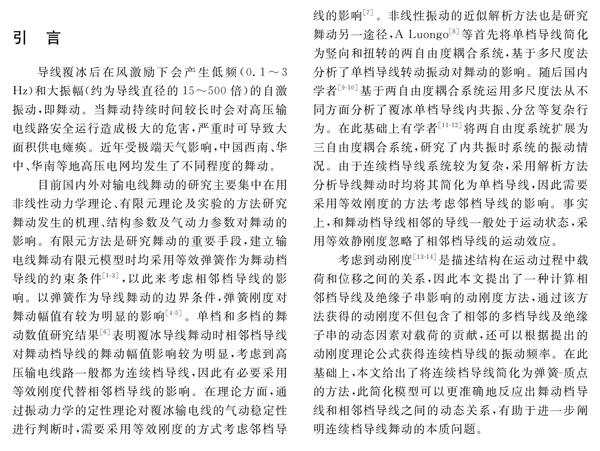
導線覆冰后在風激勵下會產生低頻(0.1~3 Hz)和大振幅(約為導線直徑的15~500倍)的自激振動,即舞動。當舞動持續時間較長時會對高壓輸電線路安全運行造成極大的危害,嚴重時可導致大面積供電癱瘓。近年受極端天氣影響,中國西南、華中、華南等地高壓電網均發生了不同程度的舞動。
目前國內外對輸電線舞動的研究主要集中在用非線性動力學理論、有限元理論及實驗的方法研究舞動發生的機理、結構參數及氣動力參數對舞動的影響。有限元方法是研究舞動的重要手段,建立輸電線舞動有限元模型時均采用等效彈簧作為舞動檔導線的約束條件[13],以此來考慮相鄰檔導線的影響。以彈簧作為導線舞動的邊界條件,彈簧剛度對舞動幅值有較為明顯的影響[45]。單檔和多檔的舞動數值研究結果[6]表明覆冰導線舞動時相鄰檔導線對舞動檔導線的舞動幅值影響較為明顯,考慮到高壓輸電線路一般都為連續檔導線,因此有必要采用等效剛度代替相鄰檔導線的影響。在理論方面,通過振動力學的定性理論對覆冰輸電線的氣動穩定性進行判斷時,需要采用等效剛度的方式考慮鄰檔導線的影響[7]。非線性振動的近似解析方法也是研究舞動另一途徑,A Luongo[8]等首先將單檔導線簡化為豎向和扭轉的兩自由度耦合系統,基于多尺度法分析了單檔導線轉動振動對舞動的影響。隨后國內學者[910]基于兩自由度耦合系統運用多尺度法從不同方面分析了覆冰單檔導線內共振、分岔等復雜行為。在此基礎上有學者[1112]將兩自由度系統擴展為三自由度耦合系統,研究了內共振時系統的振動情況。由于連續檔導線系統較為復雜,采用解析方法分析導線舞動時均將其簡化為單檔導線,因此需要采用等效剛度的方法考慮鄰檔導線的影響。事實上,和舞動檔導線相鄰的導線一般處于運動狀態,采用等效靜剛度忽略了相鄰檔導線的運動效應。
Abstract: In order to reveal the interaction between each span of conductor galloping, the motion differential equation of continuous spans conductor under the harmonic excitation is established by taking insulator string and singlespan conductor as substructure. Continuous conditions for force and displacement of the substructure are utilized to solve the above equation, and then a calculation method for dynamic stiffness of continuous spans transmission line is presented. The accuracy of calculation method for the dynamic stiffness of continuous spans transmission line is proved with the help of finite element method. The result showed that harmonic excitation frequency equals the natural frequency of continuous spans conductor when the dynamic stiffness reaches its maximum value. Based on this conclusion, the natural frequency of continuous spans conductor can be obtained. Moreover, the possibility of simplifying continuous spans conductor as springparticle is discussed on this basis. A specific example given has shown the dynamic stiffness curve of continuous spans conductor and simplified model are uniform by adjusting the spring stiffness ratio and damping under the premise of the same static stiffness and frequency between them.
Key words: transmission line; galloping; dynamic stiffness; continuous span; ABAQUS