
青島靈山灣筏式養殖魁蚶食物來源的季節變動研究
2016-12-21 06:50:18蔡星媛張秀梅劉甜雨李文濤張沛東
海洋學報 2016年12期
蔡星媛,張秀梅,2*,劉甜雨,李文濤,張沛東
(1.中國海洋大學 水產學院,山東 青島 266003;2.青島海洋科學與技術國家實驗室 海洋漁業科學與食物產出過程功能實驗室,山東 青島 266072)
?
青島靈山灣筏式養殖魁蚶食物來源的季節變動研究
蔡星媛1,張秀梅1,2*,劉甜雨1,李文濤1,張沛東1
(1.中國海洋大學 水產學院,山東 青島 266003;2.青島海洋科學與技術國家實驗室 海洋漁業科學與食物產出過程功能實驗室,山東 青島 266072)
魁蚶(Anadarabroughtonii)是我國北方重要的經濟貝類,筏式養殖是其主要的生產方式。2014年5月至2015年1月,測定了不同季節靈山灣筏式養殖魁蚶及其3種潛在食物源(表層顆粒有機物SPOM、底層顆粒有機物BPOM和附著微藻AM)的碳氮穩定同位素(δ13C和δ15N),結合胃含物分析研究了海區食物源結構的季節變化對魁蚶食物組成的影響。結果顯示,魁蚶及其食物源的穩定同位素比值均存在明顯的季節差異,魁蚶的δ13C值(-19.6‰~-19.2‰)介于SPOM(-23.3‰~-21.8‰)、BPOM(-22.1‰~-21.2‰)和AM(-17.0‰~-16.0‰)之間,δ15N值范圍集中在8.7‰~9.9‰。冬季魁蚶的δ13C值最低,δ15N值則最富集。水體顆粒有機物(主要由浮游植物組成)是魁蚶的主要食物來源(60.0%~77.8%),以夏季的餌料貢獻率最高;海區再懸浮作用使BPOM的貢獻率始終維持在較高水平(30.8%~47.1%);而養殖網籠上的附著微藻也可為魁蚶提供約22.1%~40.0%的食物。研究揭示了筏式養殖魁蚶可以混合濾食顆粒有機物和附著微藻,附著微藻是其重要的食物補充。
魁蚶;食物來源;季節變化;筏式養殖;穩定同位素分析;胃含物分析
1 引言
筏式養殖是我國沿海重要的貝類增養殖方式之一。筏養貝類主要濾食顆粒有機物(包括浮游植物、微型原生動物、碎屑等)[1—2]和海底沉積物中再懸浮的底棲微藻[3—4]。同時,浮筏及養殖網籠上的附著生物也可能是浮游動物和濾食性貝類的潛在食物來源[2,5]。然而,目前關于常見養殖貝類食物來源及其組成的相關研究尚不多見[2,6],仍缺乏更多的直接證據來表明附著微藻是養殖貝類的重要食物來源。
傳統的胃含物分析法和新興的穩定同位素技術都可用于評估消費者的食物來源。研究表明,消費者與其潛在食物源之間存在緊密的同位素相似性,通過對碳氮穩定同位素比值(δ13C、δ15N)的測定可以有效反應消費者在較長一段時間內消化吸收的食物來源信息[7—10]。通常,碳穩定同位素比值(δ13C)相對保守,富集度低,可用于反映消費者對所生活海區中不同食物來源的同化吸收情況[10—11];而消費者及其潛在食源間的氮穩定同位素比值(δ15N)則具有明顯的富集現象,多用于營養級的確定[7,12]。胃含物分析法則簡單、直觀地反映了消費者在短時間內的攝食情況,但所需樣本量大,易消化的餌料種類也因不易辨認而被忽略和低估[13—14]。因此,將穩定同位素技術與傳統的胃含物分析法相結合,可以更全面、準確獲得生物棲息地及其營養關系等方面的信息[14],并提供消費者長短期內的有效攝食信息[2]。
魁蚶(Anadarabroughtonii)作為一種經濟價值較高的海產濾食性貝類,近年來已成為我國北方重要的增養殖品種,養殖面積和產量均呈現明顯增加趨勢[15],筏式養殖也是其主要的生產方式之一[16]。本研究選擇青島靈山灣筏式養殖魁蚶為研究對象,運用穩定同位素技術和胃含物分析法比較了魁蚶及其潛在食物源碳、氮穩定同位素比值的季節變化,并評估了海區內浮游植物和附著微藻對筏養魁蚶的餌料貢獻率,旨在為全面了解魁蚶的食物關系,明確筏式養殖海區的食物網結構,構建貝類健康增養殖模式提供參考依據。
2 材料和方法
2.1 采樣海區概況及樣品處理
實驗地點選在山東省青島市膠南靈山灣筏式養殖區(35°54.590′N,120°07.630′E附近水域;水深4.8~6.7 m)(圖1)。根據2014年5月至2015年1月對筏養區內環境指標的逐月監測,水溫4.74~25.21℃,夏季7、8月達到最高,冬季1月為最低;鹽度29.27~30.32;pH 7.90~8.25;葉綠素a含量1.35~6.31 mg/m3,平均值2.97 mg/m3,在8月和翌年1月達到峰值,分別為3.45 mg/m3和6.31 mg/m3;顆粒物質量(SESQ)[17]為0.30~1.44 μg/mg,始終處于中等水平以上。
于2014年5月(春)、8月(夏)、11月(秋)和2015年1月(冬),分別在筏式養殖區內開展4個季節魁蚶及潛在食物源的取樣。每次分別采集同批次投放的筏養魁蚶15~20只,清除表面附著物,用游標卡尺(精確到0.01 cm)和電子天平(精確到0.01 g)量取魁蚶殼長、殼寬、殼高和體質量等生物學數據(表1)。解剖魁蚶取其閉殼肌,超純水沖洗除鹽,60℃下烘干待測。5~6只魁蚶的肌肉混為一個樣品,共3個平行樣。
魁蚶的潛在食物來源包括表層顆粒有機物(surface particular organic matter:SPOM)、底層顆粒有機物(bottom particular organic matter:BPOM)和附著微藻(attached microalgae:AM)。分別采集筏養區表層(距水面0.5 m處)和底層(距沉積物0.5 m處)的海水,200 μm篩絹過濾后,用Whatman GF/F玻璃纖維濾膜(450℃預先灼燒5 h)抽濾,膜樣品即為SPOM和BPOM。同時,隨機從采樣點的魁蚶網籠附近收集大型藻類、養殖籠網衣及錨繩,帶回實驗室后用清水泡洗,再用刀片輕輕將大型藻類、網衣及錨繩上的附著微藻刮取;將采集的溶液200 μm篩絹過濾后,抽濾至GF/F濾膜上,膜樣品即為AM。所有食物源樣品各設3個平行樣。
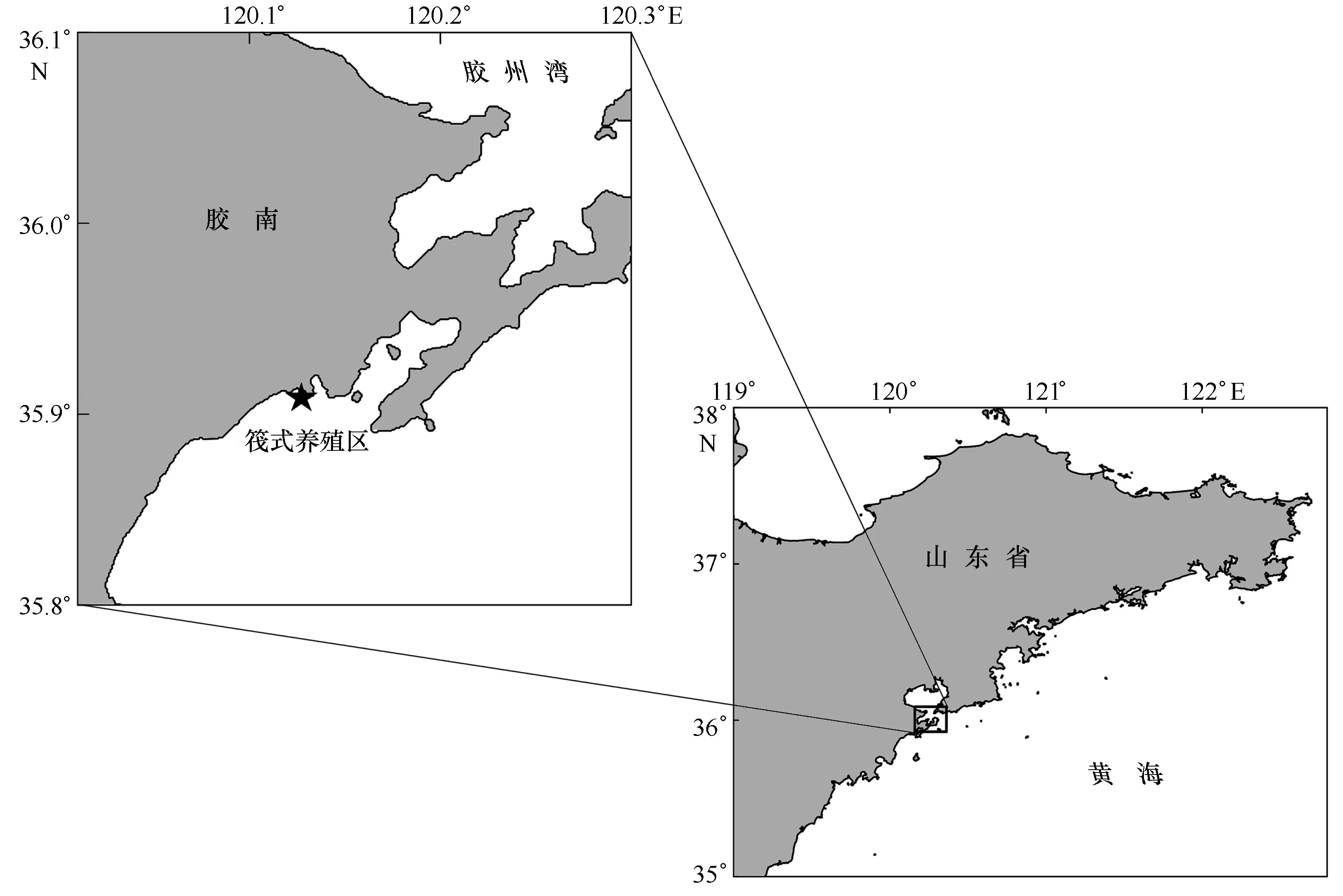
圖1 實驗研究海區及采樣點Fig.1 Location of sampling station
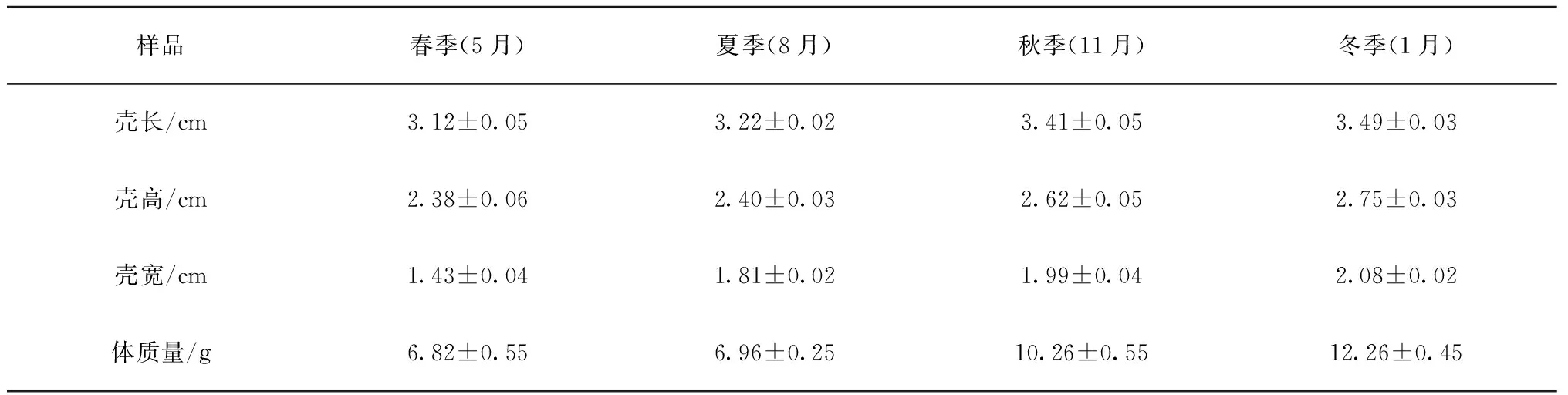
樣品春季(5月)夏季(8月)秋季(11月)冬季(1月)殼長/cm3.12±0.053.22±0.023.41±0.053.49±0.03殼高/cm2.38±0.062.40±0.032.62±0.052.75±0.03殼寬/cm1.43±0.041.81±0.021.99±0.042.08±0.02體質量/g6.82±0.556.96±0.2510.26±0.5512.26±0.45
2.2 穩定同位素分析
將所有樣品(包括魁蚶和食物源樣品)放置于60℃烘箱內烘干至恒重,魁蚶閉殼肌經石英研缽充分研磨后用脫脂溶液(甲醇∶氯仿∶水=2∶1∶0.8)浸泡除脂[18]。所有樣品研磨后用1 mol/L鹽酸酸化[19],每隔10 min混勻一次,直至沒有氣泡產生,然后用超純水反復沖洗[6],再次烘干,研磨,存放于玻璃瓶中,干燥保存,待測。
所有樣品的穩定同位素比值(δ13C、δ15N)采用穩定同位素質譜儀(MAT 253,Thermo Finnigan,美國)測定。該同位素質譜儀的外部設備是Flash EA1112元素分析儀。δ13C、δ15N表示樣品與標準物質間的差異千分比,即:

(1)
式中,Rsample表示樣品實際測得的同位素比值(R=13C/12C or15N/14N),Rstandard表示國際通用標準物(V-PDB標準物或標準大氣氮氣)的重輕同位素豐度之比。為保證儀器穩定性及實驗結果的準確性,每測試5個樣品后,插入1個標準樣品測定,且個別樣品進行復測。δ13C和δ15N值的測試精度分別小于0.1‰和0.2‰。
使用IsoSource程序[20]分析不同食物源對魁蚶的餌料貢獻度及其季節變化,碳穩定同位素比值的分餾度按0.8‰計算[2,21]。模型計算時,采用的Increment值和Tolerance值分別為5%和0.05。
2.3 胃含物分析
每個季度取9只規格相似的魁蚶,用解剖刀將胃剪開,輕輕刮取胃內含物,并用洗瓶反復沖洗,直至胃內流出清澈液體。將沖洗所得的液體用5%的甲醛溶液固定保存,沉淀24 h后在光學顯微鏡下進行物種鑒定和計數。浮游植物鑒定到屬。
2.4 數據分析處理
所有數據以平均值±標準誤差(X± SE)表示,使用Excel 2013和SPSS 20.0進行數據統計分析,顯著性水平P<0.05。選用單因素方差分析(One-way ANOVA,Duncan檢驗)比較了3種食物源(SPOM、BPOM和AM)碳、氮穩定同位素比值(δ13C、δ15N值)的季節差異,并比較了不同季節間魁蚶穩定同位素比值的差異。
3 實驗結果
3.1 魁蚶和3種食物源的穩定同位素特征及其季節變化
筏式養殖魁蚶及其潛在食物源碳、氮穩定同位素比值(δ13C和δ15N)的測定結果如表2所示。魁蚶的碳同位素比值存在明顯的季節差異(P<0.05),冬季的δ13C值僅為-19.6‰,顯著低于秋季的-19.2‰,而與春、夏季無明顯差異。魁蚶的氮同位素比值在8.7‰~9.9‰間波動,季節差異明顯(P<0.05)。春、夏季的δ15N值顯著小于秋、冬兩季,以冬季的δ15N值富集最多,為9.9‰。
3種潛在食物源的δ13C、δ15N值也存在著顯著的季節差異(P<0.05,表2,圖2),SPOM、BPOM和AM的δ13C值變化范圍依次為-23.3‰~-21.8‰、-22.1‰~-21.2‰和-17.0‰~-16.0‰,三者的δ13C富集依次增大,因此利用δ13C值可以基本將3種食物源區分開。其中,SPOM和BPOM的δ13C值均在夏季達到最大,分別為-21.8‰和-21.2‰,AM的最大值則出現在冬季,為-16.0‰。3種食物源δ15N值的變動范圍則依次是5.9‰~7.1‰、6.5‰~8.0‰和4.0‰~7.4‰。食物源的δ15N值間存在交叉,但均小于魁蚶。單因素方差分析結果亦表明,相同季節3種食物源的δ13C和δ15N值差異顯著(P<0.05)(表2,圖2)。
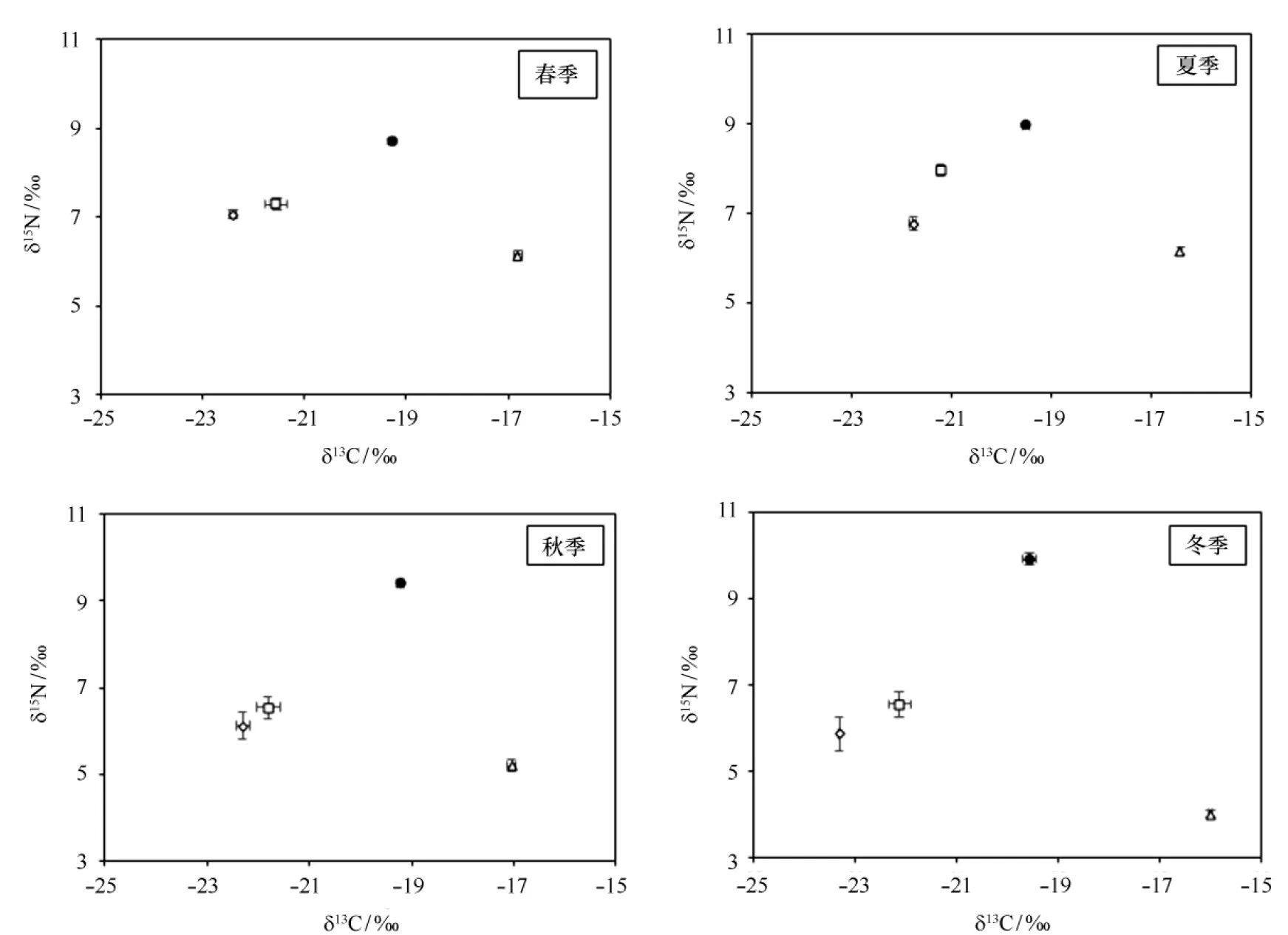
圖2 魁蚶和3種食物源的穩定同位素特征值及其季節變化Fig.2 Seasonal changes in stable isotope values of A. broughtonii and their food sources●:魁蚶;◇:表層顆粒有機物;□:底層顆粒有機物;△:附著微藻。誤差線表征δ13C、δ15N的標準誤差●:A. broughtonii; ◇:SPOM (surface particular organic matter); □:BPOM (bottom particular organic matter); △:AM (attached microalgae). Error bars indicate standard deviations
3.2 3種食物源對魁蚶的營養貢獻及其季節變化
3種潛在食物源對魁蚶的餌料貢獻率如圖3所示。在4個季節里,水體顆粒有機物(主要是浮游植物)的餌料貢獻率均高于附著微藻,依次為63.3%(春)、77.8%(夏)、60.0%(秋)和65.0%(冬),其中以夏季的貢獻率最高。AM的餌料貢獻率則分別為36.7%(春)、22.1%(夏)、40.0%(秋)和35.0%(冬),以秋季最大。SPOM和BPOM對魁蚶的餌料貢獻率也存在季節差異,SPOM的貢獻率僅在春季高于BPOM(32.5%>30.8%),其余均小于或等于BPOM。夏季BPOM對魁蚶的貢獻率高達47.1%,顯著高于其他季節。
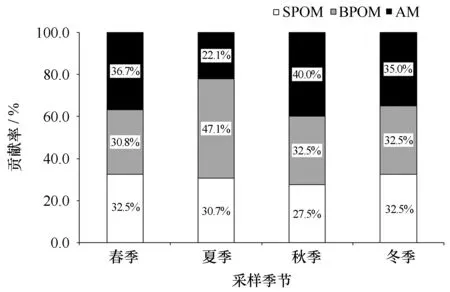
圖3 基于穩定同位素分析的不同季節3種食物源對魁蚶的餌料貢獻率(%)Fig.3 Seasonal changes in contribution (%) of three food sources of A. broughtonii by using stable isotopes analysisSPOM. 表層顆粒有機物;BPOM. 底層顆粒有機物;AM. 附著微藻SPOM. surface particular organic matter; BPOM. bottom particular organic matter; AM. attached microalgae
3.3 不同季節魁蚶胃含物組成
魁蚶胃含物中共鑒定出浮游植物2門18屬(表3)。春季:浮游植物共12屬,其中硅藻11屬,甲藻1屬。胃含物中浮游植物所占比例為54.6%,附著微藻約36.2%,其他類占9.2%。夏季:浮游植物共13屬,其中硅藻11屬,甲藻2屬。胃含物中浮游植物所占比例為66.8%,附著微藻約20.0%,其他類占13.2%。秋季:浮游植物共11屬,其中硅藻10屬,甲藻1屬。胃含物中浮游植物所占比例為54.3%,附著微藻約35.1%,其他類占10.6%。冬季:浮游植物共12屬,其中硅藻11屬,甲藻1屬。胃含物中浮游植物所占比例為61.0%,附著微藻約32.2%,其他類占6.8%。
魁蚶胃含物中4個季節均能檢測到的主要硅藻類餌料包括圓篩藻屬、舟形藻屬、曲舟藻和菱形藻屬的種類,其他未鑒定種主要包括纖毛蟲殘體、少量無脊椎動物卵和有機碎屑等。魁蚶胃含物中附著微藻的比例與穩定同位素分析中的AM餌料貢獻率相似(圖3,圖4)。
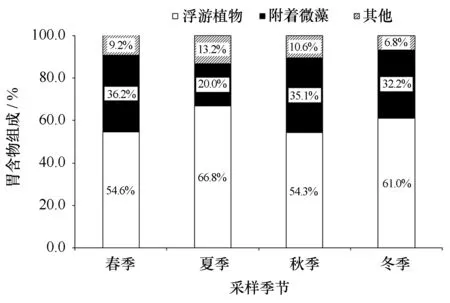
圖4 魁蚶胃含物組成及其季節變化Fig.4 Seasonal changes in the composition of stomach contents of A. broughtonii
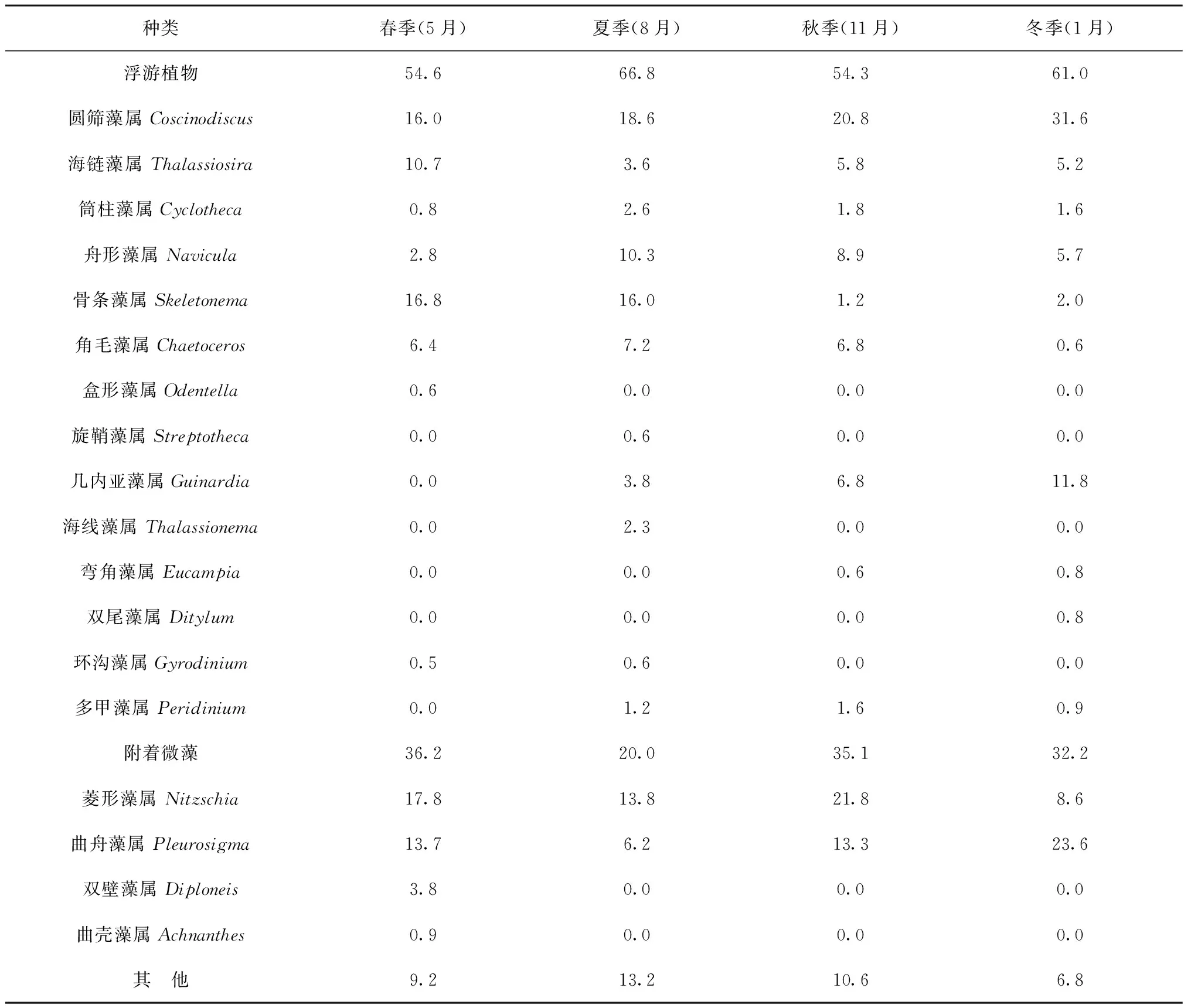
單位:%
4 討論
4.1 魁蚶及其食物源同位素特征值的季節差異
養殖海區食物組成及其可利用性的季節差異會對雙殼貝類的生長、存活產生影響[30—32]。消費者穩定同位素比值的季節差異可以有效表征食物可利用性的變化[30]。研究結果顯示,冬季筏養魁蚶的δ13C值顯著低于其他季節,這在尖角江珧蛤(Pinnanobilis)[33]、長牡蠣(Crassostreagigas)和大西洋舟螺(Crepidulafornicata)[34]同位素特征的季節性研究中也有報道,推測是因為冬季海區的浮游植物種類、生物量較少,導致筏養魁蚶的潛在餌料相對缺乏,食物限制效應突出。Riera對法國Mont Saint Michel海灣3種常見濾食性貝類(Crassostreagigas,Crepidulafornicata和Mytilusedulis)食物網的研究[35]也證實了該推測。魁蚶δ15N值的顯著季節差異亦進一步佐證了海區食物組成及其可利用性的季節變動對消費者穩定同位素比值的影響。
4.2 魁蚶及其食物源間的營養關系
一般認為,養殖貝類混合濾食水體中的顆粒有機物、底棲微藻和附著生物等,不同食物源對貝類的餌料貢獻率與其分布海區餌料食物的生物量組成和季節性變化密切相關[22],并受貝類的濾食偏好性影響[36](表4)。相比于δ13C值較低的陸源顆粒有機物,濾食性貝類更偏好δ13C值較高的海洋浮游植物和底棲微藻等。對菲律賓綴錦蛤(Tapesphilippinarum)食物組成的周年監測發現,底棲微藻和海源顆粒有機物對其餌料貢獻率存在季節差異,但始終維持在41.2%~65.1%和25.7%~49.2%之間,均遠高于河口顆粒有機物的貢獻率[3]。除冬季外,底層顆粒有機物對韓國Sunjae Island海區潮間帶養殖的菲律賓蛤仔(Ruditapesphilippinatum)的餌料貢獻率均維持在一個較高水平,尤以夏、秋季最高,分別達到了95.2%和94.4%[32],可見底層顆粒有機物是濾食性貝類重要的食物組成。而附生微藻對海南新村灣海草床中魁蚶的餌料貢獻率達到了33.6%,高于其他餌料組分[37]。Zhao等[38]對中國北方莊河灣潮間帶6種常見養殖貝類食物來源的研究也指出,顆粒有機物的相對貢獻率達到了71.6%,顆粒有機物是養殖貝類重要的食物組成[39]。在本研究中,筏養魁蚶以養殖水體中的顆粒有機物(主要是浮游植物)為主要食物來源(54.3%~66.8%),同時也濾食附著微藻(22.1%~40.0%),附著微藻是筏養魁蚶重要的食物來源之一。胃含物分析也發現,魁蚶的餌料組成相對簡單,主要以植物性餌料為主,兼食動物性餌料,硅藻是其主要濾食種類,包括圓篩藻屬、舟形藻屬、曲舟藻屬、菱形藻屬和骨條藻屬的種類。其中,附著微藻占魁蚶胃含物的比例約為20.0%~36.2%,與穩定同位素分析中附著微藻的餌料貢獻率相似。
在淺海養殖水域,由于風浪作用、低潮潮汐和間歇性大風大雨等氣象條件變化,極易引起海區沉積物的再懸浮[40],進而影響可供濾食性貝類攝食的餌料質量和數量[4,41]。因此,本研究將顆粒有機物進一步劃分為表層顆粒有機物和底層顆粒有機物。在靈山灣筏式養殖區內,因水深較淺(4.8~6.7 m),底棲微藻再懸浮后向上運輸,成為底層顆粒有機物的有效組分,極易被魁蚶濾食。本研究發現,底層顆粒有機物對筏養魁蚶的餌料貢獻率始終維持在較高水平(30.8%~47.1%),特別是春季過后,大風大浪和暴雨等極端天氣時有發生,養殖區的再懸浮作用增強,使更多的底層顆粒有機物被魁蚶濾食,并在夏季達到最大值47.1%。
研究發現,浮筏及網籠等結構物上的附著微藻也是魁蚶的重要食物來源,通常認為,貝類的濾食作用加劇了周邊水體的流動,使網籠及浮筏上的附著微藻被剝落、脫離,再懸浮后可以被魁蚶直接濾食。研究表明,貝類具有極強的濾水能力,如貽貝(Mytilusgalloprovincialis和Mytilusedulis)和蛤仔(Tapessp.)的濾水率均可達到5 L/(g·h)[42],小規格魁蚶(殼長11.8 mm)的濾水能力也達到1.89 L/(g·h)[15]。因此,筏養魁蚶可以充分過濾周圍水體,使網籠等養殖結構物上的附著微藻通過再懸浮作用而被濾食。而養殖網籠上通常也會附生大量的濾食性污損生物,包括藤壺類、海綿生物、牡蠣等無脊椎動物幼體和一些大型海藻等[43]。這些附著性污損生物會使網籠內外水體交換不暢,并與養殖魁蚶形成食物競爭關系,對魁蚶的濾食作用產生影響[44—45]。當網籠表面被高密度的污損生物附著時,勢必會降低魁蚶對水體的直接過濾效率,只能以網籠上再懸浮的附著微藻為食。已有研究指出,污損生物的種類和數量具有明顯的季節變化,夏、秋季顯著多于春、冬兩季[46],所以在夏、秋季,養殖網籠內外水體交換差,魁蚶與污損生物的食物競爭關系增強,進而使魁蚶對附著微藻的濾食率增加,這也解釋了本研究中,秋季附著微藻對魁蚶的餌料貢獻率明顯高于其他季節,達到40%。但在實際的養殖生產中,養殖戶會定期清理網籠和浮筏上的污損生物,將有效削弱魁蚶和污損生物的食物競爭關系。Fukumori等[2]在日本筏式養殖珍珠牡蠣的研究中亦指出,附著微藻是牡蠣的重要食物來源之一,養殖牡蠣主要通過吸濾作用濾食網籠上的附著微藻。由此判斷,浮筏及網籠上的附著微藻可以成為筏式養殖貝類重要的食物補充。
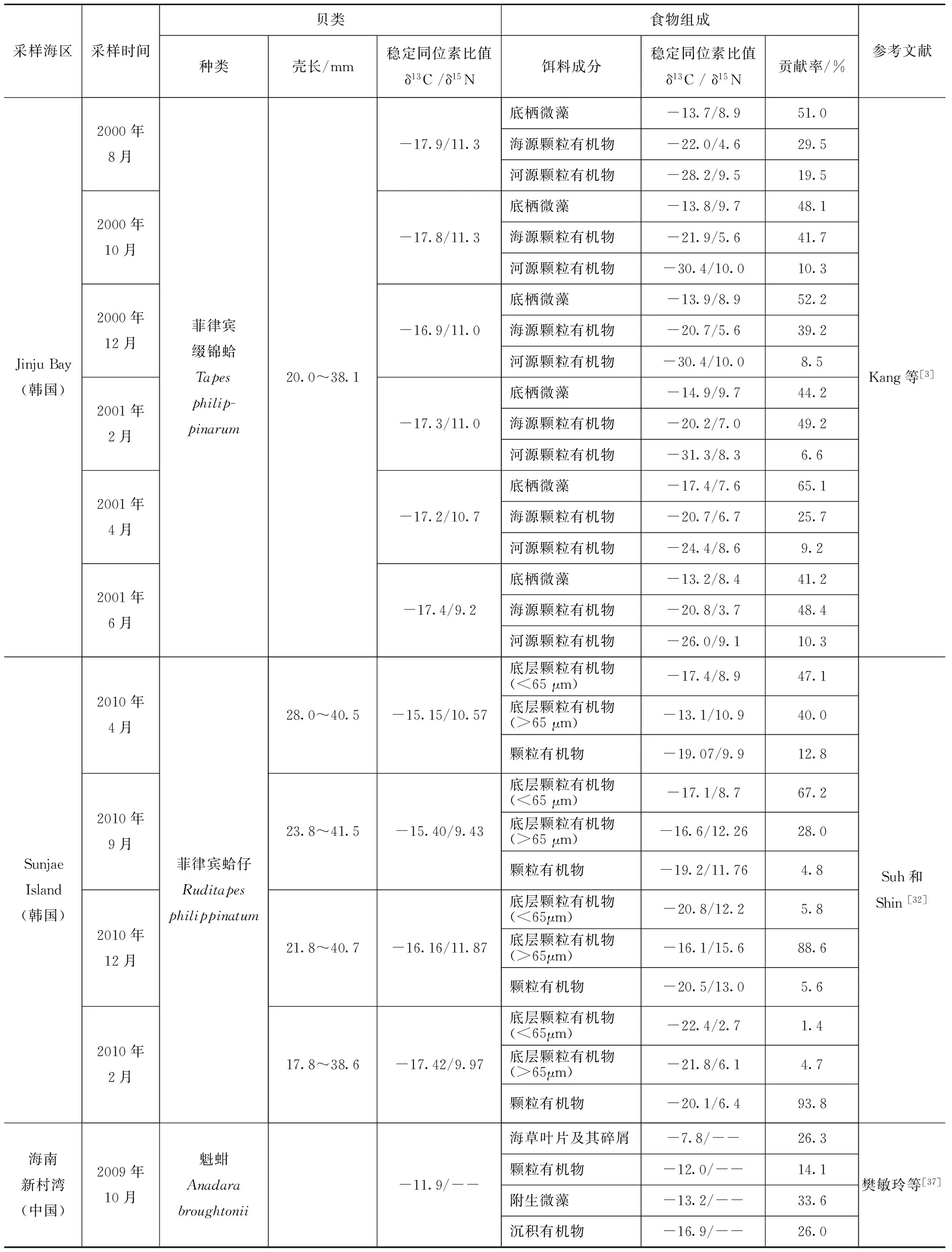
表4 常見貝類及其潛在食物源的穩定同位素組成和餌料貢獻率
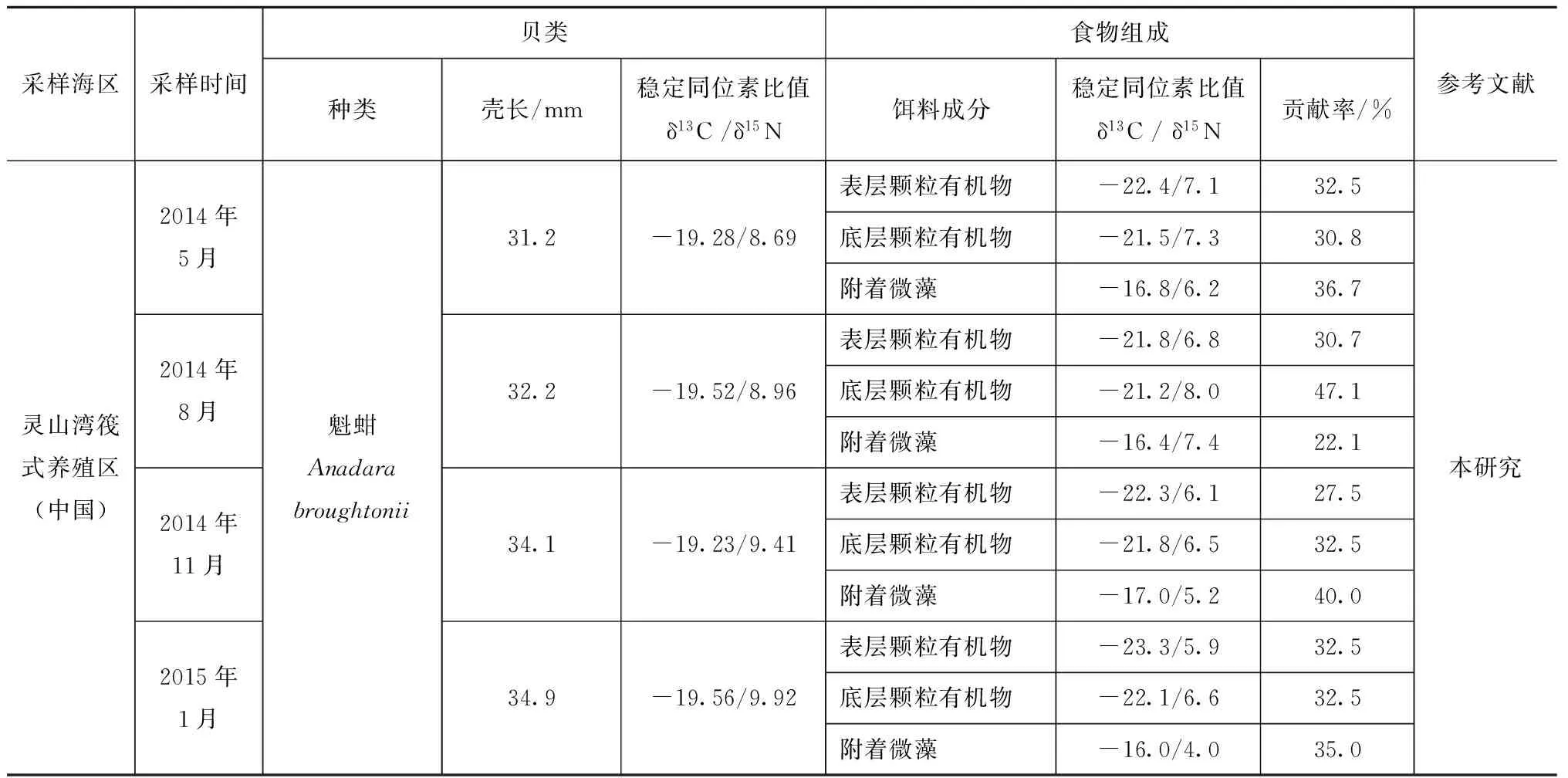
續表4
注:“-”表示未測定該數據。
[1] Crocker K M,Passow U. Differential aggregation of diatoms[J]. Marine Ecology Progress Series,1995,117(1):249-257.
[2] Fukumori K,Oi M,Doi H,et al. Food sources of the pearl oyster in coastal ecosystems of Japan:evidence from diet and stable isotope analysis[J]. Estuarine,Coastal and Shelf Science,2008,76(3):704-709.
[3] Kang C K,Kang Y S,Choy E J,et al. Condition,reproductive activity,and gross biochemical composition of the Manila clam,Tapesphilippinarumin natural and newly created sandy habitats of the southern coast of Korea[J]. Journal of Shellfish Research,2007,26(2):401-412.
[4] Yokoyama H,Ishihi Y. Feeding of the bivalveTheoralubricaon benthic microalgae:isotopic evidence[J]. Marine Ecology Progress Series,2003,255:303-309.
[5] Doi H,Chang K H,Obayashi Y,et al. Attached microalgae contribute to planktonic food webs in bays with fish and pearl oyster farms[J]. Marine Ecology Progress Series,2008,353:107-113.
[6] Hsieh H L,Kao Wenyuan,Chen Changpo,et al. Detrital flows through the feeding pathway of the oyster (Crassostreagigas) in a tropical shallow lagoon:δ13C signals[J]. Marine Biology,2000,136(4):677-684.
[7] Vander Zanden M,Rasmussen J B. Variation in δ15N and δ13C trophic fractionation:implications for aquatic food web studies[J]. Limnology and Oceanography,2001,46(8):2061-2066.
[8] Doi H,Matsumasa M,Toya T,et al. Spatial shifts in food sources for macrozoobenthos in an estuarine ecosystem:carbon and nitrogen stable isotope analyses[J]. Estuarine,Coastal and Shelf Science,2005,64(2):316-322.
[9] 林光輝. 穩定同位素生態學[M]. 北京:高等教育出版社,2013:161-162.
Lin Guanghui. Stable Isotope Ecology[M]. Beijing:Higher Education Press,2013:161-162.
[10] 鹿志創,田甲申,王召會,等. 應用碳氮穩定同位素技術研究江豚(Neophocaenaasiaeorientalisssp.sunameri)食性[J]. 生態學報,2016,36(1):69-76.
Lu Zhichuang,Tian Jiashen,Wang Zhaohui,et al. Using stable isotope technique to study feeding habits of the finless porpoise (Neophocaenaasiaeorientalisssp.sunameri)[J]. Acta Ecologica Sinica,2016,36(1):69-76.
[11] DeNiro M J,Epstein S. Mechanism of carbon isotope fractionation associated with lipid synthesis[J]. Science,1977,197(4300):261-263.
[12] Deniro M J,Epstein S. Influence of diet on the distribution of nitrogen isotopes in animals[J]. Geochimica et Cosmochimica Acta,1981,45(3):341-351.
[13] 顏云榕. 北部灣主要魚類攝食生態及食物關系的研究[D]. 青島:中國科學院海洋研究所,2010.
Yan Yunrong. Feeding ecology and food relations of the main fishes in the Beibu Gulf,South China Sea[D]. Qingdao:Institute of Oceanology,Chinese Academic of Sciences,2010.
[14] 韓東燕. 膠州灣主要蝦虎魚類攝食生態的研究[D]. 青島:中國海洋大學,2013.
Han Dongyan. Study on feeding ecology of dominate gobiid fishes in Jiaozhou Bay[D]. Qingdao:Ocean University of China,2013.
[15] Kang K H,Park H J,Kim Y H,et al. Filtration and oxygen consumption rates on various growth stages ofScapharcabroughtoniispat[J]. Aquaculture Research,2008,39(2):195-199.
[16] 王興林. 魁蚶筏式養殖技術[J]. 中國水產,1997,3:31-32.
Wang Xinglin. Raft culturing technique ofAnadarabroughtonii[J]. China Fisheries,1997,3:31-32.
[17] MacDonald B A,Ward J E. Variation in food quality and particle selectivity in the sea scallopPlacopectenmagellanicus(Mollusca:Bivalvia)[J]. Marine Ecology Progress Series,1994,108:251-264.
[18] Bligh E G,Dyer W J. A rapid method of total lipid extraction and purification[J]. Canadian Journal of Biochemistry and Physiology,1959,37(8):911-917.
[19] Jacob U,Mintenbeck K,Brey T,et al. Stable isotope food web studies:a case for standardized sample treatment[J]. Marine Ecology Progress Series,2005,287:251-253.
[20] Phillips D L,Gregg J W. Source partitioning using stable isotopes:coping with too many sources[J]. Oecologia,2003,136(2):261-269.
[21] France R L,Peters R H. Ecosystem differences in the trophic enrichment of13C in aquatic food webs[J]. Canadian Journal of Fisheries and Aquatic Sciences,1997,54(6):1255-1258.
[22] Baeta A,Pinto R,Valiela I,et al. δ15N and δ13C in the Mondego estuary food web:seasonal variation in producers and consumers[J]. Marine Environmental Research,2009,67(3):109-116.
[23] Kanaya G,Kikuchi E. Spatial changes in a macrozoobenthic community along environmental gradients in a shallow brackish lagoon facing Sendai Bay,Japan[J]. Estuarine,Coastal and Shelf Science,2008,78(4):674-684.
[24] Moncreiff C A,Sullivan M J. Trophic importance of epiphytic algae in subtropical seagrass beds:evidence from multiple stable isotope analyses[J]. Marine Ecology Progress Series,2001,215:93-106.
[25] Vizzini S,Mazzola A. Seasonal variations in the stable carbon and nitrogen isotope ratios (13C/12C and15N/14N) of primary producers and consumers in a western Mediterranean coastal lagoon[J]. Marine Biology,2003,142(5):1009-1018.
[26] 鄭新慶,黃凌風,林榮澄. 環境餌料豐度的季節變化對筼筜湖3種大型底棲動物食性的影響——來自穩定同位素的證據[J]. 海洋學報,2014,36(12):32-40.
Zheng Xinqing,Huang Lingfeng,Lin Rongcheng. Seasonal shifts in food sources influence feeding habits of three macrozoobenthos species in the Yundang Lagoon:the evidence from stable isotope[J]. Haiyang Xuebao,2014,36(12):32-40.
[27] Hemminga M A,Mateo M A. Stable carbon isotopes in seagrasses:variability in ratios and use in ecological studies[J]. Marine Ecology Progress Series,1996,140:285-298.
[28] Hofmann M,Wolf-Gladrow D A,Takahashi T,et al. Stable carbon isotope distribution of particulate organic matter in the ocean:a model study[J]. Marine Chemistry,2000,72(2):131-150.
[29] Ben-David M,Flynn R W,Schell D M. Annual and seasonal changes in diets of martens:evidence from stable isotope analysis[J]. Oecologia,1997,111(2):280-291.
[30] Madurell T,Fanelli E,Cartes J E. Isotopic composition of carbon and nitrogen of suprabenthic fauna in the NW Balearic Islands (western Mediterranean)[J]. Journal of Marine Systems,2008,71(3):336-345.
[31] Bayne B L,Svensson S. Seasonal variability in feeding behaviour,metabolic rates and carbon and nitrogen balances in the Sydney oyster,Saccostreaglomerata(Gould)[J]. Journal of Experimental Marine Biology and Ecology,2006,332(1):12-26.
[32] Suh Y J,Shin K H. Size-related and seasonal diet of the manila clam (Ruditapesphilippinarum),as determined using dual stable isotopes[J]. Estuarine,Coastal and Shelf Science,2013,135:94-105.
[33] Cabanellas-Reboredo M,Deudero S,Blanco A. Stable-isotope signatures (δ13C and δ15N) of different tissues ofPinnanobilisLinnaeus,1758 (Bivalvia):isotopic variations among tissues and between seasons[J]. Journal of Molluscan Studies,2009,75(4):343-349.
[34] Decottignies P,Beninger P G,Rincé Y,et al. Trophic interactions between two introduced suspension-feeders,CrepidulafornicataandCrassostreagigas,are influenced by seasonal effects and qualitative selection capacity[J]. Journal of Experimental Marine Biology and Ecology,2007,342(2):231-241.
[35] Riera P. Trophic subsidies ofCrassostreagigas,MytilusedulisandCrepidulafornicatain the Bay of Mont Saint Michel (France):a δ13C and δ15N investigation[J]. Estuarine,Coastal and Shelf Science,2007,72(1):33-41.
[36] Lopes-Lima M,Lima P,Hinzmann M,et al. Selective feeding byAnodontacygnea(Linnaeus,1771):the effects of seasonal changes and nutritional demands[J]. Limnologica-Ecology and Management of Inland Waters,2014,44:18-22.
[37] 樊敏玲,黃小平,張大文,等. 海南新村灣海草床主要魚類及大型無脊椎動物的食源[J]. 生態學報,2011,31(1):31-38.
Fan Minling,Huang Xiaoping,Zhang Dawen,et al. Food sources of fish and macro-invertebrates in a tropical seagrass bed at Xincun Bay,Southern China[J]. Acta Ecologica Sinica,2011,31(1):31-38.
[38] Zhao Liqiang,Yang Feng,Yan Xiwu. Stable isotopes and fatty acids as dietary tracers of intertidal bivalves[J]. Fisheries Science,2013,79(5):749-756.
[39] Zhao Liqiang,Yan Xiwu,Yang Feng. Food sources of the Manila clamRuditapesphilippinarumin intertidal areas:evidence from stable isotope analysis[J]. Chinese Journal of Oceanology and Limnology,2013,31(4):782-788.
[40] Navarro J M,Widdows J. Feeding physiology ofCerastodermaedulein response to a wide range of seston concentrations[J]. Marine Ecology Progress Series,1997,152:175-186.
[41] Navarro J M,Labarta U,Fernndez-Reiriz M J,et al. Feeding behavior and differential absorption of biochemical components by the infaunal bivalveMuliniaedulisand the epibenthicMytiluschilensisin response to changes in food regimes[J]. Journal of Experimental Marine Biology and Ecology,2003,287(1):13-35.
[42] 周毅,楊紅生,張福綏. 海水雙殼貝類的生物沉積及其生態效應[J]. 海洋科學,2003,27(2):23-26.
Zhou Yi,Yang Hongsheng,Zhang Fusui. Biodeposition by seawater bivalve mollusk[J]. Marine Sciences,2003,27(2):23-26.
[43] 田偉,徐兆禮. 廣西白龍半島鄰近海域污損生物群落結構分析[J]. 海洋學報,2015,37(6):120-127.
Tian Wei,Xu Zhaoli. The study on community structure of marine fouling in the waters off Bailong Peninsula,Guangxi[J]. Haiyang Xuebao,2015,37(6):120-127.
[44] Claereboudt M R,Bureau D,Cté J,et al. Fouling development and its effect on the growth of juvenile giant scallops (Placopectenmagellanicus) in suspended culture[J]. Aquaculture,1994,121(4):327-342.
[45] Lodeiros C J M,Himmelman J H. Identification of factors affecting growth and survival of the tropical scallopEuvola(Pecten)ziczacin the Golfo de Cariaco,Venezuela[J]. Aquaculture,2000,182(1):91-114.
[46] 張漢華,梁超愉,吳進鋒,等. 大鵬灣深水網箱養殖區的污損生物研究[J]. 中國水產科學,2003,10(5):414-418.
Zhang Hanhua,Liang Chaoyu,Wu Jinfeng,et al. Fouling organism in marine cage culture area in Dapeng Bay,South China Sea[J]. Journal of Fishery Sciences of China,2003,10(5):414-418.
Seasonal variation in the food sources of the ark-shell Anadara broughtonii in raft culture in Lingshan Bay,Qingdao
Cai Xingyuan1,Zhang Xiumei1,2,Liu Tianyu1,Li Wentao1,Zhang Peidong1
(1.CollegeofFisheries,OceanUniversityofChina,Qingdao266003,China; 2.FunctionalLaboratoryforMarineFisheriesScienceandFoodProductionProcess,QingdaoNationalLaboratoryforMarineScienceandTechnology,Qingdao266072,China)
Ark-shellAnadarabroughtoniiis one of the most important commercial bivalve species in Northern China. Raft culture of ark-shell has been developing rapidly. Stable isotope (δ13C and δ15N) analysis was conducted onAnadarabroughtoniiin raft culture and three potential food sources:surface particular organic matter (SPOM),bottom particular organic matter (BPOM) and attached microalgae (AM) in the raft culture area,Lingshan Bay of Qingdao,in four seasons,from May 2014 to January 2015. Meanwhile,the composition of food sources for the cultured ark-shell was investigated in relation to season by using stable isotopes and stomach content analysis. The results showed that,the δ13C and δ15N values of ark-shell and their food sources varied significantly with season. The δ13C values of ark-shell (-19.6‰ to -19.2‰) were higher than those of SPOM (-23.3‰ to -21.8‰) and BPOM (-22.1‰ to -21.2‰),but lower than those of AM (-17.0‰ to -16.0‰). The δ15N values mainly ranged from 8.7‰ to 9.9‰. In addition,the ark-shell in winter had significantly depleted δ13C and enriched δ15N. The particulate organic matter (mainly phytoplankton) in water column was the principle food source for ark-shell,with a contribution of about 60.0%-77.8% (with the highest contribution in summer). Meanwhile,the contribution of BPOM resulting from resuspension in this area remained a high level (about 30.8%-47.1%),and the AM on culture cages took up about 22.1%-40.0% contribution in diets. These results indicate thatA.broughtoniifeeds on a mixture diet of particulate organic matter and attached microalgae,and the AM on cages can treat as important supplemental food sources in raft culture area.
Anadarabroughtonii; food sources; seasonal changes; raft culture; stable isotope analysis; stomach content analysis
2016-05-12;
2016-06-23。
海洋公益性行業科研專項(201405010, 201305043);青島海洋科學與技術國家實驗室鰲山科技創新計劃項目(2015ASKJ01)。
蔡星媛(1989—),女,廣西壯族自治區北海市人,主要從事資源增殖生態學研究。E-mail:caixingyuan111@126.com
*通信作者:張秀梅,教授,主要從事魚類行為生態學、漁業資源保護學及增殖生態學研究。E-mail:gaozhang@ouc.edu.cn
10.3969/j.issn.0253-4193.2016.12.011
S917.4
A
0253-4193(2016)12-0106-12
蔡星媛,張秀梅,劉甜雨,等. 青島靈山灣筏式養殖魁蚶食物來源的季節變動研究[J].海洋學報,2016,38(12):106—117,
Cai Xingyuan,Zhang Xiumei,Liu Tianyu,et al. Seasonal variation in the food sources of the ark-shellAnadarabroughtoniiin raft culture in Lingshan Bay,Qingdao[J]. Haiyang Xuebao,2016,38(12):106—117,doi:10.3969/j.issn.0253-4193.2016.12.011
