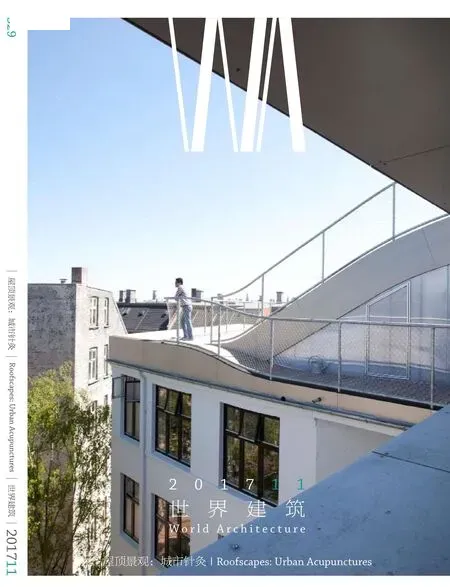
頭頂或足下
2017-04-06 11:29:58張利ZHANGLi
世界建筑 2017年11期
關鍵詞:建筑
張利/ZHANG Li
頭頂或足下
張利/ZHANG Li
Over Our Heads or Under Our Feet
屋頂是我們熟知的基本建筑要素,它與四壁一起構成對建成空間的起碼包被,在“遮風蔽雨”方面扮演著建筑史上最持之以恒的角色。
人與屋頂的故事在很長時間內保持了一種不變的空間關系的設定:即屋頂高懸在我們的“頭頂”,居高臨下,不怒自威,保持一種莫名的尊崇與距離感。我們充其量是通過閣樓或老虎窗戰戰兢兢地試圖在局部上改變屋頂的性格。不過到了工業革命以后,隨著平的上人屋頂的普及,屋頂開始從我們的“頭頂”降落到了我們的“足下”,“威嚴”不再,而是作為一種富含公共性潛能的場所而受到越來越多的建筑師的青睞。本期的《世界建筑》正是在特邀編輯、意大利建筑師及學者安布羅西尼的帶領下,對屋頂作為多功能使用空間的類型學進行一次審視。
我們必須承認的是,屋頂從“頭頂”到“足下”的改變,在建筑學上的意義不僅僅是類型與形式的,更是空間價值觀的。從某種程度上說,“屋頂觀”是“建筑觀”最直接的呈現。
在前工業時期,無論是西方還是東方,屋頂都不約而同地成為建筑的最重要的意義載體,指向一種表義屋頂的屋頂觀。不難想像,作為房屋本體與天空的界面,作為俯瞰眾生的高空遮蔽,以及作為在技術欠發達時代建造工程的最復雜也是最關鍵的成就,屋頂被有意無意地列為崇拜的對像而被賦予大量的意義是很自然的。從外面看,屋頂的輪廓線與質感的組合構成表義的句法,昭示建造者所屬群體的價值觀。佛羅倫薩圣母百花大教堂的穹頂、倫敦議會大廈的尖頂,以及遵化清東陵的多條指向背后山脊的自隆恩殿至明樓的屋頂軸線,皆是閱讀其所處時代的群體信念的范本。而從內部看,屋頂天花的符號學則更是直白(甚至是冗余)表義的集結,成為建筑學、符號學與象征學愛好者的共同天堂。這種表義屋頂的傳統一直延續到現代高密度城市形成的初期,曼哈頓早期以帝國大廈和克萊斯勒大廈為代表的高層建筑的頂冠之爭便是例子。自20世紀后期起,新一波象征意義屋頂的潮流似乎卷土重來。這一次是借著建筑的“后現代”之風(或說,庸俗的歷史主義之風)以及毫不遮掩的商業化,而其所占領的則多是新興經濟體的快速形成中的都市。無論如何,在此一個不變的主題是,表義屋頂永遠把屋頂置于所有的人的頭頂,因凌駕之勢而就崇拜之舉,這種屋頂觀恐怕要繼續在建筑的發展故事上伴隨我們一大段時間。
工業化時期,與阿爾多·羅西所指出的“天真的功能主義”相伴,造就了一種把各種機械設備放置于屋頂的常規,指向一種令人啼笑皆非的技術屋頂的屋頂觀。各種為職業建筑師編制的指南對屋頂上必須占用的機械面積津津樂道,各種建筑技術規范毫無顧忌地對管道必須突出屋頂的高度做出得寸進尺的要求。從VIV空調機組,到太陽能集熱器,到衛生間的排氣管,到廚房的煙囪,在機械化理性的推動下迅速控制了普通現代城市建筑的天際線。這種屋頂觀原本的邏輯是屋頂高高在上,所以在城市中是看不見的;但諷刺的是,現代城市高層建筑的此起彼伏恰恰使這種技術屋頂成為最可視的城市景觀——當然,也是最丑陋的城市景觀。時至今日,我們仍然不時在城市管理與工程實踐領域遇到這種技術屋頂觀的強烈擁躉者,所幸的是他們的數量正在越變越少。
后工業時期帶來了一種真正革命性的屋頂觀,雖然它所反映的是勒·柯布西耶或安東尼·高迪早年的先驅性實驗,但確實是在后工業城市中才開始形成真正的公共生活效果。它把屋頂的定位從“頭頂”移至“足下”,戲劇性地增強大型公共建筑屋頂的公眾可達性,使屋頂成為城市生活的平臺,指向一種令人振奮的廣場屋頂的屋頂觀。在意識形態上它是更公平、更公民化的城市生活的直譯,在空間類型學上它把屋頂從“第五立面”變為“第三地面”(第一為城市地面,第二為城市空中步道)。我們在斯諾赫塔事務所的大型文化建筑中看到這一潮流的啟始,在21世紀落成的一系列城市公共建筑案例中看到它的延伸與躍動。它在新的技術與文化背景下激進地將勒·柯布西耶的紀念性與公共性加以融合,用觀景臺、巨型坡面、空中花園等原型來重新定義國際城市中重要公共建筑的屋頂,造就了為我們所熟悉的以承載城市多樣化生活為訴求的一系列佳作。類似的,用聚落原型對普通建筑的屋頂進行人性化是對上述潮流在非高顯現度城市建筑——特別是居住建筑——上的補充,也是對柯布、高迪都曾嘗試過的烏托邦社區理想的現實主義的詮釋,它或許對我們中國當代城市的品質進化更具參考意義。無論如何,我們期待平臺屋頂的人性化元素在我們的城市中更加深入人心,不管是在高可視度的公共建筑,還是在普通人日常的居住建筑中。
感謝古斯塔夫·安布羅西尼的客座編輯,是他卓越的研究工作使本期《世界建筑》成為可能。□
Roof is an architectural element that we are well aware of.Together with the walls, it completes the basic envelope of the built space. It certainly continues to perform the key role in providing shelter.
For a long time, there had been an assumption regarding the relation between the roof and the human body: it is over our heads.With that exclusive position, the roof enjoys a commanding pose and all associated feelings coming from us the human beings that may well be defined as admiration or even worship. Only through the triviality of penthouses and dormer windows have we tried to touch the myth of the roofs. Industrialisation however, changed everything. Through the new flat, accessible roofs, the roof gradually changed its position,from over our heads down to under our feet. Most of its monumental features are replaced by public activities. The roof is starting to pose itself as a new typology with serious public potentials, catching the attention of architects from all around the world. In this edition of World Architecture, we are going to have a tour of this new typology, under the guide of our guest editor, Professor and Architect Gustavo Ambrosini.
Regarding the roof changing from over our heads to under our feet, there is one thing we have to make clear: such a change is not only typological, it is also ideological. The view you take at the roof eventually ref l ects the view you take at the world.
In pre-industrial times, both in the East and the West, the roof had become a key carrier of symbolic meanings. Symbolic roofs was the dominating idea about the roof. It is quite understandable that at a time of low technological capabilities, with its physicality hanging high above, overlooking everyone below and manifesting the highest possible construction achievement, the roof had to be associated with a lot of symbolic meanings. From the outside, the profile and the texture of the roof forms the syntax of collective value expression. Be it the dome of the Cattedrale di Santa Maria del Fiore, the spike of the British Parliament, or the axial sequence of the Zunhua Qing Tombs,the roof unmistakably presented the belief of the community by whom it was built. From the inside, decorations in the ceiling became the detailed, if not redundant, collection of symbols, entertaining architects, semiologists and symbolists alike. The tradition of symbolic roofs has extended far beyond the turn of the twentieth century. The beauty contest between the Empire State and the Chrysler in early Manhattan was just one of many similar stories. Even after the turn of the twenty-first century, symbolic roofs have launched yet another wave of offensive quite unexpectedly, this time mainly in capitals of emerging economies, accompanied by the vulgarity of Post-Modernism and the brutality of shameless commercialism. It is fair to say that whether you like it or not, symbolic roofs will be around for a while.
At the peak of industrialisation, with the rise of "na?ve functionalism" stated by Aldo Rossi, the roof (usually flat and surrounded by tall parapets) became a dump yard for unwanted mechanics. This led to an appalling view to the roof: mechanics roofs. Not only practical guides to architects have listed all kinds of mechanical components to be put onto the roof, but also building codes and regulations forcing architects to let mechanics penetrating the roof by large quantities. This mechanical rationality soon enabled ugly roofs dominating the skies of modern cities. Ironically, the original idea that roofs could hide all those unwanted gadgets was based upon the invisibility of the top surface of the roofs. Yet it is exactly industrialisation that had made our cities taller and taller, exposing more and more of the roofs. Today, it is not difficult to meet one or two city administrators or engineers who are still in awe of mechanics roofs. Fortunately, their number is shrinking.
It is post-industrialisation that finally brought about the real revolution in roofs. The revolution may ref l ect some early pioneering experiments by those of Le Corbusier and Antonio Gaudi, but it is in the post-industrial cities that the idea materialised into true public life. The roof is no longer over our heads, but under our feet. Public accessibility to the roof is dramatically improved, making the roof practically a theatre of human activities. This is the idea of piazza roofs, the new typology that regards the roof as the third ground(after the urban ground and the sky walk) rather than the fifth fa?ade,and takes the democratisation of urban space in the air as the only priority. Through the works of offices like Sn?hetta, we witness a trend that is now spreading over major culture facilities around the world. They combine the use of form and the provision of public space,redefining the roof vocabulary with look-out decks, giant slopes, or floating gardens. Most of the products of this trend are highly visible urban entities. In contrast, there is also another trend taking at the less visible urban artefacts such as residential blocks, which too democratises roofs, albeit through fractal small scale interventions inspired by traditional villages. Comparing with the former one, the latter trend might be even more useful to contemporary Chinese cities,where it is the generic buildings, not the high profiles ones, that are crying out for quality improvements.
We have to give special thanks to our guest editor, Professor Gustavo Ambrosini. It is his exceptional research that makes this edition of World Architecture possible.□
清華大學建筑學院/《世界建筑》
2017-11-11
猜你喜歡
北方建筑(2021年6期)2021-12-31 03:03:54
文苑(2020年10期)2020-11-07 03:15:36
現代裝飾(2020年6期)2020-06-22 08:43:12
現代裝飾(2020年4期)2020-05-20 08:55:08
攝影之友(影像視覺)(2019年2期)2019-03-05 08:27:16
藝術家(2017年3期)2018-01-26 08:54:49
文學自由談(2016年3期)2016-06-15 13:01:16
福建農業科技(2016年10期)2016-03-07 09:46:49
少兒科學周刊·兒童版(2015年6期)2015-11-24 03:49:38
中國工程咨詢(2015年4期)2015-02-14 03:49:56